
 10.30495/JTAP.162232
Theoretical analysis of ultrasonic relaxation in advanced tellurite glasses
- Raouf ElâMallawany*

 1
1

Published in Issue 2023-11-17




PDF views: 253
HTML views: 21





Abstract
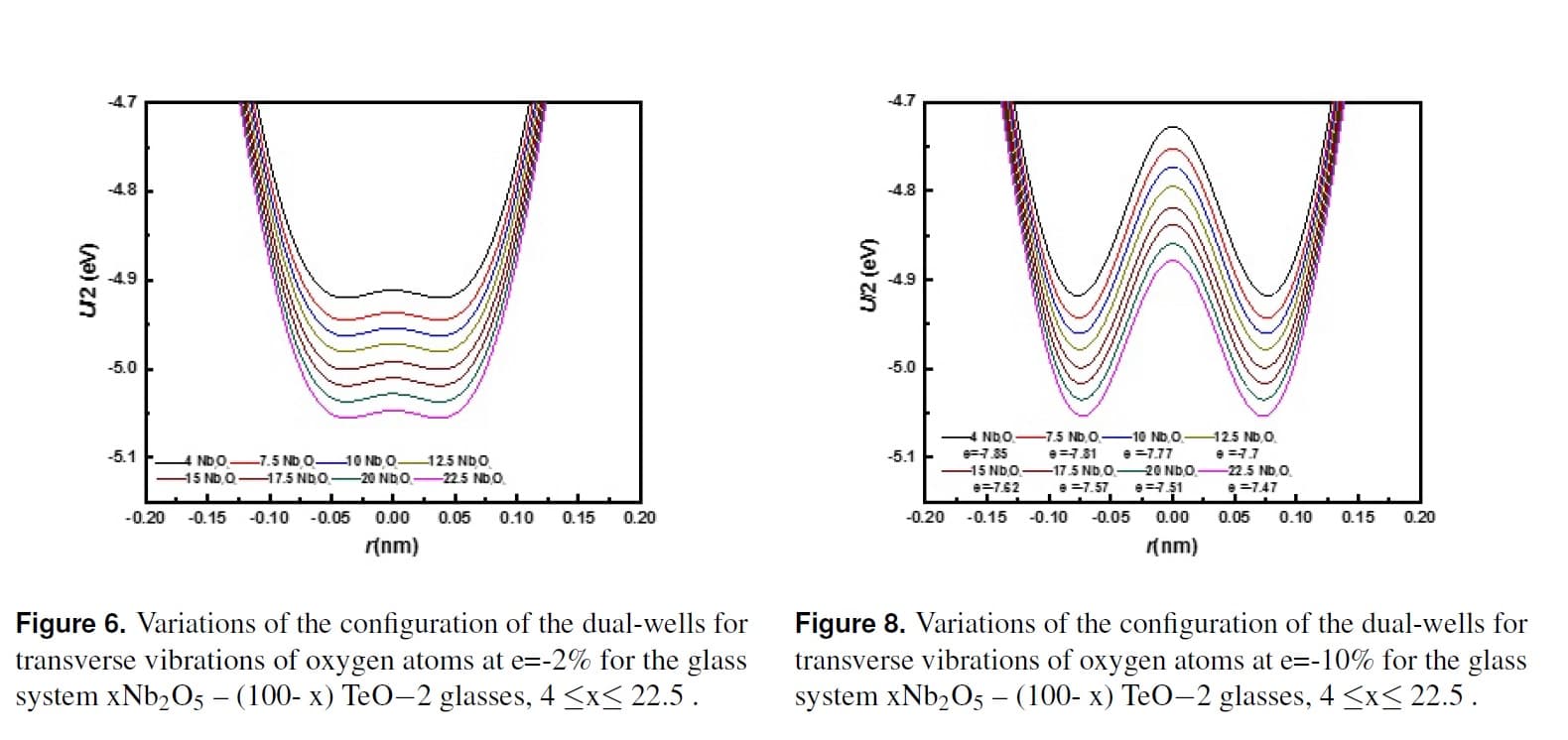
This work deals with the theoretical analysis of ultrasonic relaxation in the glass system xNb2O5 â (100â x) TeO2 glasses, and 4 ⤠x â¤22.5 mole %. The parameters of the theoretical analysis deal with the transmission of ultrasonic waves through dual-well potential. The parameters are alternate potential energy, centers of energy loss, and elongation or contraction of the two-well potential. Moreover, the deformation potential is found to be sensitive to the variations of the Nb2O5 content. The number of centers of energy loss is related to the elastic moduli as a function of Nb2O5 content. The analysis revealed a sensitive effect of variation of Nb2O5 contents for elongation or contraction of the dual-well potential. Due to the increase of Nb2O5 from 4 to 22.5 mole %, the potential energy changed from 4-92 to 5.06 eV, longitudinal and transverse deformation potential changed from 0.18 to 0.346 and from 0.06 to 0.141 eV, respectively. The increase in the deformation potential of the presented dual-well state could be attributed to the increase of the experimental elastic parameters like Youngâs and shear moduli of the present glasses.
Keywords
- Glasses,
- Tellurite,
- Ultrasonic relaxation