
 10.57647/j.gcr.2025.0802.17
Analytical Seismic Risk Assessment in the Aegean Region of Türkiye Using an Adapted Fine-Kinney Method
- Betül İrem Tarakçı*
 1
1

Received: 2025-11-20
Published in Issue 2025-12-31
Copyright (c) -1 Betül İrem Tarakçı (Author)

This work is licensed under a Creative Commons Attribution 4.0 International License.




PDF views: 242





Abstract
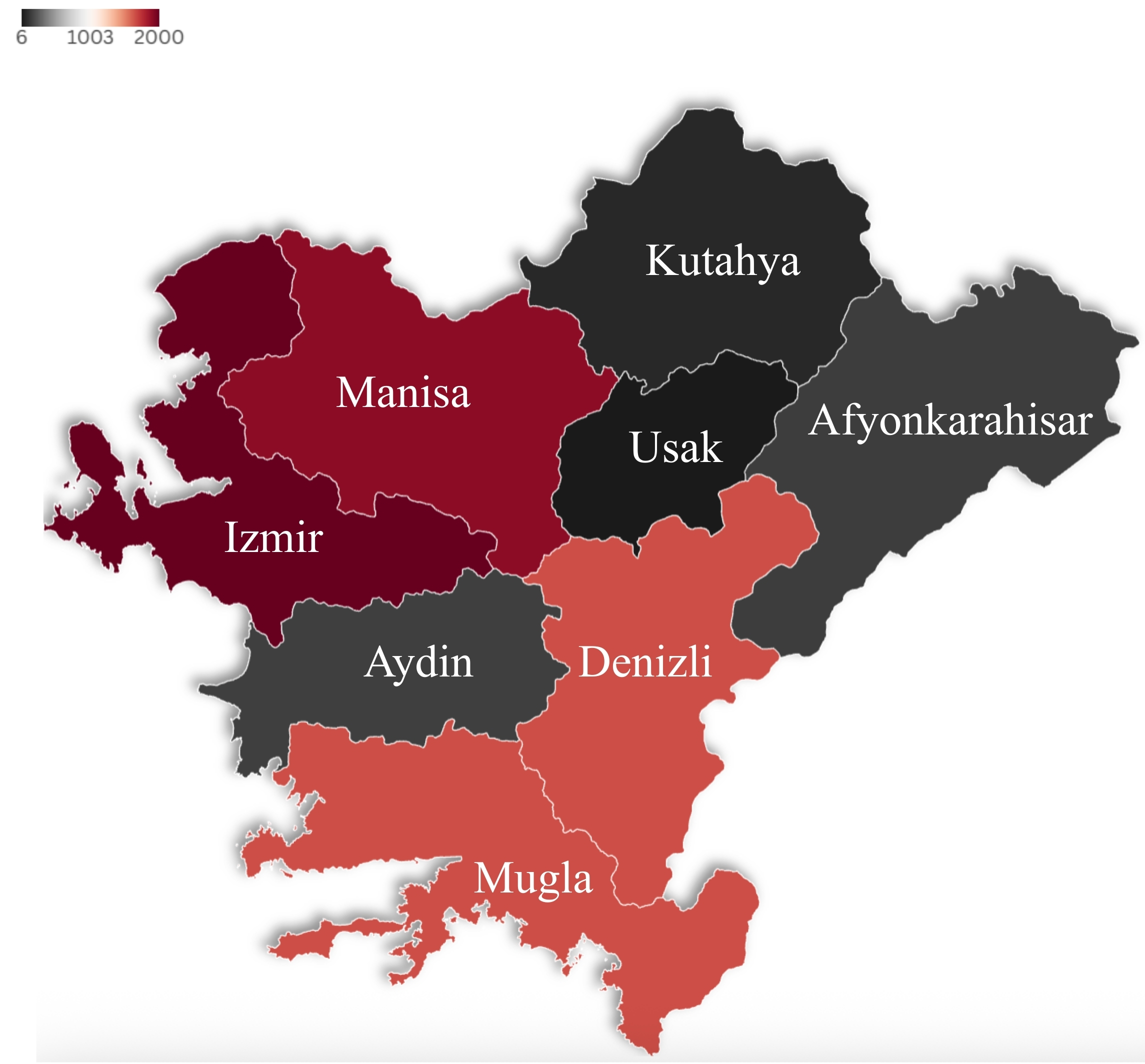
This study provides a quantitative seismic hazard and risk assessment for eight provinces in Türkiye’s Aegean Region by adapting the Fine–Kinney method to geological conditions. The method, commonly used in industrial safety, was modified by redefining probability (P), frequency (F), and severity (S) to reflect tectonic setting, historical seismicity, and structural vulnerability. Probability was based on each province’s shortest distance to active faults, frequency on the number of Mw ≥ 4.5 earthquakes over the past 35 years, and severity on total building stock. The model was applied to Izmir, Manisa, Aydin, Mugla, Denizli, Usak, Kutahya, and Afyonkarahisar. Izmir and Manisa were classified as “very high risk” (R = 2000), Denizli and Mugla as “high risk” (R = 300), Afyonkarahisar and Aydin as “significant risk,” Kutahya as “definite risk,” and Usak as “acceptable risk.” Seismic hazard is generally high, with risk distribution shaped by fault proximity and building density. The adapted method offers a practical framework for comparing provincial seismic risk and supports evidence-based decisions in disaster management, geoconservation, land-use planning, and earthquake-sensitive architectural and interior design.
Keywords
- Seismic Hazard,
- Geological Hazards,
- Risk Assessment,
- Fine–Kinney Method,
- Aegean Region,
- Structural Vulnerability,
- Disaster Risk Reduction,
- Türkiye
References
- AFAD (2025). Türkiye Deprem Tehlike Haritası Portalı. Retrieved from: https://tdth.afad.gov.tr/TDTH/main.xhtml (accessed on 10 November 2025).
- Aker A, Özçelik ÖT (2020). Metal sektöründe 5x5 Matris ve Fine-Kinney yöntemi ile risk değerlendirmesi. Karaelmas Journal of Occupational Health and Safety. 4:65–75. https://doi.org/10.33720/kisgd.630799
- Aminbakhsh S, Gunduz M, Sonmez R (2013). Safety risk assessment using analytic hierarchy process (AHP) during planning and budgeting of construction projects. Journal of Safety Research. 46:99–105. https://doi.org/10.1016/j.jsr.2013.05.003
- Büyüksaraç A, Avcil F, Alkan H, Işık E, Harirchian E, Özçelik A (2025). Seismic hazard implications of the 2025 Balıkesir earthquake of Mw 6.1 for Western Türkiye. GeoHazards. 6:64. https://doi.org/10.3390/geohazards6040064
- Chen N, Chen L, Tang C, Wu Z, Chen A (2019). Disaster risk evaluation using factor analysis: a case study of Chinese regions. Natural Hazards. 99:321–335. https://doi.org/10.1007/s11069-019-03742-w
- Cündübeyoğlu İ, Kayabaşı R (2022). Seramik fabrikasında Fine-Kinney yöntemi ile risk değerlendirmesi. Avrupa Bilim ve Teknoloji Dergisi, 35:633–642. https://doi.org/10.31590/ejosat.1061103
- Dagsuyu C, Derse O, Oturakci M (2021). Integrated risk prioritization and action selection for cold chain. Environmental Science and Pollution Research. 28:15646–15658. https://doi.org/10.1007/s11356-021-12733-z
- Daneshvar Rouyendegh B, Gür L (2020). Bulanık Fine–Kinney Yöntemiyle risk değerlendirmesi uygulaması. Journal of Industrial Engineering (Turkish Chamber of Mechanical Engineers). 31(1):75–86.
- Deng G, Wang AS, Li SK, Zhou YS (2001). Risk theory and method and its initial application in grain yield. Journal of Natural Resources. 16:221–226. https://doi.org/10.11849/zrzyxb.2001.03.005
- Derse O (2021). A new approach to the Fine Kinney method with AHP-based ELECTRE I and math model on risk assessment for natural disasters. Journal of Geography. 42:155–164. https://doi.org/10.26650/JGEOG2021-875427
- Ekinci R., Büyüksaraç A, Ekinci YL, Işık, E (2020). Bitlis ilinin doğal afet çeşitliliğinin değerlendirilmesi. Doğal Afetler ve Çevre Dergisi. 6(1): 1-11. https://doi.org/10.21324/dacd.535189
- EM-DAT (2025). Emergency Events Database. Retrieved from: https://public.emdat.be/data (accessed on 20 November 2025).
- Emblemsvåg J (2008). On probability in risk analysis of natural disasters. Disaster Prevention and Management: An International Journal. 17(4): 508-518. https://doi.org/10.1108/09653560810901755
- Ersöz T, Bayrak G (2023). Investigation of possible earthquake risk in districts of Istanbul using the Fine-Kinney Method. Uluslararası Sürdürülebilir Mühendislik ve Teknoloji Dergisi. 7(2): 139-151.
- Fine WT (1971). Mathematical evaluation for controlling hazards. Journal of Safety Research. 3:157–166. https://doi.org/10.21236/AD0722011
- Ganguly KK, Guin KK (2013). A fuzzy AHP approach for inbound supply risk assessment. Benchmarking: International Journal 20:129–146. https://doi.org/10.1108/14635771311299524
- Gong Z, Forrest JYL (2014). Special issue on meteorological disaster risk analysis and assessment: on basis of grey systems theory. Natural Hazards. 71:995–1000. https://doi.org/10.1007/s11069-013-0864-y
- Gündoğdu E, Özden S, Bekler T (2020). Sındırgı Fayı ve Düvertepe Fay Zonu Yakın Civarının Kinematik ve Sismotektonik Özellikleri: Batı Anadolu (Türkiye). Çanakkale Onsekiz Mart Üniversitesi Fen Bilimleri Enstitüsü Dergisi. 6(2): 378-395. https://izlik.org/JA24FU64FW
- Gürcanlı GE, Bilir S, Sevim M (2015). Activity based risk assessment and safety cost estimation for residential building construction projects. Safety Science. 80:1–12. https://doi.org/10.1016/j.ssci.2015.07.002
- Hong JD, Jeong KY (2019). Humanitarian supply chain network design using data envelopment analysis and multi-objective programming models. European Journal of Industrial Engineering. 13:651–680. https://doi.org/10.1504/EJIE.2019.102158
- Huang CF, Liu XL, Zhou GX, Li XJ (1998). Agricultural natural disaster risk assessment method according to the historic disaster data. Journal of Natural Disasters. 7(2):1–9.
- INFORM Risk (2025). INFORM Risk Index. Retrieved from: https://drmkc.jrc.ec.europa.eu/inform-index (accessed on 10 November 2025).
- Isik E, Ulutaş H, Büyüksaraç A (2023). The comparison of sectional damages in reinforced-concrete structures and seismic parameters on regional Basis; a case study from western Türkiye (Aegean Region). Earthquakes and Structures 24(1):37–51. https://doi.org/10.12989/eas.2023.24.1.037
- Ismail A, Rashid ASA, Amhadi T, Nazir R, Irsyam M, Faizal L (2024). Exploring the evolution of seismic hazard and risk assessment research: a bibliometric analysis. Sustainability. 16(7):2687. https://doi.org/10.3390/su16072687
- Kartal D, Soyluk A (2023). Revision of fuzzified Fine-Kinney method, an adaptive method for natural disaster risk management. Geoconservation Research. 6(2):409–426. https://doi.org/10.57647/j.gcr.2023.0602.25
- Kinney GF, Wiruth AD (1976). Practical Risk Analysis for Safety Management. NWC Technical Publication 5865, Naval Weapons Center, China Lake, CA, USA. https://hdl.handle.net/10945/31846
- Korkmaz KA, Irfanoglu A, Kayhan AH. (2010). Seismic risk assessment of buildings in Izmir, Turkey. Natural Hazards. 54:97–119. https://doi.org/10.1007/s11069-009-9455-3
- Luchuan REN (1999). Advance in risk analysis for regional natural disasters. Advances in Earth Sciences. 3:242–246. https://doi.org/10.11867/j.issn.1001-8166.1999.03.0242
- Maden Tetkik ve Arama (MTA) (2025). MTA Yerbilimleri Portalı. Retrieved from: https://yerbilimleri.mta.gov.tr/anasayfa.aspx (accessed on 1 November 2025).
- Makra K, Rovithis E, Riga E, Raptakis D, Pitilakis K (2021). Amplification features and observed damages in İzmir (Turkey) due to 2020 Samos (Aegean Sea) earthquake: identifying basin effects and design requirements. Bulletin of Earthquake Engineering. 19:4773–4804. https://doi.org/10.1007/s10518-021-01148-3
- Oturakçı M, Dağsuyu C (2017). Risk değerlendirmesinde bulanık Fine‐Kinney yöntemi ve uygulaması. Karaelmas İş Sağlığı ve Güvenliği Dergisi. 1(1):17–25.
- Osipov VI, Rumyantseva NA, Eremina ON (2019). Living with risk of natural disasters. Russian Journal of Earth Sciences. 19(6): 4. https://doi.org/10.2205/2019ES000673
- Peduzzi P, Dao H, Herold C, Mouton F (2009). Assessing global exposure and vulnerability towards natural hazards: the Disaster Risk Index. Natural Hazards and Earth System Sciences. 9(4):1149–1159. https://doi.org/10.5194/nhess-9-1149-2009
- Ranger N, Hallegatte S, Bhattacharya S, Bachu M, Priya S, Dhore K et al. (2010). An assessment of the potential impact of climate change on flood risk in Mumbai. Climatic Change. 104:139–167. https://doi.org/10.1007/s10584-010-9979-2
- Sborshchikov IM, Savostin LA, Zonenshain LP (1981). Present plate tectonics between Turkey and Tibet. Tectonophysics. 79(1-2):45–73. https://doi.org/10.1016/0040-1951(81)90232-8
- Sousa V, Almeida NM, Dias LA (2014). Risk-based management of occupational safety and health in the construction industry. Part 1: Background knowledge. Safety Science. 66:75–86. https://doi.org/10.1016/j.ssci.2014.02.008
- Sözbilir H, Özkaymak Ç, Uzel B, Sümer Ö, Eski S, Tepe Ç (2016). Palaeoseismology of the Havran-Balıkesir Fault Zone: evidence for past earthquakes in the strike-slip-dominated contractional deformation along the southern branches of the North Anatolian fault in northwest Turkey. Geodinamica Acta. 28(4):254–272. https://doi.org/10.1080/09853111.2016.1171111
- Tappura S, Sievänen M, Heikkilä J, Jussila A, Nenonen N (2015). A management accounting perspective on safety. Safety Science. 71(B):151–159. https://doi.org/10.1016/j.ssci.2014.01.011
- Tarakçı Bİ (2025a). Afet Sonrası Barınma Alanlarına Yönelik Uluslararası Yayınların Bibliyometrik Analizi (2000–2025). Afet ve Risk Dergisi. 8(3):1323-1340. https://doi.org/10.35341/afet.1761204
- Tarakçı Bİ (2025b). From local disasters to global design discourse: Interior architecture theses in Türkiye. Trends in Higher Education 4(4):72. https://doi.org/10.3390/higheredu4040072
- Tarakçı BI, Kavut IE (2025). Problems experienced in post-disaster temporary shelter units: The case of Hatay/Iskenderun. Türk Deprem Araştırma Dergisi. 7:321–334. https://doi.org/10.46464/tdad.1648044
- TÜİK (2025). 2021 Bina ve Konut Nitelikleri Araştırması. Retrieved from: https://nip.tuik.gov.tr/?value=BinaIstatistikleri (accessed on 10 November 2025).
- Usta G (2023). Dünya’da Meydana Gelen Afetlerin İstatistiksel Olarak Analizi (1900-2022). Gümüşhane University Journal of Social Sciences. 14(1): 172-186. https://doi.org/10.36362/gumus.1138791
- Xu X, Liang D, Chen X, Zhou Y (2015). A risk elimination coordination method for large group decision-making in natural disaster emergencies. Human and Ecological Risk Assessment: An International Journal. 21:1314–1325. https://doi.org/10.1080/10807039.2014.955394