
 10.57647/J.JTAP.2023.1702.24
Excitation of R- and L-waves by laser propagation through over-dense magnetized plasma and their verification
- Hitendra K. Malik*

 2
2
- Department of Physics, Indian Institute of Technology, New Delhi, India
- Plasma Science and Technology Laboratory, Department of Physics, Indian Institute of Technology Delhi, New Delhi 110016, India

Published in Issue 2023-11-17
How to Cite
1.
Kumar G, Malik HK. Excitation of R- and L-waves by laser propagation through over-dense magnetized plasma and their verification. J Theor Appl phys. 2023 Nov. 17;17(2). Available from: https://oiccpress.com/jtap/article/view/1973




PDF views: 235
HTML views: 8
Share:





Abstract
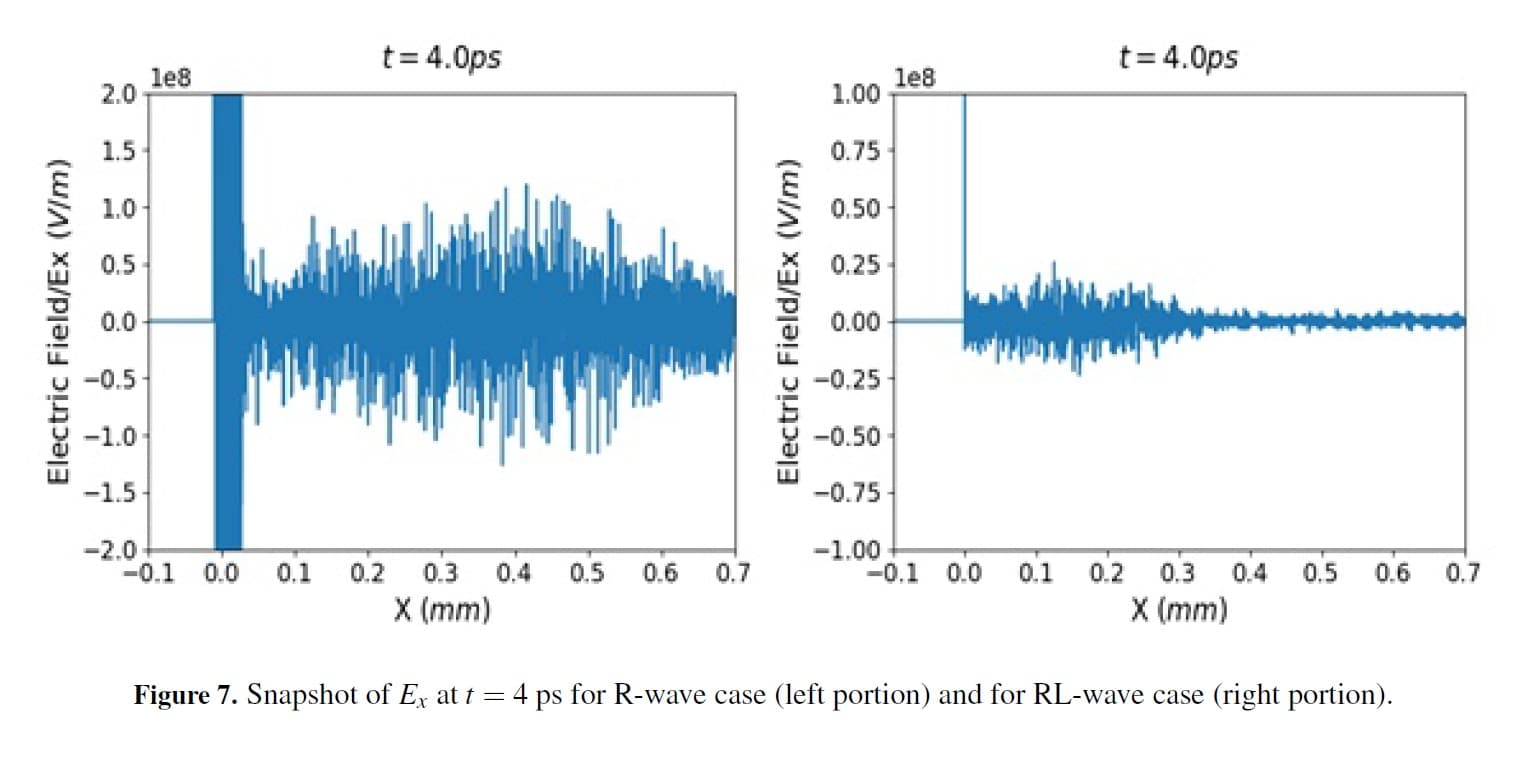
Laser-plasma interaction is a fascinating subject in view of its various applications in wave generation, particle acceleration, radiation generation, etc. The laser beam gets reflected at the vacuum-plasma interface if the plasma density is equal or larger than the critical density. However, in the presence of strong magnetic field in the order of kilo Tesla, the beam can travel some distance through over-dense plasma. Here EÃB heating and pondermotive force play role for the laser beams to propagate through the over-dense plasma. In the present article, taking the external magnetic field along the propagation direction of the laser beam we have observed the R- and L- waves to be excited. The applied magnetic field is chosen in such way that the laser frequency ðð falls between the electron cyclotron frequency ððð and ion cyclotron frequency ððð. Under this situation, it generates only an R-wave. If the laser frequency is considered to be less than the ion cyclotron frequency ( ðððð ðð<ððð) then an L-wave is additionally generated. In both the cases, an electrostatic disturbance is also formed with different but significant electric field amplitudes. We simulate these R- and L-waves in 1-D by using Particle-in-Cell (PIC) simulation using the EPOCH-4.17.10. Specifically, the electric and magnetic fields are studied that are associated with these waves, and the waves are verified based on the dispersion relation and the polarization studies.Keywords
- Electron cyclotron frequency,
- Ion cyclotron frequency,
- L-wave,
- Particle in cell,
- R-wave