
 10.57647/pibm.2023.122319
Evaluation of the Performance of a Targeted Dermal Drug Delivery System: Magnetic Liposome/CoFe2O4/Ascorbic Acid Nanocarrier
- Mohammad Yousef*
 2
2
- Department of Chemistry, SR.C., Islamic Azad University, Tehran, Iran
- Department of Chemistry, TeMS.C., Islamic Azad University, Tehran, Iran
- Department of biology, YI.C., Islamic. Azad University, Tehran, Iran

Received: 2023-08-10
Revised: 2023-10-18
Accepted: 2023-10-22
Published in Issue 2023-12-30
Copyright (c) 2025 Mojdeh Khosravi Farahani, Parviz Aberoomand Azar, Mohammad Yousef, Maryam Bikhof Torbati (Author)

This work is licensed under a Creative Commons Attribution 4.0 International License.
How to Cite









Abstract
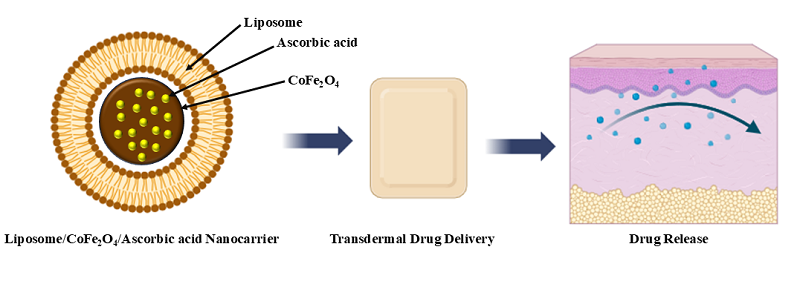
The transdermal drug delivery system represents a non-invasive and proficient approach that facilitates gradual release of pharmaceuticals while targeting the specific site of action. This modality has the potential to enhance both the therapeutic effectiveness and safety profiles of medications, sustain consistent plasma concentrations of the drug, circumvent first-pass hepatic metabolism, and offers a method that is both convenient and devoid of pain. The use of nanocarriers such as magnetic liposome/CoFe2O4 is known for targeted drug delivery. In this study, magnetic liposome/CoFe2O4 nanocarrier was synthesized and characterized. Then, ascorbic acid with high antioxidant properties was encapsulated in magnetic liposome/CoFe2O4 nanocarrier. In the next step, the absorption of ascorbic acid was evaluated by various parameters such as ascorbic acid concentration (mg/L), pH, time (min), and weight percentage of CoFe2O4 (wt%) by experimental design and Box-Behnken method. Under optimal conditions, the highest absorption rate was obtained with a concentration of ascorbic acid 11.99 mg/L, a time of 27.43 minutes, pH=8.78 and a weight percentage of 13.85% CoFe2O4, equal to 99.99%. The nanoliposome/CoFe2O4/ascorbic acid formulation achieved controlled release, with <20% released in the first hour and 86% by 12 hours. Ex-vivo studies showed ~65% steady permeation compared to <60% burst permeation for free ascorbic acid in 8 hours, highlighting superior controlled delivery.
Keywords
- Nanocarrier,
- Magnetic liposome/CoFe2O4,
- Ascorbic acid,
- Optimization,
- Release
References
- Alkilani, A. Z., Nasereddin, J., Hamed, R., Nimrawi, S., Hussein, G., Abo-Zour, H., Donnelly, R. F.: Beneath the skin: a review of current trends and future prospects of transdermal drug delivery systems. Pharm. 14(6), 1152 (2022). https://doi.org/10.3390/pharmaceutics14061152.
- Gupta, V., Trivedi, P.: In vitro and in vivo characterization of pharmaceutical topical nanocarriers containing anticancer drugs for skin cancer treatment. In: Lipid Nanocarriers for Drug Targeting, 563–627. Elsevier, Amsterdam (2018). http://dx.doi.org/10.1016/B978-0-12-813687-4.00015-3.
- Akbari, J., Saeedi, M., Ahmadi, F., Hashemi, S.M.H., Babaei, A., Yaddollahi, S., Rostamkalaei, S.S., Asare-Addo, K., Nokhodchi, A.: Solid lipid nanoparticles and nanostructured lipid carriers: a review of the methods of manufacture and routes of administration. Pharm. Dev. Technol. 27(5), 525–544 (2022). https://doi.org/10.1080/10837450.2022.2084554.
- De Oliveira, T.C., Tavares, M.E., Soares-Sobrinho, J.L., Chaves, L.L.: The role of nanocarriers for transdermal application targeted to lymphatic drug delivery: opportunities and challenges. J. Drug Deliv. Sci. Technol. 68, 103110 (2022). https://doi.org/10.1016/j.jddst.2022.103110.
- Jeong, W.Y., Kwon, M., Choi, H.E., Kim, K.S.: Recent advances in transdermal drug delivery systems: a review. Biomater. Res. 25, 1–15 (2021). https://doi.org/10.1186/s40824-021-00226-6.
- Xiao, Y., Tan, A., Jackson, A.W., Boyd, B.J.: Nonspherical nanocapsules as long-circulating drug delivery systems. Chem. Mater. 34(6), 2503–2530 (2022). https://doi.org/10.1021/acs.chemmater.1c03573.
- Ahmed, K.S., Hussein, S.A., Ali, A.H., Korma, S.A., Lipeng, Q., Jinghua, C.: Liposome: composition, characterisation, preparation, and recent innovation in clinical applications. J. Drug Target. 27(7), 742–761 (2019). https://doi.org/10.1080/1061186X.2018.1527337.
- Sun, Q., Yin, S., He, Y., Cao, Y., Jiang, C.: Biomaterials and encapsulation techniques for probiotics: current status and future prospects in biomedical applications. Nanomater. 13(15), 2185 (2023). https://doi.org/10.3390/nano13152185.
- Pisoschi, A.M., Pop, A., Cimpeanu, C., Turcuş, V., Predoi, G., Iordache, F.: Nanoencapsulation techniques for compounds and products with antioxidant and antimicrobial activity – a critical view. Eur. J. Med. Chem. 157, 1326–1345 (2018). https://doi.org/10.1016/j.ejmech.2018.08.076.
- de Queiroz, J.L.C., Medeiros, I., Trajano, A.C., Piuvezam, G., de Franca Nunes, A.C., Passos, T.S., de Araujo Morais, A.H.: Encapsulation techniques perfect the antioxidant action of carotenoids: a systematic review of how this effect is promoted. Food Chem. 385, 132593 (2022). https://doi.org/10.1016/j.foodchem.2022.132593.
- Yin, X., Chen, K., Cheng, H., Chen, X., Feng, S., Song, Y., Liang, L.: Chemical stability of ascorbic acid integrated into commercial products: a review on bioactivity and delivery technology. Antioxidants. 11(1), 153 (2022). https://doi.org/10.3390/antiox11010153.
- Wang, S., Chen, Y., Guo, J., Huang, Q.: Liposomes for tumor targeted therapy: a review. Int. J. Mol. Sci. 24(3), 2643 (2023). https://doi.org/10.3390/ijms24032643.
- Baek, J., Ramasamy, M., Willis, N.C., Kim, D.S., Anderson, W.A., Tam, K.C.: Encapsulation and controlled release of vitamin C in modified cellulose nanocrystal/chitosan nanocapsules. Curr. Res. Food Sci. 4, 215–223 (2021). https://doi.org/10.1016/j.crfs.2021.03.010.
- Abdolmohammadi, S., Shariati, S., Fard, N.E., Samani, A.: Aqueous‐mediated green synthesis of novel spiro [indole‐quinazoline] derivatives using kit‐6 mesoporous silica coated Fe3O4 nanoparticles as catalyst. J. Heterocycl. Chem. 57(7), 2729–2737 (2020). https://doi.org/10.1002/JHET.3981.
- Vandani, S. A. K., Kalaee, M., Saravani, M. G., Fard, N. E., Rahmati, M., & Kamani, M.: Preparation of magnetic Fe3O4/MoO3/MCM-22 photocatalyst and its study on metronidazole adsorption, degradation, and process optimization. Russ. J. Phys. Chem. A 97(4), 618–632 (2023). https://doi.org/10.1134/S003602442304026X.
- Elmi Fard, N., Fazaeli, R.: Fabrication of superhydrophobic CoFe2O4/polyaniline/covalent organic frameworks/cotton fabric membrane and evaluation of its efficiency in separation of olive oil from water. J. Chin. Chem. Soc. 69(12), 2014–2026 (2022). https://doi.org/10.1002/jccs.202200368.
- Fard, N.E., Fazaeli, R.: Optimization of operating parameters in photocatalytic activity of visible light active Ag/TiO2 nanoparticles. Russ. J. Phys. Chem. A 92(13), 2835–2846 (2018). https://doi.org/10.1134/S0036024418130071.
- Fekra, S.S., Fard, N.E., Fazaeli, R.: Photocatalytic degradation of antibiotic norfloxacin aqueous solution by Ce/Bi2WO6: optimization and simulation of process by RSM. Russ. J. Appl. Chem, 94(6), 824–834 (2021). https://doi.org/10.1134/S1070427221060161.
- Fard, N.E., Fazaeli, R., Yousefi, M., Abdolmohammadi, S.: Oxidative desulfurization of dibenzothiophene using M/TiO2/MWW (M= Cu, Ag, and Au) composite. Russ. J. Phys. Chem. A. 95 (Suppl 1), S23–S32 (2021). https://doi.org/10.1134/S0036024421140065.
- Nam, S.-N., Cho, H., Han, J., Her, N., Yoon, J.: Photocatalytic degradation of acesulfame K: optimization using the Box–Behnken design (BBD). Process Saf. Environ. Prot. 113, 10–21 (2018). https://doi.org/10.1016/j.psep.2017.09.002.
- Dbik, A., El Messaoudi, N., Bentahar, S., El Khomri, M., Lacherai, A., Faska, N.: Optimization of methylene blue adsorption on agricultural solid waste using Box–Behnken design (BBD) combined with response surface methodology (RSM) modeling. Biointerface Res. Appl. Chem. 12(4), 4567–4583 (2022). https://doi.org/10.33263/BRIAC124.45674583.
- Kashi, N., Elmi Fard, N., Fazaeli, R.: Empirical modeling and CCD-based RSM optimization of Cd(II) adsorption from aqueous solution on clinoptilolite and bentonite. Russ. J. Appl. Chem. 90(6), 977–992 (2017). https://doi.org/10.1134/S1070427217060210.
- Bhattacharya, S.: Central composite design for response surface methodology and its application in pharmacy. In: Response Surface Methodology in Engineering Science. IntechOpen, London (2021). https://doi.org/10.5772/intechopen.95835.
- Latif, A., Maqbool, A., Zhou, R., Arsalan, M., Sun, K., Si, Y.: Optimized degradation of bisphenol A by immobilized laccase from Trametes versicolor using Box–Behnken design (BBD) and artificial neural network (ANN). J. Environ. Chem. Eng. 10(2), 107331 (2022). https://doi.org/10.1016/j.jece.2022.107331.
- Samadi, N., Azar, P. A., Husain, S. W., Maibach, H. I., Nafisi, S.: Experimental design in formulation optimization of vitamin K1 oxide-loaded nanoliposomes for skin delivery. Int. J. Pharm, 579, 119136 (2020) https://doi.org/10.1016/j.ijpharm.2020.119136.