
 10.57647/ijrowa-2tn9-sn56
Application of lignocellulolytic fungal consortium for quality composting of spent mushroom substrate: physicochemical parameters and maturity assessment of the end-products
- Chiranjib Mili

 1
1 - Pinky Rani Biswas1
- Subham Saha1
- Kumanand Tayung*1
- Mycology and Plant Pathology Laboratory, Department of Botany, Gauhati University, Guwahati-781014, India

Received: 2023-11-26
Revised: 2024-04-30
Accepted: 2024-11-09
Published in Issue 2025-06-01
Copyright (c) 2024 Chiranjib Mili, Pinky Rani Biswas, Subham Saha, Kumanand Tayung (Author)

This work is licensed under a Creative Commons Attribution 4.0 International License.
How to Cite




PDF views: 510





Abstract
Purpose:The inappropriate disposal of agricultural residues including spent mushroom substrate (SMS) after harvesting leads to serious environmental issues. Microbial composting is a widely recognized method for the management of such residues in a sustainable manner. Therefore, the present study aims to examine the efficacy of lignocellulolytic fungal consortium (Pseudoplagiostoma eucalypti strain LLF10 and Purpureocillium lilacinum strain LLF22) on the composting of SMS.
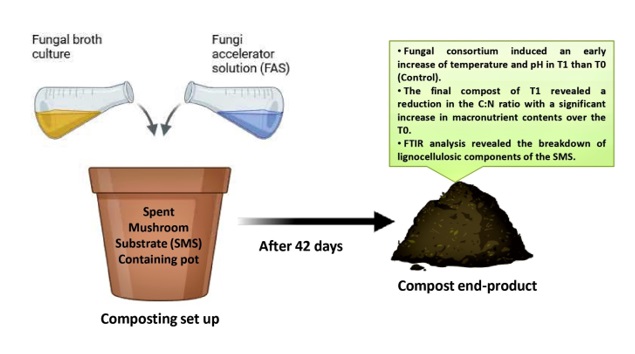
Method: The experiment consisted of two treatments- T0: only SMS, and T1: SMS+ fungal accelerator solution (FAS) + Fungal consortium. The composting process lasted for 42 days and physicochemical parameters were assessed.
Results: The results displayed that the fungal consortium accelerated SMS composting as evidenced by the decrease in the C:N ratio, an increase in macronutrient contents (TN, TK, TP, TCa, TMg), coarseness index (CI), and germination index (GI) of the final compost (T1) over the control (T0). Fourier transform infrared (FTIR) analysis revealed the breakdown of aromatic and organic compounds in the final compost suggesting humification of SMS. Furthermore, the inoculation of the fungal consortium effectively induced a faster rise in temperature and pH.
Conclusion: This study revealed that the lignocellulolytic fungal consortium can be a potential candidate for the bioconversion of agro-waste into high-quality compost for application in sustainable agricultural practices.
Research Highlighta
- Fungal consortium manifested quality composting of spent mushroom substrate (SMS).
- Fungal consortium induced an early increase in temperature and pH in T1 than in T0.
- The compost of T1 showed C:N reduction and an increase in macronutrient contents.
- FTIR analysis revealed the breakdown of lignocellulosic properties of the SMS.
- Coarseness index (CI), and germination index (GI) were higher in T1 over the T0.
Keywords
- Fungal consortium,
- Fungal accelerator solution,
- Spent mushroom substrate,
- Coarseness index,
- Germination index
References
- Abou Fayssal S, Yordanova MH, Sassine YN (2023) Effect of substrate temperature and stages duration on recycling of agro-industrial residues through Pleurotus ostreatus production. Int J Recycl Org Waste Agricult 12(4):559-571. https://doi.org/10.30486/ijrowa.2023.1964536.1513
- Ahmed R, Deka H (2022) Vermicomposting of patchouli bagasse-A byproduct of essential oil industries employing Eisenia fetida. Environ Technol Innov 25:102232. https://doi.org/10.1016/j.eti.2021.102232
- Akoglu H (2018) User's guide to correlation coefficients. Turk J Emerg Med 18(3):91-93. https://doi.org/10.1016/j.tjem.2018.08.001
- APHA (1998) Standard methods for the examination of water and wastewater, nineteenth ed. American Public Health Association (APHA). Washington 4145–4146.
- Ayilara MS, Olanrewaju OS, Babalola OO, Odeyemi O (2020) Waste management through composting: Challenges and potentials. Sustainability 12(11):4456. https://doi.org/10.3390/su12114456
- Bernal MP, Alburquerque JA, Moral R (2009) Composting of animal manures and chemical criteria for compost maturity assessment. a review. Bioresour Technol 100 (22SI):5444–5453. https://doi.org/10.1016/j.biortech.2008.11.027
- Boruah T, Deka H (2021) Biological indicators for assessing the maturity of the vermicomposted products of citronella bagasse and paper mill sludge mixture. Biomass Conv Bioref 1-7. https://doi.org/10.1007/s13399-020-01228-5
- Bose H, Satyanarayana T (2017) Microbial carbonic anhydrases in biomimetic carbon sequestration for mitigating global warming: prospects and perspectives. Front Microbiol 8:1615. https://doi.org/10.3389/fmicb.2017.01615
- Bradstreet, RB (1954) Kjeldahl method for organic nitrogen. Analytical Chemistry 26(1):185-187. https://doi.org/10.1021/ac60085a028
- Bustamante MA, Paredes C, Moral R, Agullo E, Perez-Murcia MD, Abad M (2008) Composts from distillery wastes as peat substitutes for transplant production. Resour Conserv Recycl 52 (5):792–799. https://doi.org/10.1016/j.resconrec.2007.11.005
- Cardoen D, Joshi P, Diels L, Sarma PM, Pant D (2015) Agriculture biomass in India: part 2. Post-harvest losses, cost and environmental impacts. Resour Conserv Recycl 101:143–153. https://doi.org/10.1016/j.resconrec.2015.06.002
- Chan MT, Selvam A, Wong JWC (2016) Reducing nitrogen loss and salinity during “struvite” food waste composting by zeolite amendment. Bioresour Technol 200:838–844. https://doi.org/10.1016/j.biortech.2015.10.093
- Chang HQ, Zhu XH, Jie WU, Guo DY, Zhang LH, Yao FENG (2021a) Dynamics of microbial diversity during the composting of agricultural straw. J Integr Agric 20(5):1121-1136. https://doi.org/10.1016/S2095-3119(20)63341-X
- Chang R, Li Y, Li N, Wu X, Chen Q (2021b) Effect of microbial transformation induced by metallic compound additives and temperature variations during composting on suppression of soil-borne pathogens. J Environ Manage 279:111816. https://doi.org/10.1016/j.jenvman.2020.111816
- Chen Y, Chen Y, Li Y, Wu Y, Zeng Z, Xu R, et al (2019) Changes of heavy metal fractions during co-composting of agricultural waste and river sediment with inoculation of Phanerochaete chrysosporium. J Hazard Mater 378:120757. https://doi.org/10.1016/j.jhazmat.2019.120757
- Chung WJ, Chang SW, Chaudhary DK, Shin J, Kim H, Karmegam N, et al (2021) Effect of biochar amendment on compost quality, gaseous emissions and pathogen reduction during in-vessel composting of chicken manure. Chemosphere 283:131129. https://doi.org/10.1016/j.chemosphere.2021.131129
- Das D, Deka H (2021) Vermicomposting of harvested waste biomass of potato crop employing Eisenia fetida: changes in nutrient profile and assessment of the maturity of the end products. Environ Sci Pollut Res 28:35717-35727. https://doi.org/10.1007/s11356-021-13214-z
- Deka H, Deka S, Baruah CK, Das J, Hoque S, Sarma H, Sarma NS (2011) Vermicomposting potentiality of Perionyx excavatus for recycling of waste biomass of java citronella-An aromatic oil yielding plant. Bioresour Technol 102(24):11212-11217. https://doi.org/10.1016/j.biortech.2011.09.102
- Feng L, Yang J, Ma F, Xing L, Pi S, Cui D, Li A (2021) Biological stimulation with Fe (III) promotes the growth and aerobic denitrification of Pseudomonas stutzeri T13. Sci Total Environ 776:145939. https://doi.org/10.1016/j.scitotenv.2021.145939
- Gabhane J, William SP, Bidyadhar R, Bhilawe P, Anand D, et al (2012) Additives aided composting of green waste: Effects on organic matter degradation, compost maturity, and quality of the finished compost. Bioresour Technol 114:382–388. https://doi.org/10.1016/j.biortech.2012.02.040
- Ge M, Shen Y, Ding J, Meng H, Zhou H, Zhou J, Cheng H, Zhang X, Wang J, Wang H, Cheng Q (2022) New insight into the impact of moisture content and pH on dissolved organic matter and microbial dynamics during cattle manure composting. Bioresour Technol 344:126236. https://doi.org/10.1016/j.biortech.2021.126236
- Greff B, Szigeti J, Nagy Á, Lakatos E, Varga L (2022) Influence of microbial inoculants on co-composting of lignocellulosic crop residues with farm animal manure: A review.
- J Environ Manag 302:114088. https://doi.org/10.1016/j.jenvman.2021.114088
- Gurmessa B, Cocco S, Ashworth AJ, Pedretti EF, Ilari A, Cardelli V, Fornasier F, Ruello ML, Corti G (2021) Post-digestate composting benefits and the role of enzyme activity to predict trace element immobilization and compost maturity. Bioresour Technol 338:125550. https://doi.org/10.1016/j.biortech.2021.125550
- Gusain R, Suthar S (2020) Vermicomposting of invasive weed Ageratum conyzoids: Assessment of nutrient mineralization, enzymatic activities, and microbial properties. Bioresour Technol 312:123537. http://dx.doi.org/10.1016/j.biortech.2020.123537
- Hseu ZY (2004) Evaluating heavy metal contents in nine composts using four digestion methods. Bioresour Technol 95:53–59. https://doi.org/10.1016/j.biortech.2004.02.008
- Hua L, Wu W, Liu Y, McBride MB, Chen Y (2008) Reduction of nitrogen loss and Cu and Zn mobility during sludge composting with bamboo charcoal amendment. Environ Sci Pollut Res 16(1):1–9. https://doi.org/10.1007/s11356-008-0041-0
- Jain MS, Paul S, Kalamdhad AS (2018) Utilization of biochar as an amendment during lignocellulose waste composting: Impact on composting physics and Realization (probability) amongst physical properties. Process Saf Environ Prot 121:229-238. https://doi.org/10.1016/j.psep.2018.10.031
- Jayasinghe GY (2012) Synthetic soil aggregates as a potting medium for ornamental plant production. J Plant Nutr 35:1441–1456. https://doi.org/10.1080/01904167.2012.671406
- Karwal M, Kaushik A (2020) Co-composting and vermicomposting of coal fly-ash with press mud: Changes in nutrients, micro-nutrients and enzyme activities. Environ Technol Innov 18:100708. https://doi.org/10.1016/j.eti.2020.100708
- Khatua C, Sengupta S, Balla V Krishna, Kundu B, Chakraborti A, Tripathi S (2018) Dynamics of organic matter decomposition during vermicomposting of banana stem waste using Eisenia fetida. Waste Manag 79: 287–295. http://dx.doi.org/10.1016/j.wasman.2018.07.043
- Larney FJ, Olson AF, DeMaere PR, Handerek BP, Tovell BC (2008) Nutrient and trace element changes during manure composting at four southern Alberta feedlots. Can J Soil Sci 88(1):45–59. https://doi.org/10.4141/CJSS07044
- Liu Y, Ma R, Li D, Qi C, Han L, Chen M, et al (2020) Effects of calcium magnesium phosphate fertilizer, biochar and spent mushroom substrate on compost maturity and gaseous emissions during pig manure composting. J Environ Manage 267:110649. https://doi.org/10.1016/j.jenvman.2020.110649
- Malińska K, Zabochnicka-Światek M, Cáceres R, Marfà O (2016) The effect of precomposted sewage sludge mixture amended with biochar on the growth and reproduction of Eisenia fetida during laboratory vermicomposting. Ecol Eng 90:35–41. https://doi.org/10.1016/j.ecoleng.2016.01.042
- Maurya AK, John V, Murmu R, Simon S (2019) Impact of different substrates for spawn production and production of milky mushroom (Calocybe indica). Int J Pharma Bio Sci 10(3):5-10. http://dx.doi.org/10.22376/ijpbs.2019.10.3.b5-10
- Meng X, Liu B, Zhang H, Wu J, Yuan X, Cui Z (2019) Co-composting of the biogas residues and spent mushroom substrate: Physicochemical properties and maturity assessment. Bioresour Technol 276:281-287. https://doi.org/10.1016/j.biortech.2018.12.097
- Mili C, Kalita S, Tayung K (2023) Hydrolysis efficiency of sugarcane bagasse treated with fungal consortia isolated from leaf litter. Biomass Conv Bioref 1-12. https://doi.org/10.1007/s13399-023-04973-5
- Mili C, Tayung K (2024) Application of compatible lignocellulolytic fungal consortia for quality composting of leaf litter and assessment of the end products. Bioresour Technol Rep 101800. https://doi.org/10.1016/j.biteb.2024.101800
- Pandit L, Sethi D, Pattanayak SK, Nayak Y (2020) Bioconversion ofligno-cellulosic organic wastes into nutrient rich vermicompost by Eudrilus eugeniae. Bioresour Technol Rep 100580. https://doi.org/10.1016/j.biteb.2020.100580
- Powell J, Townsend T, Zimmerman J (2016) Estimates of solid waste disposal rates and reduction targets for landfill gas emissions. Nat Clim Chang 6:162–165. https://doi.org/10.1038/nclimate2804
- Raij BV (1966) Calcium and magnesium determination in soils with EDTA. Bragantia 25 (2):317–326. https://doi.org/10.1590/S0006-87051966000200004
- Rastogi M, Nandal M, Khosla B (2020) Microbes as vital additives for solid waste composting. Heliyon 6(2):e03343. https://doi.org/10.1016/j.heliyon.2020.e03343
- Ravindran B, Sekaran G (2010) Bacterial composting of animal fleshing generated from tannery industries. Waste Manag 30:2622–2630. https://doi.org/10.1016/j.wasman.2010.07.013
- Salprima YS, Notriawan D, Angasa E, Suharto TE, Hendri J, Nishina Y (2013) Green synthesis of silver nanoparticles using aqueous rinds extract of Brucea javanica (L.) Merr at ambient temperature. Mater Lett 97:181–183. https://doi.org/10.1016/j.matlet.2013.01.114
- Samal K, Mohan A Raj, Chaudhary N, Moulick S (2019) Application of vermitechnology in waste management: A review on mechanism and performance. J Environ Chem Eng 7:103392. https://doi.org/10.1016/j.jece.2019.103392
- Sánchez ÓJ, Ospina DA, Montoya S (2017) Compost supplementation with nutrients and microorganisms in composting process. Waste Manag 69:136-153. https://doi.org/10.1016/j.wasman.2017.08.012
- Sarangi S, Swain H, Adak T, Bhattacharyya P, Mukherjee AK, Kumar G, Mehetre ST (2021) Trichoderma-mediated rice straw compost promotes plant growth and imparts stress tolerance. Environ Sci Pollut Res 28(32):44014-44027. https://doi.org/10.1007/s11356-021-13701-3
- Sharma VP, Annepu SK, Gautam Y, Singh M, Kamal S (2018) Status of mushroom production in India. Mushroom res 26(2):111-120.
- Singh A, Shahid M, Kumar V, Srivastava M (2012) Evaluation of different substrate for mass multiplication of Trichoderma spp. Trends in Biosciences 5(1):68-70.
- Soretire AA, Ezema CA, Awaogu CE, Okafor CC, Umoren AS, Adeyemi NO (2022) Biotransformation of organic wastes through composting using Trichoderma harzianum and its effects on cucumber (Cucumis sativus L.) yield. Int J Recycl Org Waste Agricult 2(Special Issue) 191-199. https://doi.org/10.30486/IJROWA.2022.1957121.1452
- Srivastava V, Goel G, Thakur VK, Singh RP, Ferreira de Araujo AS, Singh P (2020) Analysis and advanced characterization of municipal solid waste vermicompost maturity for a green environment. J Environ Manag 255:109914. https://doi.org/10.1016/j.jenvman.2019.109914
- Sun C, Wei Y, Kou J, Han Z, Shi Q, Liu L, Sun Z (2021) Improve spent mushroom substrate decomposition, bacterial community and mature compost quality by adding cellulase during composting. J Clean Prod 299:126928. https://doi.org/10.1016/j.jclepro.2021.126928
- Vijayendra SVN, Bansal D, Prasad MS, Nand K (2001) Jaggery: a novel substrate for pullulan production by Aureobasidium pullulans CFR-77. Process Biochem 37(4):359-364. https://doi.org/10.1016/S0032-9592(01)00214-X
- Wang G, Kong Y, Liu Y, Li D, Zhang X, Yuan J, Li G (2020) Evolution of phytotoxicity during the active phase of co-composting of chicken manure, tobacco powder and mushroom substrate. Waste Manag 114:25–32. http://dx.doi.org/10.1016/j.wasman.2020.06.034
- Wang M, Liu Y, Wang S, Wang K, Zhang Y (2021) Development of a compound microbial agent beneficial to the composting of Chinese medicinal herbal residues. Bioresour Technol 330:124948. https://doi.org/10.1016/j.biortech.2021.124948
- Wang X, Zheng G, Chen T, Shi, X, Wang Y, Nie E, Liu J (2019) Effect of phosphate amendments on improving the fertilizer efficiency and reducing the mobility of heavy metals during sewage sludge composting. J Environ Manag 235:124-132. https://doi.org/10.1016/j.jenvman.2019.01.048
- Wang Y, Schuchardt F, Sheng F, Zhang R, Cao Z (2004) Assessment of maturity of vineyard pruning compost by Fourier Transform Infrared Spectroscopy, biological and chemical analyses. Landbauforsch, VOLKENRODE 54:163–169.
- Werghemmi W, Abou Fayssal S, Mazouz H, Hajjaj H, Hajji L (2022) Olive and green tea leaves extract in Pleurotus ostreatus var. florida culture media: Effect on mycelial linear growth rate, diameter and growth induction index. In IOP Conference Series: Earth and Environmental Science 1090 (1): 012020. IOP Publishing. https://doi.org/10.1088/1755-1315/1090/1/012020
- Wu X, Amanze C, Yu R, Li J, Wu X, Shen L, Liu Y, Yu Z, Wang J, Zeng W (2022) Insight into the microbial mechanisms for the improvement of composting efficiency driven by Aneurinibacillus sp. LD3. Bioresour Technol 359: p.127487. https://doi.org/10.1016/j.biortech.2022.127487
- Xu P, Li J (2017) Effects of microbial inoculant on physical and chemical properties in pig manure composting. Compost Sci Util 25(Sup1): S37–S42. https://doi.org/10.1080/1065657X.2017.1295886
- Yin Z, Zhang L, Li R (2021) Effects of additives on physical, chemical, and microbiological properties during green waste composting. Bioresour Technol 340:125719. https://doi.org/10.1016/j.biortech.2021.125719
- Zawadzińska A, Salachna P, Nowak JS, Kowalczyk W, Piechocki R, Łopusiewicz Ł, Pietrak A (2021) Compost based on pulp and paper mill sludge, fruit-vegetable waste, mushroom spent substrate and rye straw improves yield and nutritional value of tomato. Agronomy 12(1):13. https://doi.org/10.3390/agronomy12010013
- Zhang K, Wu X, Chen J, Wang W, Luo H, Chen W, et al (2021) The role and related microbial processes of Mn-dependent anaerobic methane oxidation in reducing methane emissions from constructed wetland-microbial fuel cell. J Environ Manag 294:112935. https://doi.org/10.1016/j.jenvman.2021.112935
- Zhang L, Sun X (2014) Changes in physical, chemical, and microbiological properties during the two-stage co-composting of green waste with spent mushroom compost and biochar. Bioresour Technol 171:274-284. https://doi.org/10.1016/j.biortech.2014.08.079
- Zhang LU, Sun X (2018) Evaluation of maifanite and silage as amendments for green waste composting. Waste Manag 77:435–446. https://doi.org/10.1016/j.wasman.2018.04.028
- Zhang N, Li Y, Wubet T, Bruelheide H, Liang Y, Purahong W, Buscot F, Ma K (2018) Tree species richness and fungi in freshly fallen leaf litter: unique patterns of fungal species composition and their implications for enzymatic decomposition. Soil Biol Biochem 127:120-126. https://doi.org/10.1016/j.soilbio.2018.09.023
- Zhuang J, Li M, Pu Y, Ragauskas AJ, Yoo CG (2020) Observation of potential contaminants in processed biomass using fourier transform infrared spectroscopy. Appl Sci 10(12):4345. https://doi.org/10.3390/app10124345