
 10.57647/ijrowa-3h80-t656
Vermicomposted corn waste in the organic cultivation of cherry tomato seedlings and its effects on the soil-plant system
- Jos ́e Matheus de Oliveira
 1
1 - Jefferson Campos Silva1
- Andreza Jayane Nunes de Siqueira1
- Ramom Rachide Nunes*
 2
2
- Federal Rural University of Pernambuco, Laboratory of Environmental Chemistry, Serra Talhada, Brazil
- Federal Rural University of Pernambuco, Department of Chemistry, Recife, Brazil

Received: 2023-06-30
Revised: 2023-09-15
Accepted: 2024-02-07
Published in Issue 2024-05-23
Copyright (c) 2024 @Authors

This work is licensed under a Creative Commons Attribution 4.0 International License.
How to Cite




PDF views: 495
HTML views: 66





Abstract
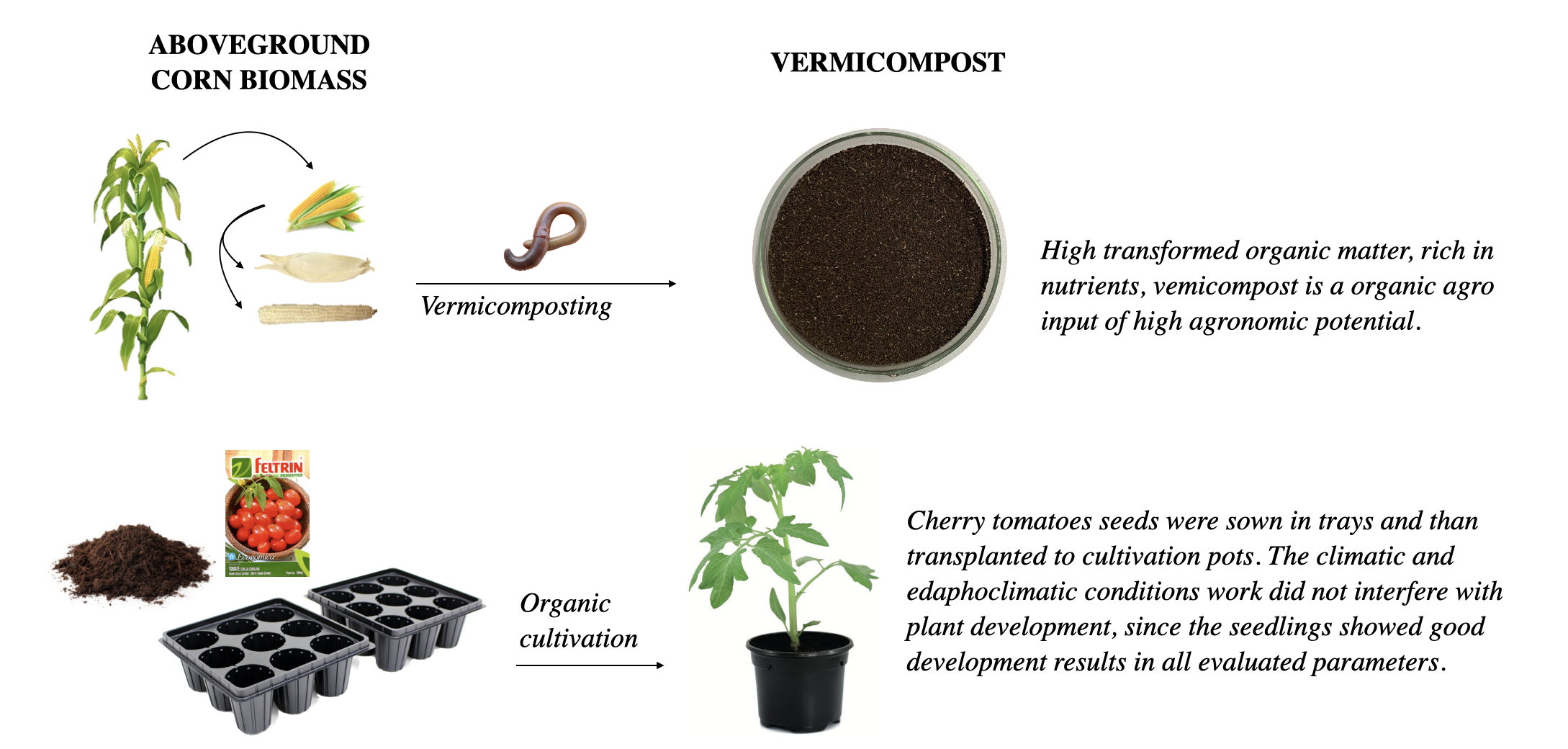
Propose: In this study, vermicomposted corn waste was applied to the organic cultivation of cherry tomato seedlings under the edaphoclimatic conditions of the Brazilian semiarid region, and the effects were evaluated in the soilâplant system.
Method: The vermicomposts were prepared by mixing corn waste in an organic substrate. The experiment was divided into two parts: sowing in trays and growing seedlings in pots. In both steps, the following biometric attributes were evaluated: plant size, root length, root weight, aboveground biomass, leaf weight, and leaf area. Three vermicompost concentrations were assessed: 1.5%, 3.0%, and 6.0% (m/m). As a control, a soil sample without vermicompost was also evaluated.
Results: In general, plants that grew in a substrate containing vermicompost developed more when compared to the sample control (19.2-22.0 vs 15 cm). Furthermore, in general, plants cultivated with higher vermicompost concentrations presented better results in all evaluated parameters. In addition, a sample composed of a mixture of corn straw and cob showed the best results, indicating that joint management of both residues is advantageous for all assessed attributes.
Conclusion: The results confirm the expectation that it is possible to apply vermicomposted corn residues in the organic cultivation of cherry tomatoes and that the strategy of carrying out germination in a tray, followed by transplantation into pots, had a positive effect on the development of seedlings. When compared to other studies, the climatic and edaphoclimatic conditions experienced in this work did not interfere with plant development, since the seedlings showed good development results in all evaluated parameters.
Research Highlights
- Vermicomposted corn waste presented attributes of high agronomic potential.
- Plants cultivated with vermicompost developed more when compared to the sample control.
- A mixture of corn straw and cob was the best treatment at a dose of 6.0% of vermicompost.
- Cherry tomato seedlings showed good development results in all evaluated parameters
Keywords
- Agrarian development,
- Agricultural waste,
- Environmental technologies,
- Organic Agriculture