
 10.57647/j.ijrowa.2024.1303.33
A comprehensive review of composting from coffee waste: Revalori-sation of coffee residue in Colombia
- Juan Manuel Trujillo-González
 1
1 - Raimundo Jiménez-Ballesta*
 2
2 - Amanda Silva-Parra3
- Marco Aurelio Torres-Mora1
- Francisco J. García Navarro4

Published in Issue 2024-04-04

This work is licensed under a Creative Commons Attribution 4.0 International License.




HTML views: 61
PDF views: 2006





Abstract
Purpose: Globally, Colombia is recognized as a coffee-growing country par excellence, which entails generating a large amount of coffee waste. This narrative study aims to review the possible use of such coffee waste to obtain nutrient-rich compost following key composting processes. The final is to investigate the importance and suitability of this compost type.
Method: The data collected for this study were from reviewing the scientific literature and research reports available in many reputable academic databases, i.e., Science Direct, Springer, PubMed, and Scopus. Reputable academic search engines like Google Scholar and ResearchGate were used to access relevant research and high-quality scientific documents.
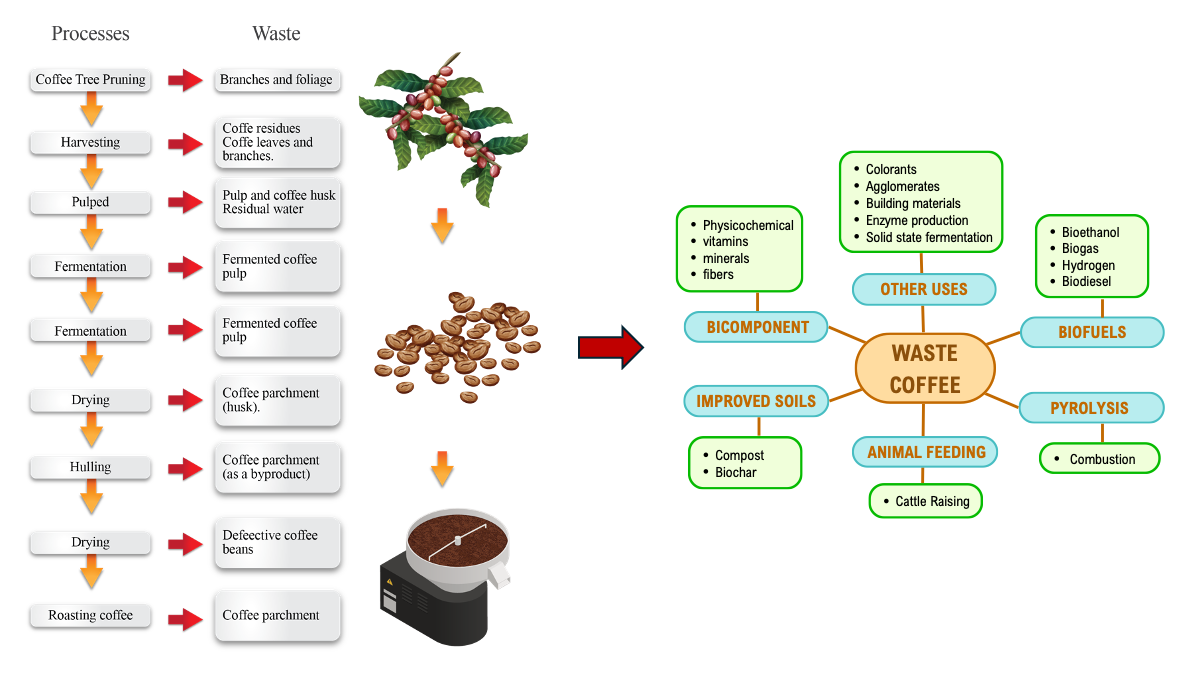
Results: The result revealed that using combinations of agro-industrial coffee waste when composted can be applied in agriculture because it provides wide-ranging nutrients, which can fertilize soil, accelerate plant growth, and even improve the nutrient content of vegetables. The SCGs used in agriculture prevent improper waste disposal by decreasing the pollution caused by the degradation of SCGsâ toxic components. Here we explore and review composting processes containing coffee waste.
Conclusion: Employing coffee waste for compost implies benefits compared to landfills. The conversion of this coffee biomass waste into compost, and using it as a soil amendment, can reduce the waste volume, improve soil physico-chemical properties, enhance the nutrient use efficiency of crops, and correct the typical soil acidity of Colombian soils used for coffee production.
Highlights
· Colombia is recognized as the coffee-growing country par excellence.
· The coffee agro-industry generates large quantities of solid waste.
· Composting coffee biomass waste can act as soil amendment and enhances physico-chemical properties.
· Composting is a highly effective remedy for environmental issues.
Keywords
- Coffee by-products; Agro-industrial coffee residues,
- Reutilisation,
- Spent coffee grounds,
- Valorisation