
 10.57647/ijrowa.2026.1503.29


Received: 2024-12-04
Revised: 2024-12-24
Accepted: 2026-04-22
Published in Issue 2026-09-30
Copyright (c) 2026 Krishanthiny Ravivarman, Sagarika Kannangara, Thavanayagam Mathiventhan (Author)

This work is licensed under a Creative Commons Attribution 4.0 International License.
How to Cite




PDF views: 20





Abstract
Purpose: Vermicompost is one of the alternative nutrient sources for crop plants as an organic amendment. This study evaluated the effect of vermicompost on the growth and performance of Okra (Abelmoschus esculentus).
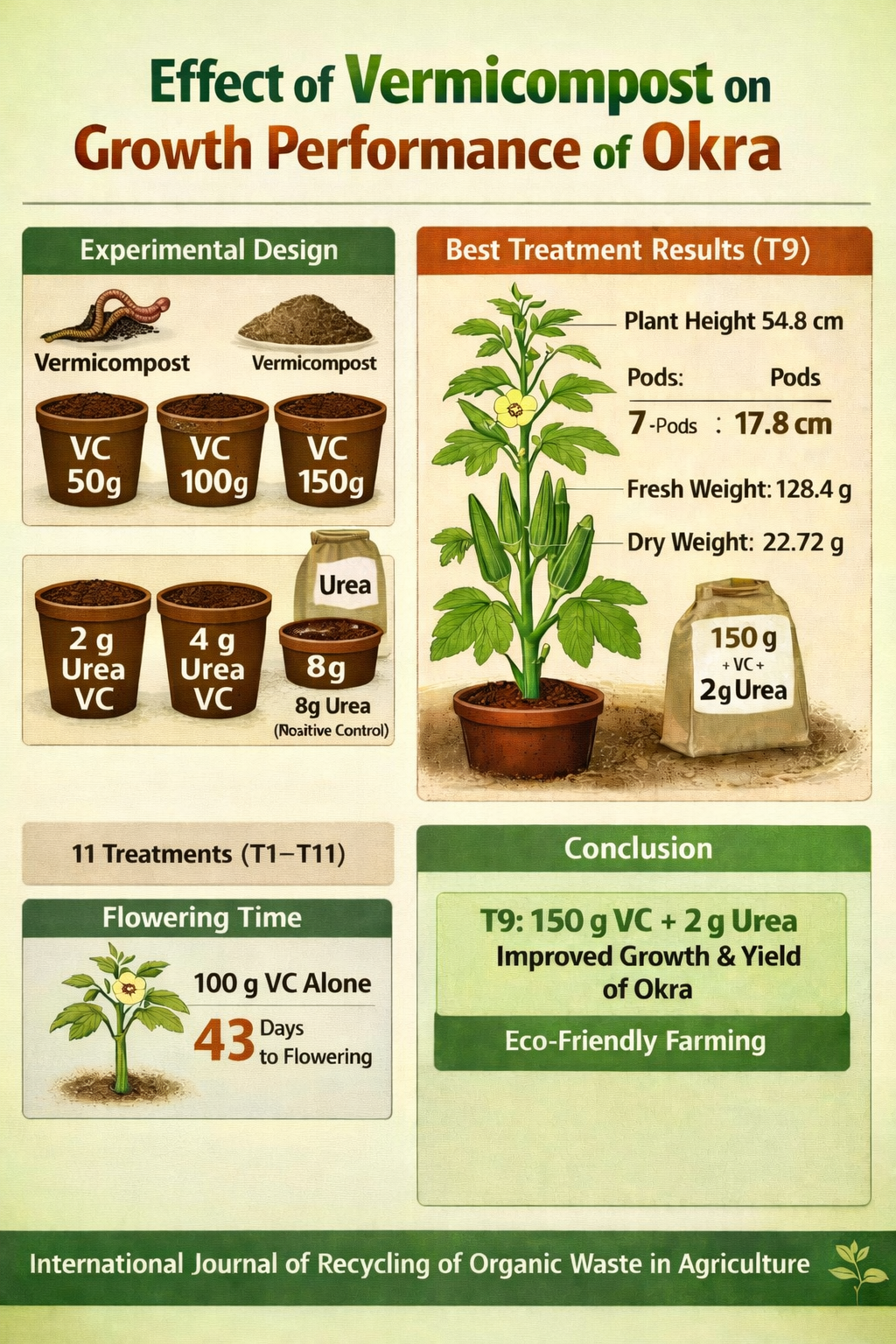
Method: A Randomized Complete Block Design with eleven treatments were applied to 5 kg of processed soil. Treatments consisted of three levels of vermicompost (50 g, 100 g, and 150 g) alone and combined with two levels of urea (2 g, 4 g), including positive (8 g urea only) and negative (soil only) controls. Treatment codes were: T1-T3: VC alone, T4-T6: 4 g urea + VC, T7-T9: 2 g urea + VC, T10: 8 g urea (positive), and T11: 5 kg soil (negative control). Each treatment had five replicates and was applied during transplanting, three, and five weeks after transplanting. Growth and yield parameters were recorded from 10 to 70 Days after planting and analyzed using Minitab 15.
Results: The combination of 2 g urea with 150 g VC (T9) showed significantly higher performance in most of the growth and yield parameters (mean values of plant height: 54.8±4.76 cm, stem circumference: 2.84±0.09 cm, number and length of pods: 7±2.0 and 17.8±1.4 cm, and fresh and dry weight:128.4±8.3 g and 22.72±1.23 g). Plants treated with 100 g VC alone (T2) took a minimum day for flowering (43 days).
Conclusion: Vermicompost supplemented with a lesser amount of urea (T9: 2 g urea with 150 g VC) enhanced the growth and yield of okra, promoting environmentally friendly agricultural practices.
Keywords
- Growth performance,
- Okra (Abelmoschus esculentus),
- Organic fertilizer,
- Vermicompost
References
- Ansari, A. A., & Ismail, S. A. (2012). Earthworms and vermiculture biotechnology. In S. Kumar & A. Bharti (Eds.), Management of organic waste, 87–96. https://doi.org/10.5772/30957
- Ansari, A., & Sukhraj, K. (2010). Effect of vermiwash and vermicompost on soil parameters and productivity of okra (Abelmoschus esculentus) in Guyana. African Journal of Agricultural Research, 5(14), 1794–1798. https://doi.org/10.5897/AJAR09.107
- AOAC International. (2016). Official Method 892.01: Nitrogen (ammoniacal and nitrate) in fertilizers—Devarda method. In Official methods of analysis of AOAC INTERNATIONAL (20th ed.).
- Cornelio, V. M., & Laines Canepa, J. R. (2017). Vermicomposting: I progress and strategies in the treatment of organic solid waste. Revista Mexicana de Ciencias Agrícolas, 8(2), 393–406. https://doi.org/10.29312/remexca.v8i2.59
- Das, A. K., Birendra, P., & Ramakant, S. (2014). Response of chemical fertilizer and vermicompost on okra (Abelmoschus esculentus) cv. Pravani Kranti. Asian Journal of Horticulture, 9(2), 372–376. https://doi.org/10.15740/HAS/TAJH/9.2/372-376
- Deshmukh, S. S., Chaudhari, V. S., Narkhede, S. D., Jadhav, R. N., & Attarde, S. B. (2010). Effect of three different composts on the growth rate of wheat (Triticum aestivum). International Journal of Plant Sciences, 6(1), 22–26.
- Ebrahimi, M., Souri, M. K., Mousavi, A., & Sahebani, N. (2021). Biochar and vermicompost improve growth and physiological traits of eggplant (Solanum melongena L.) under deficit irrigation. Chemical and Biological Technologies in Agriculture, 8(1), Article 19. https://doi.org/10.1186/s40538-021-00216-9
- Gutierrez-Miceli, F. A., Santiago-Borraz, J., Montes Molina, J. A., Nafate, C. C., Abud-Archila, M., Oliva Llaven, M. A., Rincon-Rosales, R., & Dendooven, L. (2007).
- Vermicompost as a soil supplement to improve growth, yield and fruit quality of tomato (Lycopersicum esculentum). Bioresource Technology, 98(15), 2781–2786. https://doi.org/10.1016/j.biortech.2006.02.032
- Harrington, J. T., Mexal, J. G., & Fisher, J. T. (1994). Volume displacement provides a quick and accurate way to quantify new root production. Tree Planters’ Notes, 45(3), 121–124.
- Kumar, A., Alaimo, C. P., Horowitz, R., Mitloehner, F. M., Kleeman, M. J., & Green, P. G. (2011). Volatile organic compound emissions from green waste composting: Characterization and ozone formation. Atmospheric Environment, 45, 1841–1848. https://doi.org/10.1016/j.atmosenv.2011.01.014
- Naiji, M., & Souri, M. K. (2018). Nutritional value and mineral concentrations of sweet basil under organic compared to chemical fertilization. Acta Scientiarum Polonorum Hortorum Cultus, 17(2), 167–175. https://doi.org/10.24326/asphc.2018.2.14
- Najarian, A., & Souri, M. K. (2020). Influence of sugar cane compost as potting media on vegetative growth and some biochemical parameters of Pelargonium × hortorum. Journal of Plant Nutrition, 43(17), 2680–2684. https://doi.org/10.1080/01904167.2020.1783305
- Monedero, S. M. A., Roig, A., Cegarra, J., & Bernal, M. P. (2001). Nitrogen transformation during organic waste composting by the Rutgers system and its effects on pH, EC and maturity of the composting mixtures. Bioresource Technology, 78, 301–308. https://doi.org/10.1016/S0960-8524(01)00031-1
- Oroka, F. O. (2016). Morphological and yield attributes of okra (Abelmoschus esculentus L. Moench) as influenced by vermicompost + NPK nutrient sources. Advances in Life Science and Technology, 40, 46–50.
- Perera, K. I. M., & Nanthakumaran, A. (2015). Technical feasibility and effectiveness of vermicomposting at household level. Tropical Plant Research, 2(1), 51–57.
- Samaranayake, J. W. K., & Wijekoon, S. (2010). Effects of selected earthworms on soil fertility, plant growth and vermicomposting. TARE, 1, 1–5. https://doi.org/10.4036/TARE.V1312.3136
- Sinha, R., Herat, S., Valani, D., & Chauhan, K. (2009). Earthworms vermicompost: A powerful crop nutrient over the conventional compost and protective soil conditioner against the destructive chemical fertilizers for food safety and security. American-Eurasian Journal of Agricultural and Environmental Sciences, 5(Special Issue), 1–55.
- Singh, R., Sharma, R. R., Kumar, S., Gupta, R. K., & Patil, R. T. (2008). Vermicompost substitution influences growth, physiological disorders, fruit yield and quality of strawberry (Fragaria × ananassa Duch.). Bioresource Technology, 99(17), 8507–8511. https://doi.org/10.1016/j.biortech.2008.03.034
- Sri Lanka Standards Institution. (1984). Methods of test for fertilizers Part 2: Determination of moisture content (SLS 645: Part 2: 1984). Sri Lanka Standards Institution.
- Sri Lanka Standards Institution. (1985). Methods of test for fertilizers Part 5: Determination of phosphorus content (SLS 645: Part 5: 1985). Sri Lanka Standards Institution.
- Sri Lanka Standards Institution. (1989). Methods of test for fertilizers Part 4: Determination of potassium content (SLS 645: Part 4: 1989). Sri Lanka Standards Institution.
- Sri Lanka Standards Institution. (2009). Methods of test for fertilizers Part 1: Determination of nitrogen content (SLS 645: Part 1: 2009). Sri Lanka Standards Institution.