
 10.57647/ijrowa.2026.1504.32
Effects of Organic Feedstock Type on Nutrient Transformation and Chemical Characteristics of Vermicompost Produced by Eudrilus eugeniae
- Suttayot Yimpoolsap*



Received: 2025-10-10
Revised: 2025-12-19
Accepted: 2026-02-25
Published Online: 2026-06-30
Copyright (c) 2026 Suttayot Yimpoolsap (Author)

This work is licensed under a Creative Commons Attribution 4.0 International License.




PDF views: 26





Abstract
Purpose: This study evaluated how four agricultural residues coconut coir (CC), leaf litter (LL), water hyacinth (WH), and corn cob (CCOB) mixed with dairy manure influence nutrient transformation and maturity of vermicompost produced by Eudrilus eugeniae. The practical aim was to identify which feedstock yields the most stable and nutrient-rich vermicompost for tropical agricultural use.
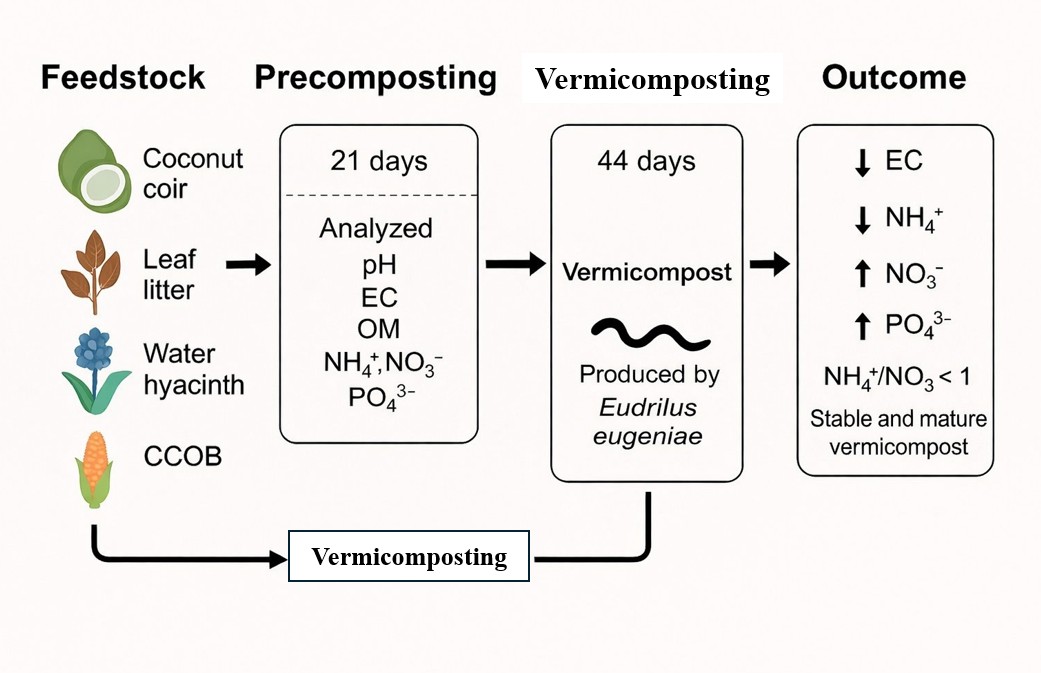
Method: A completely randomized design (CRD) with four feedstock treatments and three replicates was used. Each mixture was precomposted for 21 days before vermicomposting for 44 days. Key parameters (pH, EC, OM, NH₄⁺, NO₃⁻, PO₄³⁻) were analyzed, and nutrient-transformation ratios (NH₄⁺/NO₃⁻, NO₃⁻/PO₄³⁻) were calculated. One-way ANOVA, ANCOVA, and repeated-measures ANOVA assessed treatment effects, while PCA identified dominant nutrient-association patterns.
Results: Precompost properties varied significantly across feedstocks, particularly for nitrogen fractions. Although most values satisfied the Thai organic fertilizer standard (pH 5.5 - 8.5; EC < 10 dS/m; OM ≥ 20%), elevated NH₄⁺/NO₃⁻ ratios indicated incomplete stabilization prior to vermicomposting. After 44 days, EC and NH₄⁺ declined markedly, whereas NO₃⁻ and PO₄³⁻ increased, reflecting enhanced mineralization and nitrification processes as inferred from observed chemical transformation patterns during vermicomposting. ANCOVA demonstrated that feedstock chemistry exerted a stronger influence on nutrient dynamics than initial precompost values, especially for EC and NH₄⁺. PCA revealed contrasting nutrient pathways: WH and CCOB exhibited stronger mineralization intensity, whereas LL and CC maintained greater organic stability. All vermicomposts reached NH₄⁺/NO₃⁻ < 1, indicating chemical maturity suitable for agricultural application. CC produced the most stable nitrate-rich vermicompost, suggesting its suitability as an optimal feedstock.
Conclusion: Vermicomposting dairy manure with locally available residues generated nutrient-enriched composts that met national quality standards. Feedstock type strongly governed nitrogen and phosphorus transformation pathways, offering a practical basis for selecting substrates in tropical vermicompost production.
Highlights
• Organic feedstock type significantly influenced nutrient transformation during vermicomposting.
• Vermicomposting improved nitrogen availability and reduced the C/N ratio of organic materials.
• Eudrilus eugeniae effectively converted agricultural organic wastes into nutrient-rich vermicompost.
• Different feedstocks produced distinct chemical characteristics in the final vermicompost.
• Vermicomposting enhanced the fertilizer potential of organic waste materials.
References
- Aira, M., Monroy, F., & Domínguez, J. (2007). Earthworms strongly modify microbial biomass and activity triggering enzymatic during vermicomposting independently of the application rates of pig slurry. Science of the Total Environment, 385: 252-261. https://doi.org/10.1016/j.scitotenv.2007.06.031
- APHA, AWWA, & WEF. (2017). Standard methods for the examination of water and wastewater (23rd ed.). Washington, DC: American Public Health Association. Atiyeh, R. M., Domínguez, J., Subler, S., & Edwards, C. A. (2000). Changes in biochemical properties of cow manure during processing by earthworms (Eisenia Andrei, Bouché) and the effects on seedling growth. Pedobiologia, 44(6): 709-724. https://doi.org/10.1078/S0031-4056(04)70084-0
- Awasthi, M.K., Pandey, A.K., Bundela, P.S., & Khan, J. (2015). Co-composting of organic fraction of municipal solid waste mixed with different bulking waste: characterization of physicochemical parameters and microbial enzymatic dynamic. Bioresource Technology, 182: 200-207. https://doi.org/10.1016/j.biortech.2015.01.104
- Ayilara, M. S., Olanrewaju, O. S., Babalola, O. O., & Odeyemi, O. (2020). Waste management through composting: challenges and potentials. Sustainability, 12(11): 4456. https://doi.org/10.3390/su12114456
- Benjawan, L., Sihawong, S., Chayaprasert, W., & Liamlaem, W. (2015). Composting of biodegradable organic waste from Thai household in a semi-continuous composter. Compost Science and Utilization, 23: 11-17. https://doi.org/10.1080/1065657X.2014.963742
- Bernal, M. P., Alburquerque, J. A., & Moral, R. (2009). Composting of animal manures and chemical criteria for compost maturity assessment. A review. Bioresource Technology, 100(22): 5444-5453. https://doi.org/10.1016/j.biortech.2008.11.027
- Bhartiya, D.K., Nath, G., & Singh, K. (2024). Vermicomposting: a technology for vermiremediation of heavy metals from sewage sludhe and animal dung. International Journal of Recycling Organic Waste in Agriculture, 13(4): 1-6. https://doi.org/10.57647/ijrowa-3kgw-nr28
- Bray, R. H., & Kurtz, L. T. (1945). Determination of total, organic, and available forms of phosphorus in soils. Soil Science, 59(1), 39-46. https://doi.org/10.1097/00010694-194501000-00006
- Department of Agriculture. (2018). Thai Organic Fertilizer Standard (TAS 5702-2018). Ministry of Agriculture and Cooperatives, Bangkok, Thailand.
- Domínguez, J., & Edwards, C. A. (2011). Relationships between composting and vermicomposting. In C. A. Edwards, N. Q. Arancon, & R. Sherman (Ed.), Vermiculture Technology: earthworms, organic wastes, and environmental management (pp. 11–25). CRC Press.
- Garg, V. K., & Kaushik, P. (2005). Vermistabilization of textile mill sludge spiked with poultry droppings by an epigeic earthworm Eisenia fetida. Bioresource Technology, 96(9): 1063–1071. https://doi.org/10.1016/j.biortech.2004.09.003
- Gunadi, B., & Edwards, C. A. (2003). The effects of multiple applications of different organic wastes on the growth, fecundity and survival of Eisenia fetida (Savigny) in cattle solids. Pedobiologia, 47(4): 321–329. https://doi.org/10.1078/0031-4056-00196
- Hait, S., & Tare, V. (2011). Vermistabilization of primary sewage sludge. Bioresource Technology, 102(3): 2812-2820. https://doi.org/10.1016/j.biortech.2010.10.031
- Jolanun, B., & Towprayoon, S. (2010). Novel bulking agent from clay residue for food waste composting. Bioresource Technology, 101(11): 4484-4490. https://doi.org/10.1016/j.biortech.2010.01.116
- Lazcano, C., & Domínguez, J. (2011). The use of vermicompost in sustainable agriculture: Impact on plant growth and soil fertility. In M. Miransari (Ed.), Soil Nutrients (pp. 1-23). Nova Science Publishers, New York.
- Nair, J., Sekiozoic, V., & Anda, M. (2006). Effect of pre-composting on vermicomposting of kitchen waste. Bioresource Technology, 97(16): 2091-2095. https://doi.org/10.1016/j.biortech.2005.09.020
- Sinha, R. K., Herat, S., Valani, D., & Chauhan, K. (2010). Earthworms-the environmental engineers: review of vermiculture technologies for environmental management and resource development. International Journal of Global Environmental, 10(3-4): 265-292. https://doi.org/10.1504/IJGENVI.2010.037271
- Suthar, S. (2009). Vermicomposting of vegetable-market solid waste using Eisenia fetida: Impact of bulking material on earthworm growth and decomposition rate. Ecological Engineering, 35(5): 914-920. https://doi.org/10.1016/j.ecoleng.2008.12.019
- Suthar, S. (2010). Recycling of agro-industrial sludge through vermitechnology. Ecological Engineering, 36(8): 1028-1036. https://doi.org/10.1016/j.ecoleng.2010.04.015
- Walkley, A., & Black, I. A. (1934). An examination of the degtjareff method for determining soil organic matter, and a proposed modification of the chromic acid titration method. Soil Science, 37(1): 29-38. https://doi.org/10.1097/00010694-193401000-00003
- Wang, X., Selvam, A., Chan, M., & Wong, J.W.C. (2013). Nitrogen conservation and acidity control during food wastes composting through struvite formation. Bioresource Technology, 147: 17-22. https://doi.org/10.1016/j.biortech.2013.07.060
- Zhang, L., & Sun, X. (2014). Changes in physical, chemical, and microbiological properties during the two-stage co-composting of green waste with spent mushroom compost and biochar. Bioresource Technology, 171: 274-284. https://doi.org/10.1016/j.biortech.2014.08.079
- Zhang, L., & Sun, X. (2016). Influence of bulking agents on physical, chemical, and microbiological properties during the two-stage composting of green waste. Waste Management, 48: 115-126. https://doi.org/10.1016/j.wasman.2015.11.032