
 10.57647/ijrowa.fzz7.dd0188
Assessment of Composting Process for The Degradation of Ivermectin Residues and Elimination of Parasite Eggs in Equine Manure
- Milagros Junco*

 1
1 - Lucia Emilia Iglesias2
- Federico Azcarate3
- Andrea Alonso4
- Silvia Mestelan4
- Carlos Boschetti3
- Juan Manuel Sallovitz3
- Gisele Anahí Bernat2
- Carlos Alfredo Saumell2

Received: 2024-11-12
Revised: 2024-11-24
Accepted: 2026-05-18
Published Online: 2026-06-11

This work is licensed under a Creative Commons Attribution 4.0 International License.




PDF views: 64





Abstract
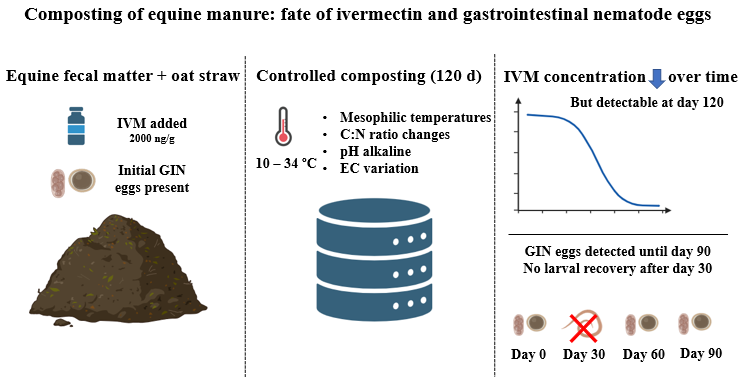
Purpose: this study aimed to evaluate the fate of veterinary pharmaceutical residues, such as ivermectin (IVM), and their impact on parasitic forms during and after composting of equine feces mixed with straw.
Method: in this study, composting trials were conducted using equine fecal matter added with IVM under controlled conditions. Physicochemical parameters of the composting process, including temperature, pH, electrical conductivity, and extractable phosphorus, were monitored over a 120-day period. High performance liquid chromatography (HPLC) was employed to quantify IVM residues in compost samples. Additionally, parasitological assessments were performed to evaluate the elimination of gastrointestinal nematodes (GIN) eggs during composting.
Results: IVM residues persisted throughout the composting period, albeit with decreasing concentrations over time. The composting process influenced physicochemical parameters, such as pH and electrical conductivity, with variations observed in response to straw additions and microbial activity. Parasitological analysis revealed the presence of GIN eggs, predominantly belonging to the Strongylus genus, up to day 60 of composting. However, larval development from these eggs was not observed beyond day 30, suggesting limited viability under composting conditions.
Conclusion: overall, composting reduced IVM concentrations and compromised GIN eggs viability. However, complete elimination of the compound was not achieved within the time of the study. These findings highlight the importance of further research to optimize composting strategies for pharmaceutical residue degradation and parasite control thereby enhancing the safety and efficacy of composted manure in agricultural applications.
References
- Arikan, O. A., Sikora, L. J., Mulbry, W., Khan, S. U., & Foster, G. D. (2007). Composting rapidly reduces levels of extractable oxytetracycline in manure from therapeutically treated beef calves. Bioresource Technology, 98(1), 169–176. https://doi.org/10.1016/j.biortech.2005.10.041
- Bernal, M. P., Sommer, S. G., Chadwick, D., Qing, C., Guoxue, L., & Michel, F. C. (2017). Current approaches and future trends in compost quality criteria for agronomic, environmental, and human health benefits. Advances in Agronomy, 144, 143–233. https://doi.org/10.1016/bs.agron.2017.03.002
- Bonhotal, J., Harrison, E., & Schwarz, M. (2006). Evaluating pathogen destruction in road kill composting. BioCycle, 47, 49–51.
- Bray, R. H., & Kurtz, L. T. (1945). Determination of total, organic and available forms of phosphorus in soil. Soil Science, 59, 39–45.
- Bremner, J. M., & Keeney, D. R. (1966). Determination and isotope-ratio analysis of different forms of nitrogen in soils: 3. Exchangeable ammonium, nitrate, and nitrite by extraction-distillation methods. Soil Science Society of America Journal, 30, 577–582.
- Budzińska, K., Szejniuk, B., & Jurek, A. (2016). Inactivation of Ascaris suum eggs during the process of sewage sludge composting in piles. Roczniki Ochrony Środowiska, 18(1), 258–272.
- Carbonell-Martín, G., Pro-González, J., Aragonese-Grunert, P., Babin-Vich, M. M., Fernández-Torija, C., & Tarazona-Lafarga, J. V. (2011). Targeting the environmental assessment of veterinary drugs with the multi-species-soil system (MS·3) agricultural soil microcosms: The ivermectin case study. Spanish Journal of Agricultural Research, 9(2), 433–445. https://doi.org/10.5424/sjar/20110902-389-10
- Capizzi-Banas, S., Deloge, M., Remy, M., & Schwartzbrod, J. (2004). Liming as an advanced treatment for sludge sanitisation: Helminth eggs elimination—Ascaris eggs as model. Water Research, 38(14–15), 3251–3258. https://doi.org/10.1016/j.watres.2004.04.015
- Chaudhari, S., Upadhyay, A., & Kulshreshtha, S. (2021). Influence of organic amendments on soil properties, microflora and plant growth. In E. Lichtfouse (Ed.), Sustainable agriculture reviews. 52: 147–191. Springer. https://doi.org/10.1007/978-3-030-73245-5_5
- Cook, D. F., Dadour, I. R., & Ali, D. N. (1996). Effect of diet on the excretion profile of ivermectin in cattle faeces. International Journal for Parasitology, 26(3), 291–295. https://doi.org/10.1016/0020-7519(95)00132-8
- Dolliver, H., Gupta, S., & Noll, S. (2008). Antibiotic degradation during manure composting. Journal of Environmental Quality, 37(3), 1245–1253. https://doi.org/10.2134/jeq2007.0399
- Escudero De Fonseca, A., & Arias Villamizar, C. A. (2012). Los microorganismos en los abonos orgánicos a partir de podas en la Universidad del Norte, Colombia. Revista Internacional de Contaminación Ambiental, 28(Suppl. 1), 67–75.
- Fujii, K. Y., Dittrich, J. R., Castro, E. A. de, & Silveira, E. O. da. (2014). Processos de tratamento de resíduos de cocheira e a redução ou eliminação de ovos e larvas infectantes do gênero Strongylus spp. Arquivos do Instituto Biológico, 81(3), 226–231. https://doi.org/10.1590/1808-1657000482012
- Fusé, L. A., & Saumell, C. A. (2002). Epidemiología y control de endoparasitosis en potrancas criollas. Revista de Medicina Veterinaria, 83, 154–158.
- Fusé, L. A., Saumell, C. A., & Iglesias, L. (2013). Variación estacional del parasitismo interno en equinos: fenómeno de hipobiosis de los pequeños estróngilos (Cyathostominae) en Tandil, Buenos Aires, Argentina. Revista de Medicina Veterinaria, 94, 62–72.
- Gokbulut, C., Nolan, A. M., & McKellar, Q. A. (2010). Plasma pharmacokinetics and faecal excretion of ivermectin, doramectin and moxidectin following oral administration in horses. Equine Veterinary Journal. https://doi.org/10.2746/042516401776254835
- Guzmán Anaya, J. M. (2018). Evaluación del compostaje de estiércol de caballo de un centro ecuestre en la región Lima [Tesis de grado, Universidad Nacional Agraria La Molina].
- Gwaltney-Brant, S. M., DeClementi, C., & Gupta, R. C. (2018). Macrocyclic lactone endectocides. En R. C. Gupta (Ed.), Veterinary toxicology: Basic and clinical principles (3rd ed., pp. xx–xx). Elsevier. https://doi.org/10.1016/B978-0-12-811410-0.00043-X
- Hakk, H., Millner, P., & Larsen, G. (2005). Decrease in water-soluble 17β-estradiol and testosterone in composted poultry manure with time. Journal of Environmental Quality, 34(3), 943–950. https://doi.org/10.2134/jeq2004.0164
- Halley, B. A., VandenHeuvel, W. J. A., & Wislocki, P. G. (1993). Environmental effects of the usage of avermectins in livestock. Veterinary Parasitology, 48(1–4), 109–125. https://doi.org/10.1016/0304-4017(93)90149-H
- Haseler, C. J., Shrubb, J. L., Davies, H. G., Rendle, D. I., Rathbone, P. C., & Mair, T. S. (2024). Environmental impacts of equine parasiticide treatment: The UK perspective. Equine Veterinary Education, 1–12. https://doi.org/10.1111/eve.13944
- Henriksen, S. A., & Korsholm, H. A. (1983). Method for culture and recovery of gastrointestinal strongyle larvae. Nordisk Veterinærmedicin, 35, 429–430.
- Iglesias, L. E., Saumell, C. A., Fernández, A. S., Fusé, L. A., Lifschitz, A. L., Rodríguez, E. M., Steffan, P. E., & Fiel, C. A. (2006). Environmental impact of ivermectin excreted by cattle treated in autumn on dung fauna and degradation of faeces on pasture. Parasitology Research, 100(1), 93–102. https://doi.org/10.1007/s00436-006-0240-x
- Iglesias, L., Junco, M., Lifschitz, A., Sallovitz, J., & Saumell, C. (2022). An environmental concern: Uptake of ivermectin from growing substrate to plant species. International Journal of Science and Research, 11(1), 1442–1451. https://doi.org/10.21275/SR22119035614
- Ji, Z., Zhang, L., Liu, Y., Li, X., & Li, Z. (2023). Evaluation of composting parameters, technologies and maturity indexes for aerobic manure composting: A meta-analysis. Science of the Total Environment, 886, 163929. https://doi.org/10.1016/j.scitotenv.2023.163929
- Kirtland, A., McAloon, C., Walshe, N., & Duggan, V. (2023). Strongyloides westeri infection on a Thoroughbred breeding farm in Ireland (2014–2019): Prevalence, risk factors and peripartum ivermectin. Equine Veterinary Education, 35(5), 438–450. https://doi.org/10.1111/eve.13736
- Koné, D., Cofie, O., Zurbrügg, C., Gallizzi, K., Moser, D., Drescher, S., & Strauss, M. (2007). Helminth eggs inactivation efficiency by faecal sludge dewatering and co-composting in tropical climates. Water Research, 41(19), 4397–4402. https://doi.org/10.1016/j.watres.2007.06.024
- Krogh, K. A., Søeborg, T., Brodin, B., & Halling-Sørensen, B. (2008). Sorption and mobility of ivermectin in different soils. Journal of Environmental Quality, 37(6), 2202–2211. https://doi.org/10.2134/jeq2007.0592
- Langrová, I., Jankovská, I., Vadlejch, J., Libra, M., Lytvynets, A., & Makovcová, K. (2008). The influence of desiccation and UV radiation on the development and survival of free-living stages of cyathostomins under field and laboratory conditions. Helminthologia, 45(1), 32–40. https://doi.org/10.2478/s11687-008-0006-3
- Lepesteur, M. (2022). Human and livestock pathogens and their control during composting. Critical Reviews in Environmental Science and Technology, 52(10), 1639–1683. https://doi.org/10.1080/10643389.2020.1862550
- Liebig, M., Fernandez, Á. A., Blübaum-Gronau, E., Boxall, A., Brinke, M., Carbonell, G., Egeler, H., Fenner, K., Fernandez, C., Fink, G., Garric, J., Halling-Sørensen, B., Knacker, T., Krogh, K. A., Küster, A., Löffler, D., Cots, M. Á. P., Pope, L., & Prasse, C. (2010). Environmental risk assessment of ivermectin: A case study. Integrated Environmental Assessment and Management, 6(1), 567–587. https://doi.org/10.1002/ieam.96
- Lifschitz A, Virkel G, Sallovitz J, Sutra JF, Galtier P, Alvinerie M, Lanusse C (2000) Comparative distribution of ivermectin and doramectin to parasite location tissues in cattle. Vet Parasitol 87(4):327–338. https://doi.org/10.1016/S0304-4017(99)00175-2
- Manga, M., Evans, B. E., Camargo-Valero, M. A., & Horan, N. J. (2016). The fate of helminth eggs during the co-composting of faecal sludge with chicken feathers and market waste. En Proceedings of the 13th IWA Specialized Conference on Small Water and Wastewater Systems (SWWS).
- Martínez, M., & Ardón, M. (2021). Drivers of greenhouse gas emissions from standing dead trees in ghost forests. Biogeochemistry, 154(3), 471–488. https://doi.org/10.1007/s10533-021-00797-5
- Maya, C., Ortiz, M., & Jiménez, B. (2010). Viability of Ascaris and other helminth genera non-larval eggs in different conditions of temperature, lime (pH) and humidity. Water Science and Technology, 62(11), 2616–2624. https://doi.org/10.2166/wst.2010.535
- Maya, C., Torner-Morales, F. J., Lucario, E. S., Hernández, E., & Jiménez, B. (2012). Viability of six species of larval and non-larval helminth eggs for different conditions of temperature, pH and dryness. Water Research, 46(15), 4770–4782. https://doi.org/10.1016/j.watres.2012.06.014
- McKinley, V. L., & Vestal, J. R. (1984). Biokinetic analyses of adaptation and succession: Microbial activity in composting municipal sewage sludge. Applied and Environmental Microbiology, 47(5), 933–941. https://doi.org/10.1128/AEM.47.5.933-941.1984
- Meng, L., Li, W., Zhang, S., Zhang, X., Zhao, Y., & Chen, L. (2021). Improving sewage sludge compost process and quality by carbon sources addition. Scientific Reports, 11(1), 1–8. https://doi.org/10.1038/s41598-020-79443-3
- Mengqi, Z., Shi, A., Ajmal, M., Ye, L., & Awais, M. (2023). Comprehensive review on agricultural waste utilization and high-temperature fermentation and composting. Biomass Conversion and Biorefinery, 13(7), 5445–5468. https://doi.org/10.1007/s13399-021-01438-5
- Mfitilodze, M. W., & Hutchinson, G. W. (1987). Development and survival of free-living stages of equine strongyles under laboratory conditions. Veterinary Parasitology, 23(1–2), 121–133. https://doi.org/10.1016/0304-4017(87)90030-6
- Miyatake, F., & Iwabuchi, K. (2005). Effect of high compost temperature on enzymatic activity and species diversity of culturable bacteria in cattle manure compost. Bioresource Technology, 96(16), 1821–1825. https://doi.org/10.1016/j.biortech.2005.01.005
- Moncol, D. J. (1996). Compostaje de desechos de establos equinos utilizando papel de periódico triturado como material de cama. Equine Practice, 18(8), 18–22.
- Montalvo, P. A., Ortiz Dongo, L. F., Calle Maraví, J. L., Téllez Monzón, L. A., Césare Coral, M. F., & Visitación Figueroa, L. (2018). Transformación del nitrógeno durante el compostaje de bosta de caballo. Producción + Limpia, 13(2), 77–88.
- Moreno-Morales, C. J., Andrade-Becerra, R. J., & Pulido-Medellín, M. O. (2014). Cuantificación de ivermectina eliminada en materia fecal de novillos tratados. Ciencia y Agricultura, 12(1), 97–102.
- Nakasaki, K., Shoda, M., & Kubota, H. (1985). Effect of temperature on composting of sewage sludge. Applied and Environmental Microbiology, 50(6), 1526–1530. https://doi.org/10.1128/AEM.50.6.1526-1530.1985
- Nielsen, M. K., Kaplan, R. M., Thamsborg, S. M., Monrad, J., & Olsen, S. N. (2007). Climatic influences on development and survival of free-living stages of equine strongyles: Implications for worm control strategies and managing anthelmintic resistance. The Veterinary Journal, 174(1), 23–32. https://doi.org/10.1016/j.tvjl.2006.05.009
- Nielsen, M. K., Steuer, A. E., Anderson, H. P., Gavriliuc, S., Carpenter, A. B., Redman, E. M., Gilleard, J. S., Reinemeyer, C. R., & Poissant, J. (2022). Shortened egg reappearance periods of equine cyathostomins following ivermectin or moxidectin treatment: Morphological and molecular investigation of efficacy and species composition. International Journal for Parasitology, 52(12), 787–798. https://doi.org/10.1016/j.ijpara.2022.09.003
- Ogbourne, C. P. (1972). Observations on the free-living stages of strongylid nematodes of the horse. Parasitology, 64(3), 461–477. https://doi.org/10.1017/S0031182000045534
- Oppel, J., Broll, G., Löffler, D., Meller, M., Römbke, J., & Ternes, T. (2004). Leaching behaviour of pharmaceuticals in soil-testing systems: A part of an environmental risk assessment for groundwater protection. Science of the Total Environment, 328(1–3), 265–273. https://doi.org/10.1016/j.scitotenv.2004.02.004
- Pérez, R., Cabezas, I., Godoy, C., Rubilar, L., Díaz, L., Muñoz, L., Arboix, M., & Alvinerie, M. (2001). Disposición plasmática y fecal de moxidectina administrada por vía oral en caballos. Archivos de Medicina Veterinaria, 33(1), 77–88. https://doi.org/10.4067/S0301-732X2001000100009
- Pérez-Cogollo, L. C., Rodríguez-Vivas, R. I., Reyes-Novelo, E., Delfín-González, H., & Muñoz-Rodríguez, D. (2017). Survival and reproduction of Onthophagus landolti (Coleoptera: Scarabaeidae) exposed to ivermectin residues in cattle dung. Bulletin of Entomological Research, 107(1), 118–125. https://doi.org/10.1017/S0007485316000705
- Pezo Jácome, C., & Barrezueta-Unda, S. (2023). Caracterización física y química de vermicompost obtenido a partir de la biomasa residual de tres sistemas agrícolas. Revista Científica Agroecosistemas, 11(3), 6–13.
- Quadar, J., Chowdhary, A. B., Dutta, R., Angmo, D., Rashid, F., Singh, S., Singh, J., & Vig, A. P. (2022). Characterization of vermicompost of coconut husk mixed with cattle dung: Physicochemical properties, SEM, and FT-IR analysis. Environmental Science and Pollution Research, 29(58), 87790–87801. https://doi.org/10.1007/s11356-022-21899-z
- Reinemeyer, C. R., & Nielsen, M. K. (2017). Control of helminth parasites in juvenile horses. Equine Veterinary Education, 29(4), 225–232. https://doi.org/10.1111/eve.12541
- Roberts, F., & O’Sullivan, P. (1950). Methods for egg counts and larval cultures for strongyles infesting the gastro-intestinal tract of cattle. Australian Journal of Agricultural Research, 1(1), 99–102. https://doi.org/10.1071/AR9500099
- Romano, P. V., Krogmann, U., Westendorf, M. L., & Strom, P. F. (2006). Small-scale composting of horse manure mixed with wood shavings. Compost Science & Utilization, 14(2), 132–141. https://doi.org/10.1080/1065657X.2006.10702274
- Saludes, R. B., Iwabuchi, K., Kayanuma, A., & Shiga, T. (2007). Composting of dairy cattle manure using a thermophilic–mesophilic sequence. Biosystems Engineering, 98(2), 198–205. https://doi.org/10.1016/j.biosystemseng.2007.07.003
- SAMLA (Sistema de Apoyo Metodológico a los Laboratorios de Análisis de Suelos) (2004) Manual de técnicas de laboratorio. Editado por SAGPyA (Secretaría de Agricultura, Ganadería, Pesca y Alimentación de la Nación Argentina). Dirección de Producción Agrícola. CD-rom. Buenos Aires, Argentina.
- Sánchez-Monedero, M. A., Roig, A., Paredes, C., & Bernal, M. P. (2001). Nitrogen transformation during organic waste composting by the Rutgers system and its effects on pH, EC and maturity of the composting mixtures. Bioresource Technology, 78(3), 301–308. https://doi.org/10.1016/S0960-8524(01)00031-1
- Santos, D. W., Madeira de Carvalho, L. M., & Molento, M. B. (2018). Identification of third stage larval types of cyathostomins of equids: An improved perspective. Veterinary Parasitology, 260, 49–52. https://doi.org/10.1016/j.vetpar.2018.08.007
- Schulze, K. L. (1962). Continuous thermophilic composting. Applied Microbiology, 10(2), 108–122. https://doi.org/10.1128/AM.10.2.108-122.1962
- Schwarz, M., & Bonhotal, J. (2015). Effectiveness of composting as a means of emergency disposal: A literature review. En Proceedings of the 5th International Symposium on Managing Animal Mortality, Products, By-Products and Associated Risks. Lancaster, PA, EE. UU.
- Suler, D. J., & Finstein, M. S. (1977). Effect of temperature, aeration, and moisture on CO₂ formation in bench-scale, continuously thermophilic composting of solid waste. Applied and Environmental Microbiology, 33(2), 345–350. https://doi.org/10.1128/AEM.33.2.345-350.1977
- Sunar, N. M., Stentiford, E. I., Stewart, D. I., & Fletcher, L. A. (2014). The process and pathogen behavior in composting: A review. arXiv. https://doi.org/10.48550/arXiv.1404.5210
- Taylor, E. L. (1954). Grazing behaviour and helminthic disease. British Journal of Animal Behaviour, 2(2), 61–62.
- Taylor, M. A. (2001). Recent developments in ectoparasiticides. The Veterinary Journal, 161(3), 253–268. https://doi.org/10.1053/tvjl.2000.0549
- Verdú, J. R., Cortez, V., Ortiz, A. J., González-Rodríguez, E., Martinez-Pinna, J., Lumaret, J.-P., Lobo, J. M., Numa, C., & Sánchez-Piñero, F. (2015). Low doses of ivermectin cause sensory and locomotor disorders in dung beetles. Scientific Reports, 5, 1–10. https://doi.org/10.1038/srep13912
- Wetselaar, R., Smith, G., & Angus, F. (1998). Field measurement of soil nitrate concentrations. Communications in Soil Science and Plant Analysis, 29, 729–739.
- Wichuk, K. M., & McCartney, D. (2007). A review of the effectiveness of current time-temperature regulations on pathogen inactivation during composting. Journal of Environmental Engineering and Science, 6(5), 573–586. https://doi.org/10.1139/S07-011
- Wohde, M., Berkner, S., Junker, T., Konradi, S., Schwarz, L., & Düring, R. A. (2016). Occurrence and transformation of veterinary pharmaceuticals and biocides in manure: A literature review. Environmental Sciences Europe, 28(1), Article 23. https://doi.org/10.1186/s12302-016-0091-8
- Zainudin, M. H., Zulkarnain, A., Azmi, A. S., Muniandy, S., Sakai, K., Shirai, Y., & Hassan, M. A. (2022). Enhancement of agro-industrial waste composting process via microbial inoculation: A brief review. Agronomy, 12(1), 198. https://doi.org/10.3390/agronomy12010198