
 10.57647/ijrowa.2026.1503.28


Received: 2025-04-06
Revised: 2025-04-22
Accepted: 2026-02-21
Published in Issue 2026-09-30
Copyright (c) 2026 Mitra Ebrahimi, Farshad Shakuri, Mohammad Reza Sarikhani, Zahra Delfruz, Nasser Aliasgharzad, Nosratollah Najafi (Author)

This work is licensed under a Creative Commons Attribution 4.0 International License.
How to Cite




PDF views: 24





Abstract
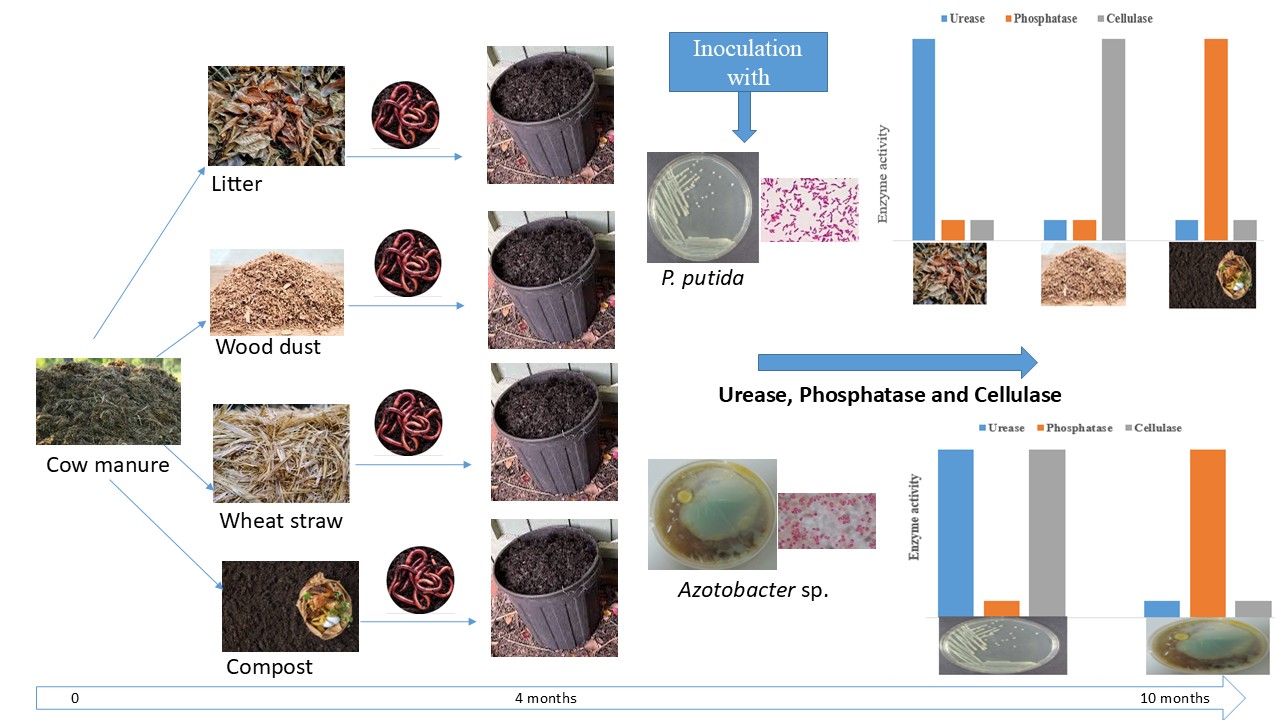
Purpose: Vermicomposting can be enhanced by inoculating vermibeds with beneficial microbes, thereby improving its biofertilizer properties. This study examined how phosphate-solubilizing bacteria (Pseudomonas putida Tabriz) and nitrogen-fixing bacteria (Azotobacter sp.) influence enzyme activity in vermicompost produced from different organic substrates (litter, wheat straw, wood dust, and compost).
Method: A mixture of cow manure and organic materials (1:8 w/w) was vermicomposted in 3-kg pots with Eisenia fetida earthworms. After four months, bacterial inoculants were introduced, and samples were analyzed at 0, 4, 7, and 10 months for acid phosphatase, urease, and cellulase activities.
Results: Bacterial inoculation significantly increased enzyme activity, with peaks observed at 4–7 months. Overall, bacterial inoculation significantly increased enzymatic activity, with the highest values observed at 4 and 7 months after inoculation. Specifically, P. putida Tabriz enhanced cellulase and urease activities, while Azotobacter sp. improved phosphatase activity in the vermibeds. The highest enzyme activities were recorded in: compost (acid phosphatase, 1864 μg pNP/g.h), leaf litter (urease, 460 μg NH₄⁺-N/2h), and wood dust (cellulase, 1568 μg GE/g.24h). Enzyme activity gradually increased during the experiment but declined toward the end of the study period.
Conclusion: Vermicompost effectively serves as a carrier for beneficial microbes, enhancing enzyme activity and soil health. This approach offers a sustainable way to improve agricultural productivity through biofertilization.
Highlights
- Inoculation with P. putida and Azotobacter sp. significantly increases vermicompost enzyme activities.
- Peak enzyme activities are substrate-dependent: acid phosphatase in compost, urease in leaf litter, cellulase in wood dust.
- Enzyme activity peaks at 4 and 7 months post-inoculation, revealing optimal harvest times.
- A strategy integrating specific microbial inoculation with substrates enhances vermicompost quality for soil health.
Keywords
- Acid phosphatase,
- Bio-inoculation,
- Biofertilizer,
- Cellulase,
- PGPR,
- Urease,
- Vermicomposting
References
- Aliasgharzad, N. (2010). Methods in Soil Biology. Translated to Farsi, 2nd Edition, Tabriz University Press. (In Persian).
- Ansari, S., Aliasgharzad, N., Sarikhani, M. R., Najafi, N., Arzanlou, M., & Ölmez, F. (2024). Nitrogen sources alter ligninase and cellulase activities of thermophilic fungi isolated from compost and vermicompost. Folia Microbiologica, 69(2), 323-332. https://doi.org/10.1007/s12223-023-01065-9
- Bhartiya, D. K., Nath, G., & Singh, K. (2024). Vermicomposting: A technology for vermiremediation of heavy metals from sewage sludge and animal dung. International Journal of Recycling of Organic Waste in Agriculture, 13(4), 1-6. https://doi.org/10.57647/ijrowa-3kgw-nr28
- Boruah, T., & Deka, H. (2023a). Comparative investigation on synergistic changes in enzyme activities during vermicomposting of cereal grain processing industry sludge employing three epigeic earthworm species. Environmental Science and Pollution Research, 30(59), 123324-123334. https://doi.org/10.1007/s11356-023-31043-0
- Boruah, T., & Deka, H. (2023b). Biological indicators for assessing the maturity of the vermicomposted products of citronella bagasse and paper mill sludge mixture. Biomass conversion and biorefinery, 13(3), 1999-2005. https://doi.org/10.1007/s13399-020-01228-5
- Chang, J., Jiang, T., Yang, J., & Ma, X. (2024). Microbial dynamics driven by application of dicyandiamide and/or nitrate to nitrous oxide emission during co-composting of swine manure and cornstalk. Environmental Technology & Innovation, 33, 103454. https://doi.org/10.1016/j.eti.2023.103454
- Das, D., & Deka, H. (2021). Vermicomposting of harvested waste biomass of potato crop employing Eisenia fetida: changes in nutrient profile and assessment of the maturity of the end products. Environmental Science and Pollution Research, 28(27), 35717-35727. https://doi.org/10.1007/s11356-021-13214-z
- Devi, R., Singh, A. K., Kumar, A., Kumar, R., Rani, S., & Chandra, R. (2024). Development of technologies for municipal solid waste management: Current status, challenges, and future perspectives. In Integrated Waste Management: A Sustainable Approach from Waste to Wealth (pp. 37-62). Singapore: Springer Nature Singapore. https://doi.org/10.1007/978-981-97-0823-9_3
- Ebrahimi, M., Sarikhani, M. R., Shiri, J., & Shahbazi, F. (2021). Modeling soil enzyme activity using easily measured variables: Heuristic alternatives. Applied Soil Ecology, 157, 103753. https://doi.org/10.1016/j.apsoil.2020.103753
- Iraji, F., Jiménez-Ballesta, R., Mongil-Manso, J., Pellejero, G., Miguélez, D., Najafi, P., & González, J. M. T. (2025). The effects of compost application on soil properties: Agricultural and environmental benefits. International Journal of Recycling of Organic Waste in Agriculture, 14(4). https://doi.org/10.57647/ijrowa-2025-8144
- Kumar, A. (2018) Influence of earthworms on various enzyme activities of compost. Journal of Experimental Zoology India, 21(2), 1323-1325.
- Kumar, B., Bhardwaj, N., Alam, A., Agrawal, K., Prasad, H., & Verma, P. (2018). Production, purification and characterization of an acid/alkali and thermo tolerant cellulase from Schizophyllum commune NAIMCC-F-03379 and its application in hydrolysis of lignocellulosic wastes. Amb Express, 8(1), 173. https://doi.org/10.1186/s13568-018-0696-y
- Kumar, B., Dhar, S., Paul, S., Paramesh, V., Dass, A., Upadhyay, P. K. & Abdelbacki, A. M. (2021). Microbial biomass carbon, activity of soil enzymes, nutrient availability, root growth, and total biomass production in wheat cultivars under variable irrigation and nutrient management. Agronomy, 11(4), 669. https://doi.org/10.3390/agronomy11040669
- Kumar, R., Sharma, S., Kumar, A., Singh, R., Awwad, F. A., Khan, M. I., & Ismail, E. A. (2025). Sustainable energy recovery from municipal solid wastes: An in-depth analysis of waste-to-energy technologies and their environmental implications in India. Energy Exploration & Exploitation, 43(1), 3-28. https://doi.org/10.1177/01445987231210323
- Lakshmi, C. S. R., Rao, P. C., Sreelatha, T., Madhavi, M., Padmaja, G., & Sireesha, A. (2014). Changes in enzyme activities during vermicomposting and normal composting of vegetable market waste. Agricultural Science Digest-A Research Journal, 34(2), 107-110. https://doi.org/10.5958/0976-0547.2014.00025.1
- Lirikum, Kakati, L. N., Thyug, L., & Mozhui, L. (2022). Vermicomposting: an eco-friendly approach for waste management and nutrient enhancement. Tropical Ecology, 63(3), 325-337. https://doi.org/10.1007/s42965-021-00212-y
- Mahanta, K., Jha, D. K., Rajkhowa, D. J., & Manoj-Kumar. (2012). Microbial enrichment of vermicompost prepared from different plant biomasses and their effect on rice (Oryza sativa L.) growth and soil fertility. Biological Agriculture & Horticulture, 28(4), 241-250. https://doi.org/10.1080/01448765.2012.738556
- Marinari, S., Masciandaro, G., Ceccanti, B., & Grego, S. (2000). Influence of organic and mineral fertilisers on soil biological and physical properties. Bioresource Technology, 72(1), 9-17. https://doi.org/10.1016/S0960-8524(99)00094-2
- Moradi, S., Sarikhani, M. R., Ale-Agha, A. B., Hasanpur, K., & Shiri, J. (2024). Effects of natural and prolonged crude oil pollution on soil enzyme activities. Geoderma Regional, 36, e00742. https://doi.org/10.1016/j.geodrs.2023.e00742
- Parewa, H. P., Meena, V. S., Kumar, M., Bhardwaj, R. L., Meena, S. K., Baswal, A. K., ... & Verma, M. P. (2024). Application of agricultural waste in soil: State of the art. Waste Management for Sustainable and Restored Agricultural Soil, 261-279. https://doi.org/10.1016/B978-0-443-18486-4.00016-6
- Pramanik, P., Ghosh, G. K., & Banik, P. (2009). Effect of microbial inoculation during vermicomposting of different organic substrates on microbial status and quantification and documentation of acid phosphatase. Waste Management, 29(2), 574-578. https://doi.org/10.1016/j.wasman.2008.06.015
- Rajasekar, K., Daniel, T., & Karmegam, N. (2012). Microbial enrichment of vermicompost. International Scholarly Research Notices, 2012(1), 946079. https://doi.org/10.5402/2012/946079
- Shanthi, K. (2018). Evaluation of maturity parameters of vermicomposts prepared from different bio-degradable wastes. Internatinal. Journal. of Life Sciences, 6(2), 487-493. https://doi.org/10.1016/j.biortech.2010.10.077
- Shariati, S., & Alikhani, H. A. (2015). The Application of Pseudomonas fluorescens Bacteria Inoculants on Certain Growth Indices and Nutrient Uptake in Maize. Journal of Agricultural Science and Sustainable Production, 24(4), 45-59.
- Sharma, A., Soni, R., & Soni, S. K. (2024). From waste to wealth: exploring modern composting innovations and compost valorization. Journal of Material Cycles and Waste Management, 26(1), 20-48. https://doi.org/10.1007/s10163-023-01839-w
- Singh, A., Karmegam, N., Singh, G. S., Bhadauria, T., Chang, S. W., Awasthi, M. K., ... & Ravindran, B. (2020). Earthworms and vermicompost: an eco-friendly approach for repaying nature’s debt. Environmental Geochemistry and Health, 42(6), 1617-1642. https://doi.org/10.1007/s10653-019-00510-4
- Singh, G., Singh, J., & Bakshi, M. (2023). Biofortification of Vermicompost with Beneficial Microorganisms and Its Field Performance in Horticultural Crops. Journal of Advanced Zoology, 44. https://doi.org/10.53555/jaz.v44iS5.960
- Tabatabai, M. A. (1994) Soil Enzymes. In A. L. Page (Ed.), Methods of Soil Analysis: Part 2 Microbiological and Biochemical Properties (pp. 775-833). Madison, WI: The American Society of Agronomy. https://doi.org/10.2136/sssabookser5.2.c37
- Yadav, B. K., Garg, N., Pandove, G., & Kalia, A. (2022). Effect of Irrigation Water Quality, Nitrogen Doses and Microbial Inoculants on Soil Enzyme Activity and Green Pod Yield of Cowpea (Vigna unguiculata) in Loamy Sand Alluvial Soil of Semi-Arid Region of Punjab, India. Journal of Soil Salinity and Water Quality, 14(1), 53-62.
- Zhou, Y., Xiao, R., Klammsteiner, T., Kong, X., Yan, B., Mihai, F. C., Liu, T., Zhang, Z., & Awasthi, M. K. (2022). Recent trends and advances in composting and vermicomposting technologies: A review. Bioresource Technology, 360, 127591. https://doi.org/10.1016/j.biortech.2022.127591