
 10.57647/ijrowa.2026.1503.24
Effects of Water Hyacinth Compost on Growth of Rhodomyrtus Tomentosa (Aiton) Hassk. and Rhodomyrtone Yield
- Jutarut Iewkittayakorn*
 1,5
1,5
- Division of Biological Science, Faculty of Science, Prince of Songkla University, Hat Yai, Songkhla 90110, Thailand
- Natural Product Research Center of Excellence, Faculty of Science, Prince of Songkla University, Hat Yai, Songkhla 90110, Thailand
- Center of Antimicrobial Biomaterial Innovation-Southeast Asia and Natural Product Research Center of Excellence, Faculty of Science, Prince of Songkla University, Hat Yai, Songkhla 90110, Thailand
- Division of Computation Science, Faculty of Science, Prince of Songkla University, Hat Yai, Songkhla 90110, Thailand
- Center for Genomics and Bioinformatics Research, Faculty of Science, Prince of Songkla University, Hat Yai, Songkhla 90110, Thailand

Received: 2024-08-20
Revised: 2024-12-10
Accepted: 2026-01-26
Published in Issue 2026-09-30
Copyright (c) 2026 Sara Bumrungsri, Unitsa Sangket, Supayang P. Voravuthikunchai, Aunkamol Kumngen, Noodchanath Kongchouy, Jutarut Iewkittayakorn (Author)

This work is licensed under a Creative Commons Attribution 4.0 International License.
How to Cite




PDF views: 33





Abstract
Purpose: Water hyacinth (WH) is an aquatic weed that has negatively impacted aquatic ecosystems. WH can be easily composted and used as a soil ameliorant to improve plant growth. In this study, the effects of WH compost on the growth of Rhodomyrtus tomentosa were evaluated.
Methods: Native R. tomentosa seedlings were cultivated with WH compost in two different systems: a pot cultivation with soil: WH compost mixed in ratios ranging from 10:0 to 7:3 and an open field cultivation with 1 to 3 parts of WH added to the topsoil. Plant growth characteristics and rhodomyrtone yield were also investigated.
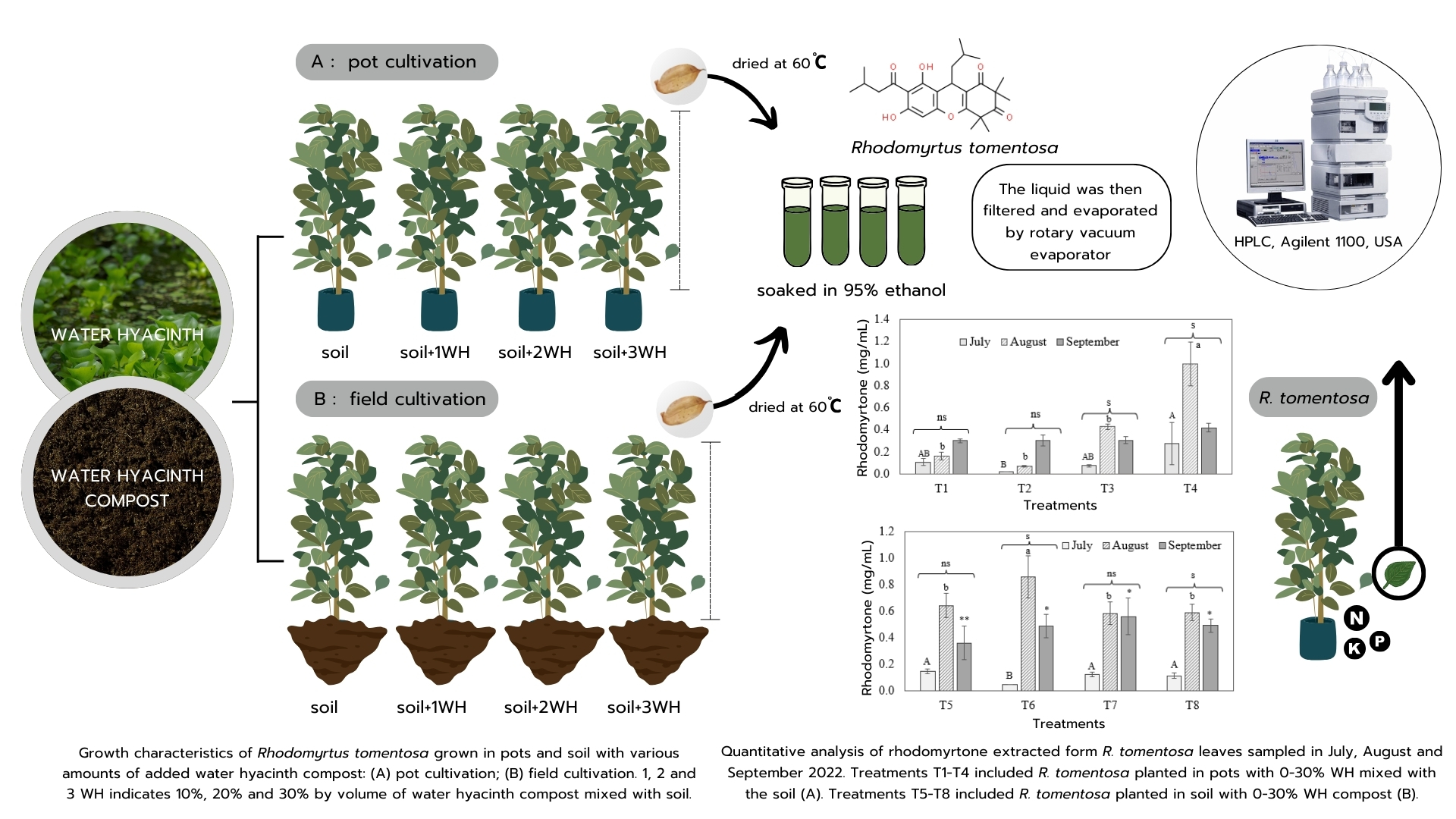
Results: Plant height and numbers of stems were not significantly different between the two cultivation methods (p>0.05). Plants treated with WH compost had more leaves than those not treated with WH compost (p<0.05). Growing the plants with WH compost resulted in significant increases in leaf biomass, especially, rhodomyrtone content in both cultivation systems. In the pot cultivation system, the highest rhodomyrtone yield (0.99 mg/mL) was obtained from R. tomentosa leaf from plants growing in a soil and coconut coir medium enriched with 1 part of WH compost by volume. In the field cultivation system, the highest rhodomyrtone yield (0.86 mg/mL) was obtained from R. tomentosa leaf sampling from plants growing in soil with 1 part of WH added to the soil at the planting period and once every month.
Conclusion: WH compost demonstrated its potential for sustainable cultivation of R. tomentosa that can be fruitfully propagated for commercial purposes.
Keywords
- Cultivation,
- Field planting,
- Potting soil,
- Rhodomyrtus tomentosa,
- Rhodomyrtone,
- Water hyacinth compost
References
- Ahmadi, M., & Souri, MK. (2021). Importance of chemical sources in salt-induced salinity on plant growth characteristics in pepper. Acta Horticulturae 1315: 425-432. https://doi.org/10.17660/ActaHortic.2021.1315.63
- Association of Official Analytical Chemists. (2019). Official methods of analysis nitrogen (total) in fertilizers (Method 955.04). AOAC International. Washington, DC, United States.
- Association of Official Analytical Chemists. (2019). Official methods of analysis organic matter in peat (Method 967.05). AOAC International. Washington, DC, United States.
- Association of Official Analytical Chemists. (2019). Official methods of analysis pH of peat (Method 973.04). AOAC International. Washington, DC, United States.
- Association of Official Analytical Chemists. (2019). Official methods of analysis phosphorus (total) in fertilizers (Method 958.01). AOAC International. Washington, DC, United States.
- Association of Official Analytical Chemists. (2019). Official methods of analysis potassium (total) in fertilizers (Method 983.02). AOAC International. Washington, DC, United States.
- Association of Official Analytical Chemists. (2019). Official methods of analysis water (total) in fertilizers (Method 950.01). AOAC International. Washington, DC, United States.
- Association of Official Analytical Chemists. (2019).Official methods of analysis lead, cadmium, zinc, copper, and iron in Foods (Method 999.10). AOAC International. Washington, DC, United States.
- Begum, SLR., Himaya SMMS., & Afreen, SMMS. (2021). Potential of water hyacinth (Eichhornia crassipes) as compost and its effect on soil and plant properties: A Review. Agricultural Review 1-9. https://doi.org/10.18805/ag.R-184
- Brinton, WF. (2000). Compost quality standards & guideline. Compost Quality in America. Woods End Research Laboratory, Inc. 42 pp.
- British Standards Institution. (1995). Soil quality—Chemical methods: Determination of organic and total carbon after dry combustion (elementary analysis) (BS 7755). British Standards Institution.
- British Standards Institution. (2000). Soil improvers and growing media—Determination of electrical conductivity (BS EN 13038). British Standards Institution.
- Compost Association. (2000). A method to determine particle size distribution of physical contaminants in composted organic materials (CATM 01). Compost Association.
- Chorachoo, J., Amnuaikit, T., & Voravuthikunchai, SP. (2013). Liposomal encapsulated rhodomyrtone: A novel antiacne drug. Evidence-Based Complementary and Alternative Medicine, Art. No. 157635: 1-7. https://doi.org/10.1155/2013/157635
- Chorachoo, J., Lambert, S., Furnholm, T., Roberts, L., Reingold, L., Auepemkiat, S., Voravuthikunchai, SP., & Johnston, A. (2018). The small molecule rhodomyrtone suppresses TNF-α and IL-17A-induced keratinocyte inflammatory responses: A potential new therapeutic for psoriasis. PLoS One 13: e0205340,1-19. https://doi.org/10.1371/journal.pone.0205340.eCollection 2018
- Chorachoo, J., Saeloh, D., Srichana, T., Amnuaikit, T., Musthafa, KS., Sretrirutchai, S., & Voravuthikunchai, SP. (2016). Rhodomyrtone as a potential anti-proliferative and apoptosis inducing agent in HaCaT keratinocyte cells. European Journal of Pharmacology 772: 144-151. https://doi.org/10.1016/j.ejphar.2015.12.005
- Deepika, P., &Mubarak Ali, D. (2020). Production and assessment of microalgal liquid fertilizer for the enhanced growth of four crop plants. Biocatalysis and Agricultural Biotechnology 28 (September), 101701. https://doi.org/10.1016/j.bcab.2020.101701
- Farag, AAA., Abdrabbo, MAA, & Abd-Elmoniem, EM. (2013). Using different nitrogen and compost levels on lettuce grown in coconut fiber. Journal of horticulture 5 (2), 21–8. https://doi.org/10.5897/JHF09.041
- Frohlich, D. (2012). Rhodomyrtus tomentosa (Downy rose-myrtle). In: Invasive Species Compendium. Commonwealth Agricultural Bureaux International (CABI), Wallingford, UK. Gaikwad, J., Wilson. https://doi.org/10.1079/cabicompendium.47297
- Gunnarsson, CC., & Petersen, CM. (2007). Water hyacinths as a resource in agriculture and energy production: A literature review. Waste Management 1:117-129. http://dx.doi.org/10.1016/j.wasman.2005.12.011
- Gupta, M., Sarmah, R., & Gupta, S. (2004). Nutrient composition of Pleurotus sajorcaju grown on different substrates. Journal of Food Science and Technology 41: 504-586.
- Hmoteh, J., Musthafa, KS., & Voravuthikunchai, SP. (2018). Effects of Rhodomyrtus tomentosa extract on virulence factors of Candida albicans and human neutrophil function. Archives of Oral Biology 87, 35-42. https://doi.org/10.1016/j.archoralbio.2017.11.007
- Khan, Sh., & Sarwar, KS. (2002). Effect of Water-hyacinth compost on physical, physico-chemical properties of soil and on rice yield. Journal of Agronomy 1 (2): 64-65. https://doi.org/10.3923/ja.2002.64.65
- Kumngen, A., Iewkittayakorn, J., Meehae, U., Suwannarat, S., Anuchan, S., Chotigeat, W., Kunwanlee, P., Kongchouy, N., Leunram, S., & Karrila, S. (2023). Effects of compost from food waste on growth of lettuce (Lactuca sativa Var Crispa L). International Journal of Recycling of Organic Waste in Agriculture 12: 247-258. https://doi.org/10.30486/ijrowa.2022.1960507.1481
- Lavanya, G., Hutadilok-Towatana, N., & Voravuthikunchai, SP. (2012). Acetone extract from Rhodomyrtus tomentosa: A potent natural antioxidant. Evidence-Based Complementary and Alternative Medicine. Art. No. 535479. https://doi.org/10.1155/2012/535479. Epub 2012 Oct 18
- Liang, HL., Liu, HN., Yang, QH., Huang, RZ., Wei, X., Ye, WH., Luo, WH., & Xiong, ZC. (2013). Seed germination of Rhodomyrtus tomentosa. Seed Science and Technology 41: 188–198. https://doi.org/10.15258/sst.2013.41.2.02
- Limsuwan, S., Heseling-Meinders, A., Voravuthikunchai, SP., van Dijl, JM., & Kayser, O. (2011). Potential antibiotic and anti-infective effects of rhodomyrtone from Rhodomyrtus tomentosa (Aiton) Hassk. on Streptococcus pyogenes as revealed by proteomics. Phytomedecine 18: 934-940. https://doi.org/10.1016/j.phymed.2011.02.007
- Limsuwan, S., Homlaead, S., & Voravuthikunchai, SP. (2014). Inhibition of microbial adhesion to plastic surface and human buccal epithelial cells by Rhodomyrtus tomentosa leaf extract. Archives of Oral Biology 59: 1256-1265. https://doi.org/10.1016/j.archoralbio.2014.07.017
- Limsuwan, S., Kayser, O., & Voravuthikunchai, SP. (2012). Antibacterial activity of Rhodomyrtus tomentosa (Aiton) Hassk. leaf extract against clinical isolates of Streptococcus pyogenes. Evidence-Based Complementary and Alternative Medicine. Art. No. 697183. https://doi.org/10.1155/2012/697183
- Malik, A. (2007). Environmental challenge vis a vis opportunity: The case of water hyacinth. Environment International 33:122-138. https://dx.doi.org/10.1016/j.envint.2006.08. 004
- Mashavira, M., Chitata, T., Mhindu, R., Muzemu, S., Kapenzi, A., & Manjeru, P. (2015). The effect of water hyacinth (Eichhornia crassipes) compost on tomato (Lycopersicon esculentum) growth attributes, yield potential and heavy metal levels. American Journal of Plant Sciences 6: 545-553. https://doi.org/10.4236/ajps.2015.64059
- Mitsuwan, W., Olaya-Abril, A., Calderón-Santiago, M., Jiménez-Munguía, I., González-Reyes, J., Priego-Capote, F., Voravuthikunchai, S.P., & Rodríguez-Ortega, M.J. (2017). Integrated proteomic and metabolomic analysis reveals that rhodomyrtone reduces the capsule in Streptococcus pneumoniae. Scientific Reports 7 (2715): 1-13. https://doi.org/10.1038/s41598-017-02996-3
- Mordmuang, A., Brouillette, E., Voravuthikunchai, SP., & Malouin, F. (2019). Evaluation of Rhodomyrtus tomentosa ethanolic extract for its therapeutic potential on Staphylococcus aureus infections using in vitro and in vivo models of mastitis. Veterinary Research 50: Art. No. 49: 1-11. https://doi.org/10.1186/s13567-019-0664-9
- Najarian A, Souri MK (2020) Influence of sugar cane compost as potting media on vegetative growth, and some biochemical parameters of Pelargonium× hortorum. J Plant Nutr. 43, 17, 2680-2684. https://doi.org/10.1080/01904167.2020.1783305
- Na-Phatthalung, ChS., Suanyuk, N., & Voravuthikunchai, SP. (2017). In vitro and in vivo assessments of Rhodomyrtus tomentosa leaf extract as an alternative anti-streptococcal agent in Nile tilapia (Oreochromis niloticus L.). Journal of Medical Microbiology 66: 430-439. https://doi.org/10.1099/jmm.0.000453
- Na-Phatthalung, P., Teles, M., Voravuthikunchai, SP., Tort, L., & Fierro-Castro, C. (2018). Immunomodulatory effects of Rhodomyrtus tomentosa leaf extract and its derivative compound, rhodomyrtone, on head kidney macrophages of rainbow trout (Oncorhynchus mykiss). Fish Physiology and Biochemistry 44: 543-555. https://doi.org/10.1007/s10695-017-0452-2
- Odedina, GF., Vongkamjan K., & Voravuthikunchai, SP. (2015). Use of Rhodomyrtus tomentosa ethanoloic leaf extract for the bio-control of Listeria monocytogenes post-cooking contamination in cooked chicken meat. Journal of Food Science and Technology 53: 4234-4243. https://doi.org/10.1007/s13197-016-2417-3
- Ogbuehi, HC., & Ibe, PK. (2021). Effect of water hyacinth compost on the morpho-physiological parameters of soybean (Glycine max l.). International Journal of Biological and Pharmaceutical Sciences Archive. 02 (01): 084–095. https://doi.org/10.53771/ijbpsa.2021.2.1.0058
- Ontong, JC., Singh, S., Nwabor, OF., Chusri, S., Kaewnam, W., Kanokwiroon, K., Septima, AW., Panichayupakaranan, P., & Voravuthikunchai, SP. (2023). Microwave-assisted extract of rhodomyrtone from Rhodomyrtustomentosa leaf: Anti-inflammatory, antibacterial, antioxidant, and safety assessment of topical rhodomyrtone formulation. Separation Science and Technology 58: 929-943. https://doi.org/10.12982/NLSC.2026.015
- Osoro, N., Muoma, JO., Amoding, A., Mukaminega, D., Muthini, M., Ombori, O., & Maingi, JM. (2014). Effects of water hyacinth (Eichhornia crassipes [mart.] solms) compost on growth and yield parameters of maize (Zea mays). British Journal of Applied Science and Technology 4(4): 617– 633. https://doi.org/10.9734/BJAST/2014/5776
- Saeloh, D., Tipmanee, V., Dekker, M., Voravuthikunchai, SP., Wenzel, M., & Hamoen LW .(2018). The novel antibiotic rhodomyrtone traps membrane proteins in vesicles with increased fluidity. PLOS Pathogens. Art. No. e1006876, 1-35. https://doi.org/10.1371/journal.ppat.1006876
- Safitri, LA., Sedijani, P., & Raksun, A. (2023). The effect of compost based on water hyacinth and NPK fertilizer on the growth of cayenne pepper (Capsicum frutescens L.). Jurnal Biologi Tropis 23 (4): 82 – 90. http://dx.doi.org/10.29303/jbt.v23i4.5492
- Saghayesh, SP., Souri, MK., & Moghaddam, M. (2019). Characterization of nutrients uptake and enzymes activity in Khatouni melon (Cucumis melo var. inodorus) seedlings under different concentrations of nitrogen, potassium and phosphorus of nutrient solution. Journal of Plant Nutrition 42(2): 178-185. https://doi.org/10.1080/01904167.2018.1551491
- Saising, J., Gotz, F., Dube, L., Ziebandt, A., & Voravuthikuncha, SP. (2015) Inhibition of staphylococcal biofilm-related gene transcription by rhodomyrtone, a new antibacterial agent. Annals of Microbiology 65: 659-665. https://doi.org/10.1007/s13213-014-0904-1
- Samarakoon, UC., Weerasinghe, PA., & Weerakkody, AP. (2006). Effect of electrical conductivity [EC] of the nutrient solution on nutrient uptake, growth and yield of leaf Lettuce (Lactuca sativa L.) in stationary culture. Tropical Agricultural Research. 18: 13–21.
- Serri, F., Souri, MK. & Rezapanah, M. (2021). Growth, biochemical quality and antioxidant capacity of coriander leaves under organic and inorganic fertilization programs. Chemical and Biological
- Technologies in Agriculture 8 (1), 1-8. https://doi.org/10.1186/s40538-021-00232-9
- Sianglum, W., Srimanote, P., Wonglumsom, W., Kittiniyom, K., & Voravuthikunchai, SP. (2011) Proteome analyses of cellular proteins in methicillin-resistant Staphylococcus aureus treated with rhodomyrtone, a novel antibiotic candidate. PLoS One, 6, e16628, 1-10. https://doi.org/10.1371/journal.pone.0016628
- Sianglum, W., Srimanote, P., Taylor, P., Rosado, H., & Voravuthikunchai, SP. (2012). Transcriptome analysis of responses to rhodomyrtone in methicillin-resistant Staphylococcus aureus. PLoS One. 7, Art. No. e45744, 1-7. https://doi.org/10.1371/journal.pone.0045744
- Souri, MK. & Neumann, G. (2018). Indications for passive rather than active release of natural nitrification inhibitors in Brachiaria humidicola root exudates. Journal of Plant Nutrition 41(4),477-486. https://doi.org/10.1080/01904167.2017.1385809
- Souri, MK., Neumann, G., & Römheld, V. (2009). Nitrogen forms and water consumption in tomato plants. Horticulture, Environment, and Biotechnology 50(5): 377-383.
- Srisuwan, S., Mackin, K., Hocking, D., Lyras, D., Bennett-Wood, V., Voravuthikunchai, SP., & Robins-Browne, R. (2018). Antibacterial activity of rhodomyrtone on Clostridium difficile vegetative cells and spores in vitro. Journal Antimicrobial Agents 52: 724-729. https://doi.org/10.1016/j.ijantimicag.2018.08.014
- Srisuwan, S., &Voravuthikunchai, SP. (2017). Rhodomyrtus tomentosa extract inhibits methicillin-resistant Staphylococcus aureus adhesion, invasion, and intracellular survival in human HaCaT keratinocytes. Microbial Drug Resistance 23: 1002-1012. https://doi.org/10.1089/mdr.2016.0284
- Sun, B., Gu, L., Bao, L., Zhang, Sh., Wei, Y., Bai, Z., Zhuang, G., & Zhuang, X. (2020). Application of biofertilizer containing Bacillus subtilis reduced the nitrogen loss in agricultural soil. Soil Biological and Biochemistry 48. 107911:1-10. https://doi.org/10.1016/j.soilbio.2020.107911
- TAS 9503 (2014) Thai Agricultural Standard. Compost. National Bureau of Agricultural Commodity and Food Standards. Ministry of Agriculture and Cooperatives. Royal Gazette.122 Section 114D.
- Visutthi, M., Srimanote, P., &Voravuthikunchai, SP. (2011)Responses in the expression of extracellular proteins in methicillin-resistant Staphylococcus aureus treated with rhodomyrtone. Journal of Microbiology 49: 956-964. https://doi.org/10.1007/s12275-011-1115-0
- Voravuthikunchai, SP., Dolah, S., & Jarernjiratrakul, W. (2010). Control of Bacillus cereus in foods by Rhodomyrtus tomentosa (Ait.) Hassk. leaf extract. Jounal of Food Prottion 73: 1907-1912. https://doi.org/10.4315/0362-028X-73.10.1907
- Weibel, FP., Bickel, R., Leuthold, S., & Alfoldi, T. (2000). Are organically grown apples tastier and healthier? comparative field study using conventional and alternative methods to measure fruit quality. Acta Horticulturae 517: 417–426. https://doi.org/10.17660/ActaHortic.2000.517.53
- Wilson, JR., Holst, N., &Rees, M. (2005). Determinants and patterns of population growth in water hyacinth. Aquatic Botany 81: 51-67. https://doi.org/10.1016/j.aquabot.2004.11.002
- Wunnoo, S., Bilhman, S., Amnuaikit, T., Onthong, JC., Singh, S., Auepemkiate, S., &Voravuthikunchai, SP. (2021) Rhodomyrtone as a new natural antibiotic isolated from Rhodomyrtus tomentosa leaf extract: A clinical application in the management of acne vulgaris. Antibiotics 10, Art. No. 108, 1-12. https://doi:10.3390/antibiotics10020108
- Zhao, Z., Wu, L., Xie, J., Feng, Y., Tian, J., He, X., Li, B., Wang, L., Wang, X., Zhang, Y., Wu, Sh., & Zheng, X. (2020). Rhodomyrtus tomentosa (Aiton.): A review of phytochemistry, pharmacology and industrial applications research progress. Food Chemistry. 309, pp.125715.