
 10.57647/ijrowa.2026.18748
Optimizing Vermicompost and Cobalt Application for Enhancing Rice (Oryza sativa L.) Yield in Inceptisol
- Pramod Kumar Sharma
 1
1 - Dibyajyoti Panda1
- Raimundo Jiménez-Ballesta*2
- Himanshu Pandey1
- Abhik Patra3
- Shashank Kumar Singh1
- Munesh Kumar Shukla1
- Department of Soil Science and Agricultural Chemistry, Institute of Agricultural Sciences; Banaras Hindu University; Varanasi, 221005, Uttar Pradesh, India
- Department of Geology and Geochemistry, Autónoma University of Madrid, 28049, Madrid, Spain
- Krishi Vigyan Kendra, Narkatiaganj, West Champaran, 845455, Bihar, India (Dr. Rajendra Prasad Central Agricultural University, Bihar, Pusa, Samastipur, India

Received: 2025-09-06
Revised: 2025-10-15
Accepted: 2026-02-03
Published in Issue 2026-02-03
Copyright (c) -1 Pramod Kumar Sharma, Dibyajyoti Panda, Raimundo Jiménez-Ballesta, Himanshu Pandey, Abhik Patra, Shashank Kumar Singh, Munesh Kumar Shukla (Author)

This work is licensed under a Creative Commons Attribution 4.0 International License.
How to Cite




PDF views: 50





Abstract
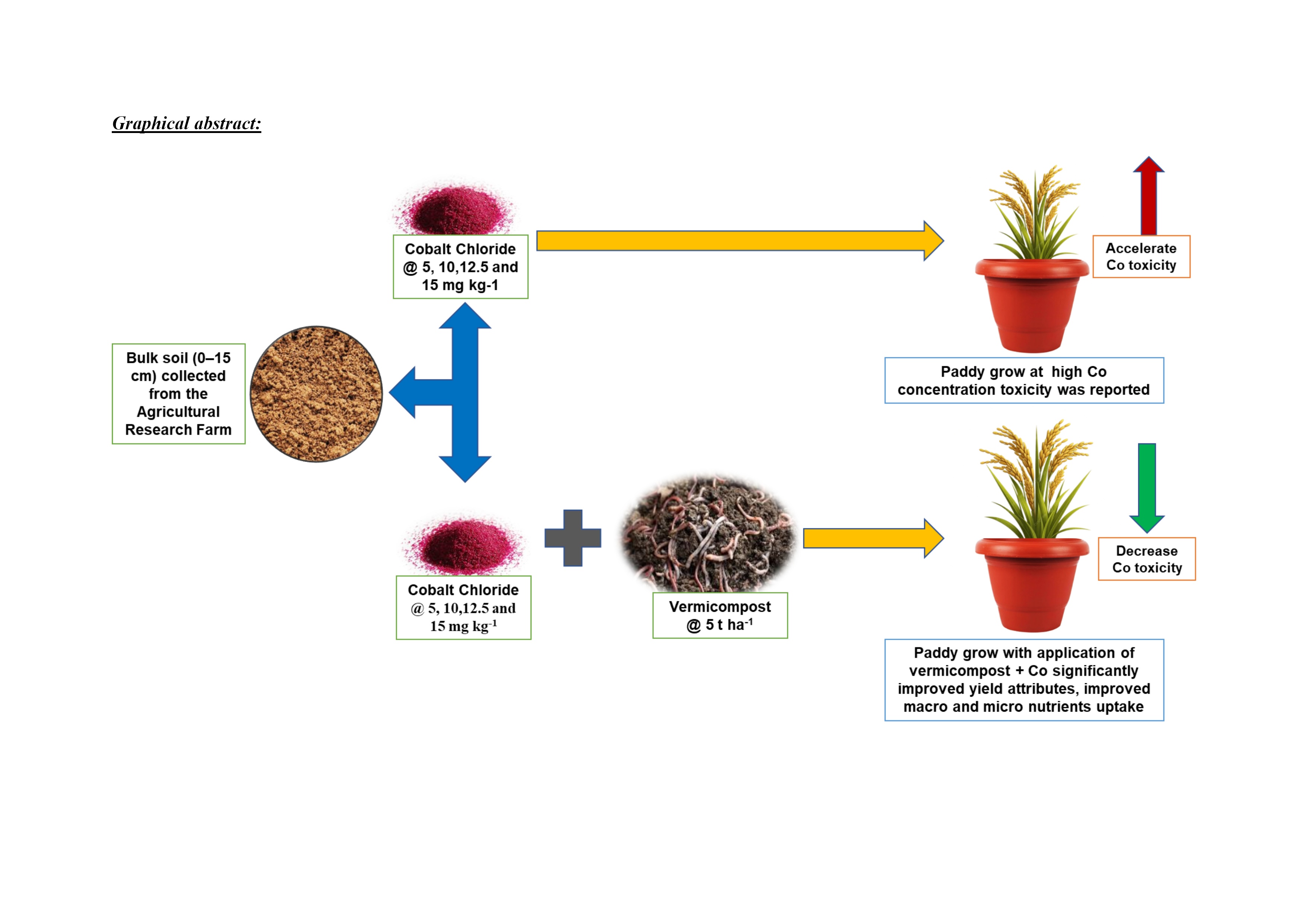
Purpose: Rice is an essential diet for more than half of the world’s inhabitants and subjected to growth in heavy metal-contaminated soil. Rice accumulates heavy metals in the above and below ground parts; the magnitude of accumulation depends upon the plant's available form of heavy metals in the soil. One such heavy metal is cobalt, which its concentration has been manifolded in post-industrial activities, leading to a high soil Co concentration. Cobalt is a component of Vitamin B12 and many enzymes. Humans can’t synthesize these enzymes, and consumption of Co-enriched grain can lead to Co toxicity in humans. The present experiment aimed to evaluate the effect of vermicompost conjugated with an optimum dose of Co for rice plants grown in an Inceptisol.
Method: The experiment was conducted using a completely randomized design (CRD) comprising nine treatments. The treatment received vermicompost, Co in the form of cobalt chloride, and the recommended dose of fertilizer (RDF).
Results: The results indicated that the application of Co at lower concentration was beneficial for rice growth without any hyperaccumulation, resulting in a significant increase of 46% and 22% in grain and straw yield, respectively. A comparable trend was also observed for Nitrogen uptake, which increased by 2 and 1.5 times over RDF in grain and straw, respectively. In contrast, higher Co application rates, either alone or in combination with vermicompost, resulted in a 10–15% reduction in cobalt uptake in grains. These findings suggest that vermicompost plays a critical role in regulating and optimizing cobalt uptake under higher Co application levels.
Conclusion: Overall, vermicompost and the lower doses of Co provide a better yield in rice without any phytotoxicity.
Highlights:
· Vermicompost and low-dose Co boosted rice yield by up to 46% over recommended dose of fertilizer
· Improved N, Fe, Mn and Zn uptake without Co hyperaccumulation in grain.
· Vermicompost raised soil OC and reduced Co uptake, enhancing food safety.
· Higher Co (>10 mg kg⁻¹) induced phytotoxicity, lowering growth and yield.
· Integrated vermicompost and Co management supports soil and crop health.
Keywords
- Hyperaccumulation,
- Phytotoxicity,
- Nitrogen,
- Uptake,
- Heavy metal
References
- Alam, M., Khan, A., Zaman, R., Khan, S., Khan, M. A., Ahmad, I. & Kim, K. I. (2024). Vermi-remediation impacts on growth and metals bioaccumulation in tomato irrigated with wastewater. Chemosphere, 362, 142848. https://doi.org/10.1016/j.chemosphere.2024.142848
- Ali, I., Ullah, S., He, L., Zhao, Q., Iqbal, A., Wei, S. & Jiang, L. (2020). Combined application of biochar and nitrogen fertilizer improves rice yield, microbial activity and N-metabolism in a pot experiment. Peer Journal, 8, e10311. https://doi.org/10.7717/peerj.10311
- Alou, I. N., Steyn, J. M., Annandale, J. G. & Van der Laan, M. (2018). Growth, phenological, and yield response of upland rice (Oryza sativa L. cv. Nerica 4®) to water stress during different growth stages. Agricultural Water Management, 198, 39-52. https://doi.org/10.1016/j.agwat.2017.12.005
- Awasthi, S., Chauhan, R. & Srivastava, S. (2022). The importance of beneficial and essential trace and ultratrace elements in plant nutrition, growth, and stress tolerance. In Plant nutrition and food security in the era of climate change (pp. 27-46). Academic Press. https://doi.org/10.1016/B978-0-12-822916-3.00001-9
- Bejbaruah, R., Sharma, R. C. & Banik, P. (2013). Split application of vermicompost to rice (Oryza sativa L.): its effect on productivity, yield components, and N dynamics. Organic Agriculture, 3(2), 123-128. https://doi.org/10.1007/s13165-013-0049-8
- Black, C. A. (1965). Operator variation. Methods of Soil Analysis: Part 1 Physical and Mineralogical Properties, Including Statistics of Measurement and Sampling, 9, 50-53.
- Blouin, M., Barrere, J., Meyer, N., Lartigue, S., Barot, S. & Mathieu, J. (2019). Vermicompost significantly affects plant growth. A meta-analysis. Agronomy for Sustainable Development, 39(4), 34. https://doi.org/10.1007/s13593-019-0579-x
- Bremner, J. M. (1996). Nitrogen‐total. Methods of soil analysis: Part 3 Chemical methods, 5, 1085-1121.
- Chakraborty, P., Sarkar, S., Mondal, S., Agarwal, B. K., Kumar, A., Bhattacharya, S. & Bhattacharyya, P. (2022). Eisenia fetida mediated vermi-transformation of tannery waste sludge into value added eco-friendly product: An insight on microbial diversity, enzyme activation, and metal detoxification. Journal of Cleaner Production, 348, 131368. https://doi.org/10.1016/j.jclepro.2022.131368
- Charan, K., Bhattacharyya, P. & Bhattacharya, S. S. (2024). Vermitechnology transforms hazardous red mud into benign organic input for agriculture: Insights on earthworm-microbe interaction, metal removal, and soil-crop improvement. Journal of Environmental Management, 354, 120320. https://doi.org/10.1016/j.jenvman.2024.120320
- Dignac, M. F., Derrien, D., Barré, P., Barot, S., Cécillon, L., Chenu, C. & Basile-Doelsch, I. (2017). Increasing soil carbon storage: mechanisms, effects of agricultural practices and proxies. A review: Soil C storage: mechanisms, practices and proxies. Agronomy for sustainable development, 37(2), 14. https://doi.org/10.1007/s13593-017-0421-2
- Dume, B., Hanc, A., Svehla, P., Michal, P., Chane, A. D. & Nigussie, A. (2022). Vermicomposting technology as a process able to reduce the content of potentially toxic elements in sewage sludge. Agronomy, 12(9), 2049. https://doi.org/10.3390/agronomy12092049
- Elshamly, A. M. & Nassar, S. M. (2024). Impacts of cobalt and zinc on improving peanuts nutrient uptake, yield and irrigation water use efficiency under different irrigation levels. Scientific Reports, 14(1), 7188. https://doi.org/10.1038/s41598-024-56898-2
- Gad, N. & El–Metwally, I. M. (2015). Chemical and physiological response of maize to salinity using cobalt supplement. International Journal of ChemTech Research, 8(10), 45-52. ISSN: 0974-4290
- Gad, N., Abd El-Moez, M. R. & Kandil, H. (2011). Barley response to salt stress at varied levels of cobalt II. Some physiological and chemical characteristics. Journal of Applied Sciences Research, 7(11), 1447-1453.
- Gad, N., Abdel-Moez, M. R., Abo-Basha, D. M. & Hassan, N. M. (2017). Mitigation the effect of salinity as a result of climate change by using cobalt on tomato production in newly reclaimed lands. Current Science International, 6, 857-866. ISSN: 2077-4435
- Gad, N., Hassan, N. M. & Sayed, S. A. A. E. (2020). Influence of Cobalt on tolerating climatic change (Salinity) in onion plant with reference to physiological and chemical approach. Plant Archieves, 20, 1496-1500. ISSN:0972-5210
- Gomez, K. A. & Gomez, A. A. (1984). Statistical procedures for agricultural research. John wiley & sons. 680 p. ISBN: 978-0-471-87092-0
- Grossman, R. B. & Reinsch, T. G. (2002). Bulk density and linear extensibility. In J. H. Dane & G. C. Topp (Eds.), Methods of Soil Analysis. Part 4. Physical Methods (pp. 201-228). Soil Science Society of America. https://doi.org/10.2136/sssabookser5.4.c9
- Hanway, J. & Heidel, H. (1952). Soil analysis methods as used in Iowa State College Soil Testing Laboratory. Iowa State College Agricultural Bulletin 57: 1- 13
- Hu, X., Wei, X., Ling, J. & Chen, J. (2021). Cobalt: an essential micronutrient for plant growth?. Frontiers in plant science, 12, 768523. https://doi.org/10.3389/fpls.2021.768523
- Iqbal, A., Khan, R., Hussain, Q., Imran, M., Mo, Z., Hua, T. & Tang, X. (2024). Vermicompost application enhances soil health and plant physiological and antioxidant defense to conferring heavy metals tolerance in fragrant rice. Frontiers in Sustainable Food Systems, 8, 1418554. https://doi.org/10.3389/fsufs.2024.1418554
- Jackson, M. L. (1973). Soil chemical analysis, pentice hall of India Pvt. Ltd., New Delhi, India, 498, 151-154.
- Javdan, G., Ghaffari, H. R., Nahidi, M., Zeraei, N., Hoseinvandtabar, S., Ahmadi, M. & Heidarinejad, Z. (2021). Health risk assessment of heavy metals (Arsenic and Cadmium) in rice (Oryza sativa L.) brands imported to Iran: Using Monte Carlo simulation. Hormozgan Medical Journal, 25(3), 104-110. https://doi.org/10.34172/hmj.2021.12
- Kaura, M., Sharma, S. & Thakur, R. (2015). Influence of cobalt on water relations in tomato and potato under water stress conditions. Journal of Agricultural Science and Technology, 17(2): 65-78.
- Khanam, R., Kumar, A., Nayak, A. K., Shahid, M., Tripathi, R., Vijayakumar, S. & Pathak, H. (2020). Metal (loid) s (As, Hg, Se, Pb and Cd) in paddy soil: Bioavailability and potential risk to human health. Science of the Total Environment, 699, 134330. https://doi.org/10.1016/j.scitotenv.2019.134330
- Khrustalev, V. V., Khrustaleva, T. A., Poboinev, V. V., Karchevskaya, C. I., Shablovskaya, E. A. & Terechova, T. G. (2019). Cobalt (ii) cation binding by proteins. Metallomics, 11(10), 1743-1752. https://doi.org/10.1039/c9mt00205g
- Kudoyarova, G., Veselova, S., Hartung, W., Farhutdinov, R., Veselov, D. & Sharipova, G. (2011). Involvement of root ABA and hydraulic conductivity in the control of water relations in wheat plants exposed to increased evaporative demand. Planta, 233(1), 87-94. https://doi.org/10.1007/s00425-010-1286-7
- Liang, L., Liu, W., Sun, Y., Huo, X., Li, S. & Zhou, Q. (2017). Phytoremediation of heavy metal contaminated saline soils using halophytes: current progress and future perspectives. Environmental Reviews, 25(3), 269-281. https://doi.org/10.1139/er-2016-0063
- Lindsay, W. L. & Norvell, W. (1978). Development of a DTPA soil test for zinc, iron, manganese, and copper. Soil Science Society of America Journal, 42(3), 421-428. https://doi.org/10.2136/sssaj1978.03615995004200030009x
- Liu, J. (1999). Cobalt: physiological effects and uptake mechanisms in plants (Doctoral dissertation, University of Adelaide, Department of Environmental Studies).
- Luo, Y., Iqbal, A., He, L., Zhao, Q., Wei, S., Ali, I. & Jiang, L. (2020). Long-term no-tillage and straw retention management enhances soil bacterial community diversity and soil properties in southern China. Agronomy, 10(9), 1233. https://doi.org/10.3390/agronomy10091233
- Nunes da Silva, M., Machado, J., Osorio, J., Duarte, R. & Santos, C. S. (2022). Non-essential elements and their role in sustainable agriculture. Agronomy, 12(4), 888. https://doi.org/10.3390/agronomy12040888
- Odaka, M. & Kobayashi, M. (2013). Cobalt proteins, overview. In Encyclopedia of metalloproteins (pp. 670-678). Springer, New York, NY. https://doi.org/10.1007/978-1-4614-1533-6_69
- Olsen, S. R. & Sommers, L. E. (1982). Phosphorus. pp. 403-430. In: A.L. Page. R.H. Miller, and D.R. Keeney (eds.), Methods of Soil Analysis. 2nd ed. Agronomy Series No.9, Part 2. Soil Science Society of America, Inc., Madison, WI.
- Olsen, S. R. (1954). Estimation of available phosphorus in soils by extraction with sodium bicarbonate (No. 939). US Department of Agriculture.
- Page, A. L., Miller, R. H. & Keeney, D. R. (1982). Methods of soil analysis. In: Chemical and microbiological properties.
- Panda, D., Ghosh, A. K., Ballesta, R. J., Espinosa, M. T. R., Pradhan, S. N. & Patra, A. (2024). Heavy Metals in the Sediments of the Chilika Lake, India: Contamination, Source and Toxicity Analysis. Water, Air, & Soil Pollution, 235(7), 415. https://doi.org/10.1007/s11270-024-07226-x
- Pathma, J. & Sakthivel, N. (2012). Microbial diversity of vermicompost bacteria that exhibit useful agricultural traits and waste management potential. Springer Plus, 1(1), 26. https://doi.org/10.1186/2193-1801-1-26
- Shukry, W. M., Abo-Hamed, S. A. E., Saleh, H. A. & Tourky, S. (2022). Effects of cobalt application on yield attributes, nutritive value, and protein pattern of rice (Oryza sativa L.) grains under drought conditions. Egyptian Journal of Agronomy, 44(2), 173-189. https://doi.org/10.21608/agro.2022.152928.1328
- Subbiah, B. V. & Asija, G. L. (1956). A rapid procedure for the estimation of available nitrogen in soils. Current Science 25: 259-260.
- Tourky, S. M., Shukry, W. M., Hossain, M. A., Siddiqui, M. H., Pessarakli, M. & Elghareeb, E. M. (2023). Cobalt enhanced the drought-stress tolerance of rice (Oryza sativa L.) by mitigating the oxidative damage and enhancing yield attributes. South African Journal of Botany, 159, 191-207. https://doi.org/10.1016/j.sajb.2023.05.035
- Vyas, P., Sharma, S. & Gupta, J. (2022). Vermicomposting with microbial amendment: implications for bioremediation of industrial and agricultural waste. BioTechnologia, 103(2), 203-215. https://doi.org/10.5114/bta.2022.116213
- Walkley, A. & Black, I. A. (1934). An examination of the Degtjareff method for determining soil organic matter, and a proposed modification of the chromic acid titration method. Soil science, 37(1), 29-38.
- Wang, Y. M., Yang, Q., Xu, H., Liu, Y. J. & Yang, H. L. (2020). Physiological and transcriptomic analysis provide novel insight into cobalt stress responses in willow. Scientific Reports, 10(1), 2308. https://doi.org/10.1038/s41598-020-59177-y
- Xue, S., Shi, L., Wu, C., Wu, H., Qin, Y., Pan, W. & Cui, M. (2017). Cadmium, lead, and arsenic contamination in paddy soils of a mining area and their exposure effects on human HEPG2 and keratinocyte cell-lines. Environmental Research, 156, 23-30. https://doi.org/10.1016/j.envres.2017.03.014
- Yadav, R. K. & Chauhan, R. (2024). Cobalt dynamics in soil-plant systems: influence of pH, organic amendments, and metal availability. International Journal of Environmental Research and Public Health, 21(3), 1584. https://doi.org/10.3390/ijerph21031584
- Zhang, J., Zhang, S., Cheng, M., Jiang, H., Zhang, X., Peng, C. & Jin, J. (2018). Effect of drought on agronomic traits of rice and wheat: A meta-analysis. International Journal of Environmental Research and Public Health, 15(5), 839. https://doi.org/10.3390/ijerph15050839