
 10.57647/ijrowa.2026.18747
Effects of Different Fertilizer Regimes and Irrigation Water Qualities on Soil Fertility under Lettuce Production
- Thomaz Figueiredo Lobo
 1
1 - Helio Grassi Filho1
- João de Andrade Bonetti*1,2
- São Paulo State University, UNESP. Avenida Universitária, 3780, CEP 18610-034, Botucatu, SP, Brazil
- Researcher at the Smart B100 Advanced Research Center/FAPESP, Brazil

Received: 2025-08-19
Revised: 2025-09-01
Accepted: 2025-12-30
Published Online: 2026-02-03
Copyright (c) -1 Thomaz Figueiredo Lobo, Helio Grassi Filho, João de Andrade Bonetti (Author)

This work is licensed under a Creative Commons Attribution 4.0 International License.
How to Cite




PDF views: 23





Abstract
Purpose: This study aimed to evaluate the effect of organic compost as a substitute for synthetic nitrogen (N) and the use of wastewater irrigation on lettuce cultivation by assessing changes in key soil fertility parameters.
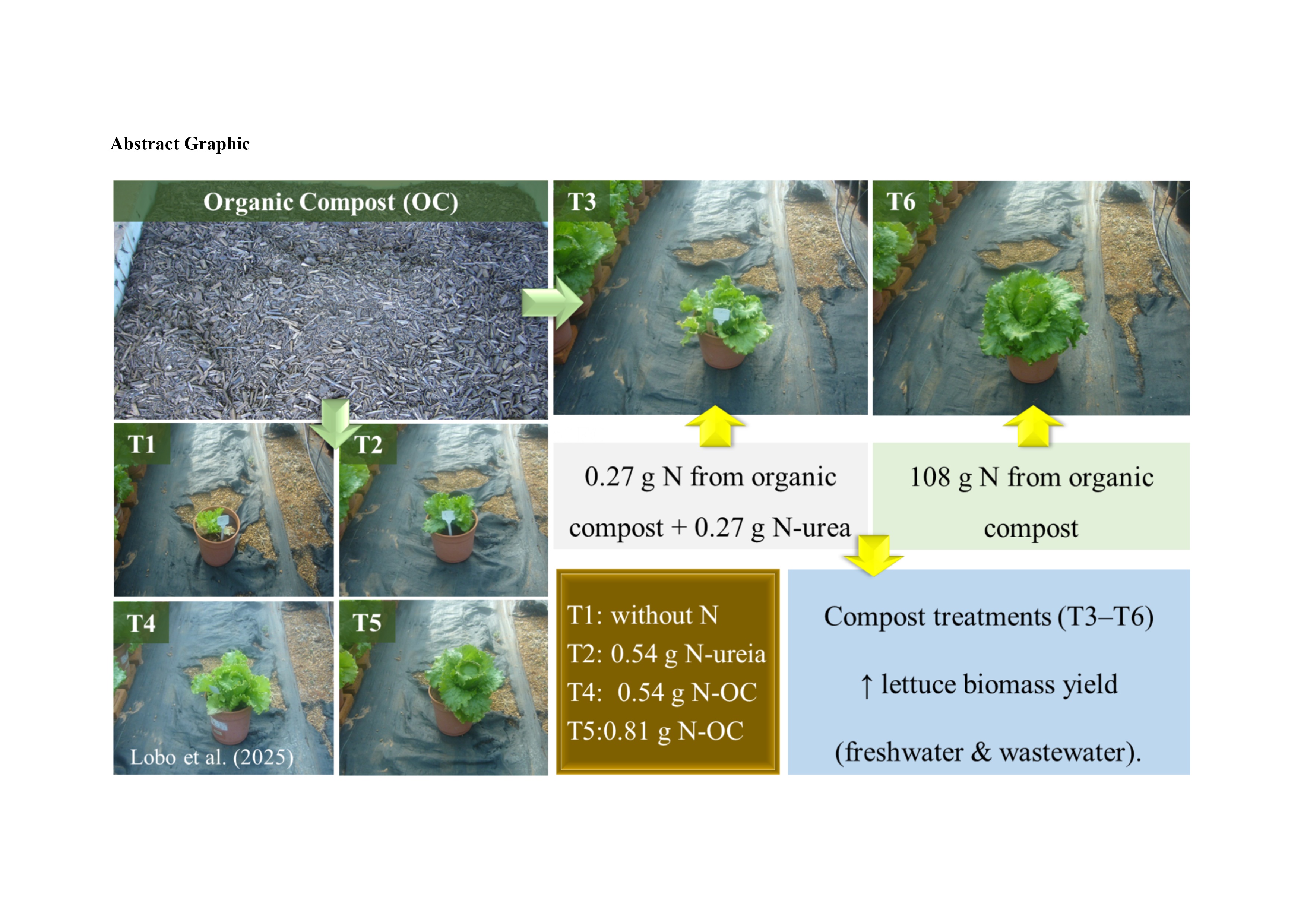
Methods: A greenhouse experiment was conducted at the Soil Science Department of the School of Agricultural Sciences in Botucatu, Brazil (22°50′S, 48°22′W), on a medium-textured Rhodic Hapludox. The experimental design was completely randomized in a split-plot arrangement, with six N fertilization treatments (organic and synthetic) combined with either wastewater or freshwater irrigation, and five replicates. The N treatments were as follows: T1 – no N; T2 – 0.54 g N applied as urea, split at 7, 14, and 28 days after transplanting; T3 – 0.27 g N from organic compost and 0.27 g N from urea, split at 7, 14, and 28 days after transplanting; T4 – 0.54 g N from organic compost; T5 – 0.81 g N from organic compost; T6 – 1.08 g N from organic compost.
Results: The highest compost rate (1.08 g N, T6) significantly improved soil fertility by increasing pH, cation exchange capacity, base saturation, and the availability of macro- and micronutrients, under both freshwater and wastewater irrigation. These treatments also enhanced soil organic matter and dissolved organic carbon contents, which were positively correlated with nutrient availability.
Conclusion: The T6 treatment also produced the highest green biomass yield of lettuce compared to the exclusive use of urea, highlighting organic compost as a sustainable alternative for N fertilization.
Highlights
· Organic compost improved soil fertility, nutrient availability, and lettuce yield.
· Wastewater irrigation enhanced nutrient recycling and crop productivity.
· Combined organic and chemical fertilization reduced soil acidity and Al³⁺ toxicity.
· Long-term compost uses increased soil organic carbon and nutrient correlations.
· Organic compost offers a sustainable alternative to synthetic nitrogen fertilizers.
Keywords
- Lettuce,
- Organic matter,
- Wastewater,
- Poultry manure,
- Composting
References
- Awaad, M. S., Badr, R. A., Badr, M. A. & Abd-elrahman, A. H. (2016). Effects of different nitrogen and potassium sources on lettuce (Lactuca sativa L.) yield in a sandy soil. Eurasian Journal of Soil Science (Ejss), 5(4), 299. https://doi.org/10.18393/ejss.2016.4.299-306
- BRADY, N. C. & WEIL, R. R. (2013). Elementos da natureza e propriedades dos solos (3rd ed.). Bookman.
- Ferreira, D. F. (2011). Sisvar: a computer statistical analysis system (5.6; pp. 1039–1042). UFLA.
- García-López, A. M. & Horta, C. (2022). Effects of compost on lettuce (Lactuca sativa) yield and soil biochemical properties. 356 Revista de Ciências Agrárias, 45(4), 356–360. https://doi.org/https://doi.org/10.19084/rca.28488
- Gatta, G., Libutti, A., Gagliardi, A., Beneduce, L., Brusetti, L., Borruso, L., Disciglio, G. & Tarantino, E. (2015). Treated agro-industrial wastewater irrigation of tomato crop: Effects on qualitative/quantitative characteristics of production and microbiological properties of the soil. Agricultural Water Management, 149, 33–43. https://doi.org/10.1016/j.agwat.2014.10.016
- Hernández, T., Chocano, C., Moreno, J. L. & García, C. (2016). Use of compost as an alternative to conventional inorganic fertilizers in intensive lettuce (Lactuca sativa L.) crops-Effects on soil and plant. Soil and Tillage Research, 160, 14–22. https://doi.org/10.1016/j.still.2016.02.005
- Jin, N., Jin, L., Wang, S., Li, J., Liu, F., Liu, Z., Luo, S., Wu, Y., Lyu, J. & Yu, J. (2022). Reduced Chemical Fertilizer Combined With Bio-Organic Fertilizer Affects the Soil Microbial Community and Yield and Quality of Lettuce. Frontiers in Microbiology, 13(April), 1–14. https://doi.org/10.3389/fmicb.2022.863325
- Mañas, P., Castro, E. & De Las Heras, J. (2009). Irrigation with treated wastewater: Effects on soil, lettuce (Lactuca sativa L.) crop and dynamics of microorganisms. Journal of Environmental Science and Health - Part A Toxic/Hazardous Substances and Environmental Engineering, 44(12), 1261–1273. https://doi.org/10.1080/10934520903140033
- Niquice-Janeiro, C. A., Arsénio, A. M. & van Lier, J. B. (2023). Wastewater-Based Nutrient Supply for Lettuce Production in the Infulene Valley, Maputo, Mozambique. Agriculture (Switzerland), 13(11). https://doi.org/10.3390/agriculture13112158
- Pane, C., Palese, A. M., Celano, G. & Zaccardelli, M. (2014). Effects of compost tea treatments on productivity of lettuce and kohlrabi systems under organic cropping management. Italian Journal of Agronomy, 9(3), 153–156. https://doi.org/10.4081/ija.2014.596
- Raij, B. van, Andrade, J. C. de, Cantarella, H. & Quasggio, J. A. (2001). Análise química para avaliação da fertilidade de solos tropicais. In Análise química para avaliação da fertilidade de solos tropicais (1st ed.).
- Regkouzas, P., Katie, N., Bontiotis, K. & Stefanakis, A. (2025). Effect of compost and compost-derived biochar on the growth of lettuce irrigated with water and treated wastewater. Nature-Based Solutions, 7(January), 100220. https://doi.org/10.1016/j.nbsj.2025.100220
- Ribeiro, R. R., Torres, J. L. R., Orioli-Junior, V., Charlo, H. C. D. O. & Vieira, D. M. D. S. (2019). Growth analysis of green-leaf lettuce under different sources and doses of organic and mineral fertilization. Revista Colombiana de Ciencias Horticolas, 13(2), 237–247. https://doi.org/10.17584/rcch.2019v13i2.8521
- Santos, A. G. dos, Mesquita, J. B., Pessoa, A. M. dos S. & Silva, L. M. da. (2021). Productivity of Lactuca Sativa L. grown under doses of organic compost and biofertilizer. Brazilian Journal of Development, 7(1), 8481–8496. https://doi.org/10.34117/bjdv7n1-575
- Silva, A. F. T., Avelino, R. C., Silva Brito, L. P., Dos Anjos, J. C. R., Silva Júnior, J. V. & Beckmann-Cavalcante, M. Z. (2017). Growth and yield of lettuce cultivars under organic fertilization and different environments. Comunicata Scientiae, 8(2), 265–274. https://doi.org/10.14295/CS.v8ii2.2167
- Silva, V. C. F. d., Silva, P. A., Oliveira, J. T. d., Oliveira, R. A. d. & Pereira, L. V. (2023). Using Wastewater From Fish Farming for Fertigation of Lettuce Crop. Engenharia Agricola, 43(4), 9–11. https://doi.org/10.1590/1809-4430-Eng.Agric.v43n4e20230025/2023
- Sylvestre, T. de B., Braos, L. B., Batistella Filho, F., Cruz, M. C. P. da & Ferreira, M. E. (2019). Mineral nitrogen fertilization effects on lettuce crop yield and nitrogen leaching. Scientia Horticulturae, 255(April), 153–160. https://doi.org/10.1016/j.scienta.2019.05.032
- Teixeira, P. C., Donagema, G. K., Fontana, A. & Teixeira, W. G. (2017). Manual de métodos de análise de solo (3rd ed.). Embrapa.
- Torres, J. L. R., da Silva, G. G., de O Charlo, H. C., Loss, A., Lemes, E. M. & Vieira, D. M. da S. (2022). Lettuce crop fertilized with organomineral source of phosphorus and micronutrients. Horticultura Brasileira, 40(4), 393–402. https://doi.org/10.1590/s0102-0536-20220407
- Tütüncü, A. Ç., Saka, A. K., Ay, A., Özer, M. Ö., Yilmaz, H. & Ozer, H. (2024). Potential use of different organic fertilizers in lettuce cultivation. In Reserach Square (Vol. 1, pp. 1–17). https://doi.org/10.21203/rs.3.rs-4412525/v1
- Van Bemmelen, J. (1890). Über Die Bestimmung Des Wassers, Des Humus, Des Schwefels, Der in Den Colloïdalen Silikaten Gebundenen Kieselsäure, Des Mangans U. S. W. Im Ackerboden. Die Landwirthschaftlichen Versuchs-Stationen, 37, 279–290.