
 10.57647/ijrowa.2026.18745
Recycling Animal and Plant Residues Through Vermicomposting: Nutrient Release, Organic Carbon Fractions, and Humate Quality Under Semi-Arid Conditions
- Larissa Fernandes da Silva*
 1
1 - Luiz Fernando de Sousa Antunes1
- Jeane Cruz Portela1
- Diana Ferreira de Freitas2
- Daniel Valadão Silva
 1
1 - Francimar Maik da Silva Morais1
- Francisco Éder Rodrigues de Oliveira1
- João Luiz Lima1
- Ramona Rodrigues Amaro de Oliveira1
- Erlen Kaline Ávila do Nascimento1
- Alessandra Nunes da Silva1
- Paulo Ricardo Chagas Oliveira1
- Pedro Victor Tavares Firmino da Silva1
- Eulene Francisco da Silva1
- Federal Rural University of the Semi-Arid, Center of Agrarian Sciences, Mossoró-RN, Brazil
- Federal University of Ceará, Center of Agrarian Sciences, Fortaleza-CE, Brazil

Published Online: 2026-02-03
Copyright (c) -1 Larissa Fernandes da Silva, Luiz Fernando de Sousa Antunes, Jeane Cruz Portela, Diana Ferreira de Freitas, Daniel Valadão Silva, Francimar Maik da Silva Morais, Francisco Éder Rodrigues de Oliveira, João Luiz Lima, Ramona Rodrigues Amaro de Oliveira, Erlen Kaline Ávila do Nascimento, Alessandra Nunes da Silva, Paulo Ricardo Chagas Oliveira, Pedro Victor Tavares Firmino da Silva, Eulene Francisco da Silva (Author)

This work is licensed under a Creative Commons Attribution 4.0 International License.
How to Cite




PDF views: 113





Abstract
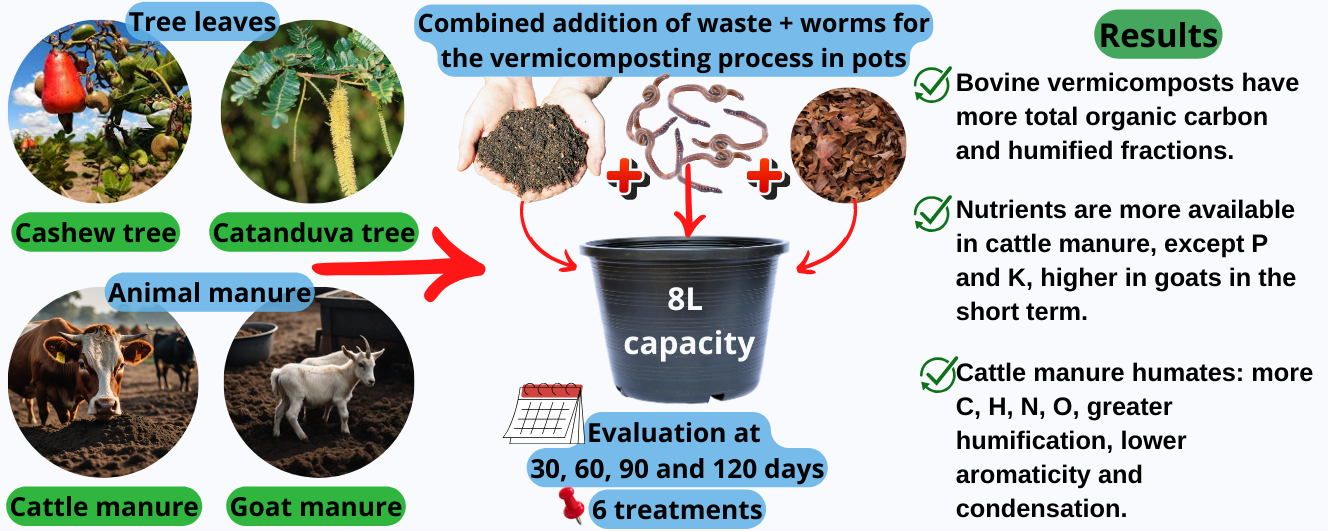
Purpose: This study aimed to evaluate the availability of nutrients through different extraction methods, their potential mineralization, total carbon content, and carbon distribution in various organic carbon fractions. Additionally, it examined the characteristics of humates derived from distinct vermicompost formulations.
Methods: The experiment followed a 6×4 factorial design, incorporating six treatments (combinations of cattle manure, goat manure, cashew leaves, and catanduva leaves) and four evaluation intervals (30, 60, 90, and 120 days of vermicomposting). The experimental units were arranged in a randomized block design with four replicates, using polyethylene containers under uniform environmental conditions.
Results: The findings revealed that vermicomposts produced with cattle manure consistently displayed higher levels of total organic carbon and carbon in both labile and humified fractions of the organic material, regardless of the plant mixtures used. Nutrients showed greater availability in both the short and medium term, except for phosphorus and potassium, which were more readily available in vermicomposts based on goat manure in the short term. Conclusion: Cattle manure vermicomposts, regardless of the plant mixture, had higher levels of nutrients available in the short and medium term, except for P and K. Humates obtained from cattle manure-based vermicomposts exhibited elevated levels of carbon, hydrogen, nitrogen, oxygen, and carboxylic acidity, demonstrating a notable increase in aliphatic carbon groups and a higher degree of humification, coupled with lower aromaticity and minimal structural condensation.
Highlights
• Producers in the semiarid region have been producing vermicompost with animal and plant waste
• The valorization of vermicomposted biowaste must have agronomic qualities within a given time.
• The characteristics analyzed were: organic matter and fractions, nutrient and humate contents.
• Vermicompost from cattle manure presented higher nutrient contents and total organic C and organic fractions.
• Humates from cattle vermicomposts present higher composition of C, H, N and O, acidity and higher E4/E6 ratios.
Keywords
- Earthworm composting,
- Vermicompost humates,
- Cattle manure,
- Humic substances,
- Nutrients,
- Elemental composition
References
- Almeida, G., Xavier, E., Valente, B., Roll, V. F., & Nichelle, D. C. (2018). Vermicomposting of a mixture of rice husk ash with bovine manure and sawdust. Archivos de Zootecnia, 67(258), 212–218. https://doi.org/10.21071/az.v67i258.3656
- Antunes, R. M., Castilhos, R. M. V., Castilhos, D. D., Leal, O. dos A., Dick, D. P., & Andreazza, R. (2015). Transformações químicas dos ácidos húmicos durante o processo de vermicompostagem de resíduos orgânicos. Engenharia Sanitaria e Ambiental, 20(4), 699–708. https://doi.org/10.1590/S1413-41522015020040114466
- Assiuty, B., Lateif, H., Khalil, M., Khalifa, A., & Ageba, M. (2021). Potential utilization of various organic waste additives in vermicomposting using two different earthworm species. Egyptian Journal of Experimental Biology (Zoology), 17(1), 1. https://doi.org/10.5455/egysebz.20210130064117
- Atmaja, I. M. D., Wirajaya, A. A. N. M., & Kartini, L. (2019). Effect of Goat and Cow Manure Fertilizer on the Growth of Shallot (Allium ascalonicum L). SEAS (Sustainable Environment Agricultural Science), 3(1), Artigo 1. https://doi.org/10.22225/seas.3.1.1336.19-23
- Baligah, H. Ul., Chesti, M. H., Ahmed Baba, Z., Mir, S., Wani, F. J., Bhat, J. A., & Khan, I. M. (2025). Vermicomposting technology as a dynamic strategy to mitigate environmental crisis: A bibliometric study of last three decades. Environmental Technology, 46(1), 72–86. https://doi.org/10.1080/09593330.2024.2339191
- Briedis, C., Sá, J. C. D. M., Caires, E. F., Navarro, J. D. F., Inagaki, T. M., Boer, A., Neto, C. Q., Ferreira, A. D. O., Canalli, L. B., & Santos, J. B. D. (2012). Soil organic matter pools and carbon-protection mechanisms in aggregate classes influenced by surface liming in a no-till system. Geoderma, 170, 80–88. https://doi.org/10.1016/j.geoderma.2011.10.011
- Castilhos, R. M. V., Dick, D. P., Castilhos, D. D., Morselli, T. B. A. G., Costa, P. F. P. D., Casagrande, W. B., & Rosa, C. M. D. (2008). Distribuição e caracterização de substâncias húmicas em vermicompostos de origem animal e vegetal. Revista Brasileira de Ciência do Solo, 32(spe), 2669–2675. https://doi.org/10.1590/S0100-06832008000700009
- Chiquito-Contreras, R. G., Reyes-Pérez, J. J., Troyo-Diéguez, E., Rueda-Puente, E. O., Torres-Rodríguez, J. A., Murillo-Amador, B., Chiquito-Contreras, R. G., Reyes-Pérez, J. J., Troyo-Diéguez, E., Rueda-Puente, E. O., Torres-Rodríguez, J. A., & Murillo-Amador, B. (2018). Growth of tomato seedlings (Solanum lycopersicum L.) treated with vermicompost humate. Revista Mexicana de Ciencias Agrícolas, 9(SPE20), 4187–4197. https://doi.org/10.29312/remexca.v0i20.989
- Cotta, J. A. de O. (2019). Ácidos húmicos: A dinâmica de mineralização durante biorremediação por vermicompostagem de solos contaminados por diesel. Research, Society and Development, 8(8), Artigo 8. https://doi.org/10.33448/rsd-v8i8.1190
- Cunha, A. H. N., Fernandes, E. P., Araújo, F. G. de, Malafaia, G., & Vieira, J. A. (2015). Vermicompostagem de Lodo de Curtume associado a diferentes substratos. Multi-Science Journal, 1(3), Artigo 3. https://doi.org/10.33837/msj.v1i3.100
- Dobbss, L. B., Rumjaneck, V. M., Baldotto, M. A., Velloso, A. C. X., & Canellas, L. P. (2009). Caracterização química e espectroscópica de ácidos húmicos e fúlvicos isolados da camada superficial de latossolos brasileiros. Revista Brasileira de Ciência do Solo, 33(1), 51–63. https://doi.org/10.1590/S0100-06832009000100006
- Dohaish, E. J. A. B. (2020). Vermicomposting of Organic Waste with Eisenia fetida Increases the Content of Exchangeable Nutrients in Soil. Pakistan Journal of Biological Sciences: PJBS, 23(4), 501–509. https://doi.org/10.3923/pjbs.2020.501.509
- Dores-Silva, P. R., Landgraf, M. D., & Rezende, M. O. de O. (2013). Processo de estabilização de resíduos orgânicos: Vermicompostagem versus compostagem. Química Nova, 36(5), 640–645. https://doi.org/10.1590/S0100-40422013000500005
- Dores-Silva, P. R., Landgraf, M. D., & Rezende, M. O. O. (2015). Chemical Differentiation of Domestic Sewage Sludge and Cattle Manure Stabilized by Microbioreators: Study by Pyrolysis Coupled to Gas Chromatography Coupled to Mass Spectroscopy. Journal of the Brazilian Chemical Society, 26(5), 860–868. https://doi.org/10.5935/0103-5053.20150046
- Dubreuil, V., Fante, K. P., Planchon, O., & Neto, J. L. S. (2018). Os tipos de climas anuais no Brasil: Uma aplicação da classificação de Köppen de 1961 a 2015. Confins. Revue franco-brésilienne de géographie / Revista franco-brasilera de geografia, 37, Artigo 37. https://doi.org/10.4000/confins.15738
- Enev, V., Pospíšilová, Ľ., Klučáková, M., Liptaj, T., & Doskočil, L. (2014). Spectral characterization of selected humic substances. Soil and Water Research, 9(1), 9–17. https://doi.org/10.17221/39/2013-SWR
- Façanha, A. R., Façanha, A. L. O., Olivares, F. L., Guridi, F., Santos, G. de A., Velloso, A. C. X., Rumjanek, V. M., Brasil, F., Schripsema, J., Braz-Filho, R., Oliveira, M. A. de, & Canellas, L. P. (2002). Bioatividade de ácidos húmicos: Efeitos sobre o desenvolvimento radicular e sobre a bomba de prótons da membrana plasmática. Pesquisa Agropecuária Brasileira, 37(9), 1301–1310. https://doi.org/10.1590/S0100-204X2002000900014
- Filep, T., Zacháry, D., Jakab, G., & Szalai, Z. (2022). Chemical composition of labile carbon fractions in Hungarian forest soils: Insight into biogeochemical coupling between DOM and POM. Geoderma, 419, 115867. https://doi.org/10.1016/j.geoderma.2022.115867
- Fritsch, C., Staebler, A., Happel, A., Cubero Márquez, M., Aguiló-Aguayo, I., Abadias, M., Gallur, M., Cigognini, I., Montanari, A., López, M., Suárez-Estrella, F., Brunton, N., Luengo, E., Sisti, L., Ferri, M., & Belotti, G. (2017). Processing, Valorization and Application of Bio-Waste Derived Compounds from Potato, Tomato, Olive and Cereals: A Review. Sustainability, 9(8), 1492. https://doi.org/10.3390/su9081492
- García Castellanos, B., García García, B., & García García, J. (2023). Economic and Environmental Effects of Replacing Inorganic Fertilizers with Organic Fertilizers in Three Rainfed Crops in a Semi-Arid Area. Sustainability, 15(24), 16897. https://doi.org/10.3390/su152416897
- Gayathri, B., Srinivasamurthy, C., Vasanthi, B., Naveen, D., Prakash, N., & Bhaskar, S. (2020). Extraction and charactrisation of humic acid from different organic wastes and its physico-chemical properties. International Journal of Chemical Studies, 8(1), 769–775. https://doi.org/10.22271/chemi.2020.v8.i1k.8359
- Ghosh, M., Chattopadhyay, G. N., & Baral, K. (1999). Transformation of phosphorus during vermicomposting. Bioresource Technology, 69(2), 149–154. https://doi.org/10.1016/S0960-8524(99)80001-7
- Guo, X., Liu, H., & Wu, S. (2019). Humic substances developed during organic waste composting: Formation mechanisms, structural properties, and agronomic functions. Science of The Total Environment, 662, 501–510. https://doi.org/10.1016/j.scitotenv.2019.01.137
- Gupta, C., Prof, D., Gupta, S., & Nazareno, M. (2019). Role of Vermicomposting in Agricultural Waste Management. Em Sustainable Green Technologies for Environmental Management (p. 283–295). https://doi.org/10.1007/978-981-13-2772-8_15
- Haroun, M., Wang, J., & Qian, X. (2025). Inspiration of combined additive on the yield of humic and fulvic acids and the formation of functional groups to mitigate heavy metal bioremediation. Biodegradation, 36(5), 80. https://doi.org/10.1007/s10532-025-10167-9
- Karmegam, N., Vijayan, P., Prakash, M., & John Paul, J. A. (2019). Vermicomposting of paper industry sludge with cowdung and green manure plants using Eisenia fetida: A viable option for cleaner and enriched vermicompost production. Journal of Cleaner Production, 228, 718–728. https://doi.org/10.1016/j.jclepro.2019.04.313
- Katakula, A., Handura, B., Gawanab, W., Itanna, F., & Mupambwa, H. (2021). Optimized vermicomposting of a goat manure-vegetable food waste mixture for enhanced nutrient release. Scientific African, 12(9), e00727. https://doi.org/10.1016/j.sciaf.2021.e00727
- Kharola, S., Ram, M., Goyal, N., Mangla, S. K., Nautiyal, O. P., Rawat, A., Kazancoglu, Y., & Pant, D. (2022). Barriers to organic waste management in a circular economy. Journal of Cleaner Production, 362, 132282. https://doi.org/10.1016/j.jclepro.2022.132282
- Klavins, M., Upska, K., Viksna, A., Bertins, M., Ansone-Bertina, L., & Krumins, J. (2020). A comparative study of the properties of industrially produced humic substances [PDF]. Agronomy Research, 18(3), 2076–2086. https://doi.org/10.15159/AR.20.185
- Kolape, S. S., Shinde, P. T., & Tathe, A. S. (2024). Response of Potassium Humate Extracted from Different Organic Sources on Yield and Quality of Green Chilli. Asian Journal of Soil Science and Plant Nutrition, 10(2), 530–538. https://doi.org/10.9734/ajsspn/2024/v10i2311
- Lanno, M., Klavins, M., Purmalis, O., Shanskiy, M., Kisand, A., & Kriipsalu, M. (2022). Properties of Humic Substances in Composts Comprised of Different Organic Source Material. Agriculture, 12(11), 1797. https://doi.org/10.3390/agriculture12111797
- Lavôr, W. K. B., Silva, E. F., Almeida Ferreira, E., Gondim, J. E. F., Portela, J. C., Antunes, L. F. S., Almeida Vasconcelos, A., Freitas, D. F., Mendonça, V., & Fernandes, B. C. C. (2024). Vermicompost and millicompost as a resource in sustainable agriculture in semiarid: Decomposition, nutrient release, and microstructure under the action of nitrogen and organic-mineral fertilizers. Environmental Science and Pollution Research, 31(23), 33924–33941. https://doi.org/10.1007/s11356-024-33446-z
- Lima, K. R., Tavares, H. G., Pereira, R. R. D. S., Carvalho, J. D. C. L., Botelho, R. D. O., Reis Spuri, A. C., Dobbss, L. B., Machado, A. R. T., Orlando, D. R., Remédio, R. N., Paiva, S. M. D., Moura, R. F. D., Dias-Peixoto, M. F., Pereira, L. J., & Andrade, E. F. (2024). Humic Acid Derived from Vermicompost Inhibits Alveolar Bone Degradation and Protects Against Renal Injury in an Experimental Model of Periodontitis. Biomedicines, 12(12), 2710. https://doi.org/10.3390/biomedicines12122710
- Lima, M. V. G., Santos Filho, C. A., Ferreira, J. V. V., Souza, K. G., Shockness, L. S. F., & Bento, G. F. (2019). Vermicompostos como substratos no desempenho de mudas de alface e rúcula. Revista Verde de Agroecologia e Desenvolvimento Sustentável, 14(3), 374–381. https://doi.org/10.18378/rvads.v14i3.6499
- Loh, T. C., Lee, Y. C., Liang, J. B., & Tan, D. (2005). Vermicomposting of cattle and goat manures by Eisenia foetida and their growth and reproduction performance. Bioresource Technology, 96(1), 111–114. https://doi.org/10.1016/j.biortech.2003.03.001
- Mao, Y., Hu, W., Li, Y., Li, Y., Lei, B., & Zheng, Y. (2023). Long-term cattle manure addition enhances soil-available phosphorus fractions in subtropical open-field rotated vegetable systems. Frontiers in Plant Science, 14. https://doi.org/10.3389/fpls.2023.1138207
- Muscolo, A., Sidari, M., & Nardi, S. (2013). Humic substance: Relationship between structure and activity. Deeper information suggests univocal findings. Journal of Geochemical Exploration, 129, 57–63. https://doi.org/10.1016/j.gexplo.2012.10.012
- Nardi, S., Pizzeghello, D., Muscolo, A., & Vianello, A. (2002). Physiological effects of humic substances on higher plants. Soil Biology and Biochemistry, 34(11), 1527–1536. https://doi.org/10.1016/S0038-0717(02)00174-8
- Nguyen, T. T., Sasaki, Y., Nasukawa, H., & Katahira, M. (2024). Recycling potassium from cow manure compost can replace potassium fertilizers in paddy rice production systems. The Science of the Total Environment, 912, 168823. https://doi.org/10.1016/j.scitotenv.2023.168823
- Raj, D., & Antil, R. S. (2011). Evaluation of maturity and stability parameters of composts prepared from agro-industrial wastes. Bioresource Technology, 102(3), 2868–2873. https://doi.org/10.1016/j.biortech.2010.10.077
- Ramos, M. L., Moscuzza, C. H., Fernández Cirelli, A., Ramos, M. L., Moscuzza, C. H., & Fernández Cirelli, A. (2020). Total content and availability of micronutrients in soils and livestock manure. Revista Internacional de Contaminación Ambiental, 36(1), 115–126. https://doi.org/10.20937/rica.2020.36.53264
- Ratnasari, A., Syafiuddin, A., Mehmood, M. A., & Boopathy, R. (2023). A review of the vermicomposting process of organic and inorganic waste in soils: Additives effects, bioconversion process, and recommendations. Bioresource Technology Reports, 21, 101332. https://doi.org/10.1016/j.biteb.2023.101332
- Rayne, N., & Aula, L. (2020). Livestock Manure and the Impacts on Soil Health: A Review. Soil Systems, 4(4), 64. https://doi.org/10.3390/soilsystems4040064
- Reyes-Pérez, J., Amador, B., Nieto-Garibay, A., & Rivas-Garcia, T. (2024). Vermicompost humates as NaCl-stress mitigator and its effect on the physiological and biochemical characteristics of basil (Ocimum basilicum L.). Pakistan Journal of Agricultural Research, 61(2), 2–9. https://doi.org/10.21162/PAKJAS/24.421
- Reyes-Perez, J. J., Amador, B. M., Hernández-Montiel, L. G., Rangel, P. P., Rueda-Puente, E. O., & Ruiz-Espinoza, F. H. (2021). Vermicompost humates as a salinity mitigator in the germination of basil. Ciência Rural, 52(7), e20210167. https://doi.org/10.1590/0103-8478cr20210167
- Ribeiro Junior, J. I. (2001). Análises estatísticas no SAEG (Sistema para análises estatísticas). Universidade Federal de Viçosa.
- Rini, J., Deepthi, M. P., Saminathan, K., Narendhirakannan, R. T., Karmegam, N., & Kathireswari, P. (2020). Nutrient recovery and vermicompost production from livestock solid wastes with epigeic earthworms. Bioresource Technology, 313, 123690. https://doi.org/10.1016/j.biortech.2020.123690
- Rocha, D. F. da, Silva, T. N., & Santos, C. A. B. (2017). Atividade reprodutiva da Eisenia foetida (Savigny, 1826) (Haplotaxida: Lumbricidae) em diferentes hábitats. Revista Ouricuri, 7(2), Artigo 2. https://doi.org/10.59360/ouricuri.vol7.i2.a5486
- Rodda, M. R. C., Canellas, L. P., Façanha, A. R., Zandonadi, D. B., Guerra, J. G. M., Almeida, D. L. de, & Santos, G. de A. (2006). Estímulo no crescimento e na hidrólise de ATP em raízes de alface tratadas com humatos de vermicomposto: II - Efeito da fonte de vermicomposto. Revista Brasileira de Ciência do Solo, 30(4), 657–664. https://doi.org/10.1590/S0100-06832006000400006
- Rosa, A., Rocha, J., & Furlan, M. (2000). Humic substances of peat: Study of the parameters that influence on the process of alkaline E extraction. Química Nova, 23(4), 472–476.
- Sanches, S. M., Campos, S. X. de, & Vieira, E. M. (2007). Caracterização das frações das substâncias húmicas de diferentes tamanhos moleculares. Eclética Química, 32(1), 49–56. https://doi.org/10.1590/S0100-46702007000100007
- Santos, T. C. dos, Silva, H. P., Lima, K. R., Salvador, M. L. N., Cândido, G. de S., Pimenta, L. C. J. P., Bertolini, N. O., Ribeiro, L. B., Fagundes, F. G., Orlando, D. R., Borges, B. D. B., Dias-Peixoto, M. F., Machado, A. R. T., Dobbss, L. B., Pereira, L. J., & Andrade, E. F. (2025). Humic Acid Derived from Vermicompost Improves Bone Mineral Content and Alters Oxidative Stress Markers in Ovariectomized Mice. Biomedicines, 13(2), 495. https://doi.org/10.3390/biomedicines13020495
- Sarker, M., Hashem, M. A., Murshed, H. M., Kamal, M., Haque, M., & Rahman, M. (2021). Production and evaluation of vermicompost from different types of livestock manures. Journal of Agriculture, Food and Environment, 02, 62–67. https://doi.org/10.47440/JAFE.2021.2211
- Schnitzer, M., & Gupta, U. C. (1964). Some Chemical Characteristics of the Organic Matter Extracted from the O and B2 Horizons of a Gray Wooded Soil. Soil Science Society of America Journal, 28(3), 374–377. https://doi.org/10.2136/sssaj1964.03615995002800030022x
- Sena, L., Arruda, J., Costa, F., Almeida, F., Brito, P., & Gondim, F. (2019). Compostagem e vermicompostagem como alternativa para tratamento e de destinação de resíduos orgânicos. Revista Verde de Agroecologia e Desenvolvimento Sustentável, 14(2), 266–272. https://doi.org/10.18378/rvads.v14i2.6136
- Shang, C., & Tiessen, H. (1997). Organic matter lability in a tropical oxisol: Evidence from shifting cultivation, chemical oxidation, particle size, density, and magnetic fractionations. Soil Science, 162(11), 795–807. https://doi.org/10.1097/00010694-199711000-00004
- Silva, F. C. (Org.). (2009). Manual de análises químicas de solos, plantas e fertilizantes. (2o ed.). Embrapa Informação Tecnológica; Rio de Janeiro: Embrapa Solos.
- Silva, L. F., Silva, E. F., Morais, F. M. S., Portela, J. C., Oliveira, F. H. T., Freitas, D. F., Ferreira, E. A., Gurgel, M. T., Pinheiro, A. M., Lima, R. B., Vasconcelos, A. A., & Antunes, L. F. S. (2023). Potential of vermicomposting with mixtures of animal manure and vegetable leaves in the development of Eisenia foetida, microbial biomass, and enzymatic activity under semi-arid conditions. Journal of Environmental Management, 330, 117169. https://doi.org/10.1016/j.jenvman.2022.117169
- Silva, L. R. B., & Kardos, L. (2024). Composting of distillery spent wash. Journal of Environmental Geography, 17(1–4), 15–28. https://doi.org/10.14232/jengeo-2024-44674
- Skrzypczak, D., Trzaska, K., Mironiuk, M., Mikula, K., Izydorczyk, G., Polomska, X., Wiśniewski, J., Mielko, K., Moustakas, K., & Chojnacka, K. (2024). Recent innovations in fertilization with treated digestate from food waste to recover nutrients for arid agricultural fields. Environmental Science and Pollution Research, 31(29), 41563–41585. https://doi.org/10.1007/s11356-023-31211-2
- Suthar, S., Pandey, B., Gusain, R., Gaur, R. Z., & Kumar, K. (2017). Nutrient changes and biodynamics of Eisenia fetida during vermicomposting of water lettuce (Pistia sp.) biomass: A noxious weed of aquatic system. Environmental Science and Pollution Research International, 24(1), 199–207. https://doi.org/10.1007/s11356-016-7770-2
- Svane, S., & Karring, H. (2019). A comparison of the transition metal concentrations in the faeces, urine, and manure slurry from different livestock animals related to environmentally relevant microbial processes. Cogent Chemistry, 5(1), 1644702. https://doi.org/10.1080/23312009.2019.1644702
- Swift, R. S. (2001). Sequestration of carbon by soil. Soil Science, 166(11), 858. https://journals.lww.com/soilsci/abstract/2001/11000/sequestration_of_carbon_by_soil.10.aspx
- Teixeira, P. C., Donagemma, G. K., Fontana, A., & Teixeira, W. G. (2017). Manual de métodos de análise de solo (3o ed.). EMBRAPA Solos.
- Tiwari, J., Ramanathan, A., Bauddh, K., & Korstad, J. (2023). Humic substances: Structure, function and benefits for agroecosystems—a review. Pedosphere, 33(2), 237–249. https://doi.org/10.1016/j.pedsph.2022.07.008
- Walia, S. S., & Kaur, T. (2024). Role of Earthworms in Vermicomposting. Em S. S. Walia & T. Kaur (Org.), Earthworms and Vermicomposting: Species, Procedures and Crop Application (p. 55–60). Springer Nature. https://doi.org/10.1007/978-981-99-8953-9_5
- Washaya, S., & Washaya, D. D. (2023). Benefits, concerns and prospects of using goat manure in sub-Saharan Africa. Pastoralism, 13(1), 28. https://doi.org/10.1186/s13570-023-00288-2
- Yakhin, O. I., Lubyanov, A. A., Yakhin, I. A., & Brown, P. H. (2017). Biostimulants in Plant Science: A Global Perspective. Frontiers in Plant Science, 7. https://doi.org/10.3389/fpls.2016.02049
- Yeomans, J. C., & Bremner, J. M. (1988). A rapid and precise method for routine determination of organic carbon in soil. Communications in Soil Science and Plant Analysis, 19(13), 1467–1476. https://doi.org/10.1080/00103628809368027