
 10.57647/ijrowa.2026.18744
Investigating the Role of Stirring in Composting of Goat Manure with Application of Corncob Biochar
- Yugi R. Ahadiyat*

 1
1 - Ervina Mela2
- Ahmad Fauzi1
- Nazzala Shafa Laksana3
- Laboratory of Agroecology, Department of Agrotechnology, Faculty of Agriculture, Universitas Jenderal Soedirman, Purwokerto, Central Java, Indonesia
- Study Program of Food Technology, Department of Agricultural Technology, Faculty of Agriculture, Universitas Jenderal Soedirman, Purwokerto, Central Java, Indonesia
- PT Pupuk Indonesia, Gedung Pusri Jl. Taman Anggrek Kemanggisan Jaya Jakarta, Indonesia

Received: 2025-03-29
Revised: 2025-04-09
Accepted: 2025-12-13
Published Online: 2026-02-02
Copyright (c) -1 Yugi R. Ahadiyat, Ervina Mela, Ahmad Fauzi, Nazzala Shafa Laksana (Author)

This work is licensed under a Creative Commons Attribution 4.0 International License.
How to Cite




PDF views: 28





Abstract
Purpose: The abundance of corncob waste has not been optimally utilized and tends to be thrown away and left to decompose. The utilization of corncobs processed into biochar in the composting process is a topic that needs to be explored. In addition, dependence on external bio-activators in the composting process can be reduced with the application of biochar as an indigenous material. In this context, the objective of this study was to know the effect of corncob biochar application and stirring on the quality of goat manure organic fertilizer.
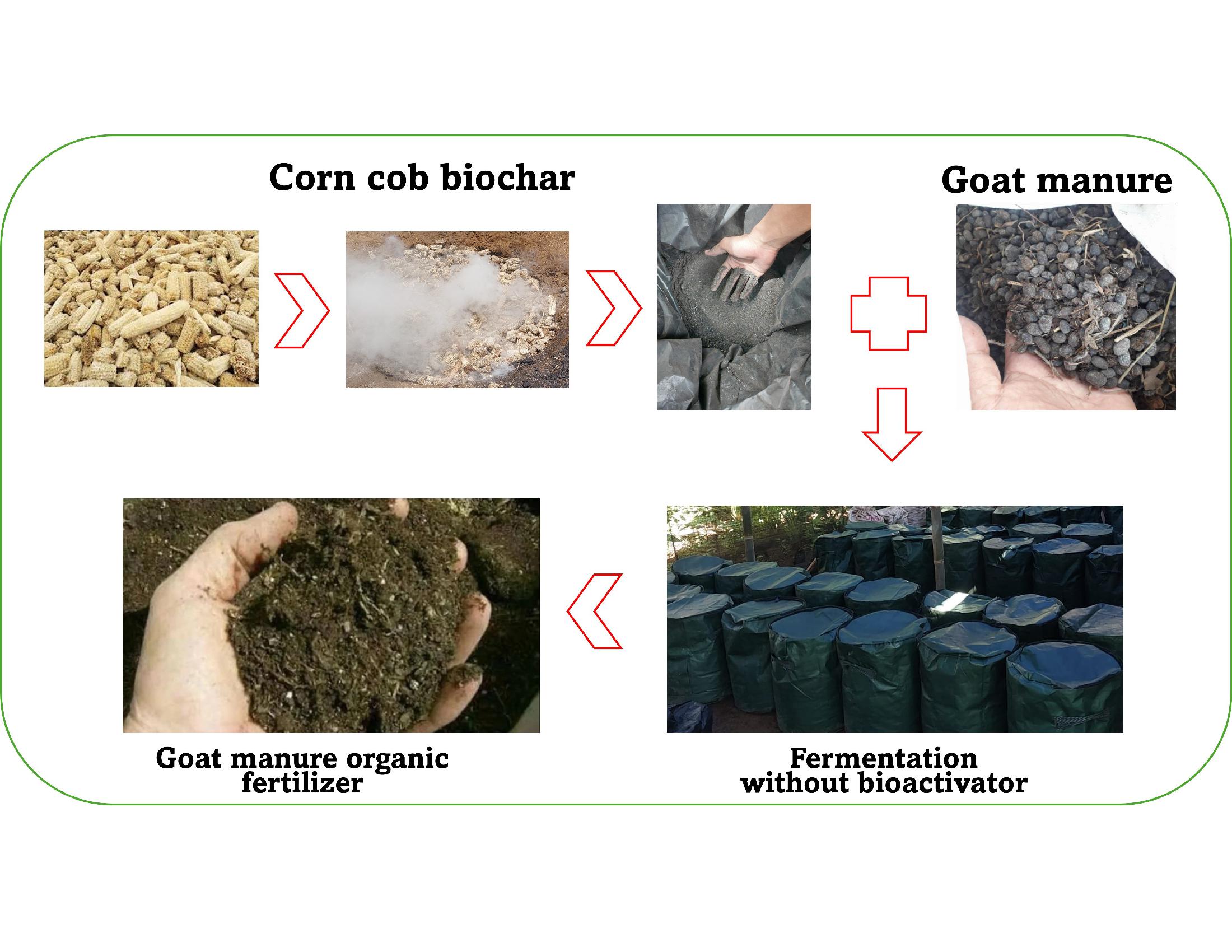
Method: A randomized Complete Block Design with the first factor of no application and application of 10% biochar based on weight of goat manure and the second factor of being without stirring or with weekly stirring was tested, and each treatment was repeated five times. The observed variables were pH, temperature, humidity, water content, and chemical characteristics viz. C-organic, N, P2O5, and K2O.
Results: The addition of corncob biochar with or without stirring to the manure of goats produced better-quality organic fertilizer with the low relative humidity, and high contents in C-organic, N, and K.
Conclusion: composting using corncob biochar with or without stirring resulted in better-quality composting by using corncob biochar with or without stirring resulted in a better-quality organic fertilizer compared to composting without biochar application based on regional and national standards supported by WHO such as those in Canada, USA and Europe.
Highlight
· Converting corncob to biochar is a promising strategy in agricultural waste management.
· Biochar could apply as an indigenous material in the composting process.
· The addition of corncob biochar can minimize the nutrient loss during the process of composting of goat manure.
· Stirring the pile during composting process apparently does not affect the nutrient content of the compost especially for goat manure.
The better quality of goat manure compost has been resulted by application of biochar.
Keywords
- Compost quality,
- Crop residue,
- Livestock waste,
- Sustainable agriculture,
- Zero waste management
References
- Antonangelo, J. A., Sun, X., & Zhang, H. (2021). The role of co-composted biochar (COMBI) in improving soil quality, crop productivity, and toxic metal amelioration. Journal of Environmental Management, 277, 1–13. https://doi.org/10.1016/j.jenvman.2020.111443
- Begum, M., Kandali, G. G., Dutta, D., & Bey, C. K. (2023). Organic Fertilizer: A Key Component of Organic Agriculture-A Review. Agricultural Reviews. https://doi.org/10.18805/ag. R2626
- Brinton, W. F. (2000). Compost Quality Standards and Guidelines. New York State Association of Recyclers. Woods End Research Laboratory, Inc. USA. https://compost.css.cornell.edu/Brinton.pdf
- Cahyono, P., Loekito, S., Wiharso, D., Afandi, Rahmat, A., Komariah, Nishimura, N., & Senge, M. (2020). Patterns of nutrient availability and exchangeable aluminum affected by compost and dolomite in red acid soils in Lampung, Indonesia. International Journal of GEOMATE, 19, 173–179. https://doi.org/10.21660/2020.76.87631
- Chung, W. J., Chang, S. W., Chaudhary, D. K., Shin, J. D., Kim, H., Karmegam, N., Govarthanan, M., Chandrasekaran, M., & Ravindr, B. (2021). Effect of biochar amendment on compost quality, gaseous emissions and pathogen reduction during in-vessel composting of chicken manure. Chemosphere, 283, 1-8. https://doi.org/10.1016/j.chemosphere.2021.131129
- Chung, W., Shim, J., Chang, S. W., & Ravindran, B. (2023). Effect of biochar amendments on the co-Composting of food Waste and livestock manure. Agronomy, 13, 1–12. https://doi.org/10.3390/agronomy13010035
- Czekala, W., Jezowska, A., & Chelkowski, D. (2019). The Use of Biochar for the Production of Organic Fertilizers. Journal of Ecological Engineering, 20, 1–8. https://doi.org/10.12911/22998993/93869
- El Ouassif, H., Gayh, U., & Ghomi, M. R. (2023). Biochar production from agricultural waste (corncob) to remove ammonia from livestock wastewater. International Journal of Recycling of Waste in Agriculture, 13(1), 132409 (1-9). https://doi.org/10.57647/j.ijrowa.2024.1301.09
- Fan, S., Li, A., ter Heijne, A., Buisman, C. J. N., & Chen, W. S. (2021). Heat potential, generation, recovery and utilization from composting: A review. Resources, Conservation and Recycling, 175, 1–15. https://doi.org/10.1016/j.resconrec.2021.105850
- Gopal, M., Apshara, S. E., Neenu, S., & Gupta, A. (2024). Cocoa pod husk wastes derived biochar for overcoming potassium deficiency in organic agriculture. International Journal of Recycling of Waste in Agriculture, 14(2), 142519 (1-7). https://doi.org/10.57647/ijrowa-tyz5-1967
- Guo, R., Li, G., Jiang, T., Schuchardt, F., Chen, T., Zhao, Y., & Shen, Y. (2012). Effect of aeration rate, C/N ratio and moisture content on the stability and maturity of compost. Bioresource Technology, 112, 171–178. https://doi.org/10.1016/j.biortech.2012.02.099
- Hong-li, L., & Yan, W. (2011). Influence of total solid and stirring frequency on performance of dry anaerobic digestion treating cattle manure. Applied Mechanics and Materials, 79, 48-52. https://doi.org/10.4028/www.scientific.net/AMM.79.48
- Jia, X., Wang, M., Yuan, W., Ju, X., & Yang. B. (2016). The influence of biochar addition on chicken manure composting and associated methane and carbon dioxide emissions. Bioresources, 11, 5255–5264. https://doi.org/10.15376/biores.11.2.5255-5264
- Jiang-ming, Z. (2017). Effect of turning frequency on co-composting pig manure and fungus residue. Journal of the Air & Waste Management Association, 67, 313–321. https://doi.org/10.1080/10962247.2016.1232666
- Jindo, K., Sánchez-Monedero, M. A., Hernández, T., García, C., Furukawa, T., Matsumoto, T., Sonoki, T., & Bastida, F. (2012). Biochar influences the microbial community structure during manure composting with agricultural wastes. The Science of the Total Environment, 416, 476–481. https://doi.org/10.1016/j.scitotenv.2011.12.009
- Jindo, K., Mizumoto, H., Sawada, Y., Sanchez-Monedero, M. A., & Sonoki, T. (2014). Physical and chemical characterization of biochars derived from different agricultural residues. Biogeosciences, 11, 6613–6621. https://doi.org/10.5194/bg-11-6613-2014
- Khan, N., Clark, I., Sánchez-Monedero, M. A., Shea, S., Meier, S., & Bolan, N. (2014). Maturity indices in co-composting of chicken manure and sawdust with biochar. Bioresource Technology, 168, 245–251. https://doi.org/10.1016/j.biortech.2014.02.123
- Khan, M. T., Aleinikoviene, J., & Butkeviˇciene, L. M. (2024). Innovative Organic Fertilizers and Cover Crops:Perspectives for Sustainable Agriculture in the Era of Climate Change an Organic Agriculture. Agronomy, 14, 2871. https://doi.org/10.3390/agronomy14122871
- Liu, N., Zhou, J., Han, L., Ma, S., Sun, X., & Huang, G. (2017). Role and multi-scale characterization of bamboo biochar during poultry manure aerobic composting. Bioresource Technology, 241, 190–199. https://doi.org/10.1016/j.biortech.2017.03.144
- López-Cano, I., Roig, A., Cayuela, M. L., Alburquerque, J. A., & Sánchez-Monedero, M. A. (2016). Biochar improves N cycling during composting of olive mill wastes and sheep manure. Waste Management, 49, 553–559. https://doi.org/10.1016/j.wasman.2015.12.031
- Melo, M. R. P., Martins, N., de Melo, E. I., & Okura, M. H. (2020). Biochar as an additive in the composting process. International Journal of Advanced Engineering Research and Science, 7(7), 267–276. https://doi.org/10.22161/ijaers.77.30
- Miyatake, F., & Iwabuchi, K. (2005). Effect of high compost temperature on enzymatic activity and species diversity of culturable bacteria in cattle manure compost. Bioresource Technology, 96, 1821–1825. https://doi.org/10.1016/j.biortech.2005.01.005
- Navianti, D., & Priyadi, K. A. (2023). The effectiveness of goat animal manure as an alternative activator for making compost from household organic waste. Journal of World Science, 2(2), 226-235. https://doi.org/10.58344/jws.v2i2.217
- Orskov, E. R., Yongabi, A. K., Subedi, M., & Smith, J. (2014). Overview of holistic application of biogas for small scale farmers in Sub-Saharan Africa. Biomass and Bioenergy, 70, 4-16. https://doi.org/10.1016/j.biombioe.2014.02.028
- Parra-Orobio, B. A., Soto-Paz, J., Hernández-Cruz, J. A., Gomez-Herreno, M. C., Dominguez-Rivera, I. C., & Oviedo-Ocana, E. R. (2023). Evaluation of biochar as an additive in the co-composting of green waste and food waste. Sustainability (Switzerland), 15(9), 1–18. https://doi.org/10.3390/su15097437
- Prasad, M., Lee, A., & Gaffney, M. T. (2012). A Detailed Chemical and Nutrient Characterisation of Compost and Digestate Fibre. rx3, Dún Laoghaire, Ireland.
- Public Works and Government Services of Canada (2013). Technical Document on Municipal Solid Waste Organics Processing. Minister of the Environment.
- Rizkiyah, S. P. A., Avivah, E. D., Rahman, A. A. T. A., & Rozci, F. (2024). Analysis of the Added Value of Goat Manure as Organic Fertilizer in Carangwulung Village, Wonosalam District. Asian Journal of Applied Research for Community Development and Empowerment, 8, 44-47. https://doi.org/10.29165/ajarcde.v8i3.449
- Setiani, V., Priastuti, U., & Yuniarta, D. P. (2021). Improvement of soil chemical properties using corncob biochar (BTJ). Jurnal Presipitasi, 18(1), 1–9. https://doi.org/10.14710/presipitasi.v18i1.1-9. (In Indonesian)
- Sudharmaidevi, C. R., Thampatti, K. C. M., & Saifudeen, N. (2017). Rapid production of organic fertilizer from degradable waste by thermochemical processing. International Journal of Recycling of Organic Waste in Agriculture, 6, 1-11. https://doi.org/10.1007/s40093-016-0147-1
- Tripathi, M., Sahu, J. N., & Ganesan, P. (2016). Effect of process parameters on production of biochar from biomass waste through pyrolysis: A review. Renewable and Sustainable Energy Reviews, 55, 467–481. https://doi.org/10.1016/j.rser.2015.10.122
- Wang, C., Lu, H., Dong, D., Strong, P. J., Wang, H., & Wu, W. (2013). Insight into the effects of biochar on manure composting: Evidence supporting the relationship between N2O emission and denitrifying community. Environmental Science and Technology, 47(13), 7341–7349. https://doi.org/10.1021/es305293h
- Wang, K., Yin, X., Mao, H., Chu, C., & Tian, Y. (2018). Changes in structure and function of fungal community in cow manure composting. Bioresource Technology, 255, 123–130. https://doi.org/10.1016/j.biortech.2018.01.064
- Wang, Y., Tang, Y., Li, M., & Yuan, Z. (2021). Aeration rate improves the compost quality of food waste and promotes the decomposition of toxic materials in leachate by changing the bacterial community. Bioresource Technology, 340, 1–10. https://doi.org/10.1016/j.biortech.2021.125716
- Widowati, L. R., Siregar, A. F., Anggria, L., Sipahutar, H. W. I. A., Septiyana, Rostaman, T., Budianto, A., Zakiah, R. A. K., Sarmah, Santri, J. A., Lindawati, D. I. K. E., Mutammimah, U., & Agustin, V. (2024). Organic Fertilizer and Soil Improver. Pertanian Press, Jakarta. e-ISBN 978-979-582-299-8. (In Indonesia)
- Xiao, R., Awasthi, M. K., Li, R., Park, J., Pensky, S. M., Wang, Q., Wang, J. J., & Zhang, Z. (2017). Recent developments in biochar utilization as an additive in organic solid waste composting: A review. Bioresource Technology, 246, 203–213. http://dx.doi.org/10.1016/j.biortech.2017.07.090
- Yang, X. C., Han, Z. Z., Ruan, X. Y., & Chai, J. (2019). Composting swine carcasses with nitrogen transformation microbial strains: succession of microbial community and nitrogen functional genes. Science of the Total Environment, 688, 555– 566. https://doi.org/10.1016/j.scitotenv.2019.06.283
- Zhang, J., Chen, G., Sun, H., Zhou, S., & Zou, G. (2016). Straw biochar hastens organic matter degradation and produces nutrient-rich compost. Bioresource Technology, 200, 876–883. https://doi.org/10.1016/j.biortech.2015.11.016
- Zhang, J., Ying, Y., & Yao, X. (2019). Effects of turning frequency on the nutrients of Camellia oleifera shell co-compost with goat dung and evaluation of co-compost maturity. Plos One, 14, 1–16. https://doi.org/10.1371/journal.pone.0222841