
 10.57647/ijrowa.2026.18743
The Quality of Organic Fertilizer from Chicken Manure Fortified with Agricultural Waste Using a Rotary Drum System
- Wehandaka Pancapalaga*
 1
1 - Khusnul Khotimah1
- Malikah Umar2
- University of Muhammadiyah Malang Ringgold standard institution - Faculty of Agricultural Animal Science Malang, Indonesia
- Bangkalan Madura University Ringgold standard institution - Faculty of Agriculture, Bangkalan, East Java, Indonesia

Received: 2025-07-21
Revised: 2025-10-03
Accepted: 2025-12-13
Published in Issue 2026-09-30
Published Online: 2026-02-02
Copyright (c) -1 Wehandaka Pancapalaga, Khusnul Khotimah, Malikah Umar (Author)

This work is licensed under a Creative Commons Attribution 4.0 International License.
How to Cite




PDF views: 117





Abstract
Purpose: Organic fertilizer from chicken manure has the ability to improve soil structure, enhance the soil's capacity to retain water and air, and stimulate beneficial microbial activity within the soil. The objective of this research is to improve the quality of organic fertilizer derived from chicken manure by adding organic waste through composting using a rotary drum system.
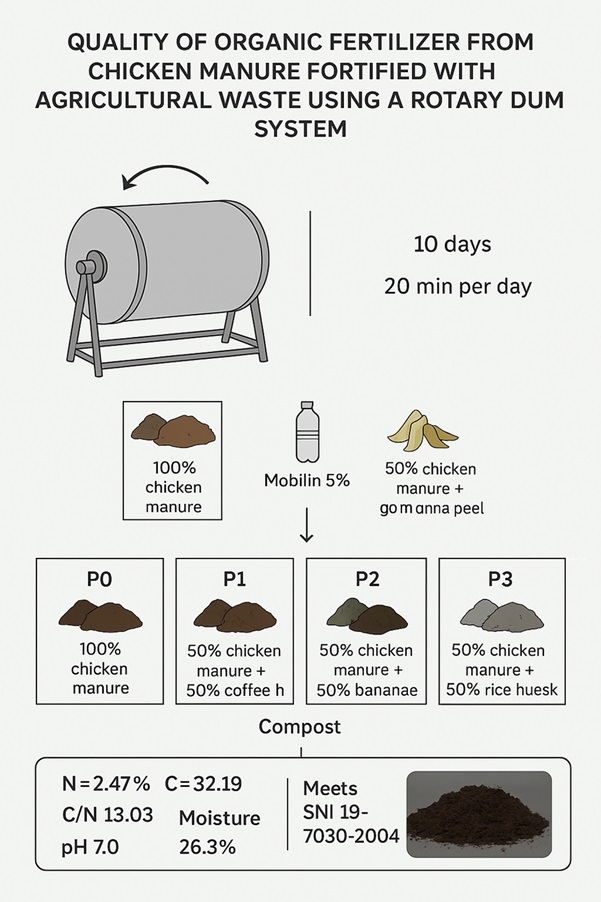
Method: follows an experimental approach using a Completely Randomized Design (CRD). The treatments applied were as follows: P0=100% layer chicken manure; P1= 50%-layer chicken manure: 50% coffee husk waste. P2= 50%-layer chicken manure: 50% banana peel waste. P3 = 50%-layer chicken manure: 50% rice husk ash. The compost quality parameters measured included nitrogen (N), phosphorus (P), potassium (K), organic carbon (C-organic), moisture content, and the C/N ratio,
Result: The research findings indicated significant differences (P<0.05) in nitrogen content, potassium content, carbon content, C/N ratio, and moisture content of the organic fertilizer with different types of agricultural waste. However, phosphorus content did not show significant differences with the addition of any agricultural waste.
Conclusion The addition of 50% coffee husk to chicken manure (P1) produced the best compost quality, with the highest nitrogen (2.47%) and organic carbon (32.19%), a C/N ratio of 13.03 within the SNI standard, and a stable pH of 7.0. While phosphorus remained stable, all treatments met the SNI requirements, confirming P1 as the most effective formulation for high-quality organic fertilizer.
Highlights
· The study evaluated the effect of fortifying chicken manure with agricultural wastes (coffee husk, banana peel, and rice husk ash) on compost quality using a rotary drum composter.
· The rotary drum system enhanced aeration and uniform mixing, accelerating composting and improving nutrient stability.
· The combination of 50% chicken manure and 50% coffee husk (P1) produced the best results with N = 2.47%, C-organic = 32.19%, and C/N ratio = 13.03, meeting SNI 19-7030-2004 standards.
· Coffee husk addition improved nitrogen, potassium, and carbon content while reducing moisture content to 26.30%.
· All formulations met SNI quality requirements, but only P1 achieved optimal compost maturity, neutral pH (7.0), and blackish-brown color indicating stable humus formation.
· The findings confirm that fortification with coffee husk in rotary drum composting is an effective method for producing high-quality organic fertilizer from poultry waste.
Keywords
- Compost quality,
- Fortification,
- Organic waste,
- Rotary drum
References
- Alfadlli, N. S., Noor, S., Hertanto, B. S., & Cahyadi, M. (2018). The effect of various decomposers on quality of cattle dung compost. Buletin Peternakan, 42(3), 250–255. https://doi.org/10.21059/buletinpeternak.v42i3.25865
- AOAC. (2016). Official methods of analysis of the Association of Official Analytical Chemistry International (20th ed.). AOAC Inc.
- Bhave, P. P., & Kulkarni, B. N. (2019). Effect of active and passive aeration on composting of household biodegradable wastes. International Journal of Recycling of Organic Waste in Agriculture, 8(2), 335–344. https://doi.org/10.1007/s40093-019-00306-7
- Chan, S. R. O., Achmad, B. S., Ferdinant, & Fambari, R. L. (2024). Analysis of nutrient content of stem banana compost as organic fertilizer. Journal Agron Tropika, 6(1), 149–154. https://doi.org/10.36378/juatika.v6i1.3377
- Cortés, F. M., Trevilla, J. P., Lopez, F. M., Buitron, G., & Quijano, G. (2021). H₂S oxidation coupled to nitrate reduction in a two-stage bioreactor: Targeting H₂S-rich biogas desulfurization. Waste Management, 120, 190–199. https://doi.org/10.1016/j.wasman.2020.11.024
- Daryono, D., & Alkas, T. R. (2017). Pemanfaatan limbah pelepah dan daun kelapa sawit sebagai pupuk kompos. Journal Hutan Tropis, 5(3), 188–195. https://doi.org/10.20527/jht.v5i3.4785
- Irfan, M., Pradani, F. Y., & Wijayanti, R. (2023). Utilization of various organic wastes as liquid biofertilizer carrier agents towards viability of bacteria and green bean growth. Journal of Tropical Life Science, 12(1), 1–7. https://doi.org/10.11594/jtls.12.01.01
- Jara-Samaniego, J., Antolín-Llovera, M., Pinedo-Vega, J., Ramos-Rodríguez, D., & Ceballos-Romero, J. (2017). Development of organic fertilizers from food market waste and their agronomic potential. PLOS ONE. https://doi.org/10.1371/journal.pone.0181621
- Khair, R. M., Mizwar, A., & Rahmadayani, E. (2018). Pemanfaatan lumpur wastewater treatment plant dan abu boiler industri refinery dan biodiesel minyak kelapa sawit dengan sistem in-vessel composting. Jukung (Journal Teknik Lingkungan), 4(2), 49–64. https://doi.org/10.20527/jukung.v4i2.6584
- Kiss, N. É., Tamás, J., Mannheim, V., & Nagy, A. (2023). Comparing the environmental impact of poultry manure and chemical fertilizers. Frontiers in Built Environment, 9, 1237476. https://doi.org/10.3389/fbuil.2023.1237476
- Muslih, A. R., & Bagastyo, A. Y. (2022). Studi teknologi pengolahan biowaste perkotaan dan potensi timbulan gas rumah kaca. Journal Teknik ITS, 11(1), C9–C16. https://doi.org/10.12962/j23373539.v11i1.82435
- Nguyen, B. T., Le, T. H., Ho, Q. T., & Van Tran, T. (2024). In-vessel composting of vegetable waste and compost application trial on lettuce (Lactuca sativa L.). Chemical Engineering Transactions, 113, 655–660. https://doi.org/10.3303/CET24113110
- Pancapalaga, W., Suyatno, S., & Sedlacek, D. (2021). The use of rumen contents as bio-activators for fermentation in goat manure fertilizer production. E3S Web of Conferences, 226, Article 00048. https://doi.org/10.1051/e3sconf/202122600048
- Ruslinda, Y., Aziz, R., Arum, L. S., & Sari, N. (2021). The effect of activator addition to compost with biopore infiltration hole (BIH) method. Journal Ilmu Lingkungan, 19(1), 53–59. https://doi.org/10.14710/jil.19.1.53-59
- Shang, B., Zhang, K., Chen, Z., & Wen, Q. (2025). Comparison of using animal manure and sludge compost as biofilter filling material for off-gas control in aerobic composting. Waste Management, 193(1), 472–480. https://doi.org/10.1016/j.wasman.2024.12.033
- Shwe, K. K., Mar, S. S., Win, T., Hlaing, W. Y., Thwin, H. M., Ngwe, K., & Sakai, T. (2021). Effect of chicken manure and chemical fertilizer applications on growth and yield of rice (Oryza sativa L.). International Journal of Environmental and Rural Development, 12(1), 149–154. https://doi.org/10.32115/ijerd.12.1_149
- Sołowiej, P., Pochwatka, P., Wawrzyniak, A., Łapiński, K., Lewicki, A., & Dach, J. (2021). The effect of heat removal during thermophilic phase on energetic aspects of biowaste composting process. Energies, 14(4), 1183. https://doi.org/10.3390/en14041183
- Walpajri, F., Siregar, F. W., Ilyosa, A. N., & Wiyaga, M. (2023). Effectiveness of various types of bio-activators to speed up the composting process and quality of compost fertilizer. International Journal of Progressive Sciences and Technologies, 36(2), 630–636. https://doi.org/10.52155/ijpsat.v36.2.4900
- Xie, A., Tran, S. H., Pu, M., & Zhang, T. (2023). Transformation characteristics of organic matter and phosphorus in composting processes of agricultural organic waste: Research trends. Materials Science for Energy Technologies, 6, 331–334. https://doi.org/10.1016/j.mset.2023.02.006
- Yanqoritha, N. (2023). The influence of physico-chemical and bioactivators for composting of traditional market vegetable waste. Journal Penelitian Pendidikan IPA, 9(4), 1696–1704. https://doi.org/10.29303/jppipa.v9i4.3238
- Yulianingsih, R. (2018). Pengaruh pupuk kandang kotoran ayam terhadap pertumbuhan dan hasil tomat (Lycopersicum esculentum Mill.). PIPER, 26(14), 313–320. https://doi.org/10.51826/piper.v14i26.129
- Zhang, L., Sun, X., & Wang, H. (2022). Techno-economic evaluation and life cycle assessment of a biorefinery using winery waste streams for succinic acid production. Bioresource Technology, 344, 126295. https://doi.org/10.1016/j.biortech.2021.126295