
 10.57647/ijrowa.2026.18742
Investigating the Influence of Three Organic Substrates on Eudrilus eugeniae Cultivation
- Ginette Sandrine Liégui
 1
1 - Carine Nono Temegne1
- Guy Valerie wafo Djumyom2
- Sylvie Mireille Mendomo Eyenga1
- Detrithus Borel Koumko Sandeu1
- Atabong Paul Agendia1
- Narcisse Steve Keundo Mbadia1
- Emmanuel Youmbi1
- Serge Hubert Togouet Zébazé1
- University of Yaounde I, Department of Plant Biology, Yaoundé, Centre Region, Cameroon
- University of Dschang, Department of Plant Biology, Dschang, West, Cameroon

Received: 2025-02-03
Revised: 2025-10-20
Accepted: 2025-12-22
Published Online: 2026-01-31
Copyright (c) -1 Ginette Sandrine Liégui, Carine Nono Temegne, Guy Valerie wafo Djumyom, Sylvie Mireille Mendomo Eyenga, Detrithus Borel Koumko Sandeu, Atabong Paul Agendia, Narcisse Steve Keundo Mbadia, Emmanuel Youmbi, Serge Hubert Togouet Zébazé (Author)

This work is licensed under a Creative Commons Attribution 4.0 International License.
How to Cite




PDF views: 27





Abstract
Purpose: To contribute to the management of organic waste and the improvement of agricultural production, the objective of this study was to assess the effect of three organic wastes on Eudrilus eugeniae cultivation.
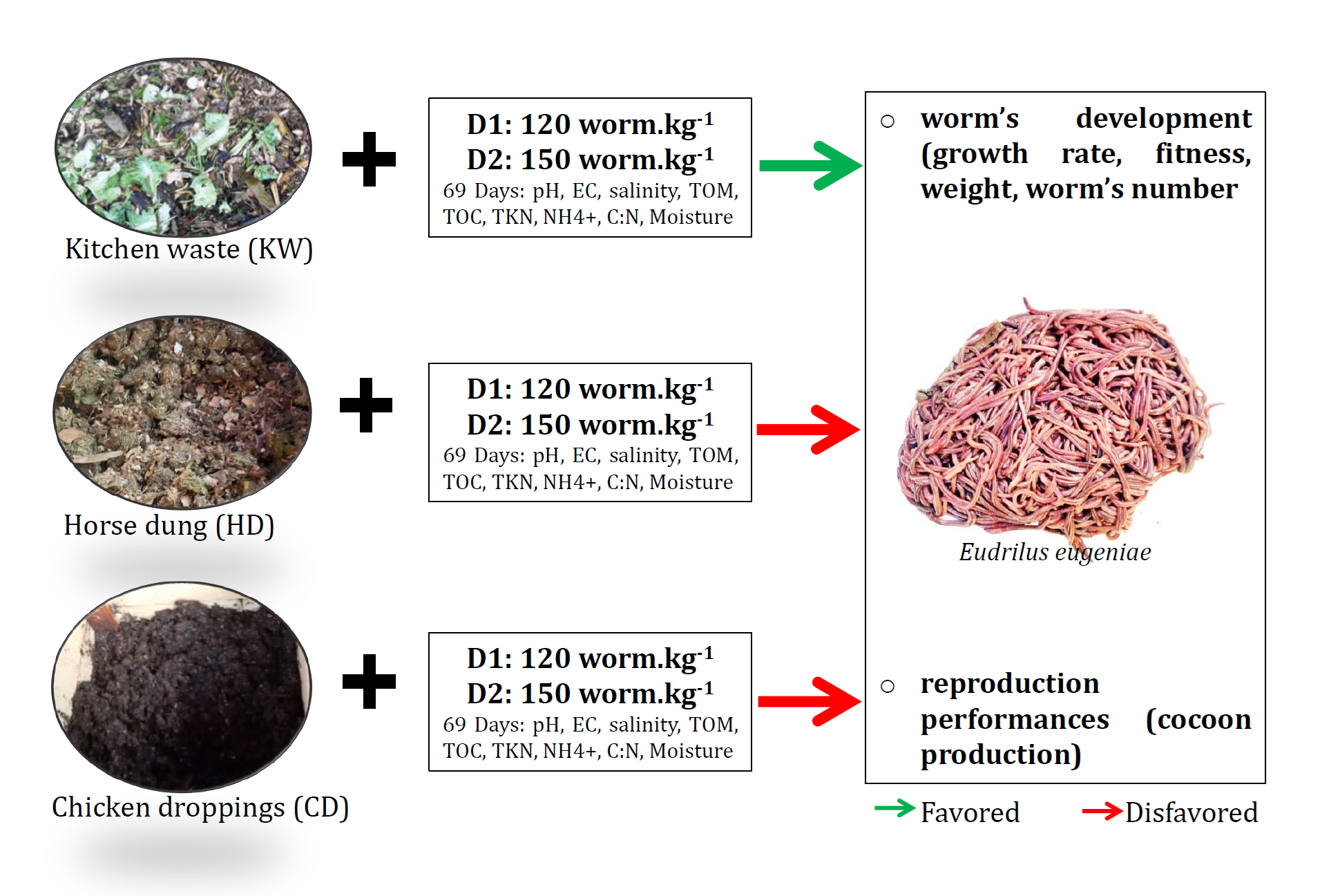
Method: The experiment was carried out from October 2022 to May 2023 at the University of Yaounde I. The method consisted of collecting and pre-composting organic wastes (kitchen waste: KW, horse dung: HD, and chicken droppings: CD). Epigeic worms, Eudrilus eugeniae were collected and a batch-feeding system was set up in boxes. The experimental design consisting of six treatments replicated three times established with T1=KW+120 worms.kg-1; T2=CD+120 worms.kg-1; T3=HD+120 worms.kg-1; T4=KW+150 worms.kg-1; T5=CD+150 worms.kg-1 and T6=HD+150 worms.kg-1. The physicochemical characteristics of the substrates (pH, Conductivity, Salinity, Total organic matter (TOM), Total organic carbon (TOC), Nitrogen, NH4+, C:N ratio) were measured every 15 days. During the 10 weeks of the experiment, the effect of the substrates on earthworms’ growth and reproduction were determined by physicochemical analyses and correlation test.
Results: The results showed that the physicochemical quality of the substrate significantly affected worm’s growth and their reproduction performances. An increase of salinity negatively affected the worm’s weight, the growth rate and the cocoon production. The decrease of C: N, TOM and TOC negatively affected the growth rate This study revealed that the best performances in terms of growth rate, fitness, weight, worm number, and cocoon production were obtained in Kitchen waste (T1: Kitchen waste + 120 worms·kg⁻¹ ).
Conclusion: Kitchen organic waste is a suitable substrate for Eudrilus eugeniae cultivation.
Highlights
· The physicochemical quality of the substrate significantly affected the growth and the reproduction performances of Eudrilus eugeniae
· The increase of salinity and conductivity negatively affected the worm’s weight, growth rate and cocoon production
· The decrease of C:N, TOM and TOC negatively affected the growth rate of Eudrilus eugeniae
· Kitchen organic waste with a stock density of 120 worms.kg-1 showed a higher growth rate, earthworm biomass, and number of cocoons
· Too much wood shavings in chicken droppings and horse dung affects the substrate quality and the earthworms’ palatability.
Keywords
- Eudrilus eugeniae,
- Organic waste,
- Reproduction,
- Substrate characteristic,
- Worm cultivation
References
- Awasthi, MK.., Pandey, AK., Khan, J., Bundela, PS., Wong, JW., & Selvam, A. (2014). Evaluation of thermophilic fungal consortium for organic municipal solid waste composting. Bioresource Technology, 168, 214-221. https://doi.org/10.1016/j.biortech.2014.01.048
- Balachandar, R., Baskaran, L., Yuvaraj, A., Thangaraj, R., Subbaiya, R., Ravindran, B., Chang, SW., & Karmegam, N. (2019). Enriched pressmud vermicompost production with green manure plants using Eudrilus eugeniae. Bioresouce Technology, 122578. https://doi.org/10.1016/j.biortech.2019.122578
- Bhat, SA., Singh, J., & Pal Vig, A. (2015). Vermitechnology: An eco Approach of Solid Waste management in rural areas. Journal of Global Ecology and Environment,. 2(2), 69–75. ISSN: 2454-2644
- Bhat, S., Singh, J., & Vig, AP. (2017). Instrumental characterization of organic wastes for evaluation of vermicompost maturity. Journal of Analytical Science and Technology, 8(2), 1–12. https://doi.org/10.1186/s40543-017-0112-2
- Bazrafshan, E., Zarei, A., Kord, MF., Poormollae, N., Mahmoodi, S., & Zazouli, MA. (2016). Maturity and Stability Evaluation of Composted Municipal Solid Wastes. Health Scope, 5(1), 1-9. https://doi.org/10.17795/jhealthscope-33202
- Belmeskine, H., Dilmi, N., & Tsagadirts, Z. (2023). Aquacultural sludge recovery and vermicomposting for soil amendment: A useful strategy for sustainable agriculture. International Journal of Recycling Organic Waste in Agriculture, 12(1): 111-121. https://doi.org/10.30486/ijrowa.2022.1944998.1372
- Biruntha, M., Karmegam, N., Archana, J., Karunai, SB., John Paul, JA., Balamuralikrishnan, B., Chang, SW., & Ravindran, B. (2020). Vermiconversion of biowastes with low-to-high C/N ratio into value added vermicompost. Bior Tech, 297, 122398. https://doi.org/10.1016/j.biortech.2019.122398
- Bokobana, A., Toundou, O., Kolani, L., Amouzouvi, K., Koledzi, E., Tozo, K., & Tchangbédj, G. (2017). Traitement de déchets ménagers par co-compostage avec la légumineuse Cassia occidentalis L. et quelques adjuvants de proximité pour améliorer la qualité agronomique de composts. Environnement Ingénierie & Développement. 73(5): 0–13. https://doi.org/10.4267/dechets-sciences-techniques.3551
- Boruah, T., Barman, A., Kalita, P., Lahkar, J., & Deka, H. (2019). Vermicomposting of citronella bagasse and paper mill sludge mixture employing Eisenia fetida. Bioresource Technology, 294(August), 122147. https://doi.org/10.1016/j.biortech.2019.122147
- Camposeco, SI., Espinoza, OCH., Cadena, ACJF., & Hernández, GMCM. (2024). Chemical and Physical Characterization of Vermicompost Produced from Organic Substrates. Journal of Global Agriculture and Ecology, 16(3), 21–29. https://doi.org/10.56557/jogae/2024/v16i38757
- Capo-Chichi, P. (2012). Association achatiniculture et vermiculture (Memoire) Mémoire, ENSTA/UAK du Bénin
- Coulibaly, SS., Tondoh, EJ., Kouassi, KI., Barsan, N., Nedeff., V., & Zoro, BI., (2016). Vermicomposts improve yields and seeds quality of Lagenaria siceraria in Côte d’Ivoire. International Journal of Agiculture and Agriculrural Resources, 8(3), 26–37.
- Degefe, G., & Tamire, G. (2017). Growth and reproductive performance of Eisenia fetida in three varieties of flower (rose, carnation and hypericum) leftovers. Journal of Entomology and Nematology, 9(July), 29–35. https://doiorg/105897/jen20170181
- Devendran, M., Rashid, S., Mohd, H., Mohd,Y., Mark, L., & Ahmer, AS. (2022). A review on treatment processes of chicken manure. Cleaner and Circular Bioeconomy, 2, 100013. https://doiorg/101016/jclcb2022100013
- Devi, C., & Khwairakpam, M. (2020). Bioconversion of Lantana camara by vermicomposting with two different earthworm species in monoculture. Bioresource Technology, 296, 122308. https://doi.org/10.1016/j.biortech.2019.122308
- Dickerson, G. (2004) Vermicomposting, Guide H-164 College of Agriculture and Home Economics/New Mexico State University pp 1–10.
- Djossa, A., Alissou, BK, Mensah, GA., & Sinsin, BA. (2014). Performance de production de biomasse du ver de fumier Eisenia foetida sur différents substrats. Bulletin de Recherche Agronomique Du Bénin, 1(229), 26–31. ISSN:1840-7099
- Dume, B., Hanc, A., Svehla, P., Michal, P., Pospisil, V., Grasserov, A., Cajthaml, T., Chan, AD., & Nigussie, A. (2023). Influence of earthworms on the behaviour of organic micropollutants in sewage sludge Alena Grasserov. Journal of Clean Production, 416(6), 137869. https://doi.org/10.1016/j.jclepro.2023.137869
- Ehouman, N., Touré, M., Soro, M., Gadjé, A., Bobo, S., & Tiho, S. (2020). Croissance et reproduction de l’espèce de ver de terre Eudrilus eugeniae (Kinberg, 1867) Eudrilidae, Oligochaeta dans trois sous-produits agricoles. Afrique Science, 16(4 ), 194–204. ISSN 1813-548X. http://www.afriquescience.net/
- FAO (2015) Perspectives pour l’environnement-l’agriculture et l’environnement Food and Agriculture Organization of the United Nations, Rome. https://wwwfaoorg/4/y3557f/y3557f11html
- Fu, X., Huang, K., Li, F., & Chen, X. (2014). The biochemical properties and microbial profiles of vermicomposts affected by the age groups of earthworms. Pakistan Journal of Zoology, 46(5), 1205–1214. ISSN00309923
- Garczyńska, M., Kostecka, J., Paczka, G., Hajduk, E., Mazur-Paczka, A., & Butt, KR. (2020). Properties of vermicomposts derived from cameroon sheep dung. Applied Sciences (Switzerland), 10(15), 1–14. https://doi.org/10.3390/app10155048
- Gebrehana, GZ., Gebremikael, MT., Beyene, S., Sleutel, S., Wesemael, WML., & De Neve, S. (2023). Organic residue valorization for Ethiopian agriculture through vermicomposting with native (Eudrilus eugeniae) and exotic (Eisenia fetida and Eisenia andrei ) earthworms. European Journal of Soil Biology 116(May–June), 103488. http://doi.org/10.1016/j.ejsobi.2023.103488
- Gebrehana, ZG., Gebremikael, MT., Beyene, S., Wesemael, WM., & De Nev,e S. (2022). Assessment of trade-offs, quantity, and biochemical composition of organic materials and farmer's perception towards vermicompost production in smallholder farms of Ethiopia. Journal of Material Cycles and Waste Management, 24(2), 540-552. http://doi.org/10.1007/s10163-021-01339-9
- Gheisari, S., Danesh, S., & Mahmoud, S. (2010). Growth and reproduction of Eisenia fetida in vermicomposting of organic fraction of municipal solid wastes. Asian Journal of Chemistry, 22(2), 1266–1274.
- Giroux, M., & Audesse, P. (2004). Comparaison de deux méthodes de détermination des teneurs en carbone organique, en azote total et du rapport C/N de divers amendements organiques et engrais de ferme. Agrosol, 15(2), 6-8.
- Guadarrama-Nonato, A., Mejía-Carranza, J., & Ramírez-Gerardo, MG. (2018). Mineralization of organic matter in soils with differential management in rose cultivation Acta Universitaria, 28(32):33-41. https://doi.org/10.15174/au.2018.1654
- Gusain, R., & Suthar, S. (2020). Vermicomposting of duckweed (Spirodela polyrhiza) by employing Eisenia fetida: Changes in nutrient contents, microbial enzyme activities and earthworm biodynamics. Bioresource Technology, 311(May), 123585. https://doi.org/10.1016/j.biortech.2020.123585
- Hussain, N., & Abbasi, SA. (2018). Efficacy of the Vermicomposts of Different Organic Wastes as “Clean” Fertilizers State-of-the-Art. Sustainability, 10 (1205): 1-63. https://doi.org/10.3390/su10041205
- HYSACAM (2023). Le Centre de Traitement des Déchets de Nkolfoulou : un exemple de décharge controlée. wwwhysacam-proprete.com
- Jayakumar, V., Murugan, S., & Manivannan, S. (2018.) Biodyanamics of epigeic earthworm Eudrilus eugeniae and Eisenia fetida during recycling of poultry waste amended with different organic food sources. Int Arch Applied Science and Technology, 9(4), 46–51. https://doi.org/10.15515/iaast.0976-4828.9.4.4651
- Joko, NWK., Nur, SB., & Tri, N. (2010). Pengaruh variasi jumlah dan jenis bulking agent pada pengomposan limbah organik sayuran dengan komposter mini. In Prosiding Seminar Nasional Perteta Purwokerto. https://doi.org/10.20885/jstl.vol2.iss1.art5
- Joy, A, & Kamath, S. (2017) Management of industrial sludge by vermicomposting: A pilot scale study. International Journal of Civil Engineering Technology, 8(4), 1471–1478. ISSN: 09766316
- Karapantzou, I., Mitropoulou, G., Prapa, I., Papanikolaou, D., Charovas, V., & Kourkoutas, Y. (2023). Physicochemical Changes and Microbiome Associations during Vermicomposting of Winery. Sustainability, 15(9), 7484. https://doi.org/10.3390/su15097484
- Karmegam, N., Vijayan, P., Prakash, M., & John Paul, JA. (2019). Vermicomposting of paper industry sludge with cowdung and green manure plants using Eisenia fetida: A viable option for cleaner and enriched vermicompost production. Journal of Cleaner Production, 228, 718–728. https://doi.org/10.1016/j.jclepro.2019.04.313
- Karwal, M., & Kaushik, A. (2021). Bioconversion of lawn waste amended with kitchen waste and buffalo dung in burden Bioconversion of lawn waste amended with kitchen waste and buffalo dung in to value ‑ added vermicompost using Eisenia foetida to alleviate landfill burden. Journal of Material Cycles and Waste Management, 9: 2020. https://doi.org/10.1007/s10163-020-01101-7
- Kemassi, S. (2015). Etude de l’impact des vers de terre sur l’évolution de la matière organique en régions sahariennes : Cas de la cuvette de Ouargla (Mémoire de Master) Université de Kasdi Merbah-Ouargla 130p.
- Kemassi, S. (2021). Contribution à l’étude de l’impact des amendements organiques sur la lombriculture à Ouargla (Thèse de Doctorat) Université de Kasdi Merbah-Ouargla 158p.
- Kohli, R., & Hussain, M. (2016). Management of Flower Waste by Vermicomposting International Conference in Global Trends Engeneening Tech Manage, 34–38. ISSN: 2395-0056
- Kouadio, KP., Soro, S., Gboko, BG., Kouhana, S., Soro, YR., & Grace, G. (2023). Production of Eudrilus eugenia and Compost From Breeding Manure (Cattle , Cavies , Rabbits , And Poultry ) In South Of Côte D’ivoire. Sustainable Environment Agricultural Science, 07(10), 90–98. https://doi.org/10.22225/seas.7.2.7403.90-98.
- Kumar, JIN., Son, H., Kumar, R.N, & Patil, N. (2010). Growth and reproduction of Eisenia foetida in various Industry waste sludge during vermicomposting: A laboratory investigation. International Journal of Environment and Waste Management, 5(3–4), 379–391. https://doiorg/101504/IJEWM2010032015
- Liégui, GS., Cognet, S., Djumyom, GVW., Atabong, PA., Noutadie, JPF., Chamedjeu, RR., Temegne, CN., & Kengne, IMN. (2021) An effective organic waste recycling through vermicomposting technology for sustainable agriculture in tropics. International Journal of Recycling Organic Waste in Agriculture, 10(3), 203–214. https://doi.org/10.30486/ijrowa.2021.1894997.1080
- Li, M., Feng, F., & Cheng, L. (2012). Expression patterns of genes involved in sugar metabolism and accumulation during apple fruit development. PloSone, 7(3), e33055. https://doi.org/10.1371/journal.pone.0033055
- Lim, SL., & Wu ,TY. (2016). Characterization of matured vermicompost derived from valorization of palm oil mill byproduct. Journal of Agriculture and Food Chemistry, 64(8), 1761-1769. https://doi.org/10.1021/acs.jafc.6b00531
- Luu, HTT., Le, LT., & Green, ID. (2024). Effects of Vermicompost on the Growth and Yield of Spring Onion (Allium Fistulosum L). Journal of Agricultual Science (Belgrade), 69(1), 31–44. http://dx.doi.org/10.2298/JAS2401031L
- Mahmud, M., Adbullah, R., & Syafawati, YJ. (2018). Effect of vermicompost amended on nutritional status of sandy loam soil, growth performance and yield of pineapple (Ananas comosus var MD2) under field condition. Agrosol, 8, 183. https://doi.org/10.3390/agronomy8090183
- Manaf, LA., Jusoh, MLC., Yusoff, MK., Tengku, ITH., Harun, R., Juahir, H.,& Jusoff, K. (2009). Influences of Bedding Material in Vermicomposting Process. International Journal of Biology, 1(1), 81–91. https://doi.org/10.5539/ijb.v1n1p81
- Manono, B.O., & Moller, H. (2015) Effects of stock type, irrigation and effluent dispersal on earthworm species composition, densities and biomasses in New Zealand pastures. Pedobiol, 58(5-6), 187-193. https://doi.org/10.1016/j.pedobi.2015.09.002
- Miller, L., & Houghton, J. (1945). The micro-Kjeldahl determination of the nitrogen content of amino acids and proteins. Journal of Biology and Chemistry, 159, 373–383.
- Nath, S., & Chaudhuri, P. (2012). Effect of rubber leaf litter diet on growth and reproduction of five tropical species of earthworm under lab- oratory conditions. Journal of Applied Biosciences, 38, 151–55. https://doi.org/10.1007/s40093-016-0120-z.
- Neuhauser, EF., Loehr, RC., & Malecki, MR. (1988). The potential of earthworms for managing sewage sludge. In: Edwards, CA and Neuhauser EF, (eds), Earthworms in Waste and Environmental Management. SPB Academic Publishing, The Hague, 9-20.
- Ngale, T., Lombeko, OTV., Suh, C., Temegne, NC., Chimi, NLL., Ngonkeu, MEL., & Tonfack, LB. (2023). New Fertilization Approach Improves Okra (Abelmoschus esculentus L Moench) Production on Acidic and Degraded Soil in Cameroon. European Journal of Agriculture and Food Sciences 5(2), 13–22. https://doi.org/10.24018/ejfood.2023.5.2.647
- Ngouana, TLS., Tonfack, LB., Temegne, CN., Agendia, AP., & Youmbi, E. (2023). Current status of strawberry (Fragaria spp) cultivation and marketing in Cameroon. Journal of Food and Agricultural Resources, 14(August), 1–9. https://doi.org/10.1016/j.jafr.2023.100761
- Njukeng, NJ., Ngome, A., & Nono, CT. (2017). Response of African Nightshade ( Solanum sp ) to cassava peel-based manure in the humid forest zone of Cameroon. African Journal of Agricultural Resource, 12(22, 1866-1873. https://doi.org/10.5897/AJAR2017.12315
- Pundee, K., Akeprathumchai, S., & Tripetchkul, S. (2024). Vermicomposting of coir pith and cow manure: Influence of initial total phenolic content on earthwormsâ™ performance. International Journal of Recycling Organic Waste in Agrculture, 13(2): 132419 (1-18). https://doi.org/10.57647/j.ijrowa.2024.1302.19
- Peramban, E., Ramachandran, M., Rayan, R., & Manoharan,V. (2023). Effects of Physico Chemical Parameters on Biomass Produced by Using Earthworm Eudrilus Eugeniae. Intenational Journal of Current Science Research and Review, 06(04), 2222–2234. https://doi.org/10.47191/ijcsrr/V6-i4-02
- Pradnya, NI., Imani, CNA., Kusumaningrum, M., Ardhiansyah, H., Nugraha, DD., & Syakila, AF. (2023). The Potential of Earthworms (Eudrilus eugeniae) in Vermicompost Production from Vegetable Market of Waste Cabbage and Fruit Skins. Sainteknol, 21(1), 18–27. https://doi.org/10.15294/sainteknol.v21i1.43485
- Rahimi, G., & Karimi, F. (2020). The prolonged effect of salinity on growth and/or survival of earthworm Eisenia fetida. Intternational Journal of Environment and Waste Management, 18(1), 58-67. https://doi.org/10.15294/sainteknol.v21i1.43485
- Ramnarain, YI., Ansari, AA., & Ori, L. (2019). Vermicomposting of different organic materials using the epigeic earthworm Eisenia foetida. International Journal of Recycling Organic Waste in Agriculture, 8(1), 23–36. https://link.springer.com/article/10.1007/s40093-018-0225-7
- Sadia, MA., Hossain, MA., Islam, MR., Akter, T., & Shaha, DC. (2020). Growth and reproduction performances of earthworm (Perionyx excavatus) fed with different organic waste materials. Journal of Advanced Veterinary and Animal Research, 7(2), 331–337. https://doi.org/10.5455/javar.2020.g426
- Sakthika, T., & Sornalaksmi, V. (2019). Nutrients Analysis of Vermicompost of Water Hyacinth Supplemented with Probiotics Nutrients Analysis of Vermicompost of Water Hyacinth Supplemented with Probiotics. Acta Scientific Agriculture, 3(10), 10-13. https://actascientific.com/ASAG/pdf/ASAG-03-0637.pdf
- Satpathy, J., Saha, MH., Mishra, AS., & Mishra, SK. (2020). Characterization of Bacterial Isolates in Vermicompost Produced from a Mixture of Cow dung, Straw, Neem leaf and Vegetable Wastes. bioRxiv, 2: 1-10. https://doi.org/10.1101/2020.07.01.183467
- Selim, SM., Zayed, MS., & Atta, HM. (2012). Evaluation of phytotoxicity of compost during composting process. Natural Science, 10(2), 69–77. (ISSN: 1545-0740). http://www.sciencepub.net. 12
- Sequeira, V., & Chandrashekar, JS. (2015). Vermicomposting of Biodegradable Municipal Solid Waste Using Indigenous Eudrilus Sp. International Journal of Current Microbiology and Applied Science, 4(4), 356–365. ISSN: 2319-7706 http://www.ijcmas.com
- Sharma, K., & Garg, VK. (2019). Recycling of lignocellulosic waste as vermicompost using earthworm Eisenia fetida. Environmental Science and Pollution Researc, 26: 14026-14035. https://doi.org/10.1007/s11356-019-04639-8
- Singh, N., & Devi, K. (2024). Feeding Biology of Earthworms (Perionyx Excavatus and Eudrilus Eugeniae) and Bacteria Associated with their Guts and Vermicompost. Journal of Microbiology and Biotechnology, 9(3), 1-10. https://doi.org/10.23880/oajmb-16000304
- Suthar, S. (2007). Influence of different food sources on growth and reproduction performance of composting epigeics: Eudrilus eugeniae, Perionyx excavatus and Perionyx sansibaricus. Applied Ecology and Environmental Research 5(2),79–92. https://doiorg/1015666/aeer/0502_079092
- Tasin. T., Mahmud, R., Islam, T., Naznin, F., Islam, N., Dep, M., Hashan, M., & Bhuiyan, M. (2024). Effect of Vermicompost and Inorganic Fertilizer on the Growth and Yield Performance of Okra (Abelmoschus esculentus L). Journal of Bangladesh Agrcultural University, 22(1), 36. https://jbau.bau.edu.bd/index.php/home/article/view/537
- Temegne, NC., Patrice, J., Dooh, N., Nbendah, P., Ntsomboh-ntsefong, G., Taffouo, VD., & Youmbi, E. (2020). Cultivation and Utilization of Bambara Groundnut (Vigna subterranea ( L) Verdc), a Neglected Plant in Cameroon. Asian Plant Research Journal, 4(2), 9–21.https://doi.org/10.9734/aprj/2020/v4i230081
- Temegne, NC., Ngome, A., Agendia, A., & Youmbi, E. (2021). Agroecology for agricultural soil management In R A (eds) Jhariya MK, Banerjee A, Meena RS, Kumar S (Ed), Sustainable intensification for agroecosystem services and management (pp 267–321) Springer Nature.https://doi.org/10.1007/978-981-16-3207-5_9
- Thorat, R., & Bobade, H. (2018). Utilization of banana pseudo-stem in food applications. International Journal of Agricultural Engineering, 11, 86–9. https://doi org/1015740/HAS/IJAE/11Sp
- Tognetti, C., Mazzarino, MJ., & Laos, F. (2007). Improving the quality of municipal organic waste compost Bioresource Technology, 98(5), 1067–1076. https://doi.org/10.1016/j.biortech.2006.04.025
- Tondoh, JE., Dimobe, K., Guéi, AM., Adahe, L., Baidai, Y., N’Dri, JK., & Forkuor, G. (2019). Soil health changes over a 25-year chronosequence from forest to plantations in rubber tree (Hevea brasiliensis) landscapes in southern Côte d’Ivoire: Do earthworms play a role? Frontiers in Environmental Science, 7(June), 1-19. https://doi.org/10.3389/fenvs.2019.00073
- Wu, Z., Yin, B., Song, X., Qiu, J., & Cao, L. (2019). Effects of Salinity on Earthworms and the Product During Vermicomposting of Kitchen Wastes. International Journal of Environmental Research and Public Health, 16(4737), 1–12. https://doi.org/10.3390/ijerph16234737
- Yu, K., Li, S., Sun, X., & Kang, Y. (2020). Maintaining the ratio of hydrosoluble carbon and hydrosoluble nitrogen within the optimal range to accelerate green waste composting. Waste Management, 105, 405–413. https://doi.org/10.1016/j.wasman.2020.02.023
- Zarea, MJ., & Karimi, N. (2022). Vermicomposting of cow dung amended with eggshell powder: Possible roles of eggshell powder on the growth models of Serendipita indica, wheat growth and performances and soil enzymes activity. International Journal of Recycling Organic Waste in Agriculture, 11(4): 463-480. https://doi.org/10.30486/ijrowa.2021.1930581.1246
- Zhan, J., & Sun, Q. (2011). Diversity of free-living nitrogen-fixing microorganisms in wastelands of copper mine tailings during the process of natural ecological restoration. Journal of Environmntal Science, 23(3), 476–487. https://doi.org/10.1016/s1001-0742(10)60433-0