
 10.57647/ijrowa.2026.18741
Nutrient Release Pattern of Different Organic Sources under Controlled Conditions
- Rashid Mukhtar
 1
1 - Wazir Ahmed*1
- Tanveer Ul Haq
 1
1 - Shafqat Saeed2
- Ashfaq Ahmad Rahi3
- Department of Soil & Environmental Sciences, MNS University of Agriculture, Multan, Pakistan
- Institute of Plant Protection, MNS University of Agriculture, Multan, Pakistan
- Pesticide Quality Control Lab, Multan, Pakistan
- Department of Agronomy, MNS University of Agriculture, Multan, Pakistan

Received: 2024-09-01
Revised: 2024-09-13
Accepted: 2025-12-13
Published in Issue 2026-06-30
Published Online: 2026-01-31
Copyright (c) -1 Rashid Mukhtar, Wazir Ahmed, Tanveer Ul Haq, Shafqat Saeed, Ashfaq Ahmad Rahi, Abdul Ghaffar (Author)

This work is licensed under a Creative Commons Attribution 4.0 International License.
How to Cite




PDF views: 59





Abstract
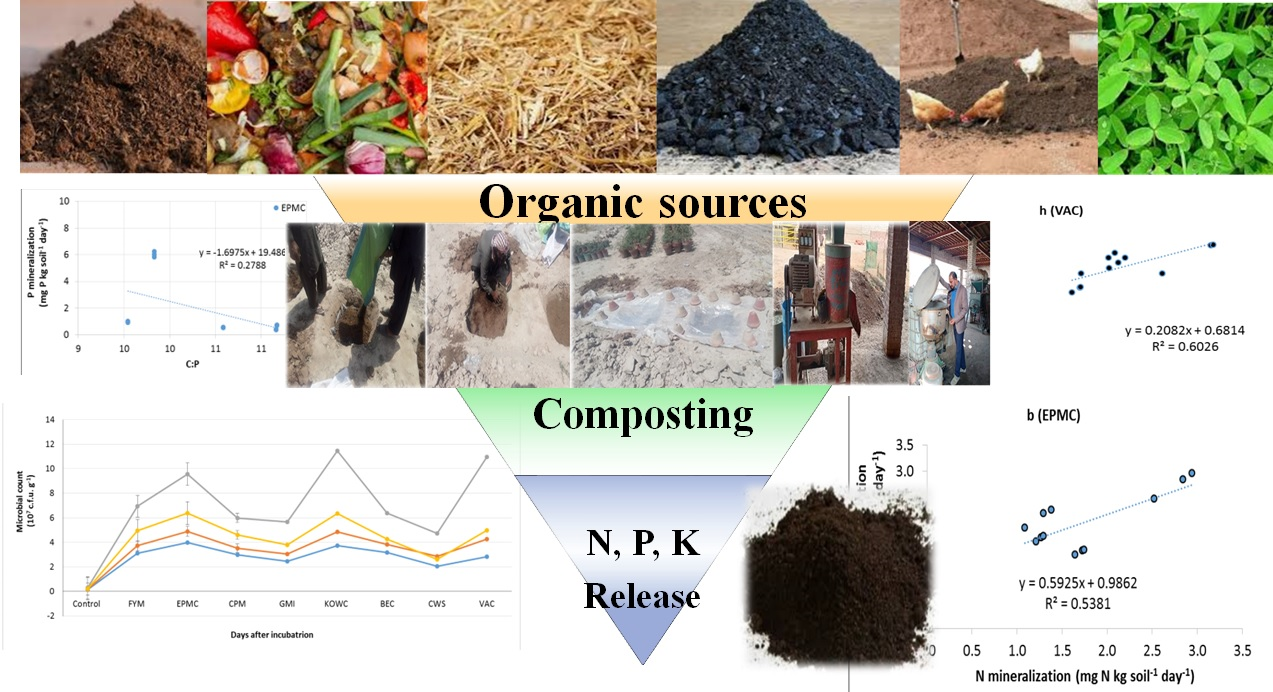
Purpose: It is essential to have up-to-date knowledge about the mineralization of organic sources and the release patterns of nutrients to ensure that crops receive sufficient nutrients throughout their growth cycle. Organic sources like compost, animal manure, and green manure are valuable nutrient sources for crop production. However, the nutrient content of these sources can vary based on factors such as the source, composition, and processing method. This study aimed to determine the release patterns of nitrogen (N), phosphorus (P), and potassium (K) from various organic sources to optimize their utilization.
Method: Seven types of compost, EPMC, CPM, GMI, Kitchen Organic Waste Compost (KOWC), Biochar-Enriched Compost (BEC), CWS, and Value-Added Compost (VAC), were collected from organic sources and evaluated for nutrient release patterns under controlled conditions over a 60-day period.
Results: The variations in SOM, C dynamics, nutrient mineralization rate were associated with chemical composition of the manures. EPMC was found as the most suitable P organic amendment for integration with chemical N fertilizers while KOWC demonstrated superior potential as an P organic source and BEC as a K-rich organic amendment. Additionally, VAC exhibited the most balanced and consistent nutrient release characteristics, making it a strong candidate for use as a general-purpose organic nutrient source.
Conclusion: No single manure type can be universally recommended for integrated management of N, P and K. Instead, nutrient specific calibration and detailed characterization of each manure source are essential for optimize the combined use of organic and inorganic nutrient inputs.
Highlights:
· The efficiency of compost mineralization was determined by the ratios of C:P and C:K, not C:N.
· Enriched poultry-based compost was a top source of organic nitrogen (N)
· Composted kitchen organic waste was ideal for phosphorus (P) nutrition.
· Biochar-enriched compost was the best organic fertilizer for potassium (K).
· Value-added compost emerged as a comprehensive single source of organic N, P and K
Keywords
- Composting,
- Compost value addition,
- Organic sources,
- Nutrient pattern
References
- Ahmed, T., Ameer, H. A., & Javed, S. (2021). Pakistan’s backyard poultry farming initiative: impact analysis from a public health perspective. Tropical Animal Health and Production, 53(2), 210. https://doi.org/10.1007/s11250-021-02659-6
- Asghar, M. S., & Afzal, M. (2020). Growth and yield promoting effect of NPK fortified with pressmud compost on sugarcane. Journal of Scientific Agriculture, 4, 96-99. https://doi.org/10.25081/jsa.2020.v4.6284
- Black, C. A., Evans, D. D., Ensminger, L. E., & White, J. L. (1965). Methods of Soil Analysis. CA Black, Editor-in-chief, DD Evans, LE Ensminger, JL White, FE Clark, Associate Editors (pp. 499-510). American Society of Agronomy. Madison, Wisconsin. https://doi.org/10.2134/agronmonogr9.1
- Bremner, J. M., & Mulvaney, C. S. (1982). Nitrogen—total. In A.L. Page (Ed.), Methods of soil analysis: Part 2 Chemical and microbiological properties (pp. 595-624). American Society of Agronomy, Inc., Soil Science Society of America, Inc. https://doi.org/ 10.2134/agronmonogr9.2.2ed
- Budiyanto, G. (2021). The effect of combination of sugarcane pressmud compost and potassium fertilizer on vegetative growth of corn in coastal sandy soil. Food Research, 5(3), 289-296. https://doi.org/10.26656/fr.2017.5(3).630
- Chapman, H. D., & Pratt, P. F. (1962). Methods of analysis for soils, plants and waters. Soil Science, 93(1), 68. https://doi.org/10.1097/00010694-196201000-00015
- Cheng, H., Che, M., Hu, W., Wu, Q., Cheng, Y., Hu, X., Xiong, S., Zheng, J., & Gong, Y. (2023). Soil-available nutrients associated with soil chemical and aggregate properties following vegetation restoration in western Sichuan, China. Forests, 14(2), 259. https://doi.org/10.3390/f14020259
- Datta, A., Mandal, B., Badole, S., Majumder, S. P., Padhan, D., Basak, N., Barmanb, R., Kundua, R., & Narkhede, W. N. (2018). Interrelationship of biomass yield, carbon input, aggregation, carbon pools and its sequestration in Vertisols under long-term sorghum-wheat cropping system in semi-arid tropics. Soil and Tillage Research, 184, 164-175. https://doi.org/10.1016/j.still.2018.07.004
- Diaz, P.M. (2016). Consequences of compost press mud as fertilizers. DJ International Journal of Advances in Microbiology & Microbiological Research, 1(1), 28–32. https://doi.org/10.18831/djmicro.org/2016011005
- FAOSTAT, F. (2019). Food and Agriculture Organization of the United Nations-Statistic Division, http://www.fao.org/faostat/en/
- Gunes, A. Y. D. I. N., Cicek, N., Inal, A. L. İ., Alpaslan, M., Eraslan, F., Guneri, E. S. R. A., & Guzelordu, T. (2006). Genotypic response of chickpea (Cicer arietinum L.) cultivars to drought stress implemented at pre-and post-anthesis stages and its relations with nutrient uptake and efficiency. Plant, Soil and Environment, 52(8), 368–376.https://doi.org/10.17221/3454-pse
- Gunjal, A., & Gunjal, B. (2021). Management of pressmud (agroindustry by-product) by conversion to value-added products: a review. Proceedings of the Indian national science academy, 87(1), 11-18. https://doi.org/10.1007/s43538-021-00010-z
- Guo, X. X., Liu, H. T., & Zhang, J. (2020). The role of biochar in organic waste composting and soil improvement: A review. Waste Management, 102, 884-899. https://doi.org/10.1016/j.wasman.2019.12.003
- Hassan, Z., Nisa, M., Shahzad, M. A., & Sarwar, M. (2011). Replacing concentrate with wheat straw treated with urea molasses and ensiled with manure: effects on ruminal characteristics, in situ digestion kinetics and nitrogen metabolism of Nili-Ravi buffalo bulls. Asian-Australasian Journal of Animal Sciences, 24(8), 1092-1099. https://doi.org/10.5713/ajas.2011.10337
- Iderawumi, A. M., & Kamal, T. O. (2022). Green manure for agricultural sustainability and improvement of soil fertility. Farming and Management, 7(1), 1-8. https://doi.org/10.31830/2456-8724.2022.fm-101
- Jackson, M. L. (1973). Soil chemical analysis, pentice hall of India Pvt. Ltd., New Delhi, India, 498, 151-154. ISBN: 978-93-83692-35-4
- Joshi, T. N., Nepali, D. B., Sah, R., Bhattarai, T., & Midmore, D. J. (2020). A comparison of composting and vermicomposting for the disposal of poultry waste. Animal Production Science, 60(7), 986-992. https://doi.org/10.1071/an17177
- Knudsen, D., Peterson, G. A., & Pratt, P. F. (1982). Lithium, sodium, and potassium. In A.L. Page (Ed.), Methods of soil analysis: part 2 chemical and microbiological properties (pp. 9, 225-246). American Society of Agronomy, Inc., Soil Science Society of America, Inc. https://doi.org/ 10.2134/agronmonogr9.2.2ed
- Lee, R. P., Meyer, B., Huang, Q., & Voss, R. (2020). Sustainable waste management for zero waste cities in China: potential, challenges and opportunities. Clean Energy, 4(3), 169-201. https://doi.org/10.1093/ce/zkaa013
- Li, L. L., & Li, S. T. (2014). Nitrogen mineralization from animal manures and its relation to organic N fractions. Journal of Integrative Agriculture, 13(9), 2040-2048. https://doi.org/10.1016/s2095-3119(14)60769-3
- Li, Z., Zhang, X., Xu, J., Cao, K., Wang, J., Xu, C., & Cao, W. (2020). Green manure incorporation with reductions in chemical fertilizer inputs improves rice yield and soil organic matter accumulation. Journal of Soils and Sediments, 20(7), 2784-2793. https://doi.org/10.1007/s11368-020-02622-2
- Ling-ling, L.I., & Shu-Tian, L.I. (2014). Nitrogen mineralization from animal manures and its relation to organic N fractions. Journal of Integrative Agriculture, 13(9): 2040-2048. https://doi.org/10.1016/S2095-3119(14)60769-3
- Olsen, S. R. (1954). Estimation of available phosphorus in soils by extraction with sodium bicarbonate (No. 939). US Department of Agriculture.
- Polprasert, C. (2007). Organic waste recycling: technology and management. IWA publishing, London. https://doi.org/10.2166/9781780402024
- Ryan, J., Estefan, G., & Rashid, A. (2001). Soil and plant analysis laboratory manual. International Center for Agricultural Research in the Dry Areas (ICARDA), Beirut, Lebanon. https://hdl.handle.net/20.500.11766/67563
- Sharma, P., Gaur, V. K., Kim, S. H., & Pandey, A. (2020). RETRACTED: Microbial strategies for bio-transforming food waste into resources. Bioresource Technology, 299, 122580. https://doi.org/10.1016/j.biortech.2019.122580
- Steel, R.G.D., Torrie, J.H. & Dickey D.A. (1997). Principles and Procedures of Statistics: A Biometrical Approach (3rd Ed.), McGraw-Hill, New York, NY. ISBN: 0070610282, 9780070610286
- Toriyama, K., Amino, T., & Kobayashi, K. (2020). Contribution of fallow weed incorporation to nitrogen supplying capacity of paddy soil under organic farming. Soil Science and Plant Nutrition, 66(1), 133-143. https://doi.org/10.1080/00380768.2020.1716389
- ur Rehman, S., Ijaz, S. S., Khan, K. S., Ansar, M., & Hussain, Q. (2021). Soil nutrient status and crop productivity after 6 years of conservation tillage in a subtropical dryland. Arabian Journal of Geosciences, 14(3), 180. https://doi.org/10.1007/s12517-021-06489-6
- Vimlesh, K., & Giri, A. K. (2011). Nitrogen mineralization in soil amended with crop residue: an incubation experiment under flooding conditions. Journal of Chemistry, 8(1), 25-28. https://doi.org/10.1155/2011/318910
- Walkley, A. (1947). A critical examination of a rapid method for determining organic carbon in soils—effect of variations in digestion conditions and of inorganic soil constituents. Soil Science, 63(4), 251-264. https://doi.org/10.1097/00010694-194704000-00001
- Wang, L., Ok, Y. S., Tsang, D. C., Alessi, D. S., Rinklebe, J., Wang, H., ... & Hou, D. (2020). New trends in biochar pyrolysis and modification strategies: feedstock, pyrolysis conditions, sustainability concerns and implications for soil amendment. Soil Use and Management, 36(3), 358-386. https://doi.org/10.1111/sum.12592
- Wolf, J. (1996). Effects of nutrient supply (NPK) on spring wheat response to elevated atmosperic CO2. Plant and Soil, 185(1), 113-123. https://doi.org/10.1007/bf02257568
- Zhang, L., Zhou, J. U. N., Zhao, Y. G., Zhai, Y., Wang, K. A. I., Alva, A. K., & Paramasivam, S. (2013). Optimal combination of chemical compound fertilizer and humic acid to improve soil and leaf properties, yield and quality of apple (Malus domestica) in the loess plateau of China. Pakistan Journal of Botany, 45(4), 1315-1320.