
 10.57647/ijrowa-2026-17554
The Effectiveness of Biochar as a Mulch for Weed Control and Soil Moisture Retention in Strawberry Cultivation
- Konstantin Olegovich Ponomarev*

 1
1 - Arina Nikolaevna Pervushina1
- Alina Aleksandrovna Dryagina1
- Darya Sergeevna Krasnova1
- Roman Borisovich Tabakaev2
- Ilya Aleksandrovich Zhovanik1
- Alexander Sergeevich Petuhov1
- Gulnoz Akhmedovna Hisamutdinova1
- Tyumen State University, 6 Volodarskogo Street, Tyumen, 625003, Russian Federation
- National Research Tomsk Polytechnic University, 30 Lenin Ave, Tomsk, 634050, Russian Federation

Received: 2024-07-22
Revised: 2025-02-25
Accepted: 2025-09-16
Published in Issue 2026-03-31
Published Online: 2025-10-01
Copyright (c) -1 Konstantin Olegovich Ponomarev, Arina Nikolaevna Pervushina, Alina Aleksandrovna Dryagina, Darya Sergeevna Krasnova, Roman Borisovich Tabakaev, Ilya Aleksandrovich Zhovanik, Alexander Sergeevich Petuhov, Gulnoz Akhmedovna Khisamutdinova (Author)

This work is licensed under a Creative Commons Attribution 4.0 International License.
How to Cite




PDF views: 337





Abstract
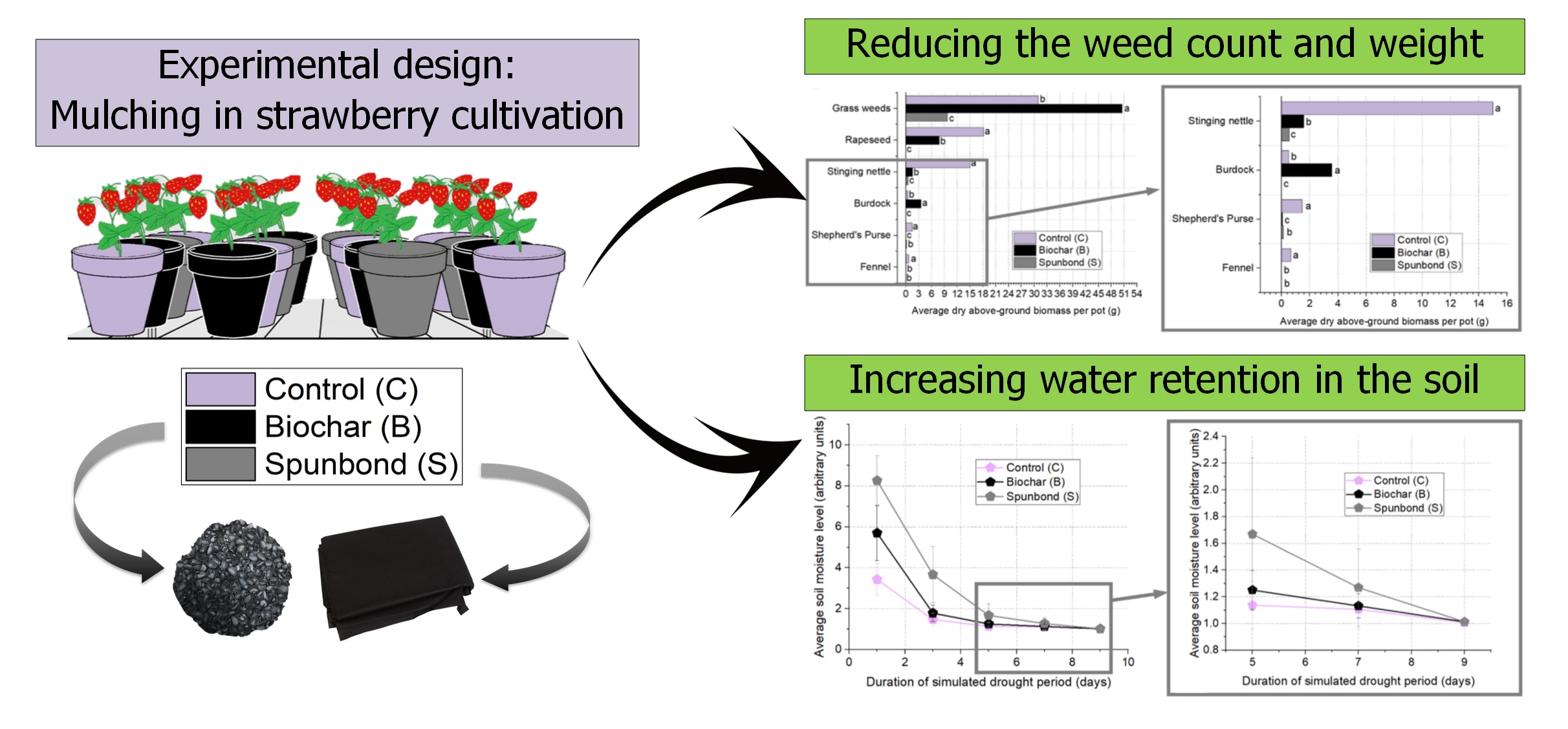
Purpose: Weed control and soil moisture retention are critical challenges in plant cultivation requiring effective solutions. This study aims to assess the impact of biochar produced from pine nut shells as a mulch for weed composition, biomass, and soil moisture retention compared to widely used spunbond covering material in strawberry cultivation.
Method: The experiment with six weed species was conducted using a growth chamber over two months with sixteen replicates for each of the three treatments: control (no mulch), soil with a 2 cm layer of biochar mulch, and soil with spunbond.
Results: In the control treatment, six weed species germinated, whereas only five and three species were observed in the biochar and spunbond treatments, respectively. Both mulching treatments significantly (p < 0.05) reduced the height of grass weeds, stinging nettles, and shepherds’ purse, as well as the mass of dry above-ground and root biomass of shepherds’ purse, rapeseed, and stinging nettle by 52–100%. Spunbond mulch demonstrated superior soil moisture retention overall. However, during the initial three days of a simulated dry period, biochar retained 7% more water compared to spunbond (2%). The application of spunbond mulch completely suppressed the emergence of rapeseed and burdock, while both biochar and spunbond effectively controlled fennel. Both mulching treatments significantly reduced the height of grasses, stinging nettles, and shepherds’ purse by different mechanisms.
Conclusion: Biochar can be useful for reducing the weed count and increasing the water retention in the soil.
Keywords
- Mulch,
- Biochar,
- Spunbond,
- Weeds,
- Moisture retention,
- Plant protection
References
- Abouziena HF, Hafez OM, El-Metwally IM, et al (2008) Comparison of weed suppression and mandarin fruit yield and quality obtained with organic mulches, synthetic mulches, cultivation, and glyphosate. Hort Sci 43:795–799. DOI: https://doi.org/10.21273/HORTSCI.43.3.795
- Abouziena HF, Haggag WM (2016) Métodos alternativos de controle não químicos de plantas daninhas: Uma revisão. Planta Daninha 34:377–392. DOI: https://doi.org/10.1590/S0100-83582016340200019
- Alhaj Hamoud Y, Shaghaleh H, Zia-ur-Rehman M, et al (2024) Cadmium and lead accumulation in important food crops due to wastewater irrigation: Pollution index and health risks assessment. Heliyon 10: e24712. DOI: https://doi.org/10.1016/j.heliyon.2024.e24712
- Alshahrani TS, Suansa NI (2020) Application of biochar to alleviate effects of allelopathic chemicals on seed germination and seedling growth. Bio Resour 15:382–400. DOI: https://doi.org/10.15376/biores.15.1.382-400
- Amin MW, Sediqui N, Azizi AH, et al (2025) Impact of soil amendments and alternate wetting and drying irrigation on growth, physiology, and yield of deeper-rooted rice cultivar under IoT-based soil moisture monitoring. Agri Engineer 7:69. DOI: https://doi.org/10.3390/agriengineering7030069
- Anugroho F, Kitou M (2011) Effect of live hairy vetch and its incorporation on weed growth in a subtropical region. Weed Biol Manag 11:1–6. DOI: https://doi.org/10.1111/j.1445-6664.2011.00398.x
- Arain S, Sarki MS, Bhatti SM, et al (2024) Enhancing bottle gourd yield through organic waste recycling. Int J Recycl Org Waste Agric 13:1–7. DOI: https://doi.org/10.57647/ijrowa-86ve-7x21
- Arkhangelskaya TA (2020) Parameters of the thermal diffusivity versus water content function for mineral soils of different textural classes. Eurasian Soil Sci 53:39–49. DOI: https://doi.org/10.1134/S1064229320010032
- Astafev A, Shanenkov I, Ibraeva K, et al (2022) Autothermal Siberian pine nutshell pyrolysis maintained by exothermic reactions. Energies 15:7118. DOI: https://doi.org/10.3390/en15197118
- Batlla D, Benech-Arnold RL (2014) Weed seed germination and the light environment: Implications for weed management. Weed Biol Manag 14:77–87. DOI: https://doi.org/10.1111/wbm.12039
- Brito I, Carvalho M, Goss MJ (2013) Soil and weed management for enhancing arbuscular mycorrhiza colonization of wheat. Soil Use Manag 29:540–546. DOI: https://doi.org/10.1111/sum.12069
- Broda J, Gawłowski A, Rom M, et al (2024) Thermoregulation and soil moisture management in strawberry cultivation mulched with sheep wool. Appl Sci 14:10884. DOI: https://doi.org/10.3390/app142310884
- Dai Y, Senge M, Yoshiyama K, et al (2016) Influencing factors, effects and development prospect of soil solarization. Rev Agric Sci 4:21–35. DOI: https://doi.org/10.7831/ras.4.21
- Demo AH, Asefa Bogale G (2024) Enhancing crop yield and conserving soil moisture through mulching practices in dryland agriculture. Front Agron 6:1361697. DOI: https://doi.org/10.3389/fagro.2024.1361697
- Dobrokhotov AV, Kozyreva LV (2023) Influence of the biochar application on the thermal properties of soddy-podzolic soil and on the energy balance fluxes of spring wheat in the Leningrad region under various soil moisture conditions. Dokuchaev Soil Bull 116:43–75. DOI: https://doi.org/10.19047/0136-1694-2023-116-43-75
- Dong F, Zeng W (2024) Effects of fall and winter cover crops on weed suppression in the United States: A meta-analysis. Sustainability 16:3192. DOI: https://doi.org/10.3390/su16083192
- Eizenberg H, Plakhine D, Ziadne H, et al (2017) Non-chemical control of root parasitic weeds with biochar. Front Plant Sci 8:939. DOI: https://doi.org/10.3389/fpls.2017.00939
- Ekern PC (1967) Soil moisture and soil temperature changes with the use of black vapor-barrier mulch and their influence on pineapple (Ananas comosus) growth in Hawaii. Soil Sci Soc Am J 31:270–275. DOI: https://doi.org/10.2136/sssaj1967.03615995003100020034x
- Farzi R, Gholami M, Baninasab B, Gheysari M (2017) Evaluation of different mulch materials for reducing soil surface evaporation in a semi-arid region. Soil Use Manag 33:120–128. DOI: https://doi.org/10.1111/sum.12325
- Garagurbanli I, Eldarov R, Hafizov G (2024) Evaluation of the productivity of garden strawberries (Fragaria × ananassa) of English breeding in the lowland part of the Guba district. Fruit Grow Vitic South Russ 6(90):72–81. DOI: https://doi.org/10.30679/2219-5335-2024-6-90-72-81
- Gorshkov A, Berezikov N, Kaltaev A, et al (2021) Analysis of the physicochemical characteristics of biochar obtained by slow pyrolysis of nut shells in a nitrogen atmosphere. Energies 14:8075. DOI: https://doi.org/10.3390/en14238075
- Gouble B, Musse M, Duret S, et al (2022) Impact of storage time and temperature of salad heads on the quality of fresh-cut Cichorium endivia. Postharvest Biol Technol 193:112050. DOI: https://doi.org/10.1016/j.postharvbio.2022.112050
- Horvath DP, Clay SA, Swanton CJ, et al (2023) Weed-induced crop yield loss: A new paradigm and new challenges. Trends Plant Sci 28:567–582. DOI: https://doi.org/10.1016/j.tplants.2022.12.014
- Huber H, Stuefer JF, Willems JH (1996) Environmentally induced carry-over effects on seed production, germination and seedling performance in Bunium bulbocastanum (Apiaceae). Flora 191:353–361. DOI: https://doi.org/10.1016/S0367-2530(17)30741-7
- Igaz D, Šimanský V, Horák J, et al (2018) Can a single dose of biochar affect selected soil physical and chemical characteristics? J Hydrol Hydromech 66:421–428. DOI: https://doi.org/10.2478/johh-2018-0034
- Kaewruang W, Sivasithamparam K, Hardy GE (1989) Effect of solarization of soil within plastic bags on root rot of gerbera (Gerbera jamesonii). Plant Soil 120:303–306. DOI: https://doi.org/10.1007/BF02377081
- Kasirajan S, Ngouajio M (2012) Polyethylene and biodegradable mulches for agricultural applications: A review. Agron Sustain Dev 32:501–529. DOI: https://doi.org/10.1007/s13593-011-0068-3
- Khanh TD, Hong NH, Xuan TD, Chung IM (2005) Paddy weed control by medicinal and leguminous plants from Southeast Asia. Crop Prot 24:421–431. DOI: https://doi.org/10.1016/j.cropro.2004.09.020
- Leng K, Liu J, Li G, et al (2023) The relationship between core rhizosphere taxa and peanut nodulation capacity under different cover crop amendments. Agronomy 13:311. DOI: https://doi.org/10.3390/agronomy13020311
- Major J, Steiner C, DiTommaso A, et al (2005) Weed composition and cover after three years of soil fertility management in the central Brazilian Amazon: Compost, fertilizer, manure and charcoal applications. Weed Biol Manag 5:69–76. DOI: https://doi.org/10.1111/j.1445-6664.2005.00159.x
- McCool C, Beattie J, Firn J, et al (2018) Efficacy of mechanical weeding tools: A study into alternative weed management strategies enabled by robotics. IEEE Robot Autom Lett 3:1184–1190. DOI: https://doi.org/10.1109/LRA.2018.2794619
- Moreno MM, Cirujeda A, Aibar J, Moreno C (2016) Soil thermal and productive responses of biodegradable mulch materials in a processing tomato (Lycopersicon esculentum) crop. Soil Res 54:207–215. DOI: https://doi.org/10.1071/SR15065
- Morison JIL, Baker NR, Mullineaux PM, Davies WJ (2008) Improving water use in crop production. Philos Trans R Soc B Biol Sci 363:639–658. DOI: https://doi.org/10.1098/rstb.2007.2175
- Obia A, Mulder J, Martinsen V, et al (2016) In situ effects of biochar on aggregation, water retention and porosity in light-textured tropical soils. Soil Tillage Res 155:35–44. DOI: https://doi.org/10.1016/j.still.2015.08.002
- Pavlovskii NB (2023) Mulching highbush blueberry plantations. Agric Crop Prod:53–56. DOI: https://doi.org/10.52101/9785870190921_2021_8_71
- Ponomarev KO, Pervushina AN, Korotaeva KS, et al (2022) Biochar influence on the development of spring wheat (Triticum aestivum) and acidity of soddy-podzolic soil in Western Siberia. Dokuchaev Soil Bull 113:110–137. DOI: https://doi.org/10.19047/0136-1694-2022-113-110-137
- Prats SA, Merino A, Gonzalez-Perez JA, et al (2021) Can straw-biochar mulching mitigate erosion of wildfire-degraded soils under extreme rainfall? Sci Total Environ 761:143219. DOI: https://doi.org/10.1016/j.scitotenv.2020.143219
- Rasheed MW, Tang J, Sarwar A, et al (2022) Soil moisture measuring techniques and factors affecting the moisture dynamics: A comprehensive review. Sustainability 14:11538. DOI: https://doi.org/10.3390/su141811538
- Rhioui W, Al Figuigui J, Boutagayout A, et al (2023) Effects of organic and inorganic mulching, nettle extract, and manual weeding on weed management under direct-seeded lentil. Crop Prot 173:106376. DOI: https://doi.org/10.1016/j.cropro.2023.106376
- Roveda-Hoyos G, Moreno-Fonseca L (2019) Physiological and antioxidant responses of cape gooseberry (Physalis peruviana) seedlings to phosphorus deficiency. Agron Colomb 37:12–20. DOI: https://doi.org/10.15446/agron.colomb.v37n1.65610
- Saha D, Marble SC, Pearson BJ (2018) Allelopathic effects of common landscape and nursery mulch materials on weed control. Front Plant Sci 9:733. DOI: https://doi.org/10.3389/fpls.2018.00733
- Saudy HS, Hamed MF, El-Metwally IM, et al (2021) Assessing the effect of biochar or compost application as a spot placement on broomrape control in two cultivars of faba bean. J Soil Sci Plant Nutr 21:1856–1866. DOI: https://doi.org/10.1007/s42729-021-00485-1
- Smith RG, Cox DA (2014) Effects of soil amendments on the abundance of a parasitic weed, yellow rattle (Rhinanthus minor) in hay fields. Weed Sci 62:118–124. DOI: https://doi.org/10.1614/WS-D-13-00106.1
- Teasdale JR, Mohler CL (2000) The quantitative relationship between weed emergence and the physical properties of mulches. Weed Sci 48:385–392. DOI: https://doi.org/10.1614/0043-1745(2000)048[0385:TQRBWE]2.0.CO;2
- Trezzi MM, Vidal RA, Junior AAB, et al (2016) Allelopathy: Driving mechanisms governing its activity in agriculture. J Plant Interact 11:53–60. DOI: https://doi.org/10.1080/17429145.2016.1159342
- Vandelook F, Janssens SB, Probert RJ (2012) Relative embryo length as an adaptation to habitat and life cycle in Apiaceae. New Phytol 195:479–487. DOI: https://doi.org/10.1111/j.1469-8137.2012.04172.x
- Wen Y, Shang S, Yang J (2017) Optimization of irrigation scheduling for spring wheat with mulching and limited irrigation water in an arid climate. Agric Water Manag 192:33–44. DOI: https://doi.org/10.1016/j.agwat.2017.06.023
- Woolley JT, Stoller EW (1978) Light penetration and light-induced seed germination in soil. Plant Physiol 61:597–600. DOI: https://doi.org/10.1104/pp.61.4.597
- Wortman SE, Kadoma I, Crandall MD (2016) Biodegradable plastic and fabric mulch performance in field and high tunnel cucumber production. Hort Technol 26:148–155. DOI: https://doi.org/10.21273/HORTTECH.26.2.148
- Xiang L, Harindintwali JD, Wang F, et al (2022) Integrating biochar, bacteria, and plants for sustainable remediation of soils contaminated with organic pollutants. Environ Sci Technol 56:16546–16566. DOI: https://doi.org/10.1021/acs.est.2c02976
- Yaseen MU, Long JM (2024) Laser weeding technology in cropping systems: A comprehensive review. Agronomy 14:2253. DOI: https://doi.org/10.3390/agronomy14102253