
 10.57647/ijrowa-2026-17447
Digestate: Scope and Application as Nitrogen Fertilizer for Rice
- Bente Foereid*

 1
1 - Maria Dietrich1
- Lisa Paruch1
- Division of Environment and Natural Resources, Norwegian Institute of Bioeconomy Research, Norway

Received: 2025-04-01
Revised: 2025-06-02
Accepted: 2025-09-02
Published in Issue 2026-03-31
Published Online: 2025-09-08
Copyright (c) -1 Bente Foereid, Maria Dietrich, Lisa Paruch (Author)

This work is licensed under a Creative Commons Attribution 4.0 International License.
How to Cite




PDF views: 237





Abstract
Purpose: Rice production in paddy soil is important for food security, and nitrogen fertilisation is important to achieve high yields. Digestate, the organic rest from biogas production can be a good fertilizer, but relatively little is known about its use in paddy soil, which is investigated here.
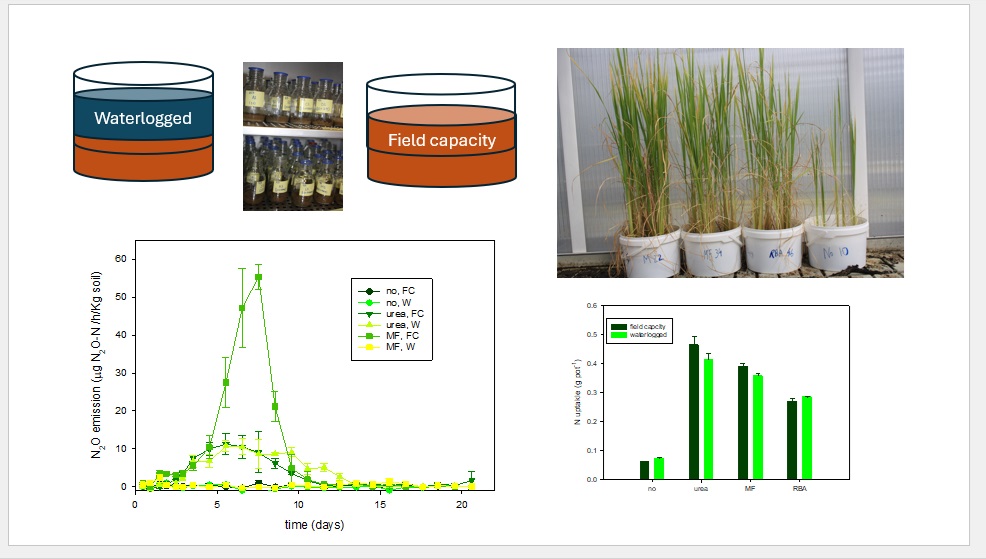
Method: Nitrogen transformations and rice growth in soil waterlogged and at field capacity after application of digestate and digestate products were assessed in a pot experiment. Nitrogen transformations and nitrous oxide (N2O) emissions with the same digestates were also assessed in an incubation.
Results: One of the tested digestates had as good fertilizer effect as urea. Nitrogen transformations went mostly as expected under given water status, but digestates were more affected by waterlogging than urea. Some instability appeared about 10 days after fertilizer application. Then nitrite levels were high, responsive microbial populations peaked and N2O emissions started. Whilst emissions after mineral fertilizer application (urea) were not affected by waterlogging, emission after application of one of the examined digestate was high at field capacity but almost zero under waterlogging. N2O emissions from all other digestate and water treatments were also low.
Conclusion: Digestates have great potential as organic fertilizers in rice production, but N2O emissions under aerobic soil conditions are of concern and warrants further investigation and mitigation strategy.
Highlights:
· Digestates are potentially good fertilisers for rice
· Nitrogen uptake from one of the tested digestates was comparable with urea
· Ammonium was released quickly from digestate, but more nitrate was formed with urea treatment
· Some instability appeared about 10 days after fertiliser application, with high nitrite levels
· Water-saving irrigation increases N2O emission more with digestate than with mineral fertilisers
Keywords
- Digestate,
- Nitrogen mineralisation,
- Rice growth,
- N2O,
- Waterlogging
References
- Alburquerque JA, de la Fuente C, Ferre-Costa A, Carrasco L, Cegarra J, Abad M, Bernal MP (2012) Assessment of the fertilizer potential of digestates from farm and agro-industrial residues. Biomass Bioenergy 40:181–189. DOI: https://doi.org/10.1016/j.biombioe.2012.02.018
- Bakken L, Frostegård Å (2020) Emerging options for mitigating N2O emissions from food production by manipulating the soil microbiota. Curr Opin Environ Sustain 47:89–94. DOI: https://doi.org/10.1016/j.cosust.2020.08.010
- Banerjee S, Helgason B, Wang L, Winsley T, Ferrari BC, Siciliano SD (2016) Legacy effects of soil moisture on microbial community structure and N2O emissions. Soil Biol Biochem 95:40-50. DOI: https://doi.org/10.1016/j.soilbio.2015.12.004
- Baral KR, Labouriau R, Olesen JE, Petersen SO (2017) Nitrous oxide emissions and nitrogen use efficiency of manure and digestates applied to spring barley. Agric Ecosyst Environ 239:188-198. DOI: https://doi.org/10.1016/j.agee.2017.01.012
- Barnes PW, Robson TM, Zepp RG, Bornman JF, Jansen MAK, Ossola R, Wang QW, Robinson SA, Foereid B, Klekociuk AR, Martinez J, Abaigar J, Hou W-C, Mackenzie R, Paul ND (2023) Interactive effects of changes in UV radiation and climate on terrestrial ecosystems biogeochemical cycles, and feedbacks to the climate system. Photochem Photobiol Sci 21:275–301. DOI: https://doi.org/10.1007/s43630-023-00376-7
- Bin Rahman ANMR, Zhang J (2023) Trends in rice research: 2030 and beyond. Food Energy Secur 12: e390. DOI: https://doi.org/10.1002/fes3.390
- Bouman BAM, Humphreys E, Tuong TP, Barker R (2007) Rice and water. Advanc Agron 92:187-237. DOI: https://doi.org/10.1016/S0065-2113(04)92004-4
- Butterbach-Bahl K, Baggs EM, Dannenmann M, Kiese R, Zechmeister- Boltenstern S (2013) Nitrous oxide emissions from soils: how well do we understand the processes and their controls? Phil Trans R Soc B 368:1621. DOI: https://doi.org/10.1098/rstb.2013.0122
- Chen Y, Guo W, Ngo HH, Wei W, Ding A, Ni B, Hoang NB, Zhang H (2024) Ways to mitigate greenhouse gas production from rice cultivation. J Environ Manag 368:122139. DOI: https://doi.org/10.1016/j.jenvman.2024.122139
- Dietrich M, Fongen M, Foereid B (2020) Greenhouse gas emissions from digestate in soil. Int J Recycl Org Waste Agric 9:1-19. DOI: https://doi.org/10.30486/IJROWA.2020.1885341.1005
- Domeignoz-Horta LA, Philippot L, Peyrard C, Bru D, Breuil MC, Bizouard F, Justes E, Mary B, Leonard J, Spor A (2018) Peaks of in situ N2O emissions are influenced by N2O -producing and reducing microbial communities across arable soils. Glob Change Biol 24:360–370. DOI: https://doi.org/10.1111/gcb.13853
- Drosg B, Fuchs W, Al Saedi T, Madsen M, Linke B (2015) Nutrient recovery by biogas digestate processing. IEA Bioenergy.
- du Plessis MCF, Kroontje W (1964) The relationship between pH and Ammonia equilibria in soil. Soil Sci Soc Am J 28:751-754. DOI: https://doi.org/10.2136/sssaj1964.03615995002800060022x
- Foereid B, Dietrich M, Fongen M, Paruch L (2025) Digestate in paddy soil – methane emission and carbon sequestration. Int J Recycl Org Waste. Agricle in Press.
- Foereid B, Szocs J, Patinvoh RJ, Horváth IS (2021) Effect of anaerobic digestion of manure before application to soil – benefits for nitrogen utilisation? Int J Recycl Org Waste Agric 10:89-99. DOI: https://doi.org/10.30486/IJROWA.2020.1897538.1055
- Frick H, Efosa Norah Oberson A, Krause H-M, Nägele H-J, Frossard E, Bünemann EK (2023) Nitrogen dynamics after slurry application as affected by anaerobic digestion, biochar and a nitrification inhibitor. Soil Use Manag 40: e12953. DOI: https://doi.org/10.1111/sum.12953
- Galloway JN, Bleeker A, Erisman JW (2021) The Human creation and use of reactive nitrogen: A global and regional perspective. Ann Rev Environ Resour 46:255–88. DOI: https://doi.org/10.1146/annurev-environ-012420-045120
- Galloway JN, Dentener FJ, Capone DG, Boyer EW, Howarth RW, Seitzinger SP, Asner GP, Cleveland CC, Green PA, Holland EA, Karl DM, Michaelis AF, Porter JH, Townsend AR, Vörösmarty CJ (2004) Nitrogen cycles: past, present, and future. Biogeochemistry 70:153–226. DOI: https://doi.org/10.1007/s10533-004-0370-0
- Galloway JN, Townsend AR, Erisman JW, Bekunda M, Cai Z, Freney JR, Martinelli LA, Seitzinger SP, Sutton MA (2008) Transformation of the nitrogen cycle: Recent trends, questions, and potential solutions. Science 320:889-892. DOI: https://doi.org/10.1126/science.1136674
- Gu J, Yang J (2022) Nitrogen (N) transformation in paddy rice field: Its effect on N uptake and relation to improved N management. Crop Environ 1:7-14. DOI: https://doi.org/10.1016/j.crope.2022.03.003
- Gupta K, Kumar R, Baruah KK, Hazarika S, Karmakar S, Bordoloi N (2021) Greenhouse gas emission from rice fields: A review from Indian context. Environ Sci Pollut Res 28:30551–30572. DOI: https://doi.org/10.1007/s11356-021-13935-1
- Jin T, Zhang T, Yan Q (2010) Characterization and quantification of ammonia-oxidizing archaea (AOA) and bacteria (AOB) in a nitrogen-removing reactor using T-RFLP and qPCR. Appl Microbiol Biotechnol 87:1167-76. DOI: https://doi.org/10.1007/s00253-010-2595-2
- Jung J, Choi S, Jung H, Scow KM, Park W (2013) Primers for amplification of nitrous oxide reductase genes associated with Firmicutes and Bacteroidetes in organic-compound-rich soils. Microbiology 159:307-315. DOI: https://doi.org/10.1099/mic.0.060194-0
- Kandeler E, Deiglmayr K, Tscherko D, Bru D, Philippot L (2006) Abundance of narG, nirS, nirK, and nosZ genes of denitrifying bacteria during primary successions of a glacier foreland. Appl Environ Microbiol 72:5957–5962. DOI: https://doi.org/10.1128/AEM.00439-06
- Kato Y, Katsura K (2014) Rice adaptation to aerobic soils: Physiological considerations and implications for agronomy. Plant Prod Sci 17:1―12. DOI: https://doi.org/10.1626/pps.17.1
- Kong D, Zhang X, Yu Q, Jin Y, Jiang P, Wu S, Liu S, Zou J (2024) Mitigation of N2O emissions in water-saving paddy fields: Evaluating organic fertilizer substitution and microbial mechanisms. J Integrat Agric 23:3159–3173. DOI: https://doi.org/10.1016/j.jia.2024.03.047
- Legg S (2021) IPCC, 2021: Climate Change 2021 - the Physical Science basis. Interaction, 49:44–45. DOI: https://search.informit.org/doi/10.3316/informit.315096509383738
- Liu H, Li Y, Pan B, Zheng X, Yu J, Ding H, Zhang Y (2022a) Pathways of soil N2O uptake, consumption, and its driving factors: A review. Environ Sci Poll Res 29:30850–30864. DOI: https://doi.org/10.1007/s11356-022-18619-y
- Liu H, Zheng X, Li Y, Yu J, Ding H, Sveen TR, Zhang Y (2022b) Soil moisture determines nitrous oxide emission and uptake. Sci Tot Environ 822:153566. DOI: https://doi.org/10.1016/j.scitotenv.2022.153566
- Liu W, Yao B, Xu Y, Dai S, Wang M, Ma J, Ye Z, Liu D (2024) Biogas digestate as a potential nitrogen source enhances soil fertility, rice nitrogen metabolism and yield. Field Crop Res 318:109568. DOI: https://doi.org/10.1016/j.fcr.2024.109568
- Lyng K (2018) Reduction of environmental impacts through optimisation of biogas value chains. Drivers, barriers and policy development. PhD thesis, Norwegian University of Life Sciences, Faculty of Environmental Sciences and Natural Resource Management. 72 pp.
- Minamikawa K, Khanh HC, Hosen Y, Nam TS, Chiem NH (2020) Variable-timing, fixed-rate application of cattle biogas effluent to rice using a leaf color chart: Microcosm experiments in Vietnam. Soil Sci Plant Nutr 66:225-234. DOI: https://doi.org/10.1080/00380768.2019.1665970
- Möller K, Müller T (2012) Effects of anaerobic digestion on digestate nutrient availability and crop growth: A review. Eng Life Sci 3:242–57. DOI: https://doi.org/10.1002/elsc.201100085
- Müller R (2021) The impact of the rise in atmospheric nitrous oxide on stratospheric ozone. Ambio 50:35–39. DOI: https://doi.org/10.1007/s13280-020-01428-3
- Muthayya S, Sugimoto JD, Montgomery S, Maberly GF (2014) An overview of global rice production, supply, trade, and consumption. Ann NY Acad Sci 1324:7–14. DOI: https://doi.org/10.1111/nyas.12540
- Nada RM, Abogadallah GM (2016) Restricting the above ground sink corrects the root/shoot ratio and substantially boosts the yield potential per panicle in field-grown rice (Oryza sativa L.). Physiol Plant 156:371–386. DOI: https://doi.org/10.1111/ppl.12377
- Orou BZS, Adjogboto A, Zakari S, Tovihoudji PG, Akponikpè PBI, Vanclooster M (2024) Improving rice yield and water productivity in lowland rice systems: A global meta-analysis exploring the synergy of agro-ecological practices and water management technologies. Irrig Drain 1–19. DOI: https://doi.org/10.1002/ird.3005
- Pandey CB, Kumar U, Kaviraj M, Minick KJ, Mishra AK, Singh JS (2020) DNRA: A short-circuit in biological N-cycling to conserve nitrogen in terrestrial ecosystems. Sci Tot Environ 738:139710. DOI: https://doi.org/10.1016/j.scitotenv.2020.139710
- Patrick Jr WH, Reddy KR (1967) Nitrification-denitrification reactions in flooded soils and water bottoms: Dependence on oxygen supply and ammonium diffusion. J Environ Qual 5:469-472. DOI: https://doi.org/10.2134/jeq1976.00472425000500040032x
- Senbayram M, Chen R, Budai A, Bakken L, Dittert K (2012) N2O emission and the N2O / (N2O +N2) product ratio of denitrification as controlled by available carbon substrates and nitrate concentrations. Agric Ecosyst Environ 147:4-12. DOI: https://doi.org/10.1016/j.agee.2011.06.022
- Smith KA, Ball T, Conen F, Dobbie KE, Massheder J, Rey A (2018) Exchange of greenhouse gases between soil and atmosphere: Interactions of soil physical factors and biological processes. Europ J Soil Sci 69:10-20. DOI: https://doi.org/10.1111/ejss.12539
- Sogn TA, Dragicevic I, Linjordet R, Krogstad T, Eijsink VGH, Eich-Greatorex S (2018) Recycling of biogas digestates in plant production: NPK fertilizer value and risk of leaching. Int J Recycl Org Waste Agric 7:49–58. DOI: https://doi.org/10.1007/s40093-017-0188-0
- Surey R, Schimpf CM, Sauheitl L, Mueller CW, Rummel PS, Dittert K, Kaiser K, Bottcher J, Mikutt R (2020) Potential denitrification stimulated by water-soluble organic carbon from plant residues during initial decomposition. Soil Biol Biochem 147:107841. DOI: https://doi.org/10.1016/j.soilbio.2020.107841
- Tang Y, Luo L, Carswell A, Misselbrook T, Shen J, Han J (2021) Changes in soil organic carbon status and microbial community structure following biogas slurry application in a wheat-rice rotation. Sci Tot Environ 757:143786. DOI: https://doi.org/10.1016/j.scitotenv.2020.143786
- Vu QD, de Neergaard A, Tran ATD, Hoang QQ, Ly P, Tran TM, Jensen LS (2015) Manure, biogas digestate and crop residue management affects methane gas emissions from rice paddy fields on Vietnamese smallholder livestock farms. Nutr Cycl Agroecosyst 103:329–346. DOI: https://doi.org/10.1007/s10705-015-9746-x
- Wang X, Azarbad H, Leclerc L, Dozois J, Mukula E, Yergeau É (2022) A drying-rewetting cycle imposes more important shifts on soil microbial communities than does reduced precipitation. mSystems 7: e00247-22. DOI: https://doi.org/10.1128/msystems.00247-22
- Wang H, Inukai Y, Yamauchi A (2006) Root development and nutrient uptake. Crit Rev Plant Sci 25:279–301. DOI: https://doi.org/10.1080/07352680600709917
- Wassmann R, Neue HU, Ladha JK, Aulakh MS (2004) Mitigating greenhouse gas emissions from rice-wheat cropping systems in Asia. Environ Develop Sustain 6:65–90. DOI: https://doi.org/10.1023/B:ENVI.0000003630.54494.a7
- Wu L, Tang S, Hu R, Wang J, Duan P, Xu C, Zhang W, Xu M (2023) Increased N2O emission due to paddy soil drainage is regulated by carbon and nitrogen availability. Geoderma 432:116422. DOI: https://doi.org/10.1016/j.geoderma.2023.116422
- Xu P, Jiang M, Khan I, Shaaban M, Wu H, Harerimana B, Hu R (2024b) Regulatory potential of soil available carbon, nitrogen, and functional genes on N2O emissions in two upland plantation systems. J Integrat Agric 23:2792–2806. DOI: https://doi.org/10.1016/j.jia.2024.01.005
- Xu P, Jiang M, Khan I, Zhao J, Hu R (2024a) Rice planting reduced N2O emissions from rice-growing seasons due to increased nosZ gene abundance under a rice-wheat rotation system. Europ J Agron 152:127025. DOI: https://doi.org/10.1016/j.eja.2023.127025
- Xu M, Xian Y, Wu J, Gu Y, Yang G, Zhang X, Peng H, Yu X, Xiao Y, Li L (2019) Effect of biogas slurry addition on soil properties, yields, and bacterial composition in the rice-rape rotation ecosystem over 3 years. J Soil Sed 19:2534–2542. DOI: https://doi.org/10.1007/s11368-019-02258-x
- Yang J, Zhang J (2023) Simultaneously improving grain yield and water and nutrient use efficiencies by enhancing the harvest index in rice. Crop Environ 2:157-164. DOI: https://doi.org/10.1016/j.crope.2023.07.001
- Yu L, Qiao X, Duan H, Zhang Z, Gong L, Li X, Lu J, Li X (2022) Life cycle assessment of liquid digestate application strategies for rice agri‑food chain in “Zero‑waste City” Biomass Conv Bioref 12:4389–4401. DOI: https://doi.org/10.1007/s13399-022-02542-w
- Zhao H, Zhu Z, Wang X, Xu M, Huang N (2024) Impacts of nitrogen fertilization on CO2 efflux with and without organic amendments in a high-pH soil. Land Degr Develop 16:4853-4863. DOI: https://doi.org/10.1002/ldr.5262
- Zhong Y, Hu J, Xia Q, Zhang S, Li X, Pan X, Zhao R, Wang R, Yan W, Shangguan Z, Hu F, Yang C, Wang W (2020) Soil microbial mechanisms promoting ultrahigh rice yield. Soil Biol Biochem 143: 107741. DOI: https://doi.org/10.1016/j.soilbio.2020.107741
- Zhou S, Sun HF, Bi JG, Zhang JN, Riya S, Hosomi M (2020) Effect of water-saving irrigation on the N2O dynamics and the contribution of exogenous and endogenous nitrogen to N2O production in paddy soil using 15N tracing. Soil Till Res 200:104610. DOI: https://doi.org/10.1016/j.still.2020.104610