
 10.57647/ijrowa-2026-17240
Release of Nitrogen, Phosphorus, and Potassium from Filter Cake, Filter Cake Biochar, and Sugarcane Bagasse Ash in a Laboratory Study
- Daojarus Ketrot*
 1
1 - Sawarin Saribut2
- Anuthida Sombatcharoennon2
- Weerawan Peungyam1
- Karuna Poomsong1
- Rathanont Jaroenchasri1
- Worachart Wisawapipat1
- Department of Soil Science, Faculty of Agriculture, Kasetsart University, Bangkok 10900, Thailand
- Agricultural Chemistry Program, Faculty of Agriculture, Kasetsart University, Bangkok 10900, Thailand

Received: 2024-11-12
Revised: 2025-03-28
Accepted: 2025-07-28
Published in Issue 2026-03-31
Published Online: 2025-08-01
Copyright (c) -1 Daojarus Ketrot, Sawarin Saribut, Anuthida Sombatcharoennon, Weerawan Peungyam, Karuna Poomsong, Rathanont Jaroenchasri, Worachart Wisawapipat (Author)

This work is licensed under a Creative Commons Attribution 4.0 International License.
How to Cite




PDF views: 339





Abstract
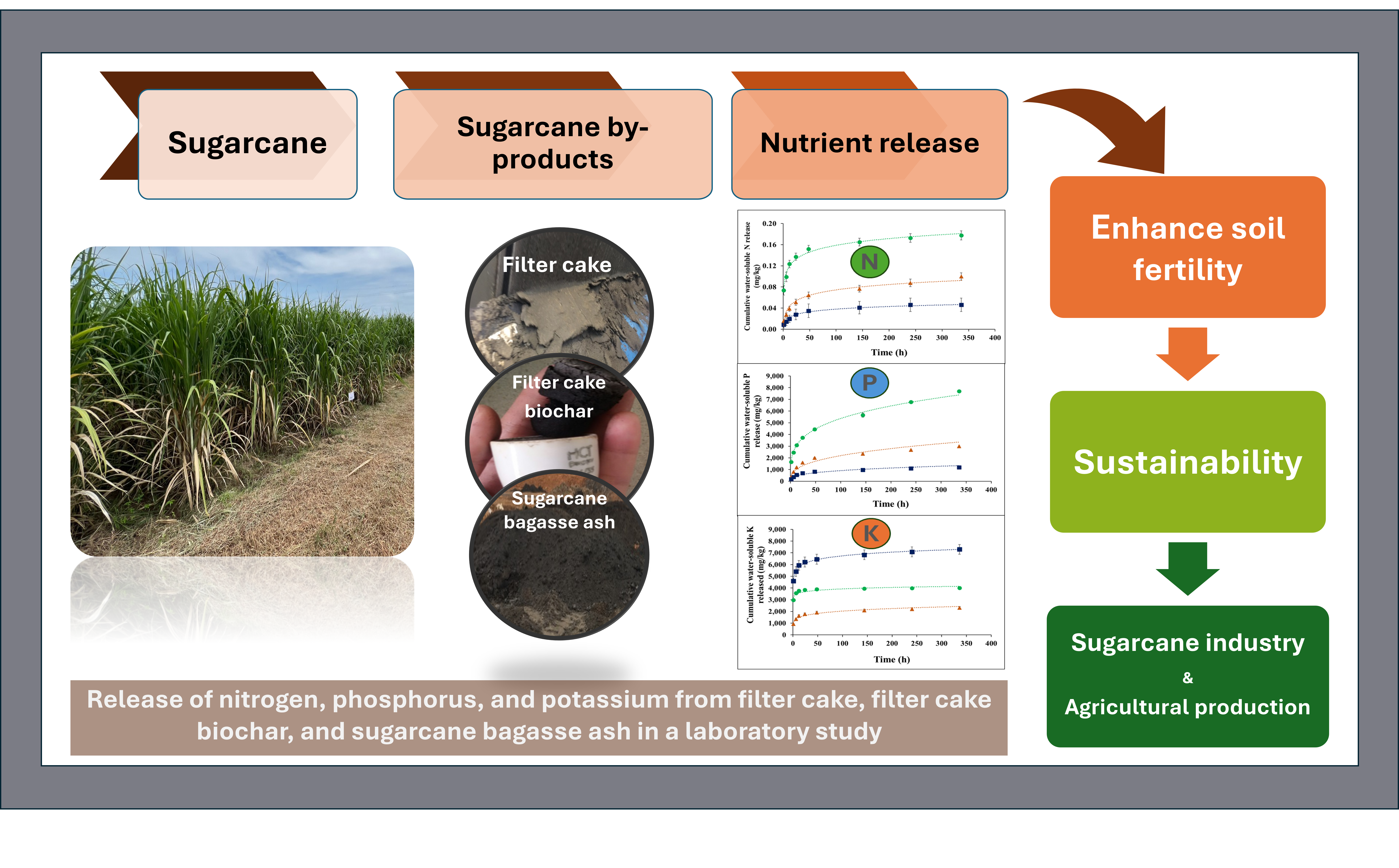
Purpose: This study characterized the chemical components and nutrient release patterns of filter cake, filter cake biochar, and sugarcane bagasse ash—by-products of the sugarcane industry, a globally significant crop.
Method: The chemical composition of each material was analyzed, nutrient release kinetics were examined using water extraction during 336 h, and kinetic models were applied.
Results: The studied materials were rich in various elements and exhibited alkaline properties. Carbon and Si were the primary components, followed by Ca, Al, P, and K. All materials released substantial amounts of K and P, with minimal N release. Filter cake had the highest cumulative release of water-soluble P (7,701±87.4 mg/kg), followed by filter cake biochar (2,982±27.3 mg/kg) and sugarcane bagasse ash (1,194±3.66 mg/kg), representing 32.2%, 7.8%, and 21.7%, respectively, of total P. Conversely, the cumulative release of water-soluble K was highest in sugarcane bagasse ash (7,295±418 mg/kg), followed by filter cake (3,999±124 mg/kg) and filter cake biochar (2,312±107 mg/kg), accounting for 23.3%, 30.3%, and 11.0%, respectively, of total K. The nutrient release kinetics showed that the magnitude of release was controlled by the inherent elemental concentrations of each material and exhibited good fits with the Elovich and power function models (R² = 0.836–0.990 and 0.810–0.996). Nutrient release depended mainly on diffusion through heterogeneous and homogeneous surfaces.
Conclusion: These sugarcane by-products have the potential to improve soil fertility through nutrient releases. Transforming filter cake into biochar slows the initial release of nutrients while ensuring a more sustained and steady long-term release.
Highlight
· Filter cake, its biochar and sugarcane bagasse ash are alkaline and rich in C and Si.
· Filter cake releases the most water-soluble P among the three materials.
· Sugarcane bagasse ash shows the highest cumulative release of water-soluble K.
· Each material shows distinct nutrient release influencing agricultural use.
Biochar transformation of filter cake slows nutrient release for long-term use.
Keywords
- Plant nutrient release,
- Kinetic models,
- Sugarcane by-products,
- Press-mud,
- Ash,
- Biochar
References
- Almaroai YA, Usman ARA, Ahmad M, Kim K, Vithanage M, Sik Y (2013) Role of chelating agents on release kinetics of metals and their uptake by maize from chromated copper arsenate-contaminated soil. Environ Technol 34 (6): 747–755. https://doi.org/10.1080/09593330.2012.715757
- Almutairi AA, Ahmad M, Rafique MI, Al-Wabel MI (2023) Variations in composition and stability of biochars derived from different feedstock types at varying pyrolysis temperature. J Saudi Soc Agric Sci 22: 25–34. https://doi.org/10.1016/j.jssas.2022.05.005
- Břendová K, Tlustoš P, Száková J (2015) Biochar immobilizes cadmium and zinc and improves phytoextraction potential of willow plants on extremely contaminated soil. Plant Soil Environ 61 (7): 303–308. https://doi.org/10.17221/181/2015-PSE
- Campos P, De la Rosa JM (2020) Assessing the effects of biochar on the immobilization of trace elements and plant development in a naturally contaminated soil. Sustainability 12: 6025. https://doi.org/10.3390/su12156025
- da Mota RP, de Camargo R, Lemes EM, Lana RMQ, de Almeida RF, de Moraes ER (2019) Biosolid and sugarcane filter cake in the composition of organomineral fertilizer on soybean responses. Int J Recycl Org Waste Agric 8: 131–137. https://doi.org/10.1007/s40093-018-0237-3
- Darunsontaya T, Thasanon P, Jindaluang W, Poomsong K (2020) Kinetics of potassium release of lowland soils in central plain of Thailand. J Agric 36 (1): 123–133.
- de Oliveira JC, Pena ANL, de Oliveira WR, Fernandes LA, Colen F, Ferreira EA, Veloso M das D, Frazão LA (2023) Filter cake biochar as a soil conditioner cultivated with native Cerrado species: Effect on soil chemical and microbiological properties. Floresta Ambient 30 (1): e20220075. https://doi.org/10.1590/2179-8087-FLORAM-2022-0075
- de Oliveira Paiva I, de Morais EG, Jindo K, Silva CA (2024) Biochar N content, pools and aromaticity as affected by feedstock and pyrolysis temperature. Waste Biomass Valor 15: 3599–3619. https://doi.org/10.1007/s12649-023-02415-x
- Dengia A, Lantinga E (2018) Effect of different soil amendment systems on sugarcane nutrient uptake and leaching. Int J Adv Res Biol Sci 5(10): 90-97. http://dx.doi.org/10.22192/ijarbs.2018.05.10.009
- Dey A, Srivastava PC, Pachaurl SP, Shukla AK (2019) Time‑dependent release of some plant nutrients from different organic amendments in a laboratory study. Int J Recycl Org Waste Agric 8: 173–188. https://doi.org/10.1007/s40093-019-0287-1
- Domingues RR, Trugilho PF, Silva CA, Melo ICNAd, Melo LCA, Magriotis ZM, Sa´nchez-Monedero MA (2017) Properties of biochar derived from wood and high-nutrient biomasses with the aim of agronomic and environmental benefits. PLoS ONE 12(5): e0176884. https://doi.org/10.1371/journal.pone.0176884
- Eykelbosh AJ, Johnson MS, Queiroz ESD, Dalmagro HJ, Couto EG (2014) Biochar from sugarcane filtercake reduces soil CO2 emissions relative to raw residue and improves water retention and nutrient availability in a highly-weathered tropical soil. PLOS ONE 9: 6. https://doi.org/10.1371/journal.pone.0098523
- FAO (2022) FAOSTAT: Crops and livestock products. Food and Agriculture Organization of the United Nations. Available at: https://www.fao.org/faostat/en/#data/QCL". Accessed 25 October 2024.
- Gonfa A, Bedadi B, Argaw A (2018) Effect of bagasse ash and filter cake amendments on wheat (Triticum turgidum L.var. durum) yield and yield components in Nitisol. Int J Recycl Org Waste Agric 7: 231–240. https://doi.org/10.1007/s40093-018-0209-7
- Guo L, Nie Z, Zhou J, Zhang S, An F, Zhang L, Tóth T, Yang F, Wang Z (2022) Effects of different organic amendments on soil improvement, bacterial composition, and functional diversity in saline–sodic soil. Agronomy 12: 2294. https://doi.org/10.3390/agronomy12102294
- Hemwong S, Vityakon P (2019) Effects of organic materials managements on soil fertility, growth and yield of sugarcane. Prawarun Agr J 16 (2): 361–373.
- Hu P, Zhang Y, Liu L, Wang X, Luan X, Ma X, Chu PK, Zhou J, Zhao P (2019) Biochar/struvite composite as a novel potential material for slow release of N and P. Environ Sci Pollut Res 26: 17152–17162. https://doi.org/10.1007/s11356-019-04458-x
- Inthasan J, Suwanpingka T, Dechjiraratthanasiri C (2023) Effects of sugarcane filter cake on soil chemical properties of soil series group no.35, Chiang Mai province. J Agric 39 (1): 59 - 70.
- Ippolito JA, Spokas KA, Novak JM, Lentz RD, Cantrell KB (2015) Biochar elemental composition and factors influencing nutrient retention. In: Lehmann J, Joseph S(eds) Biochar for environmental management: Science, technology and implementation, 2nd edition. Routledge, UK. pp 137–161, 944.
- Islami T, Wisnubroto EI, Nugroho WH (2017) Biochar derived from sugarcane industry waste increasing productivity of degraded land. Int J Soil Sci 12 (1): 1–9. https://doi.org/10.3923/ijss.2017.1.9
- Jiang J, Xu R, Jiang T, Li Z (2012) Immobilization of Cu(II), Pb(II) and Cd(II) by the addition of rice straw derived biochar to a simulated polluted Ultisol. J Hazard Mater 229–230: 145–150. https://doi.org/10.1016/j.jhazmat.2012.05.086
- Ketrot D, Wisawapipat W (2021) Lead immobilisation in mining contaminated soil using biochar and ash from sugarcane. Plant Soil Environ 67 (8): 474–481. https://doi.org/10.17221/57/2021-PSE
- Kumar A, Bhattacharya T (2022) Removal of arsenic by wheat straw biochar from soil. Bull Environ Contam Toxicol 108: 415–422. https://doi.org/10.1007/s00128-020-03095-2
- Manirakiza E, Gagnon B, Ziadi N (2025) Soil and plant cations as affected by application of wood ash, biochar, and papermill biosolids. Agronomy J 117(1): e21714. https://doi.org/10.1002/agj2.21714
- Office of the Cane Sugar Board (2024) Annual Report on the sugarcane planting situation for the 2023/24 growing season. Information and Communication Technology Group, Strategy and Planning Division, Ministry of Industry, Thailand.
- Pluemjai N, Tungkananuruk N, Tungkananuruk K, Kerot D (2018) Utilization of filter cake from sugarcane factory for alternative fertilizer and reducing soil degradation after sugarcane cultivation. KKU Research Journal (Graduate study) 18 (3): 53–66.
- Prakongkep N, Gilkes RJ, Wiriyakitnateekul W (2015) Forms and solubility of plant nutrient elements in tropical plant waste biochars. J Plant Nutr Soil Sci 178: 732–740. https://doi.org/10.1002/jpln.201500001
- Shamila SK, Udumann SS, Dissanayaka NS, Rajaratnam K, Atapattu AJ (2024) Assessing the impact of king coconut husk ash and biochar, combined with chemical fertilizer application, on enhancing soil fertility in coconut plantations. Crops (4): 227–241. https://doi.org/10.3390/crops4020017
- Spark DL, Singh B, Siebecker MG (2024) Environmental soil chemistry. 3rd edition. Elsevier, Amsterdam.
- Sparks DL, Page AL, Helmke PA, Loeppert RH, Soltanpour PN, Tabatabai MA, Johnston CT, Sumner ME (1996) Methods of soil analysis part 3: Chemical methods. Soil Science Society of America, American Society of Agronomy, Madison.
- Speratti AB, Johnson MS, Sousa HM, Dalmagro HJ, Couto EG (2018) Biochar feedstock and pyrolysis temperature effects on leachate: DOC characteristics and nitrate losses from a Brazilian Cerrado Arenosol mixed with agricultural waste biochars. J Environ Manage 211: 256–268. https://doi.org/10.1016/j.jenvman.2017.12.052
- Speratti AB, Johnson MS, Sousa HM, Torres GN, Couto EG (2017) Impact of different agricultural waste biochars on maize biomass and soil water content in a Brazilian Cerrado Arenosol. Agronomy 7: 49. https://doi.org/10.3390/agronomy7030049
- Ungureanu N, Vladut V, Biris S (2022) Sustainable valorization of waste and by-products from sugarcane processing. Sustainability. 14: 11089. https://doi.org/10.3390/su141711089
- USDA (2022) Sugar: World Markets and Trade. Foreign Agricultural Service, Department of Agriculture, USA. https://usda.library.cornell.edu/concern/publications/z029p472x?locale=en. Accessed 25 October 2024.
- USDA (2024) Production – Sugar: Top Producing Countries. Foreign Agriculture Service. Department of Agriculture, USA. https://fas.usda.gov/data/production/commodity/0612000. Accessed 25 October 2024.
- Uwiringiyimana E, Lai Hw, Ni N, Shi Ry, Pan Xy, Gao Jn, Biswash MR, Li Jy, Cui Xm, Xu Rk (2024) Comparative efficacy of alkaline slag, biomass ash, and biochar application for the amelioration of different acidic soils. Plant Soil 504: 47–61. https://doi.org/10.1007/s11104-024-06678-8
- Wibisono Y, Rafianto V, Alvianto D, Djoyowasito G, Nugroho BDA, Arif C (2023) Crab shell biowaste hydroxyapatite as inert material for gradual releaser of crop nutrients for sustainable food production. Int J Recycl Org Waste Agric 12(4): 601–614. https://doi.org/10.30486/IJROWA.2023.1964772.1518
- Ye Z, Zhang L, Huang Q, Tan Z (2019) Development of a carbon-based slow-release fertilizer treated by bio-oil coating and study on its feedback effect on farmland application. J Clean Prod 239: 118085. https://doi.org/10.1016/j.jclepro.2019.118085
- Zareian G, Farpoor MH, Hejazi-Mehrizi M, Jafari A (2018) Kinetics of non-exchangeable potassium release in selected soil orders of southern Iran. Soil Water Res 13 (4): 200–207. https://doi.org/10.17221/138/2017-SWR
- Zhao L, Cao X, Zheng W, Kan Y (2014) Phosphorus-assisted biomass thermal conversion: Reducing carbon loss and improving biochar stability. PLoS ONE 9 (12): e115373. https://doi.org/10.1371/journal.pone.0115373
- Zhao Y, Zhao L, Mei Y, Li F, Cao X (2018) Release of nutrients and heavy metals from biochar-amended soil under environmentally relevant conditions. Environ Sci Pollut Res 25: 2517–2527. https://doi.org/10.1007/s11356-017-0668-9