
 10.57647/pibm.2026.152603
RNA-Seq Analysis Revealed the Suppressor Effects of Silybinin in Gastric and Breast Cancers Through the Downregulation of FGF and Wnt Signaling in Silybinin-Driven Modulation of ADSCs in Tumor Microenvironment
- Soheila Zamanlui Benisi
 2
2 - Saeed Hesami Tackallou1

Received: 2025-07-12
Revised: 2026-01-29
Accepted: 2026-02-12
Published in Issue 2026-03-31
Copyright (c) 2026 Zahra Derakhshandeh, Keyvan Ansari Shiri, Soheila Zamanlui Benisi, Saeed Hesami Tackallou (Author)

This work is licensed under a Creative Commons Attribution 4.0 International License.









Abstract
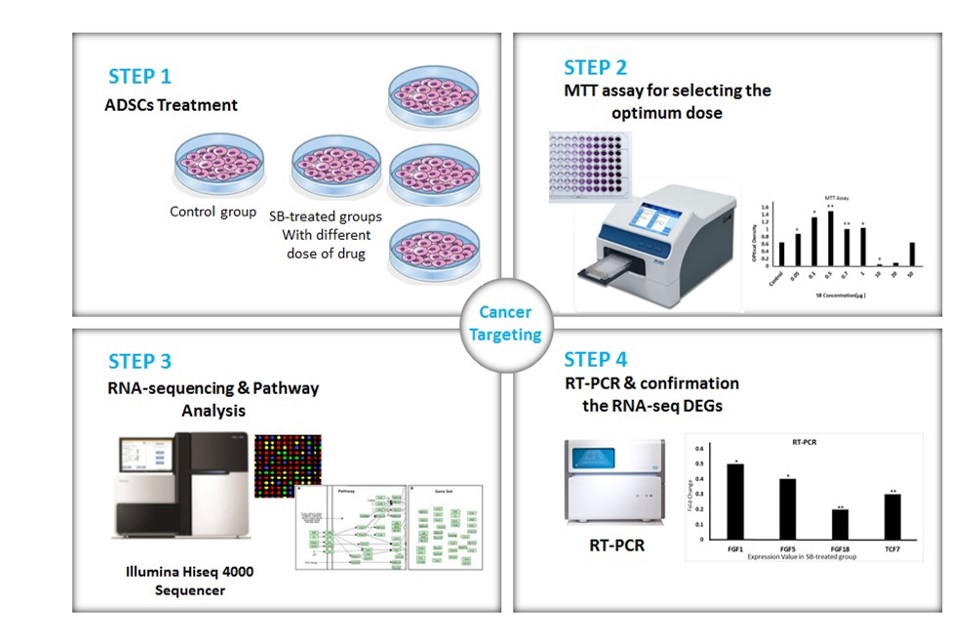
Adipose-derived mesenchymal stem cells (ADSCs) are key elements of the tumor microenvironment (TME), driving oncogenic advancement through paracrine signaling, epithelial-mesenchymal transition (EMT), and angiogenesis. Silybinin (SB), flavonoid from Silybum marianum, illustrated anticancer potential; however, impacts on ADSCs in breast and gastric cancers remain poorly understood. Human (ADSCs) treated with various SB concentration, and viability was assessed by MTT assay to detect the optimum dose. Gene expression profiling was performed by RNA-sequencing (Illumina HiSeq 4000). Differentially expressed genes (DEGs) were detected using HISAT2 and NOISeq (log2|FC| ≥ 1, p ≤ 0.05, and FDR ≤ 0.1), followed by KEGG enrichment analysis and qRT-PCR validation. 1- MTT assay demonstrated low-dose SB (0.005-0.5 pg) increased ADSCs viability (p < 0.01), while higher doses (10-50 pg) induced cytotoxicity (p < 0.05); 0.5 pg was optimal. 2- SB modulated expression of 324 genes (210 downregulated, 114 upregulated), enriching breast and gastric cancer pathways. Four oncogenic genes, FGF1, FGF5, FGF18, and TCF7 were downregulated, regulators of FGF-FGFR and Wnt/β-catenin signaling sustaining tumor growth, metastasis, and EMT. 3- qRT-PCR confirmed these findings (P < 0.05). Downregulation of FGF1, FGF5, and FGF18 inhibits proliferative and angiogenic signaling, while reduced TCF7 suppresses Wnt-driven stemness, promoting apoptosis. Silybinin reprograms ADSCs within the TME by downregulating FGF1, FGF5, FGF18, and TCF7, key drivers of FGF-FGFR and Wnt/β-catenin-mediated tumor progression, reducing ADSC-mediated tumor support, increasing apoptosis, positioning it as a candidate for disrupting ADSC-cancer crosstalk.
Keywords
- ADSCs,
- Silybinin,
- Gastric cancer,
- Breast cancer,
- RNA-sequencing
References
- Pahlavan Y, Nasr MM, Abdolahinia ED, et al. Prominent roles of microRNA-142 in cancer. Pathol Res Pract 2020 :153220
- Pourgholi A, Dadashpour M, Mousapour A, Amandi AF, and Zarghami N. Anticancer Poten-tial of Silybinin Loaded Polymeric Nanoparticles against Breast Cancer Cells: Insight into the Apop-totic Genes Targets. Asian Pac J Cancer Prev 2021; 22:2587–96
- Amos SE and Choi YS. The Cancer Microenvi-ronment: Mechanical Challenges of the Metastatic Cascade. Frontiers in Bioengineering and Biotech-nology 2021; 9:625859
- Jahanban-Esfahlan R, Seidi K, and Zarghami N. Tumor vascular infarction:prospects and challenges. Int J Hematol 2017; 105:244–56
- Baghban R, Roshangar L, Jahanban-Esfahlan R, Seidi K, Ebrahimi-Kalan A, Jaymand M, and Zare P. Tumor microenvironment complexity and thera-peutic implications at a glance. Cell Communica-tion and Signaling 2020; 18
- Farc O and Cristea V. An overview of the tumor microenvironment, from cells to complex networks (Review). Experimental and Therapeutic Medicine 2021; 21:96
- Wu S, Wang Y, Yuan Z, Wang S, Du H, Liu X, and Zhu X. Human adipose derived mesenchymal stem cells promote breast cancer MCF7 cell epithe-lial mesenchymal transition by cross interacting with the TGF β/Smad and PI3K/AKT signaling pathways. Molecular Medicine Reports 2018
- Castro-Oropeza R, Vazquez-Santillan K, D´ıaz-Gastelum C, Melendez-Zajgla J, Zampedri C, Ferat-Osorio E, and Maldonado V. Adipose-derived mes-enchymal stem cells promote the malignant pheno-type of cervical cancer. Scientific Reports 2020; 10
- Xie F, Ling L, Dam H van, Zhou F, and Zhang L. TGF β signaling in cancer metastasis. Acta Biochim Biophys Sin (Shanghai) 2018; 50:121–32
- Marzieh N, Nosratollah Z, Kazem NK, and Mahdieh M. Curcumin and silybinin inhibit telom-erase expression in T47D human breast cancer cells. Asian Pac J Cancer Prev 2013; 14:3449–53
- Atanasov AG, Zotchev SB, Dirsch VM, and Supu-ran CT. Natural products in drug discovery: ad-vances and opportunities. Nat Rev Drug Discov 2021; 20:200–216
- Tavsan Z and Kayali HA. Flavonoids showed an-ticancer effects on the ovarian cancer cells: In-volvement of reactive oxygen species, apoptosis, cell cycle and invasion. Biomed Pharm 2019; 116:109004
- Chen J, Li DL, Xie LN, et al. Synergistic anti-inflammatory effects of silybinin and thymol com-bination on LPS-induced RAW264. 7 cells by in-hibition of NF-????B and MAPK activation. Phy-tomedicine 2020; 78:153309
- Feher J and Lengyel G. Silymarin in the prevention and treatment of liver diseases and primary liver cancer. Curr Pharm Biotechnol 2012; 13:210–7
- De Francesco F, Giulia R, D´ Andrea F, et al. Human adipose stem cells: from bench to bedside. Tissue Eng Part B Rev 2015; 2:572–584
- Poorolajal J and Jenabi E. The association between BMI and cervical cancer risk: a meta-analysis. Eur J Cancer Prev 2016; 25:232–238
- Donnenberg Vera S, Ludovic Z, Peter RJ, et al. Regenerative therapy after cancer: what are the risks? Tissue Eng Part B Rev 2010; 16:567–575
- Berry R, Rodeheffer MS, Rosen CJ, and Horowitz MC. Adipose tissue residing progenitors (adipocyte lineage progenitors and adipose derived stem cells (ADSC). Curr Mol Biol Rep 2015; 1:101–109
- Dwyer RM et al. Monocyte chemotactic protein-1 secreted by primary breast tumors stimulates migration of mesenchymal stem cells. Clin Cancer Res 2007; 13:5020–5027
- Chu Y et al. STAT3 activation by IL-6 from adipose-derived stem cells promotes endometrial carcinoma proliferation and metastasis. Biochem Biophys Res Commun 2018; 500:626–631
- Lin G, Yang R, Lia B, et al. Effects of transplanta-tion of adipose tissue-derived stem cells on prostate tumor. Prostate 2010; 70:1066–1073
- Koellensperger E et al. Alterations of gene ex-pression and protein synthesis in co-cultured adi-pose tissue-derived stem cells and squamous cell-carcinoma cells: consequences for clinical applica-tions. Stem Cell Res. Ther. 2014; 5:65
- Raghu K and Michael Z. Fibroblasts in cancer. Nat Rev Cancer 2006; 6:392–401. doi: 10.1038/ nrc1877
- Rhyu JJ, Yun JW, Kwon E, Che JH, and Kang BC. Dual effects of human adipose tissue-derived mesenchymal stem cells in human lung adenocarci-noma A549 xenografts and colorectal adenocarci-noma HT-29 xenografts in mice. Oncol. Rep. 2015; 34:1733–1744. doi: 10.3892/or.2015.4185
- Yan Wang YC et al. Adipose-derived mesenchy-mal stem cells promote osteosarcoma proliferation and metastasis by activating the STAT3 pathway. Oncotarget 2017; 8:23803–23816
- Li M et al. Human omental adipose-derived stem cells from donors with different body mass index had similar effects on proliferation and migration of endometrial cancer cells in vitro. J. Obstet. Gy-naecol. Res. 2019; 45:417–427. doi: 10.1111/jog. 13820
- Constantin J, Eckhard A, Gabriel W, and orhers. Adipose tissue derived stem cells differentiate into carcinoma-associated fibroblast-like cells under the influence of tumor derived factors. Cell Oncol 2011; 34:55–67
- Eva K, Felix G, Fabian P, et al. Alterations of gene expression and protein synthesis in co-cultured adipose tissue-derived stem cells and squamous cell-carcinoma cells: consequences for clinical ap-plications. Stem Cell Res Ther 2014; 6:65
- Frees Kyle E, Lauren K, Edwards Robert P, et al. Adipose-derived stems cells and their role in human cancer development, growth, progression, and metastasis: a systematic review. Cancer Res. 2015; 75:1161–1168
- Bittencourt MLF, Rodrigues RP, Kitagawa RR, and Ca´ssia Ribeiro Gonc¸alves R de. The gastropro-tective potential of silybinin against Helicobacter pylori infection and gastric tumor cells. Life Sci-ences 2020 :117977
- Zhang Y, Ge Y, Ping X, Yu M, Lou D, and Shi W. Synergistic apoptotic effects of silybinin in enhanc-ing paclitaxel toxicity in human gastric cancer cell lines. 2018; Molecular Medicine Reports
- Shimokawa T, Furukawa Y, Sakai M, Li M, Miwa N, Lin YM, et al. Involvement of the FGF18 gene in colorectal carcinogenesis, as a novel downstream target of the β-catenin/T-cell factor complex. Can-cer Res 2003; 63:6116–20
- Wei W, Mok SC, Esther O, Sung-Hoon K, Gayatry M, and Birrer MJ. FGF18 as a prognostic and therapeutic biomarker in ovarian cancer. J Clin Invest 2013; 123:4435–48. doi: 10.1172/JCI70625
- Guo P, Wang Y, Dai C, Tao C, Wu F, Xie X, et al. Ribosomal protein S15a promotes tumor angio-genesis via enhancing Wnt/beta-catenin-induced FGF18 expression in hepatocellular carcinoma. Oncogene 2018; 37:1220–36. doi: 10 . 1038 / s41388-017-0017-y
- Zhang J, Zhou Y, Huang T, Wu F, Pan Y, Dong Y, et al. FGF18, a prominent player in FGF signaling, promotes gastric tumorigenesis through autocrine manner and is negatively regulated by miR-590-5p. Oncogene 2019; 38:33–46. doi: 10.1038/s41388-018-0430-x
- Yang C, Zhang Z, Ye F, Mou Z, Chen X, Ou Y, and Jiang H. FGF18 Inhibits Clear Cell Renal Cell Carcinoma Proliferation and Invasion via Regu-lating Epithelial-Mesenchymal Transition. 2020; Frontiers in Oncology
- Chang L, Graham PH, Hao J, Ni J, Bucci J, Cozzi PJ, et al. Acquisition of epithelial-mesenchymal transition and cancer stem cell phenotypes is as-sociated with activation of the PI3K/Akt/mTOR pathway in prostate cancer radioresistance. Cell Death Dis 2013; 4:e875
- Zhang J, Zhou Y, Huang T, et al. FGF18, a promi-nent player in FGF signaling, promotes gastric tumorigenesis through autocrine manner and is negatively regulated by miR-590-5p. Oncogene 2019; 38:33–46
- Duan T, Zhou D, Yao Y, and Shao X. The As-sociation of Aberrant Expression of FGF1 and mTOR-S6K1 in Colorectal Cancer. Front Oncol 2021; 11:706838
- Niu J, Liu N, Zhang J, Sun S, Feng H, Qiao H, and Sun Q. Expression and clinical significance of fi-broblast growth factor 1 in gastric adenocarcinoma. 2015; OncoTargets and Therapy:615
- Szymczyk J, Sochacka M, Chudy P, Opalinski L, Otlewski J, and Zakrzewska M. FGF1 protects FGFR1-overexpressing cancer cells against drugs targeting tubulin polymerization by activating AKT via two independent mechanisms. Front Oncol 2022; 12:1011762
- King ML, Lindberg ME, Stodden GR, Okuda H, Ebers SD, Johnson A, et al. WNT7A/Beta-Catenin Signaling Induces FGF1 and Influences Sensitivity to Niclosamide in Ovarian Cancer. Oncogene 2015; 34:3452–62
- Liu P, Zhang R, Yu W, Ye Y, Cheng Y, Han L, et al. FGF1 and IGF1-Conditioned 3D Culture Sys-tem Promoted the Amplification and Cancer Stem-ness of Lung Cancer Cells. Biomaterials 2017; 149:63–76
- Wu D, Yang B, Chen J, Xiong H, Li Y, Pan Z, et al. Upregulation of Long Non-Coding RNA RAB1A-2 Induces FGF1 Expression Worsening Lung Cancer Prognosis. Cancer Lett 2018; 438:116–25
- Chen J, Zhou Z, Yao Y, Dai J, Zhou D, Wang L, and Zhang QQ. Dipalmitoylphosphatidic Acid Inhibits Breast Cancer Growth by Suppressing Angiogen-esis via Inhibition of the CUX1/FGF1/HGF Sig-nalling Pathway. J Cell Mol Med 2018; 22:4760–70
- Li H, Yin H, and Yan Y. Circ 0041732 regulates tu-mor properties of triple-negative breast cancer cells by the miR-149-5p/FGF5 pathway. International Journal of Biological Markers 2022; 37:178–90
- Lua G, Caob Q, Zhaoc H, Duand J, and Liu Z. Effects of miR-873 Targeted Regulation of FGF5 on Gastric Cancer and Its Related Mechanism. Revista Argentina de Cl´ınica Psicolo´gica 2020; XXIX:1030–40
- Saxena M, Kalathur Ravi Kiran R, Neutzner M, et al. Correction: PyMT-1099, a versatile murine cell model for EMT in breast cancer. Sci Rep 2020; 10:11444. doi: 10.1038/s41598-018-30640-1
- Zhang J, Zhou Y, Huang T, et al. FGF18, a promi-nent player in FGF signaling, promotes gastric tumorigenesis through autocrine manner and is negatively regulated by miR-590-5p. Oncogene 2019; 38:33–46
- Reya T. Clevers H: Wnt signalling in stem cells and cancer. Nature 2005; 434:843–50
- Nikuseva-Martic T, Serman L, Zeljko M, et al. Expression of secreted frizzled-related protein 1 and 3, T-cell factor 1 and lymphoid enhancer factor 1 in clear cell renal cell carcinoma. Pathol Oncol Res 2013; 19:545–51
- Leal LF, Bueno AC, Gomes DC, et al. Inhibition of the Tcf/beta-catenin complex increases apoptosis and impairs adrenocortical tumor cell proliferation and adrenal steroidogenesis. Oncotarget 2015; 6:43016–32
- Pramanik KC, Fofaria NM, Gupta P, et al. Inhibi-tion of beta-catenin signaling suppresses pancreatic tumor growth by disrupting nuclear beta-catenin/ TCF-1 complex: Critical role of STAT-3. Oncotar-get 2015; 6:11561–74
- Park J, Schlederer M, Schreiber M, et al. AF1q is a novel TCF7 co-factor which activates CD44 and promotes breast cancer metastasis. Oncotarget 2015; 6:20697–710
- Xu X, Liu Z, Tian F, Xu J, and Chen Y. Clinical Significance of Transcription Factor 7 (TCF7) as a Prognostic Factor in Gastric Cancer. Med Sci Monit 2019; 25:3957–63