
 10.57647/pibm.2025.1402.31
An in Vitro Investigation into the AntifungalProperties of Electrospun Polyethylene OxideNanofibers Loaded with Extracted Lipids Against Dermatophytes
- Mohaddeseh Larypoor*
 2
2
- Department of Biotechnology, NT.C., Islamic Azad University,North Tehran Branch, Tehran, Iran
- Department of Microbiolog, NT.C., Islamic Azad University,North Tehran Branch, Tehran, Iran

Received: 2025-03-22
Accepted: 2025-05-23
Published in Issue 2025-06-30
Copyright (c) 2025 Helia Ramezani, Mohaddeseh Larypoor (Author)

This work is licensed under a Creative Commons Attribution 4.0 International License.
How to Cite









Abstract
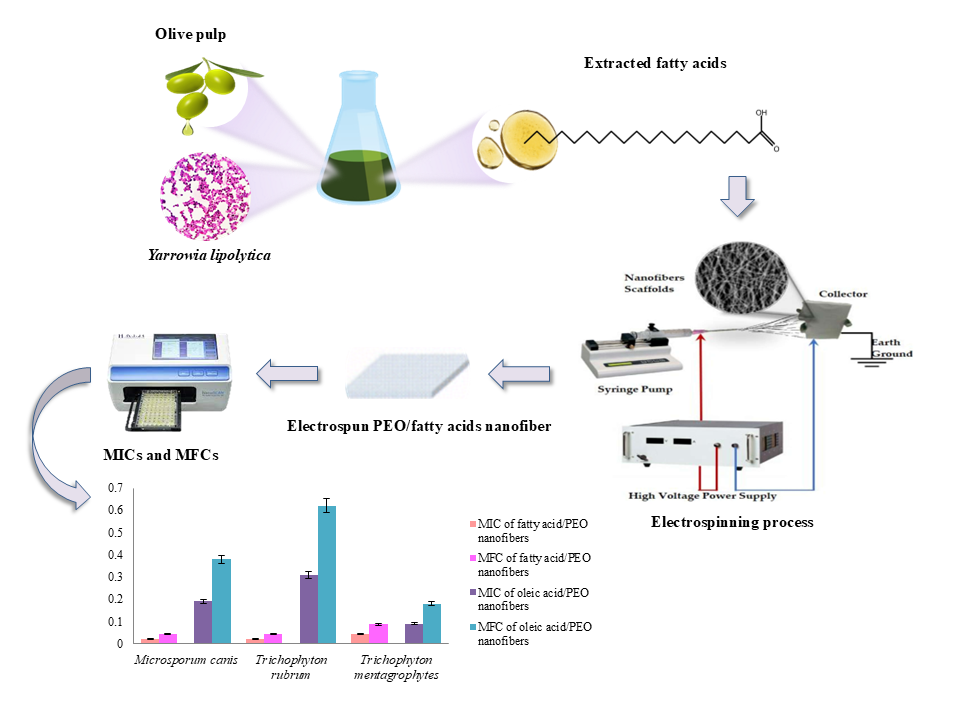
Dermatophytic infections caused by Microsporum canis, Trichophyton rubrum, and Trichophyton mentagrophytes remain a global health concern, especially with rising antifungal resistance. Developing biobased alternatives and novel delivery systems offers promising therapeutic potential. In this research, fatty acids were produced by cultivating Yarrowia lipolytica (ATCC 18942) on oil pressing pulp. The extracted fatty acids identified by GC-MS and FT-IR as primarily oleic acid, palmitic acid, linoleic acid, and stearic acid were incorporated into polyethylene oxide (PEO) nanofibers through electrospinning (15 kV, 15 cm, 1 mL/h). The nanofibers were characterized using SEM and FT-IR. Their antifungal activity was assessed against Microsporum canis, Trichophyton rubrum, and Trichophyton mentagrophytes via microbroth dilution, pour plate, and agar well diffusion assays. The minimum inhibitory concentrations (MICs) of PEO/extracted lipid nanofibers were 21 µg/ml for M. canis and T. rubrum, and 44 µg/ml for T. mentagrophytes. The minimum fungicidal concentrations (MFCs) were 42, 42, and 88 µg/ml, respectively. These findings suggest that naturally derived fatty acids could serve as effective, low-risk alternatives for managing drug-resistant dermatophytosis.
Keywords
- Yarrowia lipolytica,
- Fatty acids Nanofibers,
- Microsporum canis,
- Trichophyton rubrum,
- Trichophyton mentagrophytes