
 10.57647/pibm.2024.132415
Structure-Driven pH-Responsive Doxorubicin Release from Titanium-Modified Zeolite Nanoparticles
- Fatemeh Mirjalili*
 1
1

Published in Issue 2024-12-30
Copyright (c) 2024 Fatemeh Mirjalili (Author)

This work is licensed under a Creative Commons Attribution 4.0 International License.









Abstract
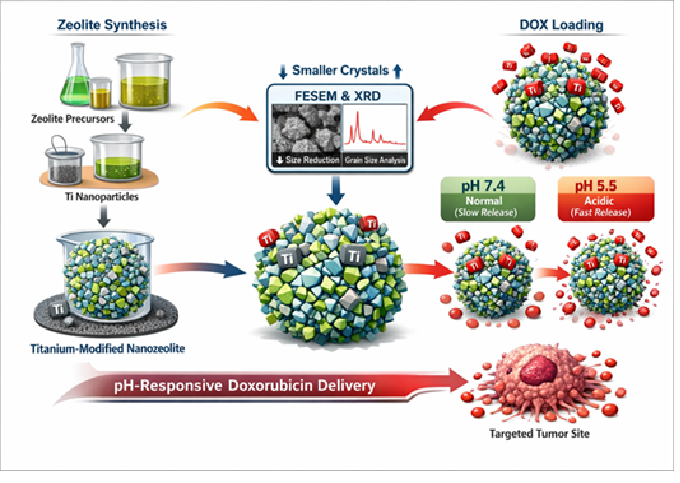
In this study, nanozeolite powders were synthesized via a chemical route using zeolite soil, sodium silicate, sodium hydroxide, calcined kaolin, and distilled water. The influence of synthesis parameters, particularly stirring time, on crystal growth and structural evolution was systematically investigated. Subsequently, the synthesized zeolite powders were surface-modified with controlled amounts of titanium nanoparticles through continuous magnetic stirring for 24 h to tailor their physicochemical properties. Crystallite size analysis based on Scherrer’s equation and field emission scanning electron microscopy (FESEM) revealed that increasing the titanium nanoparticle content led to a significant reduction in average grain size, while prolonged stirring time promoted crystal growth. The crystallite sizes obtained from X-ray diffraction (XRD) analysis were in good agreement with FESEMobservations, confirming the reliability of the structural characterization. Titanium modification induced pronounced grain refinement and increased surface reactivity without altering the fundamental aluminosilicate framework of the zeolite.The drug delivery performance of the prepared nanozeolites was evaluated using doxorubicin (DOX) as a model anticancer drug. In vitro release studies conducted at pH 7.4 and pH 5.5 demonstrated a clear pH-responsive release behavior, with significantly enhanced DOX release under acidic conditions mimicking the tumor microenvironment. Titanium-modified nanozeolites exhibited higher DOX loading capacity and more controlled release profiles compared to unmodified samples, attributed to increased surface hydroxyl groups and refined microstructure.Overall, the results highlight that, controlled synthesis and titanium surface modification effectively enhance the structural and functional performance of nanozeolites, making them promising candidates for pH-triggered and targeted anticancer drug delivery applications.
Keywords
- Nanozeolite,
- XRD,
- FE-SEM,
- Doxorubicin,
- Hydroxyl groups,
- DOX release