
 10.5764/pibm.2024.132414
Biomaterial-Based Delivery of Ornithogalum brachystachys Methanolic Extract Enhances Apoptosis in HT-29 Colorectal Cancer Cells via BAX/BCL2 Modulation
- Maryam Khoshsokhan-Mozaffar*
 1
1
- Department of Biology, Qo.C. Islamic Azad University, Qom, Iran

Published in Issue 2024-12-30
Copyright (c) 2024 Mahdi Il Saadatmand, Maryam Khoshsokhan-Mozaffar, Farah Farahani (Author)

This work is licensed under a Creative Commons Attribution 4.0 International License.
How to Cite









Abstract
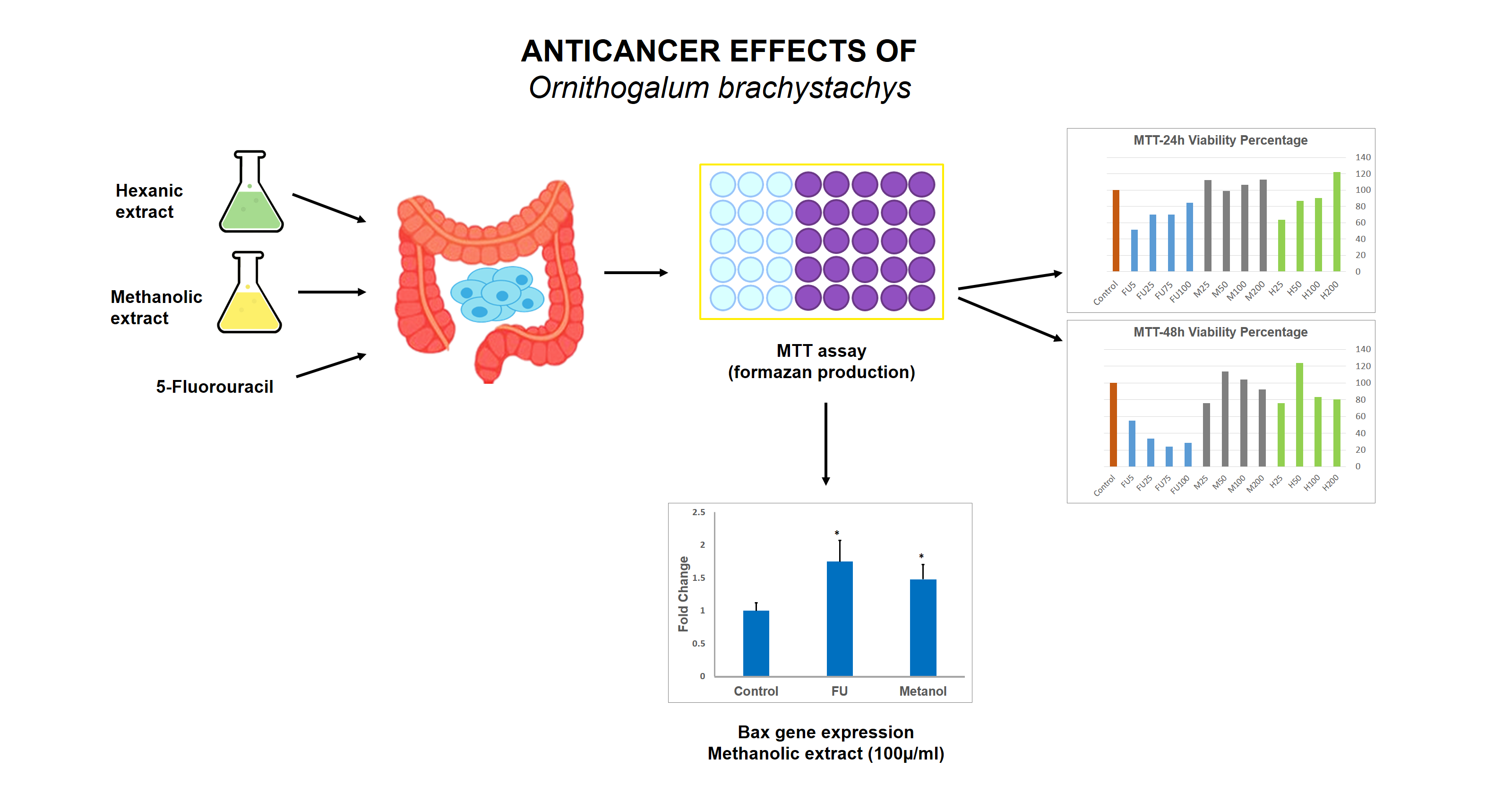
This study evaluated methanolic and hexanic extracts of Ornithogalum brachystachys C.Koch for anti-cancer effects on HT-29 colorectal cancer cells, comparing them to 5-fluorouracil (5-FU). Cells were treated with extracts (25−200 µg/mL) or 5-FU (5−100 µM) for up to 72 hours. Cytotoxicity was assessed by MTT, and apoptosis-related gene expression (BAX and BCL2) by qRT-PCR. The methanolic extract showed the strongest cytotoxicity, reducing viability to 44.9% at 100 µg/mL after 72 hours and increasing BAX expression by 1.48-fold, indicating apoptosis. The hexanic extract had moderate cytotoxicity (63.7% viability at 25 µg/mL, 24 hours) with no significant changes in apoptotic gene expression. 5-FU decreased viability to 51.9% at 5 µM after 72 hours and produced stronger apoptotic signaling (BAX +1.75-fold, BCL2 −0.63-fold). Overall, the methanolic extract demonstrates notable, albeit weaker, pro-apoptotic activity via BAX/BCL2 modulation and may serve as a promising, lower-toxicity complementary natural anticancer candidate warranting further phytochemical and in vivo studies.
Keywords
- BAX,
- BCL2,
- Colorectal cancer,
- Hexanic extract,
- Methanolic extract,
- Ornithogalum brachystachys
References
- Baidoun F., Elshiwy K., Elkeraie Y., Merjaneh Z., Khoudari G., Sarmini M. T., et al. (2021) Colorectal Cancer Epidemiology: Recent Trends and Impact on Outcomes. Current Drug Targets 22:998–1009. DOI: https://doi.org/10.2174/1389450121999201117115717.
- Baptista-Silva S., Borges S., Ramos O. L., Pintadoa M., Sarmento B. (2020) The progress of essential oils as potential therapeutic agents: a review. Journal of Essential Oil Research 32:279–295. DOI: https://doi.org/10.1080/10412905.2020.1746698.
- Calabrese E. J., Hayes A. W., Pressman P., Dhawan G., Kapoor R., Agathokleous E., et al. (2024) Quercetin induces its chemoprotective effects via hormesis. Food and Chemical Toxicology 184:114419.
- De S., Paul S., Manna A., Majumder C., Pal K., Casarcia N., et al. (2023) Phenolic phytochemicals for colorectal cancer prevention. Cancers 15:993.
- Ejder N. et al. (2024) Antioxidant and anti-proliferative effects of Or nithogalum species extracts. Life 14:1365. DOI: https://doi.org/10.1016/j.fct.2023.114419.
- Han J. H., Lee E. J., Park W., Choi J. G., Ha K. T., Chung H. S. (2023) Cosmosiin induces apoptosis in colorectal cancer. Antioxidants 12 (12): 1231. DOI: https://doi.org/10.3390/antiox12122131.
- Hossain M. S., Karuniawati H., Jairoun A. A., Urbi Z., Ooi D. J., John A., et al. (2022) Colorectal cancer: a review of carcinogenesis, global epidemiology, current challenges, risk factors, preventive and treatment strategies. Cancers 14:1732.
- IPNI/POWO (2024) Taxonomic records for Ornithogalum brachystachys. Online botanical database DOI: https://doi.org/10.3390/cancers14071732.
- Jodynis-Liebert J., Kujawska M. (2020) Biphasic dose-response induced by phytochemicals. Journal of Clinical Medicine 9 (3): 718. DOI: https://doi.org/10.3390/jcm9030718.
- Ke¸dzia-Berut R., Berut M., Włodarczyk M., Włodarczyk J., Dziki Ł., Dziki A., et al. (2023) Colorectal Cancer: Is it Still a Disease of the Elderly? Polish Journal of Surgery 96:41–45. DOI: https://doi.org/10.5604/01.3001.0054.0956.
- Khoogar R., Kim B.-C., Morris J., Wargovich M. J. (2016) Chemoprevention in gastrointestinal physiology and disease. AJP–Gastrointestinal and Liver Physiology 310:G629–G644. DOI: https://doi.org/10.1152/ajpgi.00201.2015.
- Lee J. E., Jayakody J. T. M., Kim J. I., Jeong J. W., Choi K. M., Kim T. S., et al. (2024) Influence of solvent choice on extraction of Asteraceae compounds. Foods 13 (19): 3151. DOI: https://doi.org/10.3390/foods13193151.
- Mhaidat N. M., Bouklihacene M., Thorne R. F. (2014) 5-Fluorouracil Induced apoptosis in colorectal cancer cells is caspase-9-dependent and mediated by activation of protein kinase C-δ. Oncology Letters 8:699–704. DOI: https://doi.org/10.3892/ol.2014.2211.
- Neamtu A. A., Maghiar T. A., Turcus V., Maghiar P. B., Cˆapraru A. M., Lazar B. A., et al. (2024) A Comprehensive View on Impact of chlorogenic acids on colorectal cancer. Current Issues in Molecular Biology 46:6783–6804. DOI: https://doi.org/10.3390/cimb46070405.
- Niero E. L. d. O., Machado-Santelli G. M. (2013) Cinnamic acid induces apoptotic cell death. Journal of Experimental & Clinical Cancer Research 32:31.
- NkwochaC.C.,Felix J. O., Michael L. O., Ale A. B. (2024) Phytochemical screening and GC-FID identification of bioactive compounds in nhexane, ethylacetate and methanol fractions of methanolic leaves extract of Azanza garckeana. Food Chemistry Advances 4:100712. DOI: https://doi.org/10.1016/j.focha.2024.100712.
- Onyoh E. F., Hsu W. F., Chang L. C., Lee Y. C., Wu M. S., Chiu H. M. (2019) The Rise of Colorectal Cancer in Asia: Epidemiology, Screening, and Management. Current Gastroenterology Reports 21:36. DOI: https://doi.org/10.1007/s11894-019-0703-8.
- Patel S. G., Karlitz J. J., Yen T., Lieu C. H., Boland C. R. (2022) Early-onset colorectal cancer: a comprehensive review. Lancet Gastroenterology &Hepatology 7:262–274.
- Pyo Y., Kwon K. H. (2024) Target for prevention/therapy of colon cancer Journal of Men’s Health 20:1–8.
- Queffelec J., Beraud W., Ferron S., Boustie J., Rodr´ıguez-Gonz´alez I., DiazReinoso b., Torres D., Dom´ınguez H. (2024) Alternatives for the extraction of bioactives and biopolymers from Evernia prunastri for the formulation of antimicrobial bio-based films. Green Chemistry 26:10205–10224. DOI: https://doi.org/10.1039/d4gc02741h.
- Riahi-Chebbi I., Souid S., Othman H., Haoues M., Karoui H., Morel A., et al. (2019) Kaempferol overcomes 5-FU resistance. Scientific Reports 9:195. DOI: https://doi.org/10.1038/s41598-018-36808-z.
- Sharma S. H., Rajamanickam V., Nagarajan S. (2018) Antiproliferative effect of p-Coumaric acid. Chemico–Biological Interactions 291:16–28. DOI: https://doi.org/10.1016/j.cbi.2018.06.001.
- Siddiqui A. J., Jahan S., Singh R., Saxena J., Ashraf S. A., Khan A., et al. (2022) Plants in anticancer drug discovery. Biomed Research International, 5425485. DOI: https://doi.org/10.1155/2022/5425485.
- Singh A., Chauhan S., Tripathi V. (2018) Quinic acid attenuates oral cancer cell proliferation by downregulating cyclin D1 Expression and Aktsignaling. Pharmacognosy Magazine 14:14. DOI: https://doi.org/10.4103/pm.pm“˙36“˙18.
- Tehami W., Nani A., Khan N. A., Hichami A. (2023) New Insights Into the Anticancer effects of p-Coumaric acid. Dose Response 21:15593258221150704. DOI: https://doi.org/10.1177/15593258221150704.
- U˘gur D., G¨unes H., G¨unes F., Mammadov R. (2017) Cytotoxic activities of medicinal plants. Turkish Journal of Pharmaceutical Sciences 14:222–230. DOI: https://doi.org/10.4274/tjps.80299.
- Zhan Z. et al. (2021) Anticancer effects of OSW-1 from Ornithogalum saundersiae: A Review. Frontiers in Oncology 11:742718. DOI: https://doi.org/10.3389/fonc.2021.747718.
- Zheng Y., Wang Z. Z. (2021) Interpretation of global colorectal cancer statistics. Chinese Journal of Epidemiology 42:149–152.
- Zhu B., Shang B., Li Y., Zhen Y. (2016) Inhibition of histone deacetylases by trans-cinnamic acid and its antitumor effect against colon cancer xenografts in athymic mice. Mol Med Rep 13 (5): 4159–66. DOI: https://doi.org/10.1152/ajpgi.00201.2015.