
 10.57647/pibm.2024.132401
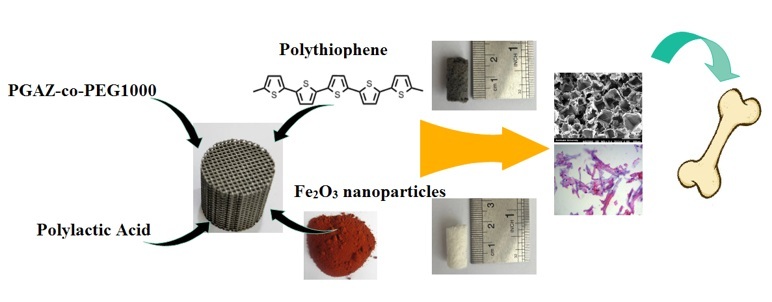
Effect of Conductive Polymer, Magnetic Nanoparticles and Simvastatin Drug on Bone Regenaration in 3D Scaffolds Based on PGAZ-co-PEG1000 and PLA
- Shahrokh Shojaei*
 1
1

Published in Issue 2024-03-30
Copyright (c) 2025 Rahele Samizadeh, Shahrokh Shojaei, Soheila Zamanlui Benisi, Sadegh Rahmati, Milad Jafari-Nodoushan (Author)

This work is licensed under a Creative Commons Attribution 4.0 International License.









Abstract
In this study, new 3D scaffolds based on synthesized PGAZ-co-PEG1000 and PLA were prepared by salt leaching technique and Polythiophene as conductive pairs and Fe2O3 as magnetic nanoparticles, were also added to the 3D scaffolds. The FTIR test revealed that there is a relatively good interaction between the components used in these scaffolds. The XRD test also showed that the simultaneous presence of nanoparticles Fe2O3 and Polythiophene has a reducing effect on the crystal structure of the samples. SEM analysis also showed that suitable three-dimensional structures were formed within the samples and that the presence of other components in the scaffolds had significant effects on the three-dimensional structures of the scaffolds. The mechanical behavior of the samples in compression mode was analyzed in both dry and wet states. Young's modulus in dry and wet states showed completely different behavior among the samples. The compressive strength of the nanocomposite sample, which has twice the amount of nanoparticles as Polythiophene, was higher in both wet and dry states than in all the samples. Also, the degradation test was investigated in two acidic and basic pH, and interesting results were obtained. Alizarin red, H&E, and cell adhesion tests were performed on simple samples and samples loaded with the drug, and the results showed that the presence of Polythiophene and nanoparticles have a good effect on cell growth and proliferation, and Simvastatin drug has also demonstrated sound effects in addition to these substances.
Keywords
- PGAZ-co-PEG1000,
- Polythiophene,
- Salt leaching,
- Scaffolds
References
- Aghajan MH, Panahi-Sarmad M, Alikarami N, et al (2020) Using solvent-free approach for preparing innovative biopolymer nanocomposites based on PGS/gelatin. Eur Polym J 131:. https://doi.org/10.1016/j.eurpolymj.2020.109720
- Bakhtiari A, Madaah Hosseini HR, Alizadeh R, et al (2025) Enhancing mechanical and biological properties of 3D-printed polylactic acid scaffolds by graphitic carbon nitride addition for bone tissue engineering. J Mater Res Technol 35:308–316. https://doi.org/https://doi.org/10.1016/j.jmrt.2025.01.046
- Bedian L, Villalba-Rodríguez AM, Hernández-Vargas G, et al (2017) Bio-based materials with novel characteristics for tissue engineering applications – A review. Int J Biol Macromol 98:837–846. https://doi.org/https://doi.org/10.1016/j.ijbiomac.2017.02.048
- Bharti S, Kumar A (2025) Correlation in Stem Cell Technology, Tissue Engineering, and Regenerative Medicine. Regen Eng Transl Med. https://doi.org/10.1007/s40883-025-00388-y
- Bradshaw KJ, Leipzig ND (2025) Applications of Regenerative Tissue-Engineered Scaffolds for Treatment of Spinal Cord Injury. Tissue Eng Part A 31:108–125. https://doi.org/10.1089/ten.tea.2024.0194
- Bronze-Uhle ES, Melo CC da SB de, da Silva ISP, et al (2025) Simvastatin-Loaded Chitosan Microspheres as a Biomaterial for Dentin Tissue Engineering. J Biomed Mater Res Part B Appl Biomater 113:e35536. https://doi.org/https://doi.org/10.1002/jbm.b.35536
- Brouki Milan P, Masoumi F, Biazar E, et al (2025) Exploiting the Potential of Decellularized Extracellular Matrix (ECM) in Tissue Engineering: A Review Study. Macromol Biosci 25:2400322. https://doi.org/https://doi.org/10.1002/mabi.202400322
- Charles-Harris M, Koch MA, Navarro M, et al (2008) A PLA/calcium phosphate degradable composite material for bone tissue engineering: an in vitro study. J Mater Sci Mater Med 19:1503–1513. https://doi.org/10.1007/s10856-008-3390-9
- Chen QZ, Ishii H, Thouas GA, et al (2010) An elastomeric patch derived from poly(glycerol sebacate) for delivery of embryonic stem cells to the heart. Biomaterials. https://doi.org/10.1016/j.biomaterials.2010.01.108
- Chen QZ, Thompson ID, Boccaccini AR (2006) 45S5 Bioglass®-derived glass-ceramic scaffolds for bone tissue engineering. Biomaterials 27:2414
- Davoodi B, Goodarzi V, Hosseini H, et al (2022) Design and manufacturing a tubular structures based on poly(ɛ-caprolactone) / poly(glycerol-sebacic acid) biodegradable nanocomposite blends: suggested for applications in the nervous, vascular and renal tissue engineering. J Polym Res 2022 292 29:1–15. https://doi.org/10.1007/S10965-021-02881-8
- Golbaten-Mofrad H, Seyfi Sahzabi A, Seyfikar S, et al (2021) Facile template preparation of novel electroactive scaffold composed of polypyrrole-coated poly(glycerol-sebacate-urethane) for tissue engineering applications. Eur Polym J 159:110749. https://doi.org/https://doi.org/10.1016/j.eurpolymj.2021.110749
- Guo B, Ma PX (2014) Synthetic biodegradable functional polymers for tissue engineering: A brief review. Sci China Chem 57:490–500. https://doi.org/10.1007/s11426-014-5086-y
- Guo B, Ma PX (2018) Conducting Polymers for Tissue Engineering. Biomacromolecules 19:1764–1782. https://doi.org/10.1021/acs.biomac.8b00276
- Gupta S, Del Fabbro M, Chang J (2019) The impact of simvastatin intervention on the healing of bone, soft tissue, and TMJ cartilage in dentistry: a systematic review and meta-analysis. Int J Implant Dent 5:17. https://doi.org/10.1186/s40729-019-0168-4
- Hashempoor S, Najmoddin N, Mohammadi M, et al (2025) Tissue-engineered scaffold based on poly (glycerol sebacic itaconic acid)/clay nanocomposite using salt leaching process. Polym Bull 82:4901–4921. https://doi.org/10.1007/s00289-025-05737-z
- Hashemzadeh MR, Taghavizadeh Yazdi ME, Amiri MS, Mousavi SH (2021) Stem cell therapy in the heart: Biomaterials as a key route. Tissue Cell 71:101504. https://doi.org/https://doi.org/10.1016/j.tice.2021.101504
- Hassanajili S, Karami-Pour A, Oryan A, Talaei-Khozani T (2019) Preparation and characterization of PLA/PCL/HA composite scaffolds using indirect 3D printing for bone tissue engineering. Mater Sci Eng C 104:109960. https://doi.org/https://doi.org/10.1016/j.msec.2019.109960
- Hosseini Chenani F, Rezaei VF, Fakhri V, et al (2021) Green synthesis and characterization of poly(glycerol-azelaic acid) and its nanocomposites for applications in regenerative medicine. J Appl Polym Sci 138:50563. https://doi.org/https://doi.org/10.1002/app.50563
- Iravani S, Varma RS (2019) Plants and plant-based polymers as scaffolds for tissue engineering. Green Chem 21:4839–4867. https://doi.org/10.1039/C9GC02391G
- Janmohammadi M, Nourbakhsh MS, Bahraminasab M (2025) 3D printed polycaprolactone scaffold incorporated with tragacanth gum/bioactive glass and cellulose nanocrystals for bone tissue engineering. Int J Biol Macromol 305:141114. https://doi.org/https://doi.org/10.1016/j.ijbiomac.2025.141114
- Kasi PB, Serafin A, O’Brien L, et al (2025) Electroconductive gelatin/hyaluronic acid/hydroxyapatite scaffolds for enhanced cell proliferation and osteogenic differentiation in bone tissue engineering. Biomater Adv 173:214286. https://doi.org/https://doi.org/10.1016/j.bioadv.2025.214286
- Khademhosseini A, Langer R (2016) A decade of progress in tissue engineering. Nat Protoc 11:1775–1781. https://doi.org/10.1038/nprot.2016.123
- Liu Z, Ma X, Liu J, et al (2025) Advances in the application of natural/synthetic hybrid hydrogels in tissue engineering and delivery systems: A comprehensive review. Int J Pharm 672:125323. https://doi.org/https://doi.org/10.1016/j.ijpharm.2025.125323
- Mahdavi R, Zahedi P, Goodarzi V (2024) Application of Poly(Glycerol Itaconic Acid) (PGIt) and Poly(ɛ-caprolactone) Diol (PCL-diol) as Macro Crosslinkers Containing Cloisite Na+ to Application in Tissue Engineering. J Polym Environ 1–15. https://doi.org/10.1007/S10924-023-03162-9/METRICS
- Mohammadi A, Salimi A, Goodarzi V, et al (2024) Synthesis and Characterization of PEGylated Poly(Glycerol Azelaic Acid) and Their Nanocomposites for Application in Tissue Engineering. J Polym Environ 1–17. https://doi.org/10.1007/S10924-024-03194-9/METRICS
- Parhamrad N, Najmoddin N, Mohammadi M, Goodarzi V (2025) Fabrication and characterization of magnetic bio-polymeric films comprising PCL-based polyurethane, poly (glycerol azelaic acid) and SPIONs for biomedical application. Mater Chem Phys 345:131200. https://doi.org/https://doi.org/10.1016/j.matchemphys.2025.131200
- Pitts J, Hänsch R, Roger Y, et al (2025) 3D Porous Polycaprolactone with Chitosan-Graft-PCL Modified Surface for In Situ Tissue Engineering. Polymers (Basel) 17:. https://doi.org/10.3390/polym17030383
- Rostamian M, Hosseini H, Fakhri V, et al (2022) Introducing a bio sorbent for removal of methylene blue dye based on flexible poly(glycerol sebacate)/chitosan/graphene oxide ecofriendly nanocomposites. Chemosphere 289:133219. https://doi.org/https://doi.org/10.1016/j.chemosphere.2021.133219
- Rostamian M, Kalaee MR, Dehkordi SR, et al (2020) Design and characterization of poly(glycerol-sebacate)-co-poly(caprolactone) (PGS-co-PCL) and its nanocomposites as novel biomaterials: The promising candidate for soft tissue engineering. Eur Polym J 138:109985. https://doi.org/10.1016/J.EURPOLYMJ.2020.109985
- Sajesh KM, Jayakumar R, Nair S V, Chennazhi KP (2013) Biocompatible conducting chitosan/polypyrrole–alginate composite scaffold for bone tissue engineering. Int J Biol Macromol 62:465–471. https://doi.org/https://doi.org/10.1016/j.ijbiomac.2013.09.028
- Shahrousvand M, Goodarzi V, Ghorbani M (2025) Gallic acid functionalized poly(glycerol-cosebacate-co-citrate): A next-generation bioadhesive for hemostatic applications. Eur Polym J 238:114203. https://doi.org/https://doi.org/10.1016/j.eurpolymj.2025.114203
- Shastri VP, Rahman N, Martin I, Langer R (1998) Application of Conductive Polymers in Bone Regeneration. MRS Proc 550:215. https://doi.org/10.1557/PROC-550-215
- Shirali D, Emadi R, Khodaei M, et al (2025) Surface modification of 3D-printed polylactic acid-hardystonite scaffold for bone tissue engineering. Int J Biol Macromol 308:142496. https://doi.org/https://doi.org/10.1016/j.ijbiomac.2025.142496
- Sood A, Gupta A, Agrawal G (2021) Recent advances in polysaccharides based biomaterials for drug delivery and tissue engineering applications. Carbohydr Polym Technol Appl 2:100067. https://doi.org/10.1016/J.CARPTA.2021.100067
- Tidke S, Waknis PP, Badhe R, et al (2025) Comparative Evaluation of Bone Regeneration in Third Molar Extraction Using Simvastatin Powder And Simvastatin Gel—A Split-Mouth Study. J Maxillofac Oral Surg. https://doi.org/10.1007/s12663-025-02497-1
- Venkatesan J, Kim SK (2014) Nano-hydroxyapatite composite biomaterials for bone tissue engineering - A review. J. Biomed. Nanotechnol. 10:3124–3140
- Wang W, Zhang B, Li M, et al (2021) 3D printing of PLA/n-HA composite scaffolds with customized mechanical properties and biological functions for bone tissue engineering. Compos Part B Eng 224:109192. https://doi.org/https://doi.org/10.1016/j.compositesb.2021.109192
- Zhang Q, Song M, Xu Y, et al (2021) Bio-based polyesters: Recent progress and future prospects. Prog Polym Sci 120:101430. https://doi.org/https://doi.org/10.1016/j.progpolymsci.2021.101430
- Zia KM, Noreen A, Zuber M, et al (2016) Recent developments and future prospects on bio-based polyesters derived from renewable resources: A review. Int J Biol Macromol 82:1028–1040. https://doi.org/10.1016/J.IJBIOMAC.2015.10.040