
 10.57647/pibm.2023.122321
Eco-Friendly Antibacterial Dyes from Nerium oleander and Bougainvillea spectabilis for Sustainable Wool Dyeing Applications
- Mahboubeh Sadat Sharif
 1
1 - Maryam Khoshsokhan-Mozaffar2
- Department of Chemistry, Qo.C. Islamic Azad University, Qom Branch, Qom, Iran
- Department of Biology, Qo.C. Islamic Azad University, Qom Branch, Qom, Iran

Received: 2023-08-14
Revised: 2023-11-10
Accepted: 2023-11-17
Published in Issue 2023-12-30
Copyright (c) 2025 Mohsen Arslaninia, Mahboubeh Sadat Sharif, Maryam Khoshsokhan-Mozaffar, Amir Mansour Arbabi-Fattah (Author)

This work is licensed under a Creative Commons Attribution 4.0 International License.
How to Cite









Abstract
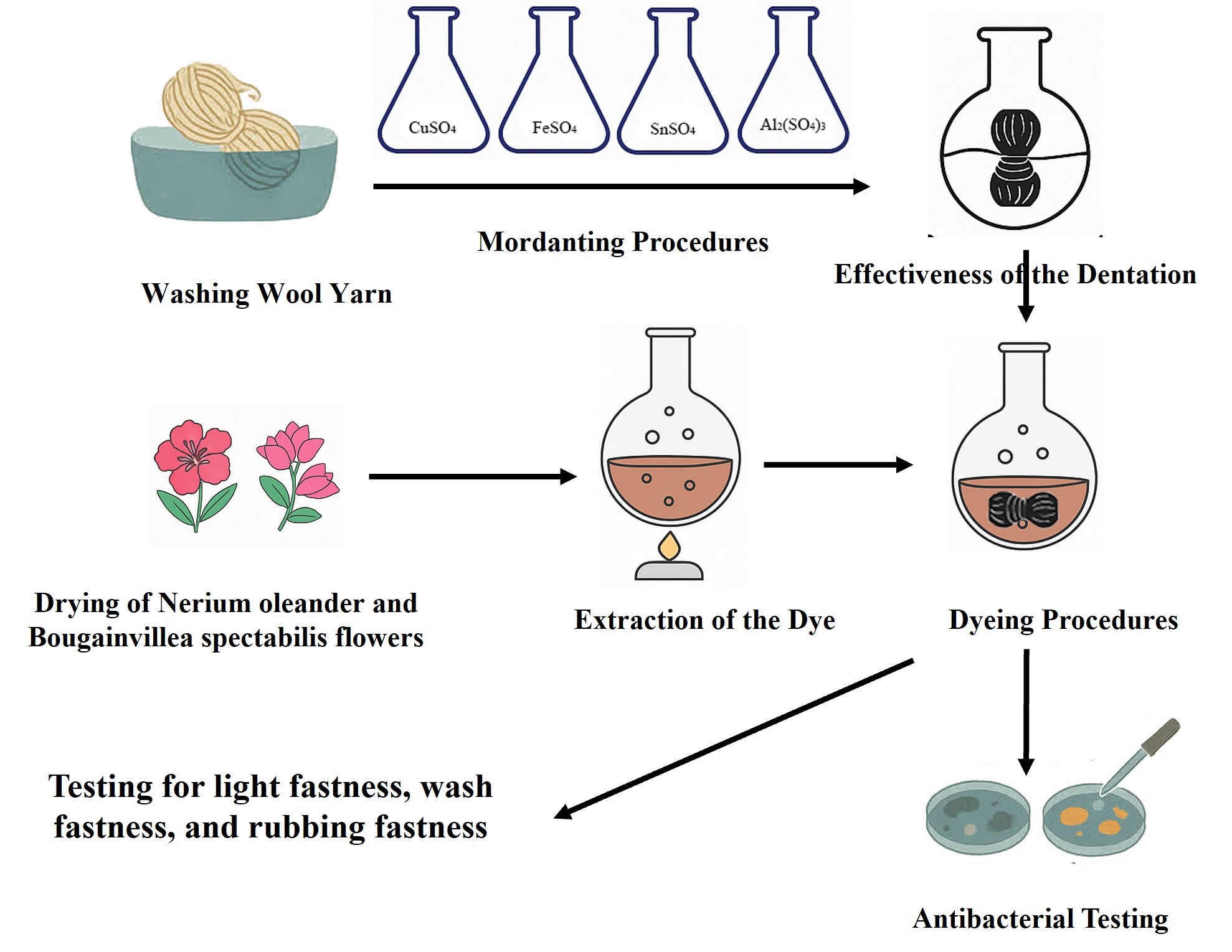
This study evaluates plant-derived antibacterial dyes from Nerium oleander and Bougainvillea spectabilis for bio-based wool textile applications, with a focus on mordant effects. Wool yarns were pre-treated using various mordants-aluminum sulfate, stannous chloride, iron sulfate, and copper sulfate-and subsequently dyed with flower extracts. The dyeing was performed at different liquor ratios and temperatures, and outcomes were assessed for color stability, wash fastness, rubbing fastness, and antibacterial activity against Escherichia coli (Gram-negative) and Staphylococcus aureus (Gram-positive). Findings show that iron mordants enhanced light fastness for oleander-dyed fibers, while stannous mordant improved performance for bougainvillea-dyed samples. Copper mordants yielded strong antibacterial activity, particularly against E. coli, whereas iron mordants produced the largest inhibition zones overall, suggesting both Cu and Fe substantially contribute to antimicrobial efficacy in a dye- and plant-dependent manner. Wash and rubbing fastness remained satisfactory across samples, indicating stable dye-mordant-fiber complexes with minimal leaching and abrasion. Overall, the results support the potential of these natural dyes as sustainable alternatives in textile dyeing, offering functional benefits such as antibacterial properties and improved colorfastness. The study emphasizes the crucial role of mordant selection in optimizing dye performance and durability, contributing to eco-friendly textile processing.
Keywords
- Natural dyes,
- Antibacterial textiles,
- Mordants,
- Colorfastness,
- Wool dyeing,
- Sustainable textiles