
 10.57647/pibm-2025-17327
Unveiling the Multifaced Therapeutic Potential of Thymus vulgaris L. and its Phytochemical Analysis
- Mohamed A. Fareid
 1
1 - Gamal M. El-Sherbiny*
 2
2 - Nancy M. Elafandy1
- Nagat E. Eltoum3
- Mohamed S. Othman4
- Mohamed H. Kalaba2
- Ahmed A. Radwan2
- Fatma A. Hamada5
- Dina M. Elkhashab6

Received: 2025-07-29
Accepted: 2025-09-19
Published in Issue 2025-09-30
Copyright (c) 2025 Mohamed A. Fareid, Gamal M. El-Sherbiny, Nancy M. Elafandy, Nagat E. Eltoum, Mohamed S. Othman, Mohamed H. Kalaba, Ahmed A. Radwan, Fatma A. Hamada, Dina M. Elkhashab (Author)

This work is licensed under a Creative Commons Attribution 4.0 International License.









Abstract
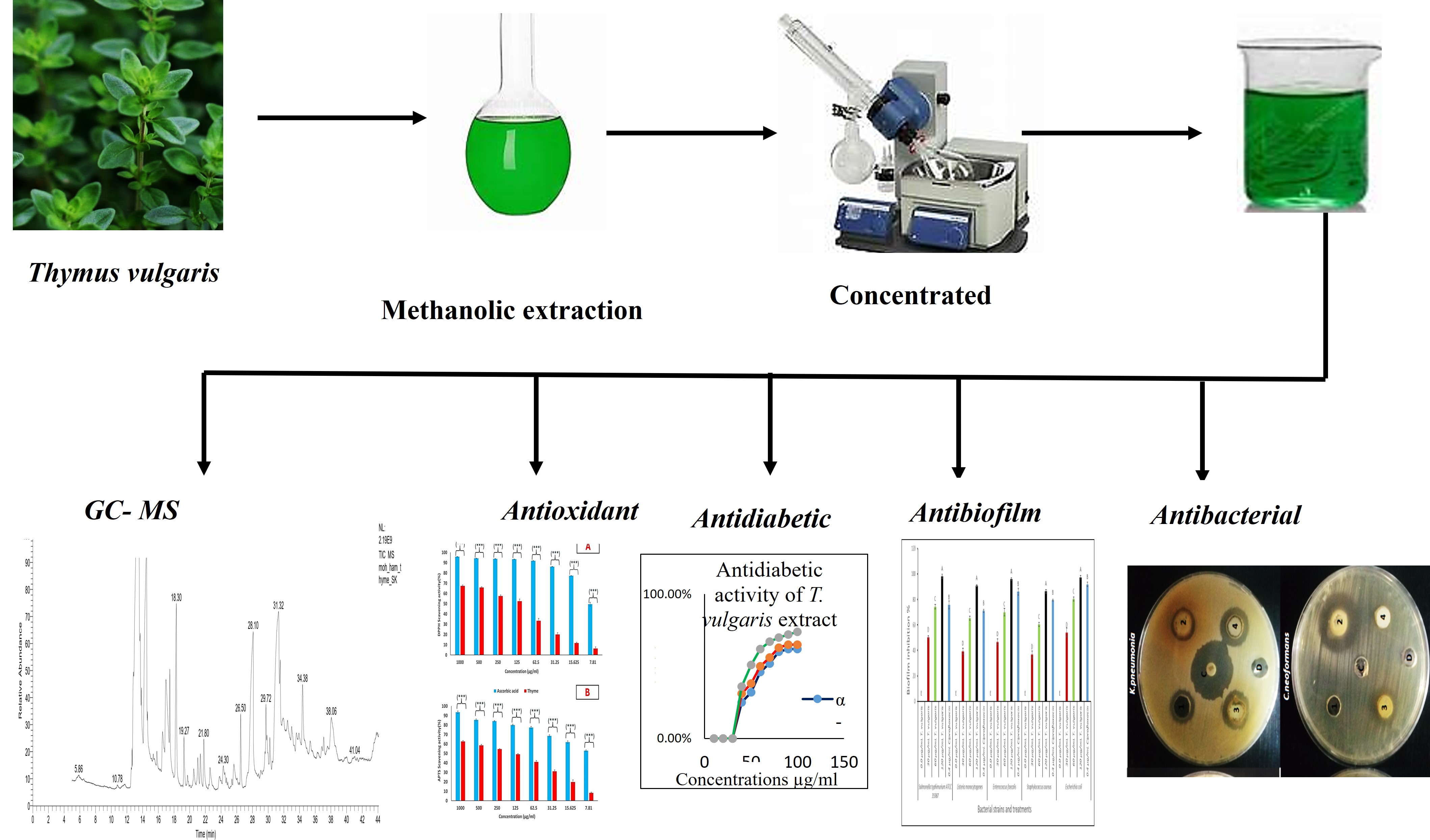
The pharmaceutical properties and chemical constituents of Thymus vulgaris extract have attracted considerable interest from both researchers and the food industry. In this study, we evaluated the therapeutic potential of T. vulgaris extract, focusing on its antioxidant, anti-inflammatory, antidiabetic, antibacterial, and antibiofilm activities. In addition, we characterized its chemical composition and predicted the pharmacokinetic profile of its major compound, thymol, using ADMET analysis, to assess its potential as a natural therapeutic agent. Phytochemical analysis of the methanolic extract revealed high levels of phenolics (225 ± 1.42 mg GAE/g extract), tannins (20 ± 0.57 mg GAE/g extract), and flavonoids (25 ± 0.79 mg RE/g extract). GC–MS analysis identified thymol (28.23%) as the predominant active constituent.The methanolic extract of T. vulgaris demonstrated strong antioxidant activity, with IC₅₀ values of 27 μg/mL (DPPH assay) and 35 μg/mL (ABTS assay). It also inhibited human erythrocyte hemolysis by 55.60%–74.81% at concentrations between 4 and 50 μg/mL.Furthermore, the extract significantly suppressed carbohydrate-metabolizing enzymes, producing 62.0% inhibition of α-glucosidase and 65.0% inhibition of α-amylase at 100 μg/mL. The extract exhibited notable antibacterial effects against several bacterial strains, with inhibition zones of 11 ± 0.45 mm to 14 ± 0.82 mm and minimum inhibitory concentration (MIC) values ranging from 95 to 450 μg/mL. In addition, it showed potent antibiofilm activity, achieving complete inhibition (100%) at 120 μg/mL. ADMET predictions further confirmed that thymol possesses favorable pharmacokinetic properties.These findings highlight the significant therapeutic potential of T. vulgaris extract and suggest that it may serve as a promising natural alternative for managing chronic diseases and combating antibiotic-resistant pathogens.
Keywords
- Biomimetic soft tissue regeneration,
- Carboxymethyl cellulose,
- Alginate,
- Mucosal dressing
References
- Adeli, H., M. T. Khorasani and M. Parvazinia (2019). "Wound dressing based on electrospun PVA/chitosan/starch nanofibrous mats: Fabrication, antibacterial and cytocompatibility evaluation and in vitro healing assay." International journal of biological macromolecules 122: 238-254.
- Akar, E., A. Altınışık and Y. Seki (2012). "Preparation of pH-and ionic-strength responsive biodegradable fumaric acid crosslinked carboxymethyl cellulose." Carbohydrate polymers 90(4): 1634-1641.
- Asaka, D., M. Yoshikawa, T. Okushi, T. Nakayama, Y. Matsuwaki, N. Otori and H. Moriyama (2012). "Nasal splinting using silicone plates without gauze packing following septoplasty combined with inferior turbinate surgery." Auris Nasus Larynx 39(1): 53-58.
- Camacho, P., H. Busari, K. B. Seims, J. W. Tolbert and L. W. Chow (2019). "Materials as bioinks and bioink design." 3D Bioprinting in Medicine: Technologies, Bioinks, and Applications: 67-100.
- Cheng, H., Z. Shi, K. Yue, X. Huang, Y. Xu, C. Gao, Z. Yao, Y. S. Zhang and J. Wang (2021). "Sprayable hydrogel dressing accelerates wound healing with combined reactive oxygen species-scavenging and antibacterial abilities." Acta biomaterialia 124: 219-232.
- Chiu, C.-W., T.-K. Huang, Y.-C. Wang, B. G. Alamani and J.-J. Lin (2014). "Intercalation strategies in clay/polymer hybrids." Progress in Polymer Science 39(3): 443-485.
- Dehghani, S., M. Rasoulianboroujeni, H. Ghasemi, S. H. Keshel, Z. Nozarian, M. N. Hashemian, M. Zarei-Ghanavati, G. Latifi, R. Ghaffari and Z. Cui (2018). "3D-Printed membrane as an alternative to amniotic membrane for ocular surface/conjunctival defect reconstruction: An in vitro & in vivo study." Biomaterials 174: 95-112.
- Dilaver, M. and K. Yurdakoc (2016). "Fumaric acid cross-linked carboxymethylcellulose/poly (vinyl alcohol) hydrogels." Polymer Bulletin 73: 2661-2675.
- El-Bana, A., N. Barakat, A. Abdelghany and M. Meikhail (2023). "Effect of surfactants addition on physical, structure and antimicrobial activity of (Na-CMC/Na–Alg) biofilms." Polymer Bulletin 80(3): 2883-2909.
- Elbein, A. D., Y. Pan, I. Pastuszak and D. Carroll (2003). "New insights on trehalose: a multifunctional molecule." Glycobiology 13(4): 17R-27R.
- Ficek, K., J. Filipek, P. Wojciechowski, K. Kopec, S.-Z. Ewa and S. Blazewicz (2016). "A bioresorbable polylactide implant used in bone cyst filling." Journal of Materials Science: Materials in Medicine 27: 1-8.
- Fraser, J. R. E., T. C. Laurent and U. Laurent (1997). "Hyaluronan: its nature, distribution, functions and turnover." Journal of internal medicine 242(1): 27-33.
- Gorgieva, S. and V. Kokol (2011). "Synthesis and application of new temperature-responsive hydrogels based on carboxymethyl and hydroxyethyl cellulose derivatives for the functional finishing of cotton knitwear." Carbohydrate polymers 85(3): 664-673.
- Habib, A., V. Sathish, S. Mallik and B. Khoda (2018). "3D printability of alginate-carboxymethyl cellulose hydrogel." Materials 11(3): 454.
- He, H., E. Markoutsa, Y. Zhan, J. Zhang and P. Xu (2017). "Mussel-inspired PLGA/polydopamine core-shell nanoparticle for light induced cancer thermochemotherapy." Acta biomaterialia 59: 181-191.
- Higashiyama, T. (2002). "Novel functions and applications of trehalose." Pure and applied Chemistry 74(7): 1263-1269.
- Jahanshahi, J., F. Hashemian, S. Pazira, M. H. Bakhshaei, F. Farahani, R. Abasi and J. Poorolajal (2014). "Effect of topical tranexamic acid on bleeding and quality of surgical field during functional endoscopic sinus surgery in patients with chronic rhinosinusitis: a triple blind randomized clinical trial." PLoS One 9(8): e104477.
- Jaikumar, D., K. Sajesh, S. Soumya, T. Nimal, K. Chennazhi, S. V. Nair and R. Jayakumar (2015). "Injectable alginate-O-carboxymethyl chitosan/nano fibrin composite hydrogels for adipose tissue engineering." International journal of biological macromolecules 74: 318-326.
- Jung, S., G. Zhang and H. Yoshida (2007). "Evaluation of compatibility in polymer blend systems by simultaneous DSC-FTIR measurement." Journal of thermal analysis and calorimetry 89(3): 675-680.
- Kluger, P. J., R. Wyrwa, J. Weisser, J. Maierle, M. Votteler, C. Rode, M. Schnabelrauch, H. Walles and K. Schenke-Layland (2010). "Electrospun poly (D/L-lactide-co-L-lactide) hybrid matrix: a novel scaffold material for soft tissue engineering." Journal of Materials Science: Materials in Medicine 21: 2665-2671.
- Kotecha, B., S. Fowler, P. Harkness, J. Walmsley, P. Brown and J. Topham (1996). "Management of epistaxis: a national survey." Annals of the Royal College of Surgeons of England 78(5): 444.
- Lau, A. S., N. S. Upile, L. Lazarova and A. C. Swift (2016). "Evaluating the use of Floseal haemostatic matrix in the treatment of epistaxis: a prospective, control-matched longitudinal study." European Archives of Oto-Rhino-Laryngology 273(9): 2579-2584.
- Laurent, T. C., U. B. Laurent and J. R. Fraser (1995). "Functions of hyaluronan." Ann Rheum Dis 54(5): 429-432.
- Ma, H.-Y., Y.-N. Hu, H. Yang, L.-J. Zhu, G. Wang, Z.-X. Zeng and L.-H. Wang (2021). "In situ mussel-inspired Janus membranes using catechol and polyethyleneimine as the additives for highly efficient oil/water emulsions separation." Separation and Purification Technology 262: 118310.
- Mathiasen, R. A. and R. M. Cruz (2005). "Prospective, randomized, controlled clinical trial of a novel matrix hemostatic sealant in patients with acute anterior epistaxis." The Laryngoscope 115(5): 899-902.
- Osaheni, A. O., E. B. Finkelstein, P. T. Mather and M. M. Blum (2016). "Synthesis and characterization of a zwitterionic hydrogel blend with low coefficient of friction." Acta Biomaterialia 46: 245-255.
- Priya, G., B. Madhan, U. Narendrakumar, R. V. Suresh Kumar and I. Manjubala (2021). "In vitro and in vivo evaluation of carboxymethyl cellulose scaffolds for bone tissue engineering applications." ACS omega 6(2): 1246-1253.
- Prokop, A., A. Jubel, H. Helling, T. Eibach, C. Peters, S. Baldus and K. Rehm (2004). "Soft tissue reactions of different biodegradable polylactide implants." Biomaterials 25(2): 259-267.
- Reise, M., R. Wyrwa, U. Müller, M. Zylinski, A. Völpel, M. Schnabelrauch, A. Berg, K. D. Jandt, D. C. Watts and B. W. Sigusch (2012). "Release of metronidazole from electrospun poly (L-lactide-co-D/L-lactide) fibers for local periodontitis treatment." Dental Materials 28(2): 179-188.
- Ryu, J. H., J. S. Choi, E. Park, M. R. Eom, S. Jo, M. S. Lee, S. K. Kwon and H. Lee (2020). "Chitosan oral patches inspired by mussel adhesion." Journal of Controlled Release 317: 57-66.
- Sannino, A., C. Demitri and M. Madaghiele (2009). "Biodegradable cellulose-based hydrogels: design and applications." Materials 2(2): 353-373.
- Schkarpetkin, D., M. Reise, R. Wyrwa, A. Völpel, A. Berg, M. Schweder, M. Schnabelrauch, D. C. Watts and B. W. Sigusch (2016). "Development of novel electrospun dual-drug fiber mats loaded with a combination of ampicillin and metronidazole." Dental Materials 32(8): 951-960.
- Shang, B., Y. Wang, B. Peng and Z. Deng (2020). "Bioinspired polydopamine coating as a versatile platform for synthesizing asymmetric Janus particles at an air-water interface." Applied Surface Science 509: 145360.
- Singh, B., N. Panda, R. Mund and K. Pramanik (2016). "Carboxymethyl cellulose enables silk fibroin nanofibrous scaffold with enhanced biomimetic potential for bone tissue engineering application." Carbohydrate polymers 151: 335-347.
- Sizílio, R., J. Galvão, G. Trindade, L. Pina, L. Andrade, J. Gonsalves, A. Lira, M. Chaud, T. Alves and M. Arguelho (2018). "Chitosan/pvp-based mucoadhesive membranes as a promising delivery system of betamethasone-17-valerate for aphthous stomatitis." Carbohydrate Polymers 190: 339-345.
- Stange, G. (1975). "Bindegewebs-Siliconfolien-Plastiken bei Adhaesivprozessen des Mittelohres." Archives of oto-rhino-laryngology 210(2): 368-368.
- Su, T., M. Zhang, Q. Zeng, W. Pan, Y. Huang, Y. Qian, W. Dong, X. Qi and J. Shen (2021). "Mussel-inspired agarose hydrogel scaffolds for skin tissue engineering." Bioactive materials 6(3): 579-588.
- Weber, R. K. (2009). "Nasal packing and stenting." GMS current topics in otorhinolaryngology, head and neck surgery 8.
- Wyrwa, R., K. Otto, S. Voigt, A. Enkelmann, M. Schnabelrauch, T. Neubert and G. Schneider (2018). "Electrospun mucosal wound dressings containing styptics for bleeding control." Materials Science and Engineering: C 93: 419-428.
- Xiong, Y., X. Zhang, X. Ma, W. Wang, F. Yan, X. Zhao, X. Chu, W. Xu and C. Sun (2021). "A review of the properties and applications of bioadhesive hydrogels." Polymer Chemistry 12(26): 3721-3739.
- Yadollahi, M., H. Namazi and S. Barkhordari (2014). "Preparation and properties of carboxymethyl cellulose/layered double hydroxide bionanocomposite films." Carbohydrate polymers 108: 83-90.
- Zahed, R., P. Moharamzadeh, S. AlizadehArasi, A. Ghasemi and M. Saeedi (2013). "A new and rapid method for epistaxis treatment using injectable form of tranexamic acid topically: a randomized controlled trial." The American journal of emergency medicine 31(9): 1389-1392.
- Zhang, K., Y. Wang, Q. Wei, X. Li, Y. Guo and S. Zhang (2021). "Design and fabrication of sodium alginate/carboxymethyl cellulose sodium blend hydrogel for artificial skin." Gels 7(3): 115.
- Zhang, Y. and M. Zhang (2001). "Synthesis and characterization of macroporous chitosan/calcium phosphate composite scaffolds for tissue engineering." Journal of Biomedical Materials Research: An Official Journal of The Society for Biomaterials, The Japanese Society for Biomaterials, and The Australian Society for Biomaterials and the Korean Society for Biomaterials 55(3): 304-312.