
 10.1186/2194-0517-1-4
Polystyrene surface modification using excimer laser and radio-frequency plasma: blood compatibility evaluations
- Shadab Bagheri-khoulenjani
 1
1 - Hamid Mirzadeh*1

Published in Issue 2012-11-14









Abstract
Abstract
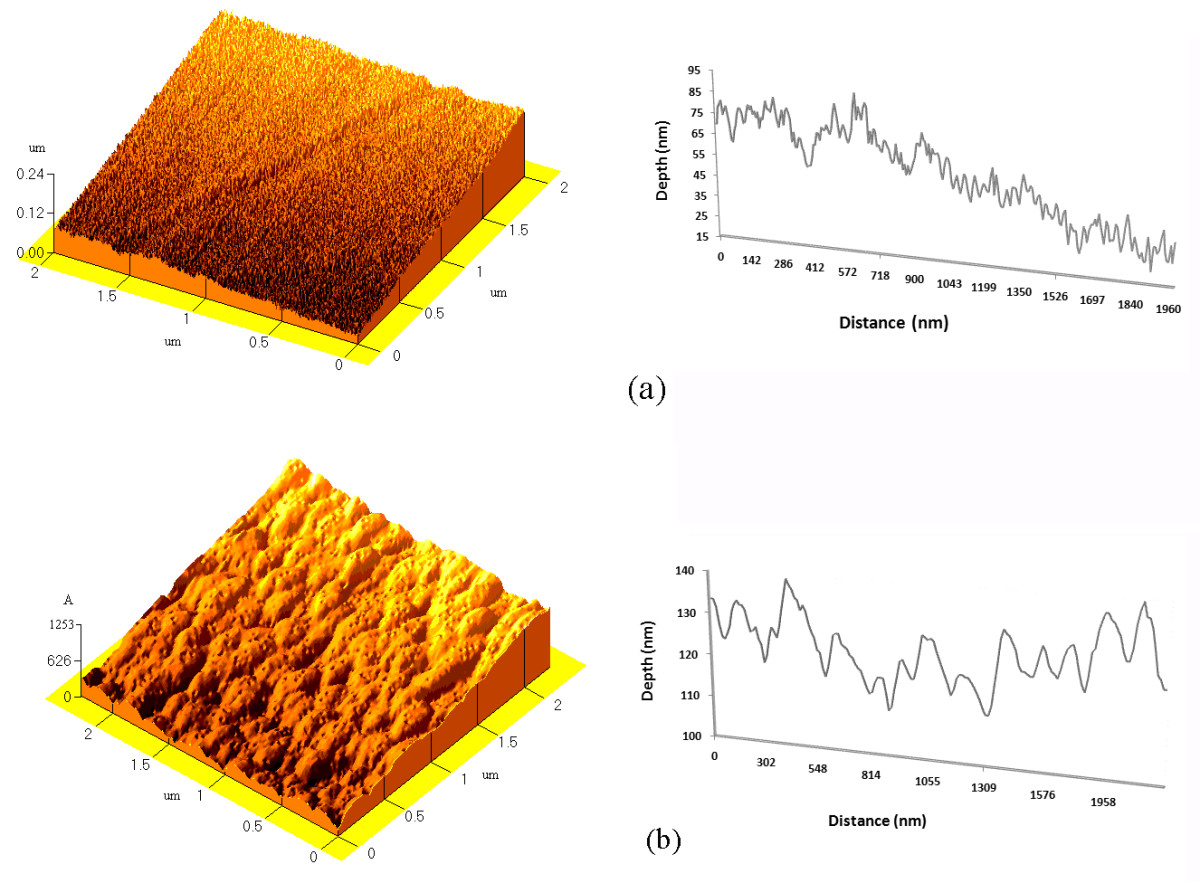
Biomaterial surface modification is an efficient method to improve and control blood component-material interactions. In the present study, two different methods (ArF excimer laser irradiation and radio-frequency (RF) plasma treatment) were applied in separate procedures to create a vast range of physicochemical characteristics on the surface of polystyrene (PS) and investigate their effects on blood compatibility of treated surfaces. Atomic force microscopy (AFM) and Fourier transmission infrared analysis were applied to study the morphology and chemical characteristics of treated samples in comparison with those of the untreated PS. Contact angle and surface tension measurements with two different solvents were used to evaluate the wettability and surface energy of the treated PS films. The effect of the physicochemical properties of the PS surface on blood compatibility was investigated using lactate dehydrogenase (LDH) method. AFM studies showed that after laser treatment, some distinctive nanostructures are created on the surface of PS. The data from contact angle measurements demonstrated that ArF excimer laser irradiation and RF plasma treatment created surfaces with a vast range of properties in the wettability point of view. The LDH results revealed that after surface modification by laser irradiation and plasma treatment, blood compatibility of PS films was enhanced. In addition, these results offered that the most blood compatible samples were those which irradiated with 5 pulses of laser and the one treated 4 minutes in oxygen plasma.
Keywords
- Polystyrene,
- RF plasma,
- Excimer laser,
- Hydrophobicity,
- Hydrophilicity,
- Morphology,
- Blood compatibility
References
- Aiping and Tian (2006) Blood compatibility of surface-engineered poly(ethylene terephthalate) via o-carboxymethylchitosan 50(2) (pp. 120-125) https://doi.org/10.1016/j.colsurfb.2006.04.021
- Chen et al. (2008) Biocompatible polymer materials: role of protein-surface interactions 33(11) (pp. 1059-1087) https://doi.org/10.1016/j.progpolymsci.2008.07.006
- Chu (2007) Plasma surface treatment of artificial orthopedic and cardiovascular biomaterials 201(9–11) (pp. 5601-5606) https://doi.org/10.1016/j.surfcoat.2006.07.003
- Corum and Hlady (2010) Screening platelet-surface interactions using negative surface charge gradients 31(12) (pp. 3148-3155) https://doi.org/10.1016/j.biomaterials.2010.01.025
- Dadsetan et al. (2001) Cell behavior on laser surface-modified polyethylene terephthalate in vitro 57(2) (pp. 183-189) https://doi.org/10.1002/1097-4636(200111)57:2<183::AID-JBM1157>3.0.CO;2-M
- Dadsetan et al. (2001) In vitro studies of platelet adhesion on laser-treated polyethylene terephthalate surface 54(4) (pp. 540-546) https://doi.org/10.1002/1097-4636(20010315)54:4<540::AID-JBM100>3.0.CO;2-O
- Ikada et al. (1981) Blood compatibility of hydrophilic polymers (pp. 697-718) https://doi.org/10.1002/jbm.820150507
- Ikada et al. (1983) Polymer surfaces possessing minimal interaction with blood components 24(1) (pp. 19-20)
- Ingaki (1996) Tehnomic®
- Jung et al. (2009) Surface graft polymerization of poly(ethylene glycol) methacrylate onto polyurethane via thiol-ene reaction: preparation and characterizations 20(10) (pp. 1473-1482) https://doi.org/10.1163/092050609X12457419024109
- Karkhaneh et al. (2010) Novel materials to enhance corneal epithelial cell migration on keratoprosthesis 95(3) (pp. 405-409) https://doi.org/10.1136/bjo.2009.178632
- Khorasani and Mirzadeh (2004) BHK cells behaviour on laser treated polydimethylsiloxane surface 35(1) (pp. 67-71) https://doi.org/10.1016/j.colsurfb.2004.01.011
- Khorasani and Mirzadeh (2004) Laser surface modification of silicone rubber to reduce platelet adhesion in vitro 15(1) (pp. 59-72) https://doi.org/10.1163/156856204322752237
- Knittel et al. (1997) Surface structuring of synthetic fibres by UV laser irradiation, part II: mechanism and models 43(3) (pp. 240-250) https://doi.org/10.1002/(SICI)1097-0126(199707)43:3<240::AID-PI798>3.0.CO;2-9
- Lu et al. (2004) Cell culturing on nanogrooved polystyrene petri dish induced by ultraviolet laser irradiation 58(1) (pp. 29-32) https://doi.org/10.1016/S0167-577X(03)00408-7
- Mirzadeh and Bagheri (2007) Comparison of the effect of excimer laser irradiation and RF plasma treatment on polystyrene surface 76(8–9) (pp. 1435-1440) https://doi.org/10.1016/j.radphyschem.2007.02.079
- Mirzadeh and Dadsetan (2003) Influence of laser surface modifying of polyethylene terephthalate on fibroblast cell adhesion 67(3–4) (pp. 381-385) https://doi.org/10.1016/S0969-806X(03)00071-9
- Mirzadeh et al. (1993) CO2 - pulsed laser induced surface grafting of acrylamide onto ethylene - propylene rubber (EPR) 42(1–3) (pp. 53-56) https://doi.org/10.1016/0969-806X(93)90201-5
- Mirzadeh et al. (2011) Laser-modified nanostructures of PET films and cell behavior 98(1) (pp. 63-71) https://doi.org/10.1002/jbm.a.33097
- Mochizuki et al. (2011) Blood compatibility of gas plasma-treated diamond-like carbon surface - effect of physicochemical properties of DLC surface on blood compatibility 31(3) (pp. 567-573) https://doi.org/10.1016/j.msec.2010.11.019
- Owens and Wendt (1969) Estimation of the surface free energy of polymers 3(8) (pp. 1741-1747) https://doi.org/10.1002/app.1969.070130815
- Rabek (1995) Springer https://doi.org/10.1007/978-94-011-1274-1
- Rabek (1996) Springer https://doi.org/10.1007/978-3-642-80090-0
- Solouk et al. (2011) Application of plasma surface modification techniques to improve hemocompatibility of vascular grafts: a review 58(5) (pp. 311-327) https://doi.org/10.1002/bab.50
- Solouk et al. (2011) Surface modification of POSS-nanocomposite biomaterials using reactive oxygen plasma treatment for cardiovascular surgical implant applications 58(3) (pp. 147-161) https://doi.org/10.1002/bab.22
- Srinivasan et al. (1990) The significance of a fluence threshold for ultraviolet laser ablation and etching of polymers 67(3) (pp. 1604-1606) https://doi.org/10.1063/1.345647