
 10.1186/2194-0517-2-11


Published in Issue 2013-04-23
How to Cite
Sailakshmi, G., Mitra, T., & Gnanamani, A. (2013). Engineering of chitosan and collagen macromolecules using sebacic acid for clinical applications. Progress in Biomaterials, 2(1 (December 2013). https://doi.org/10.1186/2194-0517-2-11




Share:





Abstract
Abstract
Transformation of natural polymers to three-dimensional (3D) scaffolds for biomedical applications faces a number of challenges,
viz
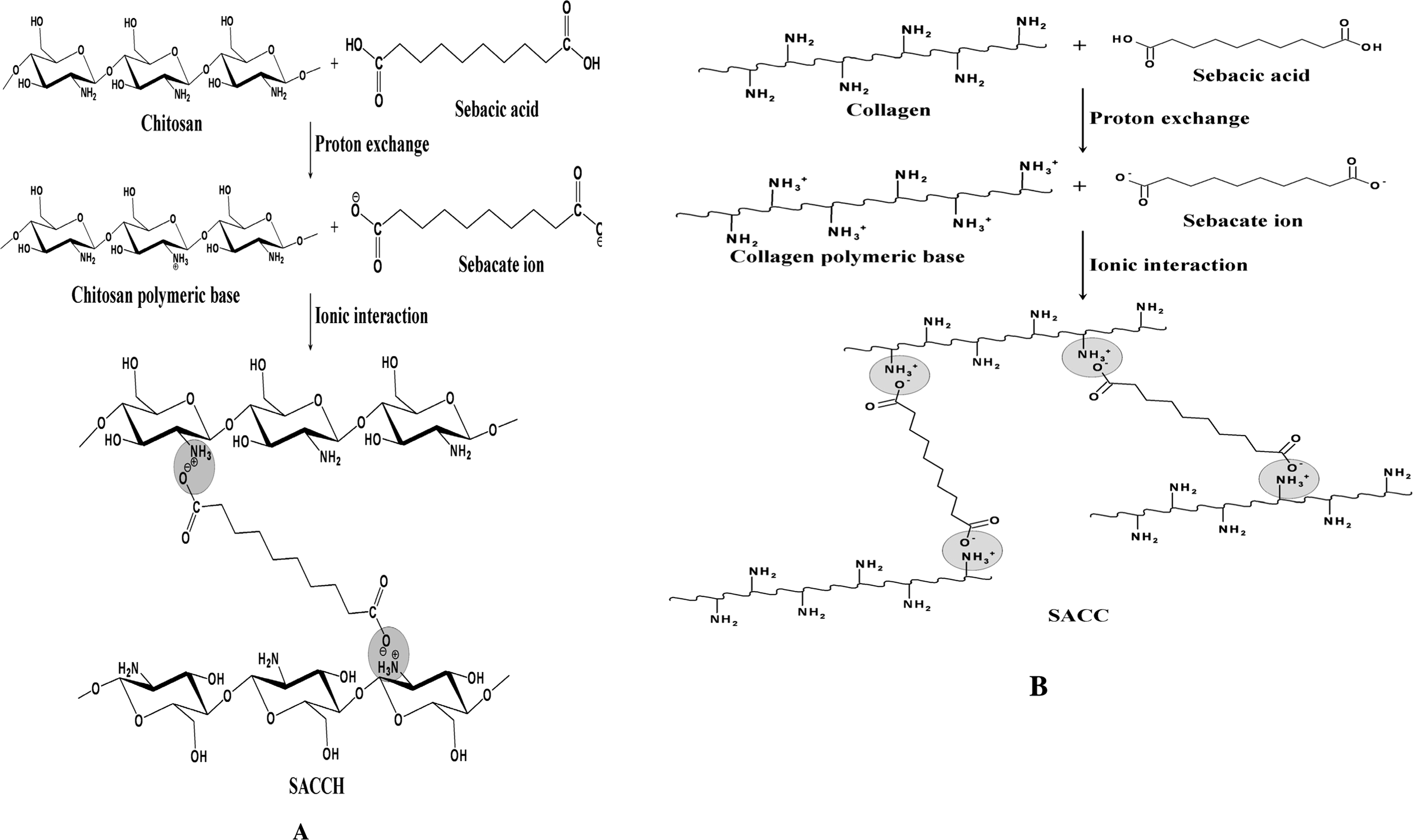
., solubility, stability (mechanical and thermal), strength, biocompatibility, and biodegradability. Hence, intensive research on suitable agents to provide the requisite properties has been initiated at the global level. In the present study, an attempt was made to engineer chitosan and collagen macromolecules using sebacic acid, and further evaluation of the mechanical stability and biocompatible property of the engineered scaffold material was done. A 3D scaffold material was prepared using chitosan at 1.0% (
w
/
v
) and sebacic acid at 0.2% (
w
/
v
); similarly, collagen at 0.5% (
w
/
v
) and sebacic acid at 0.2% (
w
/
v
) were prepared individually by freeze-drying technique. Analysis revealed that the engineered scaffolds displayed an appreciable mechanical strength and, in addition, were found to be biocompatible to NIH 3T3 fibroblast cells. Studies on the chemistry behind the interaction and the characteristics of the cross-linked scaffold materials suggested that non-covalent interactions play a major role in deciding the property of the said polymer materials. The prepared scaffold was suitable for tissue engineering application as a wound dressing material.
Keywords
- Chitosan,
- Collagen,
- Sebacic acid,
- Mechanical strength,
- Biocompatible
References
- Unknown (2009) Advanced Chemistry Development, Inc.
- Austero et al. (2012) New crosslinkers for electrospun chitosan fibre mats (pp. 2551-2562) https://doi.org/10.1098/rsif.2012.0241
- Bhumkar and Pokharkar (2006) Studies on effect of pH on crosslinking of chitosan with sodium tripolyphosphate: a technical note (pp. 1-6) https://doi.org/10.1208/pt070250
- Bubnis and Ofner (1992) The determination of ε-amino groups in soluble and poorly soluble proteinaceous materials by a spectrophotometric method using trinitrobenzenesulfonic acid (pp. 129-133) https://doi.org/10.1016/0003-2697(92)90513-7
- El-Tahlawy et al. (2006) Novel method for preparation of cyclodextrin/grafted chitosan and its application (pp. 385-392) https://doi.org/10.1016/j.carbpol.2005.08.057
- Friess (1998) Collagen—biomaterial for drug delivery (pp. 113-136) https://doi.org/10.1016/S0939-6411(98)00017-4
- Gough et al. (2002) Cytotoxicity of glutaraldehyde crosslinked collagen/poly (vinyl alcohol) films is by the mechanism of apoptosis (pp. 121-130) https://doi.org/10.1002/jbm.10145
- Iwasaki et al. (2011) Chitosan-based hyaluronic acid hybrid polymer fibers as a scaffold biomaterial for cartilage tissue engineering (pp. 100-113) https://doi.org/10.3390/polym3010100
- Jin et al. (2004) Novel chitosan-based films cross-linked by Genipin with improved physical properties (pp. 162-168) https://doi.org/10.1021/bm034286m
- Jorge-Herrero et al. (1999) Influence of different chemical cross-linking treatments on the properties of bovine pericardium and collagen (pp. 539-545) https://doi.org/10.1016/S0142-9612(98)90205-8
- Ko et al. (2010) Novel synthesis strategies for natural polymer and composite biomaterials as potential scaffolds for tissue engineering (pp. 1981-1997) https://doi.org/10.1098/rsta.2010.0009
- Lawrie et al. (2007) Interactions between alginate and chitosan biopolymers characterized using FTIR and XPS (pp. 2533-2541) https://doi.org/10.1021/bm070014y
- Ligler et al. (2001) Development of uniform chitosan thin-film layers on silicon chips (pp. 5082-5084) https://doi.org/10.1021/la010148b
- Liu et al. (1996) Mechanisms for the transport of α, β-dicarboxylates through the mitochondrial inner membrane (pp. 25338-25344) https://doi.org/10.1074/jbc.271.41.25338
- Lopez et al. (2008) A kinetic study on the thermal behaviour of chitosan (pp. 633-639) https://doi.org/10.1007/s10973-007-8321-3
- Majumder et al. (2011) Simulated microgravity promoted differentiation of bipotential murine oval liver stem cells by modulating BMP4/Notch1 signaling (pp. 1898-1908) https://doi.org/10.1002/jcb.23110
- Miles et al. (2005) The increase in denaturation temperature following cross-linking of type-I collagen is caused by dehydration of the fibres (pp. 551-556) https://doi.org/10.1016/j.jmb.2004.12.001
- Milosavljevic et al. (2010) Chitosan, itaconic acid and poly(vinyl alcohol) hybrid polymer networks of high degree of swelling and good mechanical strength (pp. 686-694)
- Mitra et al. (2011) Preparation and characterization of a thermostable and biodegradable biopolymers using natural cross-linker (pp. 276-285) https://doi.org/10.1016/j.ijbiomac.2010.11.011
- Mitra et al. (2012) Preparation and characterization of malonic acid cross-linked chitosan and collagen 3D scaffolds: an approach on non-covalent interactions (pp. 1309-1321) https://doi.org/10.1007/s10856-012-4586-6
- Morris et al. (2009) Autodock4 and AutoDockTools4: automated docking with selective receptor flexibility (pp. 2785-2791) https://doi.org/10.1002/jcc.21256
- Mossmann (1983) Rapid colorimetric assay for cellular growth and survival: application to proliferation and cytotoxicity assays (pp. 55-63) https://doi.org/10.1016/0022-1759(83)90303-4
- Nam et al. (2008) Controlling coupling reaction of EDC and NHS for preparation of type-I collagen gels using ethanol/water co-solvents (pp. 32-37) https://doi.org/10.1002/mabi.200700206
- Ohkawa et al. (2004) Electrospinning of chitosan (pp. 1600-1605) https://doi.org/10.1002/marc.200400253
- Olde Damink et al. (1995) Glutaraldehyde as a cross-linking agent for collagen-based biomaterials (pp. 460-472) https://doi.org/10.1007/BF00123371
- Olde Damink et al. (1995) Influence of ethylene oxide gas treatment on the in vitro degradation behavior of dermal sheep type-I collagen (pp. 149-155) https://doi.org/10.1002/jbm.820290203
- Parenteau-Bareil et al. (2010) Collagen-based biomaterials for tissue engineering applications (pp. 1863-1887) https://doi.org/10.3390/ma3031863
- Pavia et al. (2001) Thomson Learning, Inc
- Peng et al. (2006) Preparation and evaluation of porous chitosan/collagen scaffolds for periodontal tissue engineering (pp. 207-220) https://doi.org/10.1177/0883911506065100
- Petite et al. (1990) Use of the acyl azide method for cross-linking type-I collagen-rich tissues such as pericardium (pp. 179-187) https://doi.org/10.1002/jbm.820240205
- Rinaudo (2010) New way to crosslink chitosan in aqueous solution (pp. 1537-1544) https://doi.org/10.1016/j.eurpolymj.2010.04.012
- Saito et al. (2008) Characterization of alkali-treated type-I collagen gels prepared by different crosslinkers (pp. 1297-1305) https://doi.org/10.1007/s10856-007-3239-7
- Schauer et al. (2003) Color changes in chitosan and poly(allyl amine) films upon metal binding (pp. 250-257) https://doi.org/10.1016/S0040-6090(03)00055-5
- Schiffman and Schauer (2007) Cross-linking chitosan nanofibers (pp. 594-601) https://doi.org/10.1021/bm060804s
- Schmidt and Baier (2000) Acellular vascular tissues: natural biomaterials for tissue repair and tissue engineering (pp. 2215-2231) https://doi.org/10.1016/S0142-9612(00)00148-4
- Shanmugasundaram et al. (2004) Comparative physico-chemical and in vitro properties of fibrillated collagen scaffolds from different sources (pp. 247-264) https://doi.org/10.1177/0885328204040945
- Sheu et al. (2001) Characterization of type-I collagen gel solutions and type-I collagen matrices for cell culture (pp. 1713-1719) https://doi.org/10.1016/S0142-9612(00)00315-X
- Tamada and Langer (1992) The development of polyanhydrides for drug delivery applications (pp. 315-353) https://doi.org/10.1163/156856292X00402
- Tual et al. (2000) Transport properties of chitosan membranes: influence of crosslinking (pp. 1521-1529) https://doi.org/10.1002/(SICI)1099-0488(20000601)38:11<1521::AID-POLB120>3.0.CO;2-#
- Usha and Ramasami (2000) Effect of crosslinking agents (basic chromium sulfate and formaldehyde) on the thermal and thermomechanical stability of rat tail tendon type-I collagen fibre (pp. 59-66) https://doi.org/10.1016/S0040-6031(00)00518-9
- Vijayaraghavan et al. (2010) Biocompatibility of choline salts as crosslinking agents for collagen based biomaterials (pp. 294-296) https://doi.org/10.1039/B910601D
- Wang et al. (2002) A tough biodegradable elastomer (pp. 602-606) https://doi.org/10.1038/nbt0602-602
- Weadock et al. (1995) Physical crosslinking of type-I collagen fibers: comparison of ultraviolet irradiation and dehydrothermal treatment (pp. 1373-1379) https://doi.org/10.1002/jbm.820291108
- Wei et al. (1992) The cross linking of chitosan fibers (pp. 2187-2193) https://doi.org/10.1002/pola.1992.080301013