
 10.1007/s40204-014-0022-y


Published in Issue 2014-04-03
How to Cite
Bagheri, M., Bigdeli, E., & Pourmoazzen, Z. (2014). pH-responsive stealth micelles composed of cholesterol-modified PLA as a nano-carrier for controlled drug release. Progress in Biomaterials, 3(1 (June 2014). https://doi.org/10.1007/s40204-014-0022-y




Share:





Abstract
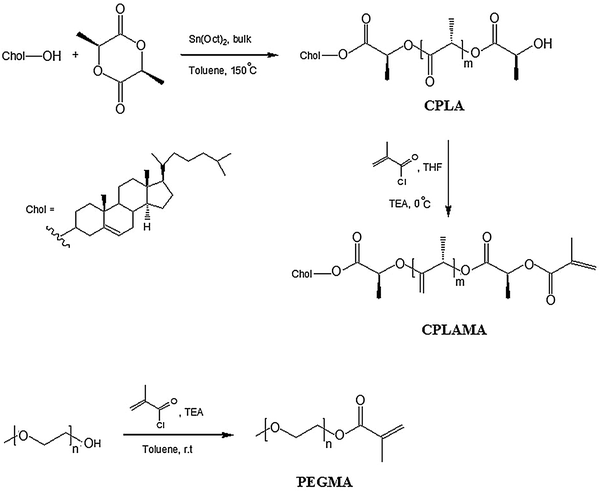
Abstract Present research is a preliminary report on the novel pH-responsive micelles based on an amphiphilic brush copolymer P(PEGMA)- b -P(DMAEMA- co -CPLAMA) used as the promising drug carrier. The copolymer was synthesized using cholesteryl poly( l -lactic acid) methacrylate (CPLAMA), poly(ethylene glycol) monomethyl ether methacrylate (PEGMA) and 2-(dimethylamino)ethyl methacrylate (DMAEMA) with appropriate hydrophobic/hydrophilic ratios via atom transfer radical polymerization. The copolymer compositions were determined by 1 H NMR. The synthesized copolymer self-assembled into nano-scale micelles capable of encapsulating hydrophobic model drug naproxen in their hydrophobic cores in aqueous solutions. pH sensitivity and self-assembly behaviors of copolymer were studied by UV–vis transmittance, fluorescence spectroscopy, transmission electron microscopy (TEM) and dynamic light scattering. The results showed that the copolymer had high pH responsivity with a phase transition pH around pH 6.2. The critical micelle concentrations at pH 6.5 were found about 2.4 mg L −1 . The stable and small micelles were obtained at pH 5.5–6.5. Upon increasing pH higher than 7, the single micelles further assembled into the micellar aggregates. TEM images of copolymer micelles showed that the micelles are spherical in shape with the mean diameter of 152 nm at pH 6.2. In vitro release study of naproxen-loaded micelles with about 44 % loading efficiency and 8 % loading capacity was performed using dialysis method in phosphate-buffered solution at 37 °C. Release study implied that the proposed brush copolymer could produce stable nano-carriers with controllable drug release at the target sites (pH 5.5–7).Keywords
- l-lactide,
- Cholesterol,
- 2-(Dimethylamino)ethyl methacrylate,
- Amphiphilic brush copolymer,
- Macromonomer,
- pH-responsive micelles
References
- Allen and Cullis (2004) Drug delivery systems: entering the mainstream (pp. 1818-1822) https://doi.org/10.1126/science.1095833
- Bagheri and Bigdeli (2013) Preparation of stealth micellar nanoparticles of novel biodegradable and biocompatible brush copolymers with cholesteryl-modified PLA and PEG side chains 20(3) (pp. 84-95) https://doi.org/10.1007/s10965-013-0084-x
- Bagheri and Motirasoul (2012) Synthesis and characterization of an amphiphilic methoxy poly(l-lactide)-block-poly(glycidylmethacrylate) copolymer as a drug nanocarrier (pp. 1-13)
- Bagheri and Motirasoul (2013) Synthesis, characterization, and micellization of cholesteryl-modified amphiphilic poly(l-lactide)-block-poly (glycidyl methacrylate) as a nanocarrier for hydrophobic drugs (pp. 59-67) https://doi.org/10.1007/s10965-012-0059-3
- Bagheri and Pourmirzaei (2013) Synthesis and characterization of cholesteryl-modified graft copolymer from hydroxypropyl cellulose and its application as nanocarrier (pp. 801-808) https://doi.org/10.1007/s13233-013-1080-z
- Bagheri et al. (2013) Self-assembled micellar nanoparticles of a novel amphiphilic cholesteryl-poly(l-lactic acid)-b-poly(poly(ethylene glycol) methacrylate) block-brush copolymer 22(4) (pp. 293-302) https://doi.org/10.1007/s13726-013-0125-7
- Bougard et al. (2007) Synthesis and supramolecular organization of amphiphilic diblock copolymers combining poly(N, N-dimethylamino-2-ethyl methacrylate) and poly(e-caprolactone) 23(5) (pp. 2339-2345) https://doi.org/10.1021/la0620657
- De Paz Bánez et al. (2001) Use of oxyanion-initiated polymerization for the synthesis of amine methacrylate-based homopolymers and block copolymers (pp. 29-37) https://doi.org/10.1016/S0032-3861(00)00329-3
- Felber et al. (2011) pH-sensitive vesicles, polymeric micelles, and nanospheres prepared with polycarboxylates 64(11) (pp. 979-992) https://doi.org/10.1016/j.addr.2011.09.006
- Geun-woo et al. (2009) Preparation of naproxen-loaded poly(ethylene oxide-b-methacrylic acid) micelle and its pH-dependent drug release behavior (pp. 931-934) https://doi.org/10.5012/bkcs.2009.30.4.931
- Jhurry and Motala-Timol (2007) Synthesis of graft and block copolymers from 2-dimethylaminoethyl methacrylate and caprolactone (pp. 1053-1062) https://doi.org/10.1002/pi.2243
- Kabanov et al. (1995) Micelle formation and solubilization of fluorescent probes in poly (oxyethylene-b-oxypropylene-b-oxyethylene) solutions https://doi.org/10.1021/ma00111a026
- Lee et al. (1999) Characterizing the structure of pH-dependent polyelectrolyte block copolymer micelles (pp. 4302-4310) https://doi.org/10.1021/ma981865o
- Li et al. (2011) Synthesis and characterization of an amphiphilic graft polymer and its potential as a pH-sensitive drug carrier (pp. 3304-3310) https://doi.org/10.1016/j.polymer.2011.05.049
- Liu et al. (2001) A schizophrenic water-soluble diblock copolymer https://doi.org/10.1002/1521-3773(20010618)40:12<2328::AID-ANIE2328>3.0.CO;2-M
- Liu et al. (2007) Syntheses and micellar properties of well-defined amphiphilic AB(2) and A(2)B Y-shaped miktoarm star copolymers of e-caprolactone and 2-(dimethylamino)ethyl methacrylate 45(8) (pp. 1446-1462) https://doi.org/10.1002/pola.21915
- Luo et al. (2002) Cellular internalization of poly(ethylene oxide)-b-poly(epsilon-caprolactone) diblock copolymer micelles (pp. 1259-1265) https://doi.org/10.1021/bc025524y
- Miller et al. (1998) Liposome–cell interactions in vitro: effect of liposome surface charge on the binding and endocytosis of conventional and sterically stabilized liposomes (pp. 12875-12883) https://doi.org/10.1021/bi980096y
- Nottelet et al. (2008) Novel amphiphilic degradable poly(ecaprolactone)-graft-poly(4-vinyl pyridine), poly(e-caprolactone)-graft-poly(dimethylaminoethyl methacrylate) and water-soluble derivatives 29(9) (pp. 743-750) https://doi.org/10.1002/marc.200800037
- Penga and Zhanga (2009) Self-assembled micelles of N-phthaloyl-carboxymethychitosan for drug delivery (pp. 21-25) https://doi.org/10.1016/j.colsurfa.2008.11.046
- Rajesh and James (2009) Nanoparticle-based targeted drug delivery (pp. 215-223) https://doi.org/10.1016/j.yexmp.2008.12.004
- Schmaljohann (2006) Thermo- and pH-responsive polymers in drug delivery (pp. 1655-1670) https://doi.org/10.1016/j.addr.2006.09.020
- Srinivas and Feldman (2009) A phase II trial of calcitriol and naproxen in recurrent prostate cancer (pp. 3605-3629)
- Valerii et al. (2012) Drug delivery by polymeric micelles: an in vitro and in vivo study to deliver lipophilic substances to colonocytes and selectively target inflamed colon (pp. 1549-9634)
- Wang et al. (2007) Self-aggregated nanoparticles of cholesterol-modified chitosan conjugate as a novel carrier of epirubicin (pp. 43-51) https://doi.org/10.1016/j.eurpolymj.2006.09.007
- Xu et al. (2004) Enhanced stability of core-surface cross-linked micelles fabricated from amphiphilic brush copolymers 5(5) (pp. 1736-1744) https://doi.org/10.1021/bm049874u
- Yang et al. (2011) pH-sensitive micelles self-assembled from amphiphilic copolymer brush for delivery of poorly water-soluble drugs 12(1) (pp. 116-122) https://doi.org/10.1021/bm101058w
- Zhang et al. (2010) Preparation of block-brush PEG-b-P(NIPAM-g-DMAEMA) and its dual stimulus-response (pp. 3039-3046) https://doi.org/10.1016/j.polymer.2010.05.012
- Zhou et al. (2010) Temperature- and pH-responsive star amphiphilic block copolymer prepared by a combining strategy of ring-opening polymerization and reversible addition–fragmentation transfer polymerization 46(2010) (pp. 1288-1298) https://doi.org/10.1016/j.eurpolymj.2010.03.004
- Zhou et al. (2010) Temperature- and pH-responsive star amphiphilic block copolymer prepared by a combining strategy of ring-opening polymerization and reversible addition–fragmentation transfer polymerization (pp. 1288-1298) https://doi.org/10.1016/j.eurpolymj.2010.03.004
- Zhu et al. (2005) pH-induced micellization kinetics of ABC triblock copolymers measured by stopped-flow light scattering (pp. 9803-9812) https://doi.org/10.1021/ma051808c