
 10.1007/s40097-017-0250-5
Aflatoxin M1 detoxification from infected milk using Fe3O4 nanoparticles attached to specific aptamer
- Fatemeh Javani Jouni
 1
1 - Jaber Zafari2
- Parviz Abdolmaleki*1
- Hossein Vazini3
- Leila Ghandi4
- Mohamad Satari1

Published in Issue 14-12-2017




HTML views: 41
PDF views: 136





Abstract
Abstract
Aflatoxins are a kind of mycotoxins that are mostly produced by a group of molds such as
Aspergillus flavus
and
Aspergillus parasiticus
. The studies on different parts of Iran showed that AFM
1
infection of milk is higher than European Union’s standard. In this study, the specific aptamer with the carboxylic group at the end of 5′ and Fe
3
O
4
nanoparticles with amine groups was synthesized. Morphological and structural qualities of Fe
3
O
4
were determined by the Fourier-transform infrared spectrograph (FTIR), dynamic light scattering, scanning electron microscope, and X-ray diffraction devices. The specificity of the aptamer to AFM
1
was investigated in adjacent of AFM
1
and aflatoxin B
1
. Then, aptamers were attached to nanoparticles to improve synthetic qualities and to ease of its detachment. The attachment was approved by FTIR method. The complex (Fe
3
O
4
–APT) was then added to infected milk and after the proper time was detached from the milk using a magnet. The remained amount of AFM
1
was attained in milk using high-performance liquid chromatography. Our result showed that this method for aflatoxin detoxification is much more effective than conventional methods based on recognition of AFM
1
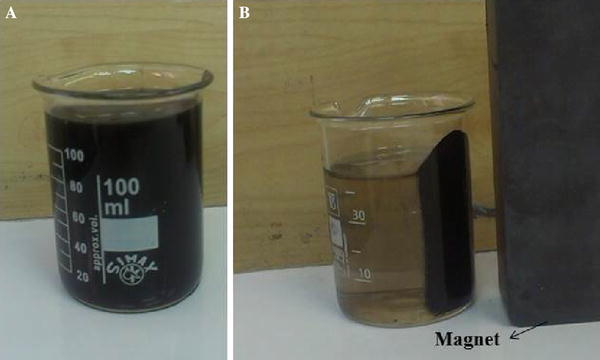
and their concentration in infected milk. This method is more applicable, faster, and cheaper highlighting its application in milk factories.
Graphical abstract
Keywords
- Aflatoxin,
- Aptamer,
- Fe3O4 nanoparticle,
- Detoxification,
- Mycotoxin
References
- Nguyen et al. (2013) Label-free detection of aflatoxin M1 with electrochemical Fe3O4/polyaniline-based aptasensor 33(4) (pp. 2229-2234) https://doi.org/10.1016/j.msec.2013.01.044
- Prandini et al. (2009) On the occurrence of aflatoxin M1 in milk and dairy products 47(5) (pp. 984-991) https://doi.org/10.1016/j.fct.2007.10.005
- Xiulan et al. (2006) Development of an immunochromatographic assay for detection of aflatoxin B1 in foods 17(4) (pp. 256-262) https://doi.org/10.1016/j.foodcont.2004.10.007
- Sefidgar et al. (2011) Aflatoxin M1 in pasteurized milk in Babol city, Mazandaran Province, Iran 40(1) (pp. 115-118)
- Kang’ethe and Lang’a (2009) Aflatoxin B1 and M1 contamination of animal feeds and milk from urban centers in Kenya 9(4) (pp. 218-226)
- Mosiello, L., Lamberti, I.: Biosensors for aflatoxins detection. Available from:
- http://www.intechopen.com/books/aflatoxins-detection-measurement-and-control/biosensors-for-aflatoxinsdetection
- . Accessed 23 June 2017
- Piermarini et al. (2009) An ELIME-array for detection of aflatoxin B1 in corn samples 20(4) (pp. 371-375) https://doi.org/10.1016/j.foodcont.2008.06.003
- Shim and Wong (2004) Stem cell cardiomyoplasty: state-of-the-art 33(4) (pp. 451-460)
- Lin et al. (2015) Enzymatic hydrolysate-induced displacement reaction with multifunctional silica beads doped with horseradish peroxidase–thionine conjugate for ultrasensitive electrochemical immunoassay 87(16) (pp. 8531-8540) https://doi.org/10.1021/acs.analchem.5b02253
- Lin et al. (2016) Silver nanolabels-assisted ion-exchange reaction with CdTe quantum dots mediated exciton trapping for signal-on photoelectrochemical immunoassay of mycotoxins 88(15) (pp. 7858-7866) https://doi.org/10.1021/acs.analchem.6b02124
- Lin et al. (2017) Signal-on photoelectrochemical immunoassay for aflatoxin B1 based on enzymatic product-etching MnO2 nanosheets for dissociation of carbon dots 89(10) (pp. 5637-5645) https://doi.org/10.1021/acs.analchem.7b00942
- Lin et al. (2015) Simple and sensitive detection of aflatoxin B 1 within five minute using a non-conventional competitive immunosensing mode (pp. 680-686) https://doi.org/10.1016/j.bios.2015.07.029
- Chen et al. (2012) A simple and rapid biosensor for ochratoxin A based on a structure-switching signaling aptamer 25(2) (pp. 555-560) https://doi.org/10.1016/j.foodcont.2011.11.039
- Qiu et al. (2017) Bioresponsive release system for visual fluorescence detection of carcinoembryonic antigen from mesoporous silica nanocontainers mediated optical color on quantum dot-enzyme-impregnated paper 89(9) (pp. 5152-5160) https://doi.org/10.1021/acs.analchem.7b00989
- Xu et al. (2013) Synthesis and characterization of magnetic nanoparticles and its application in lipase immobilization 34(8) (pp. 2408-2412) https://doi.org/10.5012/bkcs.2013.34.8.2408
- Du et al. (2012) Ag-deposited silica-coated Fe3O4 magnetic nanoparticles catalyzed reduction of p-nitrophenol 258(7) (pp. 2717-2723) https://doi.org/10.1016/j.apsusc.2011.10.122
- Malhotra et al. (2014) Selection of aptamers for aflatoxin M1 and their characterization 27(8) (pp. 493-500) https://doi.org/10.1002/jmr.2370
- Yu et al. (2011) Novel aptamer–nanoparticle bioconjugates enhances delivery of anticancer drug to MUC1-positive cancer cells in vitro 6(9) https://doi.org/10.1371/journal.pone.0024077
- Zahoor and Ali Khan (2016) Aflatoxin B1 detoxification by magnetic carbon nanostructures prepared from maize straw 57(25) (pp. 11893-11903) https://doi.org/10.1080/19443994.2015.1046147
- Muneeb Ur Rahman Khattak, M., Zahoor, M., Muhammad, B., Khan, F.A., Ullah, R., AbdEI-Salam, N.M.: Removal of heavy metals from drinking water by magnetic carbon nanostructures prepared from biomass. J. Nanomater.
- 2017
- , (2017).
- https://doi.org/10.1155/2017/5670371
- Zahoor, M., Khan, F.A.: Adsorption of aflatoxin B1 on magnetic carbon nanocomposites prepared from bagasse. Arab. J. Chem. (2014) (
- In Press
- )
- Xu et al. (2013) Synthesis and characterization of magnetic nanoparticles and its application in lipase immobilization 34(8) (pp. 2409-2412)
- Kazemi Darsanaki et al. (2013) Aflatoxin M1 contamination in milk and milk products in Iran: a review 3(3) (pp. 13-20)
- Han et al. (2010) An ultra-high-performance liquid chromatography-tandem mass spectrometry method for simultaneous determination of aflatoxins B1, B2, G1, G2, M1 and M2 in traditional Chinese medicines 664(2) (pp. 165-171) https://doi.org/10.1016/j.aca.2010.02.009
- Karimi et al. (2007) Aflatoxin M1 contamination in pasteurized milk in Mashhad, Iran 3(3) (pp. 153-156)
- Tajkarimi et al. (2007) Seasonal study of aflatoxin M1 contamination in milk in five regions in Iran 116(3) (pp. 346-349) https://doi.org/10.1016/j.ijfoodmicro.2007.02.008
- Huang et al. (2010) Amine-functionalized magnetic nanoparticles for rapid capture and removal of bacterial pathogens 44(20) (pp. 7908-7913) https://doi.org/10.1021/es102285n
- Gao et al. (2013) Magnetic bead-based reverse colorimetric immunoassay strategy for sensing biomolecules 85(14) (pp. 6945-6952) https://doi.org/10.1021/ac401433p
- Tang et al. (2011) Magneto-controlled graphene immunosensing platform for simultaneous multiplexed electrochemical immunoassay using distinguishable signal tags 83(13) (pp. 5407-5414) https://doi.org/10.1021/ac200969w
- Zhang et al. (2012) DNA-based hybridization chain reaction for amplified bioelectronic signal and ultrasensitive detection of proteins 84(12) (pp. 5392-5399) https://doi.org/10.1021/ac3009065
- Feng et al. (2014) Optical aptasensors for quantitative detection of small biomolecules: a review (pp. 64-74) https://doi.org/10.1016/j.bios.2014.03.014
- Trucksess and Pohland (2001) Springer
- Shim et al. (2014) Chemiluminescence competitive aptamer assay for the detection of aflatoxin B1 in corn samples 36(1) (pp. 30-35) https://doi.org/10.1016/j.foodcont.2013.07.042
- Hu et al. (2012) Polymeric nanoparticle–aptamer bioconjugates can diminish the toxicity of mercury in vivo 208(1) (pp. 69-74) https://doi.org/10.1016/j.toxlet.2011.10.006