
 10.1007/s40089-015-0141-z
Synthesis of Fe3O4 nanoparticles and its antibacterial application
- Y. T. Prabhu*
 1
1 - K. Venkateswara Rao1
- B. Siva Kumari2
- Vemula Sesha Sai Kumar1
- Tambur Pavani1

Published in Issue 2015-02-21




HTML views: 130
PDF views: 187





Abstract
Abstract
The Present work outlines the antibacterial activity of Fe
3
O
4
nanoparticles synthesized through chemical combustion method where ferric nitrate is used as precursor material and urea as fuel with the assistant of Tween 80, a non-ionic surfactant. The obtained Fe
3
O
4
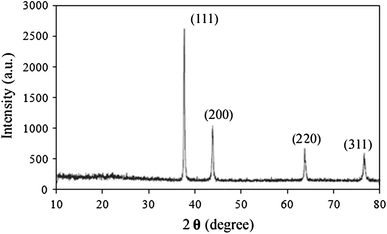
nanoparticles were characterized by X-ray diffraction, differential thermal analysis/thermo gravimetric analysis (DTA/TGA), particle size analyzer, SEM with EDAX and TEM. Various parameters such as dislocation density, micro strain, analysis of weight loss and surface morphological studies were calculated. The particle size was calculated from XRD and it was found to be 33–40 nm. Using well diffusion method antibacterial activity of Fe
3
O
4
nanoparticles was tested against gram-positive and gram-negative
Staphylococus aureus
, Xanthomonas,
Escherichia
coli
and
Proteus
vulgaris
. Fe
3
O
4
nanoparticles exhibited strong antibacterial activity against bacterial species.
Keywords
- Fe3O4 nanoparticles,
- XRD,
- TG/DTA,
- TEM,
- SEM,
- EDAX,
- Antibacterial activity
References
- Siegel RW. In: Siegel RW, Hu E, Roco MC (eds) Nanostructure science and technology. A worldwide study. WTEC, Loyola College in Maryland (1999)
- Zhou et al. (2006) Synthesis, characterization and catalytic properties of CuO nanocrystals with various shapes https://doi.org/10.1088/0957-4484/17/15/055
- Xin-ling and Zheng-tao (2005) Research on preparation of nano-copper powder by liquid-phase method 34(10) (pp. 615-617)
- Sadeghpour et al. (2014) Fabrication of a novel nanostructured calcium zirconium silicate scaffolds prepared by a freeze-casting method for bone tissue engineering (pp. 16107-16114) https://doi.org/10.1016/j.ceramint.2014.07.039
- Furno et al. (2004) Silver nanoparticles and polymeric medical devices: a new approach to prevention of infection? https://doi.org/10.1093/jac/dkh478
- Jeong et al. (2005) The effect of filler particle size on the antibacterial properties of compounded polymer/silver fibers https://doi.org/10.1007/s10853-005-4339-8
- Hsiao et al. (2006) One-pot synthesis of hollow Au3Cu1 spherical-like and biomineral botallackite Cu2(OH)3Cl flowerlike architectures exhibiting antimicrobial activity https://doi.org/10.1021/jp054827x
- Hutmacher (2000) Scaffolds in tissue engineering bone and cartilage (pp. 2529-2543) https://doi.org/10.1016/S0142-9612(00)00121-6
- Mirhadi et al. (2012) Synthesis, characterization and formation mechanism of single-phase nanostructure bredigite powder (pp. 133-139) https://doi.org/10.1016/j.msec.2011.10.007
- Tavangarian and Li (2012) Carbon nanostructures as nerve scaffolds for repairing large gaps in severed nerves (pp. 6075-6090) https://doi.org/10.1016/j.ceramint.2012.05.038
- Zreiqat et al. (2010) The incorporation of strontium and zinc into a calcium–silicon ceramic for bone tissue engineering (pp. 3175-3184) https://doi.org/10.1016/j.biomaterials.2010.01.024
- Tavangarian and Emadi (2011) Nanostructure effects on the bioactivity of forsterite bioceramic (pp. 740-743) https://doi.org/10.1016/j.matlet.2010.11.014
- Emadi et al. (2010) Nanostructured forsterite coating strengthens porous hydroxyapatite for bone tissue engineering (pp. 2679-2683) https://doi.org/10.1111/j.1551-2916.2010.03817.x
- Roohani-Esfahani et al. (2012) Repairing a critical-sized bone defect with highly porous modified and unmodified baghdadite scaffolds (pp. 4162-4172)
- Oswald et al. (1997) Liver positive enhancement after injection of superparamagnetic nanoparticles: respective role of circulating and uptaken particles https://doi.org/10.1016/S0730-725X(97)00004-0
- Kim et al. (2001) Characterization and MRI study of surfactant-coated superparamagnetic nanoparticles administered into the rat brain https://doi.org/10.1016/S0304-8853(00)01255-5
- Cornell and Schwertmann (1996) VCH
- Verwey (1939) Electronic conduction of magnetite (Fe3O4) and its transition point at low temperatures https://doi.org/10.1038/144327b0
- Kang et al. (1996) Synthesis and characterization of nanometer-size Fe3O4 and γ-Fe2O3 particles https://doi.org/10.1021/cm960157j
- Zhou et al. (2001) Synthesis of Fe3O4 nanoparticles from emulsions https://doi.org/10.1039/b100758k
- Zhou et al. (2009) Study of higher selectivity to styrene oxide in the epoxidation of styrene with hydrogen peroxide over La-doped MCM-48 catalyst (pp. 7181-7185) https://doi.org/10.1021/jp8101095
- Corot et al. (2006) Recent advances in iron oxide nanocrystal technology for medical imaging (pp. 1471-1504) https://doi.org/10.1016/j.addr.2006.09.013
- Zhao et al. (2009) Preparation and coercivity and saturation magnetization dependence of inductive heating property of Fe3O4 nanoparticles in an alternating current magnetic field for localized hyperthermia (pp. 215-218) https://doi.org/10.1016/j.jallcom.2008.01.083
- Lu et al. (2009) Manganese ferrite nanoparticle micellar nanocomposites as MRI contrast agent for liver imaging (pp. 2919-2928) https://doi.org/10.1016/j.biomaterials.2009.02.001
- Bahadur and Giri (2003) Biomaterials and magnetism (pp. 639-656) https://doi.org/10.1007/BF02706451
- Alexiou et al. (2000) Locoregional cancer treatment with magnetic drug targeting (pp. 6641-6648)
- Sutton et al. (1971) Reduction in the absorption of dietary strontium in children by an alginate derivative
- Cheng et al. (2005) Characterization of aqueous dispersions of Fe3O4 nanoparticles and their biomedical applications (pp. 729-738) https://doi.org/10.1016/j.biomaterials.2004.03.016
- Stoimenov et al. (2002) Metal oxide nanoparticles as bactericidal agents 18(17) (pp. 6679-6686) https://doi.org/10.1021/la0202374
- Chung et al. (1998) Effects of benzidine and benzidine analogues on growth of bacteria including Azotobacter vinelandii (pp. 271-275) https://doi.org/10.1002/etc.5620170219
- Cullity (1978) Addison-Wesley
- Pal and Chauhan (2009) Structural and optical characterization of tin dioxide nanoparticles prepared by a surfactant mediated method https://doi.org/10.1016/j.matchar.2009.08.007
- Yamamoto (2001) Influence of particle size on the antibacterial activity of zinc oxide 3(7) (pp. 643-646) https://doi.org/10.1016/S1466-6049(01)00197-0
- Padmavathy and Vijayaraghavan (2008) Enhanced bioactivity of ZnO nanoparticles—an antimicrobial study 9(3) (pp. 35004-35010) https://doi.org/10.1088/1468-6996/9/3/035004
- Rezaei-Zarchi et al. (2010) Comparative study of antimicrobial activities of TiO2 and CdO nanoparticles against the pathogenic strain of Escherichia coli 5(2) (pp. 83-89)
- Zhang and Chen (2009) Potent antibacterial activities of Ag/TiO2 nanocomposite powders synthesized by a one-pot sol–gel method 43(8) (pp. 2905-2910) https://doi.org/10.1021/es803450f
- Mahdy et al. (2012) Antimicrobial activity of zero-valent iron nanoparticles 2(1) (pp. 578-581)
- Tran et al. (2010) Bactericidal effect of iron oxide nanoparticles on Staphylococcus aureus 5(1) (pp. 277-283)
- Touati (2000) Iron and oxidative stress in bacteria 373(6) (pp. 1-6) https://doi.org/10.1006/abbi.1999.1518
- Lee et al. (2008) Bactericidal effect of zero-valent iron nanoparticles on Escherichiacoli 42(13) (pp. 4927-4933) https://doi.org/10.1021/es800408u
- Makhluf et al. (2005) Microwave-assisted synthesis of nanocrystalline MgO and Its use as a bacteriocide 15(10) (pp. 1708-1715) https://doi.org/10.1002/adfm.200500029
- Zhang et al. (2007) Investigation into the antibacterial behaviour of suspensions of ZnO nanoparticles (ZnO nanofluids) 9(3) (pp. 479-489) https://doi.org/10.1007/s11051-006-9150-1
- Taylor and Webster (2009) The use of superparamagnetic nanoparticles for prosthetic biofilm 4(1) (pp. 145-152)