
 10.57647/tpr.2025.0904.21
Naphthalene acetic acid as a potent elicitor of coordinated defense responses and terpenoid metabolism reprogramming in the medicinal succulent Euphorbia trigona Mill. (Euphorbiaceae)
- Hakimeh Rezaei
 1
1 - Aryan Sateei*1,2
- Tahereh A. Aghajanzadeh
 3
3 - Mehdi Ebadi2,4

Received: 2025-10-01
Revised: 2025-12-20
Accepted: 2025-12-20
Published in Issue 2025-12-31
Copyright (c) 2026 Hakimeh Rezaei, Aryan Sateei, Tahereh A. Aghajanzadeh, Mehdi Ebadi (Author)

This work is licensed under a Creative Commons Attribution 4.0 International License.




PDF views: 71





Abstract
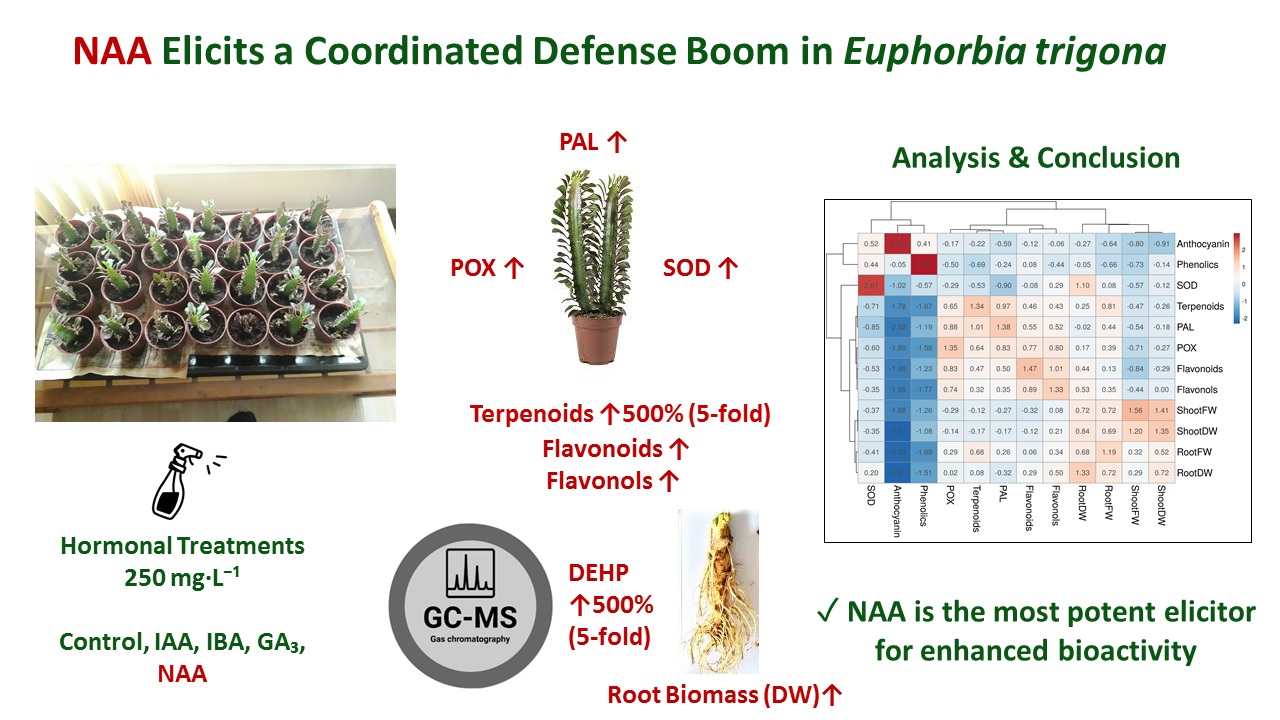
Plant growth regulators (PGRs) are effective tools for enhancing phytochemical production in medicinal plants. This study investigated the elicitation efficacy of gibberellin (GA3) and auxins (IAA, IBA, NAA) at 250 mg/L on the medicinal succulent Euphorbia trigona Mill. (Euphorbiaceae). After seven months, NAA treatment significantly increased root biomass and uniquely triggered a coordinated defense response. This was evidenced by the significant upregulation of phenylalanine ammonia-lyase (PAL) and increased activities of the antioxidant enzymes peroxidase and superoxide dismutase. Consequently, NAA induced a substantial accumulation of defense-related metabolites, most strikingly a five-fold increase in terpenoids, along with elevated flavonoids and flavonols. GC-MS profiling suggested an NAA-induced reprogramming of the terpenoid profile. The results demonstrate that unlike GA3 or other auxins, NAA is the most effective elicitor for enhancing bioactive compounds in E. trigona through a coordinated defense network.
Keywords
- Coordinated response,
- Elicitation,
- Euphorbiaceae,
- Euphorbia trigona Mill,
- Metabolic reprogramming,
- Naphthalene acetic acid (NAA),
- Phenylalanine ammonia-lyase,
- Secondary metabolism,
- Terpenoids
References
- Abdelsalam, A., Chowdhury, K., Boroujerdi, A., and El Bakry, A. 2023. Effect of stress hormones on the metabolome of a suspension culture of the aromatic medicinal plant Cymbopogon schoenanthus subsp. proximus. Plant Cell, Tissue and Organ Culture (PCTOC). 155(1): 137-163. https://doi.org/10.1007/s11240-023-02610-7
- Akhtar, S. S., Mekureyaw, M. F., Pandey, C., and Roitsch, T. 2020. Role of cytokinins for interactions of plants with microbial pathogens and pest insects. Frontiers in Plant Science. 10: 1777. https://doi.org/10.3389/fpls.2019.01777
- Akkol, E.K., Göger, F., Koşar, M., and Başer, K.H.C. 2008. Phenolic composition and biological activities of Salvia halophila and Salvia virgata from Turkey. Food Chemistry. 108(3): 942–949. https://doi.org/10.1016/j.foodchem.2007.12.003
- Almagro, L., Gómez Ros, L. V., Belchi-Navarro, S., Bru, R., Ros Barceló, A., and Pedreño, M. A. 2009. Class III peroxidases in plant defence reactions. Journal of Experimental Botany. 60(2): 377–390. https://doi.org/10.1093/jxb/ern277
- Amtaghri, S., Akdad, M., Slaoui, M., and Eddouks, M. 2022. Traditional uses, pharmacological, and phytochemical studies of Euphorbia: A review. Current Topics in Medicinal Chemistry. 22(19): 1553–1570. https://doi.org/10.2174/1568026622666220412094546
- Atzori, E., Rescigno, A., and Padiglia, A. 2011. Molecular analysis of a copper-and zinc-containing superoxide dismutase gene isolated from the latex of Euphorbia characias: Another piece in the molecular puzzle of Euphorbiaceae latex proteins. International Journal of Plant Research. 1(1): 16–24. (DOI یافت نشد)
- Bae, H., Song, G., and Lim, W. 2020. Stigmasterol causes ovarian cancer cell apoptosis by inducing endoplasmic reticulum and mitochondrial dysfunction. Pharmaceutics. 12(6): 488. https://doi.org/10.3390/pharmaceutics12060488
- Bagheri, F., Sateei, A., Golsefidi, M.A., and Ebadi, M. 2025. Quantitative and qualitative improvement of the content of some medicinal compounds of the pencil tree (Euphorbia tirucalli L), using chelate iron fertilizer. Iranian Journal of Plant Physiology. 3(15): 5647-5656. http://doi.org/10.71551/ijpp.2025.1025717
- Bakrim, S., Benkhaira, N., Bourais, I., Benali, T., Lee, L. H., El Omari, N., Sheikh, R. A., Goh, K. W., Ming, L. C., and Bouyahya, A. 2022. Health benefits and pharmacological properties of stigmasterol. Antioxidants. 11(10): 1912. https://doi.org/10.3390/antiox11101912
- Baldwin, A., and Booth, B. W. 2022. Biomedical applications of tannic acid. Journal of Biomaterials Applications. 36(8): 1503-1523. https://doi.org/10.1177/08853282211058090
- Beauchamp, C., and Fridovich, I. 1971. Superoxide dismutase: Improved assays and an assay applicable to acrylamide gels. Analytical Biochemistry. 44(1): 276–287. https://doi.org/10.1016/0003-2697(71)90370-8
- Beltagy, A. M. 2019. Chemical composition and antibacterial activity of medicinally useful essential oil from the inflorescence of Euphorbia helioscopia L. grown in Egypt. International Journal of Pharmaceutical Sciences and Research. 10(8): 3660-3667. https://doi.org/10.13040/IJPSR.0975-8232.10(8).3660-67
- Boncan, D.A.T., Tsang, S.S., Li, C., Lee, I.H., Lam, H.M., Chan, T.F., and Hui, J.H. 2020. Terpenes and terpenoids in plants: Interactions with environment and insects. International Journal of Molecular Sciences. 21(19): 7382. https://doi.org/10.3390/ijms21197382
- Boran, H., and Terzi, S. 2019. Bis(2-ethylhexyl) phthalate induces DNA strand breaks and gene expression alterations in larval zebrafish Danio rerio. Toxicology and industrial health. 35(8): 520–529. https://doi.org/10.1177/0748233719869531
- Calvo, A.M., and Cary, J.W. 2015. Association of fungal secondary metabolism and sclerotial biology. Frontiers in Microbiology. 6:62. https://doi.org/10.3389/fmicb.2015.00062
- Curran-Everett, D. 2018. Explorations in statistics: The coefficient of variation. Advances in Physiology Education. 42(3): 500–501. https://doi.org/10.1152/advan.00057.2018
- Dai, Z.R., and Li, J.L. 2006. Advances in effects of hormones on metabolites formation for plant cell suspension culture. China Biotechnology. 26(6): 107–111. (DOI یافت نشد)
- Dermastia, M. 2019. Plant hormones in phytoplasma infected plants. Frontiers in Plant Science. 10:477. https://doi.org/10.3389/fpls.2019.00477
- Dixon, W. J. 1950. Analysis of extreme values. Annals of Mathematical Statistics. 21(4): 488–506. https://doi.org/10.1214/aoms/1177729747
- Elshamy, A. I., Abd‐ElGawad, A. M., El Gendy, A. E. N. G., and Assaeed, A. M. 2019. Chemical characterization of Euphorbia heterophylla L. essential oils and their antioxidant activity and allelopathic potential on Cenchrus echinatus L. Chemistry & Biodiversity. 16(5): e1900051. (DOI یافت نشد)
- Erb, M., and Kliebenstein, D. J. 2020. Plant secondary metabolites as defenses, regulators, and primary metabolites: the blurred functional trichotomy. Plant Physiology. 184(1): 39–52. https://doi.org/10.1104/pp.20.00433
- Espinosa-Leal, C. A., Puente-Garza, C. A., and García-Lara, S. 2018. In vitro plant tissue culture: means for production of biological active compounds. Planta. 248(1): 1–18. https://doi.org/10.1007/s00425-018-2910-3
- Farnia, R., Sateei, A., Ebadi, M., and Golsefidi, M.A. 2022. The effect of sulfur fertilizers in intensifying or modulating the stressful effects of NPK fertilizer on the ornamental-medicinal plant Euphorbia tirucalli L. in potted conditions. Journal of Plant Environmental Physiology. 17(68): 123–139. https://doi.org/10.30495/iper.2022.690258
- Ghorai, N., Chakraborty, S., Guchhait, S., Saha, S.K., and Biswas, S. 2012. Estimation of total terpenoids concentration in plant tissues using a monoterpene, linalool as standard reagent. Protocol Exchange. https://doi.org/10.1038/protex.2012.055
- Gómez, S., Orians, C. M., and Preisser, E. L. 2012. Exotic herbivores on a shared native host: tissue quality after individual, simultaneous, and sequential attack. Oecologia. 169(4): 1015–1024. https://doi.org/10.1007/s00442-012-2267-2
- Guo, X., Wu, Q., Zhu, G., Hussien Ibrahim, M. E., and Zhou, G. 2022. Gibberellin increased yield of sesbania pea grown under saline soils by improving antioxidant enzyme activities and photosynthesis. Agronomy. 12(8): 1855. (DOI یافت نشد)
- Huang, S., Zhou, R., Yuan, Y., and Shen, Y. 2024. Stigmasterol alleviates airway inflammation in OVA-induced asthmatic mice via inhibiting the TGF-β1/Smad2 and IL-17A signaling pathways. Aging (Albany NY). 16(7): 6478. https://doi.org/10.18632/aging.205716
- Jacoby, R. P., Koprivova, A., and Kopriva, S. 2021. Pinpointing secondary metabolites that shape the composition and function of the plant microbiome. Journal of Experimental Botany. 72(1): 57–69. https://doi.org/10.1093/jxb/eraa414
- Javed, M. R., Salman, M., Tariq, A., Tawab, A., Zahoor, M. K., Naheed, S., Shahid, M., Ijaz, A., and Ali, H. 2022. The Antibacterial and Larvicidal Potential of Bis-(2-Ethylhexyl) Phthalate from Lactiplantibacillus plantarum. Molecules. 27(21): 7220. https://doi.org/10.3390/molecules27217220
- Jokar, E., Sateei, A., Ebadi, M., and Ahmadi Golsefidi, M. 2023. Changes in the medicinal and antimicrobial compounds, methyl palmitate, methyl stearate, and bis (2-ethylhexyl) phthalate in American agave (Agave Americana L. cv Marginata) under urea treatment. Iranian Journal of Plant Physiology. 13(3): 4637-4643. (DOI یافت نشد)
- Kapoor, D., Kaur, S., and Bhardwaj, R. 2014. Physiological and biochemical changes in Brassica juncea plants under Cd-induced stress. BioMed Research International. 2014: 726070. https://doi.org/10.1155/2014/726070
- Karki, S., Shrestha, K., Gautam, R., and Jha, R. N. 2020. Phytochemical screening, FT-IR and GC-MS analysis of Euphorbia hirta. Journal of Pharmacognosy and Phytochemistry. 9(1): 1883-1889. (DOI یافت نشد)
- Kellos, T., Tímár, I., Szilágyi, V., Szalai, G., Galiba, G., and Kocsy, G. 2008. Stress hormones and abiotic stresses have different effects on antioxidants in maize lines with different sensitivity. Plant Biology. 10(5): 563–572. https://doi.org/10.1111/j.1438-8677.2008.00071.x
- Kemboi, D., Siwe-Noundou, X., Krause, R.W., Langat, M.K., and Tembu, V.J. 2021. Euphorbia diterpenes: an update of isolation, structure, pharmacological activities and structukapoorre–activity relationship. Molecules. 26(16): 5055. https://doi.org/10.3390/molecules26165055
- Khan, A., Asaf, S., Khan, A.L., Shehzad, T., Al-Rawahi, A., and Al-Harrasi, A. 2020. Comparative chloroplast genomics of endangered Euphorbia species: insights into hotspot divergence, repetitive sequence variation, and phylogeny. Plants. 9(2): 199. https://doi.org/10.3390/plants9020199
- Khan, T., and Abbasi, B. H. 2020. Thidiazuron-induced changes in biomass and secondary metabolites in medicinal plants. South African Journal of Botany. 135: 88-97. https://doi.org/10.1016/j.sajb.2020.08.014
- Kubwabo, C., Rasmussen, P. E., Fan, X., Kosarac, I., Wu, F., Zidek, A., and Kuchta, S. L. 2013. Analysis of selected phthalates in C anadian indoor dust collected using household vacuum and standardized sampling techniques. Indoor air. 23(6): 506-514. https://doi.org/10.1111/ina.12048
- Kulbat, K. 2016. The role of phenolic compounds in plant resistance. Biotechnology and Food Science. 80(2): 97–108. (DOI یافت نشد)
- Landi, M., Tattini, M., and Gould, K. S. 2015. Multiple functional roles of anthocyanins in plant-environment interactions. Environmental and Experimental Botany. 119: 4–17. https://doi.org/10.1016/j.envexpbot.2015.05.012
- Li, Y. 2013. Life cycle assessment to di-2-ethylhexyl phthalate (DEHP), applications and potential alternatives (Doctoral dissertation, University of Pittsburgh). (DOI یافت نشد)
- Li, Y., Wang, Y., and Xu, J. 2022. Auxin-mediated regulation of secondary metabolism in plants: A review. Plant Physiology and Biochemistry. 170: 316-326. https://doi.org/10.1016/j.plaphy.2021.12.015
- Likittrakulwong, W., Chanburee, S., Kitpot, T., Ninjiaranai, P., and Pongpamorn, P. 2023. Phytochemical properties, in vitro antimicrobial, and bioactive compounds of banana peel extractions using GC-MS. Natural and Life Sciences Communications. 22(2): e2023021. (DOI یافت نشد)
- Lucaccioni, L., Trevisani, V., Passini, E., Righi, B., Plessi, C., Predieri, B., and Iughetti, L. 2021. Perinatal exposure to phthalates: from endocrine to neurodevelopment effects. International Journal of Molecular Sciences. 22(8): 4063. https://doi.org/10.3390/ijms22084063
- MacDonald, M.J., and D'Cunha, G.B. 2007. A modern view of phenylalanine ammonia lyase. Biochemistry and Cell Biology. 85(3): 273–282. https://doi.org/10.1139/o07-018
- Masi, M. 2024. Biological Activities and Potential Applications of Phytotoxins. Toxins. 16(10): 444. https://doi.org/10.3390/toxins16100444
- Medda, R., Padiglia, A., Longu, S., Bellelli, A., Arcovito, A., Cavallo, S., Pedersen, J.Z., and Floris, G. 2003. Critical role of Ca2+ ions in the reaction mechanism of Euphorbia characias peroxidase. Biochemistry. 42(29): 8909–8918. https://doi.org/10.1021/bi034609z
- Medda, R., Pintus, F., Spano, D., and Floris, G. 2011. Bioseparation of four proteins from euphorbia characias latex: amine oxidase, peroxidase, nucleotide pyrophosphatase/phosphodiesterase, and purple acid phosphatase. Biochemistry Research International. 2011:369484. https://doi.org/10.1155/2011/369484
- Mittler, R. 2017. ROS are good. Trends in Plant Science. 22(1): 11–19. https://doi.org/10.1016/j.tplants.2016.08.002
- Mohd Jaafar, F., Kantasamy, N., and Hashim, N. 2013. Chemical Constituents and Healing Properties of Kalanchoe Pinnata Extracts. The Open Conference Proceedings Journal. 4(1). (DOI یافت نشد)
- Mura, A., Pintus, F., Lai, P., Padiglia, A., Bellelli, A., Floris, G., and Medda, R. 2006. Catalytic pathways of Euphorbia characias peroxidase reacting with hydrogen peroxide. Biological chemistry. 387(5): 559–567. https://doi.org/10.1515/BC.2006.072
- Mustafa, I., Anwar, H., Irfan, S., Muzaffar, H., and Ijaz, M.U. 2022. Attenuation of carbohydrate metabolism and lipid profile by methanolic extract of Euphorbia helioscopia and improvement of beta cell function in a type 2 diabetic rat model. BMC Complementary Medicine and Therapies. 22(1): 23. https://doi.org/10.1186/s12906-021-03482-0
- Nagar, S., Singh, V. P., Arora, A., Dhakar, R., Singh, N., Singh, G. P., Meena, S., Kumar, S., and Shiv Ramakrishnan, R. 2021. Understanding the Role of Gibberellic Acid and Paclobutrazol in Terminal Heat Stress Tolerance in Wheat. Frontiers in Plant Science. 12: 692252. https://doi.org/10.3389/fpls.2021.692252
- Nakamiya, K., Hashimoto, S., Ito, H., Edmonds, J. S., Yasuhara, A., and Morita, M. 2005. Microbial treatment of bis (2-ethylhexyl) phthalate in polyvinyl chloride with isolated bacteria. Journal of bioscience and bioengineering. 99(2): 115–119. https://doi.org/10.1263/jbb.99.115
- Nakano, Y., and Asada, K. 1981. Hydrogen peroxide is scavenged by ascorbate-specific peroxidase in spinach chloroplasts. Plant and Cell Physiology. 22(5): 867–880. https://doi.org/10.1093/oxfordjournals.pcp.a076232
- Nashikkar, N., Begde, D., Bundale, S., Pise, M., Rudra, J., and Upadhyay, A. 2011. Inhibition of swarming motility, biofilm formation and virulence factor expression of urinary pathogens by Euphorbia trigona latex extracts. International Journal of Pharmaceutical Sciences and Research. 2(3): 558–563. https://doi.org/10.13040/IJPSR.0975-8232.2(3).558-63
- Pérez-Llorca, M., Pollmann, S., and Müller, M. 2023. Ethylene and jasmonates signaling network mediating secondary metabolites under abiotic stress. International Journal of Molecular Sciences. 24(6): 5990. https://doi.org/10.3390/ijms24065990
- Pintus, F., Mura, A., Bellelli, A., Arcovito, A., Spanò, D., Pintus, A., Floris, G., and Medda, R. 2008. Allosteric modulation of Euphorbia peroxidase by nickel ions. The FEBS Journal. 275(6): 1201–1212. https://doi.org/10.1111/j.1742-4658.2008.06280.x
- Pott, D.M., Osorio, S., and Vallarino, J.G. 2019. From central to specialized metabolism: An overview of some secondary compounds derived from the primary metabolism for their role in conferring nutritional and organoleptic characteristics to fruit. Frontiers in Plant Science. 10:835. https://doi.org/10.3389/fpls.2019.00835
- Qadir, A., Singh, S. P., Akhtar, J., Ali, A., and Arif, M. 2018. Chemical Composition of Saudi Arabian Sukkari variety of Date Seed Oil and Extracts Obtained by Slow Pyrolysis. Indian Journal of Pharmaceutical Sciences. 80(5). https://doi.org/10.4172/pharmaceutical-sciences.1000423
- Rasool, F., Uzair, M., Naeem, M.K., Rehman, N., Afroz, A., Shah, H., and Khan, M.R. 2021. Phenylalanine ammonia-lyase (PAL) genes family in wheat (Triticum aestivum L.), Genome-wide characterization and expression profiling. Agronomy. 11(12): 2511. https://doi.org/10.3390/agronomy11122511
- Rasouli, H., Farzaei, M. H., Mansouri, K., Mohammadzadeh, S., and Khodarahmi, R. 2016. Plant cell cancer: may natural phenolic compounds prevent onset and development of plant cell malignancy? A literature review. Molecules. 21(9): 1104. https://doi.org/10.3390/molecules21091104
- Rezaei, H., Sateei, A., Aghajanzadeh, T.A., and Ebadi, M. 2023. Study of the effect of auxin and gibberellin on growth, total chlorophyll, carotenoid and terpenoid content in Euphorbia trigona Mill. Journal of Plant Environmental Physiology. 18(72): 143–166. https://doi.org/10.71890/iper.2023.1105569
- Rezayi, H., Sateei, A., Aghajanzadeh, T.A., and Ebadi, M. 2022. Change in the content of bioactive pharmaceutical-industrial compounds under the influence of hormonal treatments In Euphorbia trigona Mill. Iranian Journal of Plant Physiology. 5(4): 4311 – 4320. https://doi.org/10.30495/ijpp.2022.699182
- Rui, Z., Xiu-Juan, W., and Wei, G. 2020. [Regulation mechanism of plant hormones on secondary metabolites]. Zhongguo Zhong Yao Za Zhi = China Journal of Chinese Materia Medica. 45(17): 4205–4210. https://doi.org/10.19540/j.cnki.cjcmm.20200514.602
- Sanora, G. D., Mastura, E. Y., Handoyo, M. O. M., and Purnama, E. R. 2019. Identification of Anticancer Active Compound from GC-MS Test Results of Zodia Leaves (Evodia suaveolens) Ethanol Extract. Jurnal Biota. 5(2): 89-95. (DOI یافت نشد)
- Sedighi, A., Sedighi-dehkordi, F., Gholami, M., and Rafieian-kopaei, M. 2014. Study of the effect of plant growth regulators, size, and cultivar of the grape inflorescence explant on production of phenolic compounds in an in vitro condition. Journal of HerbMed Pharmacology. 3(1): 35–40. (DOI یافت نشد)
- Sharma, A., Sidhu, G. P. S., Araniti, F., Bali, A. S., Shahzad, B., Tripathi, D. K., Brestic, M., Skalicky, M., and Landi, M. 2020. The role of salicylic acid in plants exposed to heavy metals. Molecules. 25(3): 540. https://doi.org/10.3390/molecules25030540
- Shi, Q. W., Su, X. H., and Kiyota, H. 2008. Chemical and pharmacological research of the plants in genus Euphorbia. Chemical Reviews. 108(10): 4295–4327. https://doi.org/10.1021/cr078350s
- Shukla, A., Gundampati, R.K., and Jagannadham, M.V. 2016. Biochemical and biophysical characterization of a peroxidase isolated from Euphorbia tirucalli with antifungal activity. Biocatalysis and Biotransformation. 34(5): 236–248. https://doi.org/10.1080/10242422.2016.1228090
- Simon, S., and Petrášek, J. 2011. Why plants need more than one type of auxin. Plant Science. 180(3): 454–460. https://doi.org/10.1016/j.plantsci.2010.12.007
- Tao, J., Cao, C., Zhao, D., Zhou, C., and Liang, G. 2011. Molecular analysis and expression of phenylalanine ammonia-lyase from poinsettia (Euphorbia pulcherrima willd.). African Journal of Biotechnology. 10(2): 126–135. (DOI یافت نشد)
- Tassinari, R., Tait, S., Busani, L., Martinelli, A., Valeri, M., Gastaldelli, A., Deodati, A., La Rocca, C., Maranghi, F., and The Life Persuaded Project Group. 2021. Toxicological Assessment of Oral Co-Exposure to Bisphenol A (BPA) and Bis(2-ethylhexyl) Phthalate (DEHP) in Juvenile Rats at Environmentally Relevant Dose Levels: Evaluation of the Synergic, Additive or Antagonistic Effects. International Journal of Environmental Research and Public Health. 18(9): 4584. https://doi.org/10.3390/ijerph18094584
- Upadhyay, M., Nashikkar, N., Begde, D., Bundale, S., Pise, M., Rudra, J., and Upadhyay, A. 2013. Study of antimicrobial, antioxidant and antiquorum sensing properties of Euphorbia trigona. Global Journal of Research on Medicinal Plants & Indigenous Medicine. 2(9): 630–639. (DOI یافت نشد)
- Velioglu, Y.S., Mazza, G., Gao, L., and Oomah, B.D. 1998. Antioxidant activity and total phenolics in selected fruits, vegetables, and grain products. Journal of Agricultural and Food Chemistry. 46(10): 4113–4117. https://doi.org/10.1021/jf9801973
- Wagner, G.J. 1979. Content and vacuole/extravaoule distribution of neutral sugars, free amino acids, and anthocyanin in protoplasts. Plant Physiology. 64(1): 88–93. https://doi.org/10.1104/pp.64.1.88
- Wang, J.E., Liu, K.K., Li, D.W., Zhang, Y.L., Zhao, Q., He, Y.M., and Gong, Z.H. 2013. A Novel Peroxidase CanPOD Gene of Pepper Is Involved in Defense Responses to Phytophtora capsici Infection as well as Abiotic Stress Tolerance. International Journal of Molecular Sciences. 14(2): 3158–3177. https://doi.org/10.3390/ijms14023158
- Wang, J.W., Zheng, L.P., Wu, J.Y., and Tan, R.X. 2006. Involvement of nitric oxide in oxidative burst, phenylalanine ammonia-lyase activation and Taxol production induced by low-energy ultrasound in Taxus yunnanensis cell suspension cultures. Nitric Oxide. 15(4): 351–358. https://doi.org/10.1016/j.niox.2006.04.002
- Wasternack, C., and Song, S. 2017. Jasmonates: biosynthesis, metabolism, and signaling by proteins activating and repressing transcription. Journal of Experimental Botany. 68(6): 1303–1321. https://doi.org/10.1093/jxb/erw443
- Weng, J. K., and Lynch, J. H. 2019. Metabolic channeling: A defense doctrine for the assembly of multi-trophic metabolons. Current Opinion in Plant Biology. 50: 88-96. https://doi.org/10.1016/j.pbi.2019.03.009
- Yusoff, E., Ahmad, A., Mohamad, S., and Muhammad, N. F. 2017. GC-MS analysis of some volatile constituents extracted from stem of Euphorbia tirucalli Linn. Archives of Orofacial Science. 12(1). (DOI یافت نشد)
- Zanotelli, V. R., Neuhauss, S. C., and Ehrengruber, M. U. 2010. Long‐term exposure to bis (2‐ethylhexyl) phthalate (DEHP) inhibits growth of guppy fish (Poecilia reticulata). Journal of Applied Toxicology: An International Journal. 30(1): 29-33. https://doi.org/10.1002/jat.1468
- Zhang, L., and Liu, J. 2021. New insights into the regulation of phenylpropanoid pathway by auxin. Journal of Experimental Botany. 72(7): 2309-2323. https://doi.org/10.1093/jxb/erab027
- Zhang, Q., Gong, M., Xu, X., Li, H., and Deng, W. 2022. Roles of auxin in the growth, development, and stress tolerance of horticultural plants. Cells. 11(17): 2761. https://doi.org/10.3390/cells11172761
- Zhang, X., and Liu, C. J. 2015. Multifaceted regulations of gateway enzyme phenylalanine ammonia-lyase in the biosynthesis of phenylpropanoids. Molecular Plant. 8(1): 17–27. https://doi.org/10.1016/j.molp.2014.12.001
- Zhang, Y. P., E, Z. G., Jiang, H., Wang, L., Zhou, J., and Zhu, D. F. 2015. A comparative study of stress-related gene expression under single stress and intercross stress in rice. Genetics and Molecular Research. 14(2): 3702–3717. https://doi.org/10.4238/2015.April.17.20
- Zhao, L., Wang, W., Fu, X., Liu, A., Cao, J., and Liu, J. 2022. Graphene Oxide, a Novel Nanomaterial as Soil Water Retention Agent, Dramatically Enhances Drought Stress Tolerance in Soybean Plants. Frontiers in Plant Science. 13: 810905. https://doi.org/10.3389/fpls.2022.810905
- Zhishen, J., Mengcheng, T., and Jianming, W. 1999. The determination of flavonoid contents in mulberry and their scavenging effects on superoxide radicals. Food Chemistry. 64(4): 555–559. https://doi.org/10.1016/S0308-8146(98)00102-2