
 10.57647/jnsc.2026.1603.16
Mo₃C₂ Nanosheet-Enhanced Ditercalinium Biosensor: Insights into Redox and Intercalation Processes
- Beibei Wang*

 2
2

Received: 01-04-2026
Revised: 08-05-2026
Accepted: 29-05-2026
Published in Issue 30-06-2026
Copyright (c) 2026 Zhangming Lei, Beibei Wang (Author)

This work is licensed under a Creative Commons Attribution 4.0 International License.




PDF views: 86





Abstract
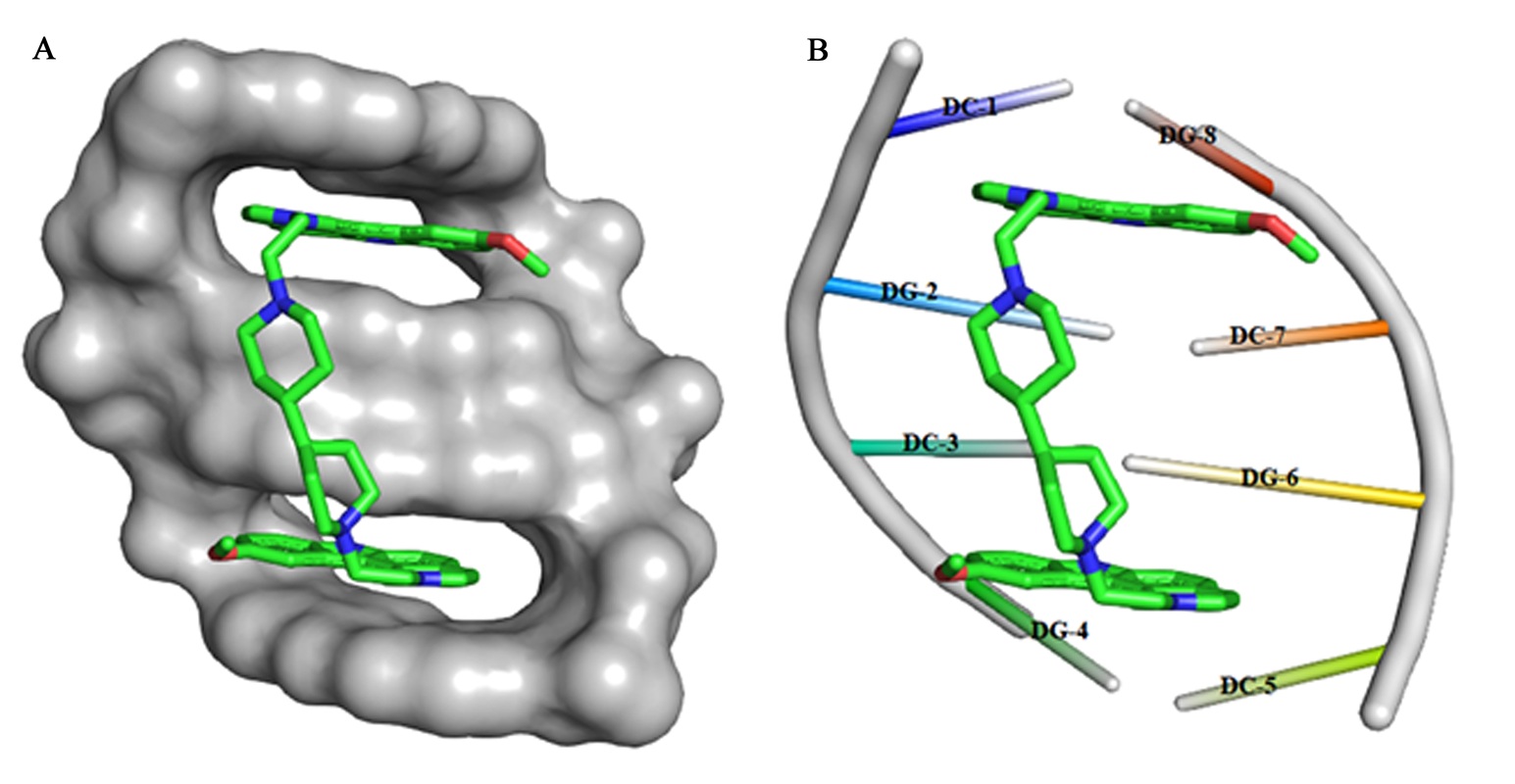
In the present study, an electrochemical sensing framework was developed for identifying Ditercalinium, a therapeutic medication. The Mo3C2 MXene material was fabricated by precisely removing the aluminum component from Mo3AlC2 MAX structures and analyzed via SEM, TEM, XRD, XPS, BET, FT-IR plus EDS techniques. The data obtained from these analyses confirm that the nanolayers were successfully synthesized, showing the expected morphology and structure, indicating that the Mo3C2 MXene was effectively fabricated for further applications. A glassy carbon electrode (GCE) modified with Mo3C2 MXene and ds-DNA (Salmon sperm) showed higher sensitivity than that of bare GCE; therefore, the detection threshold for Ditercalinium became lower. Furthermore, molecular docking was performed to verify that bis-intercalation binds to ds-DNA molecules; the drug prefers to bind between C-G base pairs with an interaction free energy of -10.2 kcal/mol. The preferred binding mode contributes to the formation of a stable Ditercalinium-DNA complex and strengthened the anti-cancer effect via this mechanism.
Keywords
- Ditercalinium,
- DNA biosensor,
- Docking study,
- Mo3C2 MXene
References
- Y. Nie, D. Li, Y. Peng, S. Wang, S. Hu, M. Liu, J. Ding, and W. Zhou, “Metal organic framework coated MnO₂ nanosheets delivering doxorubicin and self-activated DNAzyme for chemo-gene combinatorial treatment of cancer,” Int. J. Pharm., 585, 119513, (2020).
- R. Chinnappan, T. Makhzoum, M. Arai, A. Hajja, F. Abul Rub, I. Alodhaibi, M. Alfuwais, M.A. Elahi, E.A. Alshehri, and L. Ramachandran, “Recent Advances in Biosensor Technology for Early-Stage Detection of Hepatocellular Carcinoma-Specific Biomarkers: An Overview,” Diagnostics, 14, 1519, (2024).
- M.K. Fam, N.I. Ismail, A.I. Zahari, N.A. Ghazali, and N. Hassan, “Biosensor technologies in cancer: tools for early detection and prognostic monitoring,” Biomark. Res., (2025).
- Y. Xu, S.-W. Wang, H. Bagheri, C. Chen, and Y. Zhou, “Innovative TiVC/dsDNA biosensor platform for enhanced detection of anastrozole; Experiment and DFT approaches,” Alexandria Eng. J., 129, 1146–1152, (2025).
- J. Kirsch, C. Siltanen, Q. Zhou, A. Revzin, and A. Simonian, “Biosensor technology: recent advances in threat agent detection and medicine,” Chem. Soc. Rev., 42, 8733–8768, (2013).
- H. Zeng, Y. Zhang, M. Zhang, H. Liu, J. Liu, L. Zhu, J. Wang, and W. Guo, “A signal enhanced lateral flow immunoassay based on core–shell quantum dots labeled antibody and antigen for sensitive detection of CP4-EPSPS protein,” Microchem. J., 209, 112758, (2025).
- B. Huang, Z. Zhao, Y. Zheng, K. Xu, D. Wang, Q. Yang, T. Yang, X. Yang, and H. Chen, “2D/3D-printed PEDOT/PSS conductive hydrogel for biomedical sensors,” Int. J. Bioprint., 10, 1725, (2024).
- L. Jia, Z. Lei, N. Zare, T. Wu, M. Ghalkhani, L. Wan, and Y. Xu, “Ti₃C₂ MXene-enhanced Electrochemical Biosensors for Prostate-Specific Antigen (PSA) Detection in Prostate Cancer,” J. Nanostruct. Chem., 15, 152502 (2025).
- N. Zare, J. Ye, N. Zhong, L. Fu, T.M. Aminabhavi, Y. Xu, and H. Karimi-Maleh, “Porous 2D Ti₃C₂ MXene–based DNA biosensor for electrochemical sensing of toxic atrazine herbicide in soil and water media,” Microchem. J., 118125, (2026).
- C. Karaman, O. Karaman, J. Jiang, and T. Zhao, “MXene-Based Wearable Sweat Biosensors for Personalized Health Monitoring: Materials Innovation and Data-Driven Approaches,” J. Nanostruct. Chem., 16, 72–111, (2026).
- C. Li, S. Lei, L. Ding, Y. Xu, X. Wu, H. Wang, Z. Zhang, T. Gao, Y. Zhang, and L. Li, “Global burden and trends of lung cancer incidence and mortality,” Chin. Med. J., 136, 1583–1590, (2023).
- L. Ruge, M. Verheyen, F. John, and J. Wolf, “Global disparities in access to diagnostics and therapies for advanced non-small cell lung cancer: from discovery to delivery–a review,” Front. Oncol., 16, 1807704, (2026).
- M. Okamaoto, T. Ohsato, K. Nakada, K. Isobe, J.N. Spelbrink, J.-I. Hayashi, N. Hamasaki, D. Kang, “Ditercalinium chloride, a pro-anticancer drug, intimately associates with mammalian mitochondrial DNA and inhibits its replication,” Curr. Genet., 43, 364-370 (2003).
- S. Bilal, S. Saleem, S. Ahmad, F. Hayder, A. Zhou, M. Badea, and A. Hayat, “Frontiers in nano-biosensors for drug monitoring: Shaping the future of anti-cancer therapy,” Chem. Eng. J., 520, 166039 (2025).
- W. Shalannanda, A. Satriawan, M.F. Nurrajab, A.C.H. Ayulestari, D.A. Safitri, F.A. Nabila, C. Setianingsih, and I. Anshori, “Biosensors for therapeutic drug monitoring: a review,” F1000Res., 12, 171, (2023).
- K. Liu, L. Zhang, D. Fu, Y. Fu, Y. Ouyang, X. Ding, and C. Wei, “A novel biosensor based on well-aligned manganese-doped ZnO nanorods for detecting lung cancer antigen,” Alexandria Eng. J., 126, 368–376, (2025).
- Y. Xu, L. Wan, N. Zare, S.-W. Wang, and Z. Lei, “Cr₂C MXene Modification of an Electrochemical Platform Allows for Highly Selective and Sensitive Detection of PSMA, a Prostate Cancer Biomarker,” J. Nanostruct. Chem., 15, 152517 (2025).
- J. Sengupta and C.M. Hussain, “MXene-based electrochemical biosensors: advancing detection strategies for biosensing (2020–2024),” Biosensors, 15, 127, (2025).
- A. Mousa Pour, H. Mahmoudi-Moghaddam, and Z. Garkani-Nejad, “Electrochemical DNA Biosensor Based on Pt²⁺-Doped ZnCo₂O₄ for Sensitive Detection of the Anti-Cancer Drug Sunitinib,” J. Electrochem. Soc., 173, 037503, (2026).
- B.-H. Liu, L.-Y. Meng, L.-H. Han, and B. Jin, “Ultra-high sensitivity electrochemical aptamer biosensor based on a carbon nano-confined interface for the detection of aflatoxin B1 in traditional chinese materia medica decoction pieces,” Carbon Lett., 35, 1461–1472, (2025).
- A. Ges, H. Viltres, A. Castro, S.S. Samhitha, C. Quezada, G. Sánchez-Sanhueza, S. Bollo, S. Ladame, and J. Morales, “Advancing electrochemical nanobiosensors for gastric cancer diagnostics: Engineering challenges and clinical integration toward mHealth applications,” Talanta, 296, 128451, (2026).
- N. Zare, H. Karimi-Maleh, Z. Zhang, L. Fu, J. Rouhi, N. Zhong, Y. Wen, and M. Ghalkhani, “Enhancing cancer biomarker identification: precise monitoring of MUC1 using V₂C/Au nanocomposite-amplified electrochemical biosensor,” Carbon Lett., 35, 1691-1700 (2025).
- E. Halalkhor-Mirkolayi, A. Ghorbani-HasanSaraei, M.B. Limooei, P. Ariaii, and S.-A. Shahidi, “A High-Sensitivity Sensor with Simultaneous Enhanced Effect with Ionic Liquid and NiO/SWCNTs Catalysts to Create High-Performance Conditions for Vanillin Measurement,” J. Nanostruct. Chem., 15, 152518 (2025).
- Y. Guan, K. Enock, B. Zhou, Z. Qi, M.S. Nadeem, J. Chen, Z. Shujie, Y. Hu, Z. Wu, and J. Wang, “High-Efficiency removal of Cu²⁺, Zn²⁺, and Mg²⁺ from contaminated water using a conductive hydrogel based on gellan Gum/Ti₃C₂ MXene/PEDOT-S:H/Aluminum oxide silicate composite,” Chem. Eng. Sci., 332, 124091, (2026).
- Y. Li, J. Bu, Y. Sun, Z. Huang, X. Zhu, S. Li, P. Chen, Y. Tang, G. He, and S. Zhong, “Efficient degradation of norfloxacin by synergistic activation of PMS with a three-dimensional electrocatalytic system based on Cu-MOF,” Sep. Purif. Technol., 356, 129945, (2025).
- H. Mohammed, M.F. Mia, J. Wiggins, and S. Desai, “Nanomaterials for energy storage systems—a review,” Molecules, 30, 883, (2025).
- M. Holzinger, A. Le Goff, and S. Cosnier, “Nanomaterials for biosensing applications: a review,” Front. Chem., 2, 63, (2014).
- M. Hussain, C. Wang, H. Yang, K. Ettayri, Y. Chen, K. Wang, J. Wei, and J. Qian, “Recent advances and future prospects of Ti₃C₂Tₓ MXene-based electrochemical sensors: A review,” Microchem. J., 206, 111495, (2024).
- Z. Zhao, J. Cao, B. Zhu, X. Li, L. Zhou, and B. Su, “Recent advances in MXene-based electrochemical sensors,” Biosensors, 15, 107, (2025).
- M. Yang, C. Xie, and H. Lu, “Advances in MXene-based electrochemical sensors for multiplexed detection in biofluids,” Int. J. Mol. Sci., 26, 5368, (2025).
- H. Karimi-Maleh, Z. Zhang, N. Zare, O. Karaman, Y. Wen, T. Wu, N. Zhong, and L. Fu, “A novel disposable dual-sensing platform based on DNA-aptamer amplified with gold nanoparticles/Nb₄C₃-MXene for simultaneous detection of lead and cadmium,” Adv. Compos. Hybrid Mater., 8, 1–11, (2025).
- A. Khataee, H. Imanzadeh, Y. Orooji, and L.G. Voskressensky, “High performance Mo₃C₂ MXene‑carbon black nanocomposites electrochemical sensor for sensitive detection of nitrite in environmental water samples,” Microchem. J., 220, 116600, (2025).
- Y. Nan, Z. Zhang, Z. Wang, H. Yuan, Y. Zhou, and J. Wei, “Controllable synthesis of Mo₃C₂ encapsulated by N-doped carbon microspheres to achieve highly efficient microwave absorption at full wavebands: from lemon-like to fig-like morphologies,” Inorg. Chem., 61, 6281–6294, (2022).
- J. Halim, S. Kota, M.R. Lukatskaya, M. Naguib, M.Q. Zhao, E.J. Moon, J. Pitock, J. Nanda, S.J. May, and Y. Gogotsi, “Synthesis and characterization of 2D molybdenum carbide (MXene),” Adv. Funct. Mater., 26, 3118–3127, (2016).
- J. Halim, K.M. Cook, P. Eklund, J. Rosen, and M.W. Barsoum, “XPS of cold pressed multilayered and freestanding delaminated 2D thin films of Mo₂TiC₂Tₓ and Mo₂Ti₂C₃Tₓ (MXenes),” Appl. Surf. Sci., 494, 1138–1147, (2019).
- M. Alhabeb, K. Maleski, B. Anasori, P. Lelyukh, L. Clark, S. Sin, and Y. Gogotsi, “Guidelines for Synthesis and Processing of Two-Dimensional Titanium Carbide (Ti₃C₂Tₓ MXene),” Chem. Mater., 29, 7633–7644, (2017).
- S. Luo, A. Kamali, J.M. Little, A. Warty, J.K. Keum, P.-Y. Chen, Y. Kwak, H.K. Kim, D.G. Vlachos, K. Zhang, J. Yang, and D. Liu, “Vapor-phase pillarization of MXenes for engineering hierarchical interlayer porosity,” J. Mater. Chem. A, (2026) DOI: 10.1039/d5ta09345g.
- P.A. Maughan, L. Bouscarrat, V.R. Seymour, S. Shao, S.J. Haigh, R. Dawson, N. Tapia-Ruiz, and N. Bimbo, “Pillared Mo₂TiC₂ MXene for high-power and long-life lithium and sodium-ion batteries,” Nanoscale Adv., 3, 3145–3158, (2021).
- O. Trott and A.J. Olson, “AutoDock Vina: improving the speed and accuracy of docking with a new scoring function, efficient optimization, and multithreading,” J. Comput. Chem., 31, 455–461, (2010).
- G.M. Morris, R. Huey, W. Lindstrom, M.F. Sanner, R.K. Belew, D.S. Goodsell, and A.J. Olson, “AutoDock4 and AutoDockTools4: Automated docking with selective receptor flexibility,” J. Comput. Chem., 30, 2785–2791, (2009).
- W.L. DeLano, “The PyMOL molecular graphics system, version 1.8,” Schrödinger, LLC, (2002).