
 10.57647/jnsc.2026.1604.17
Machine Learning and Quantum-Inspired Optimization of Microwave-Synthesized High-Entropy Alloy Magnetic Nanoparticles for Photocatalytic Diazinon Degradation
- Mostafa Khajeh
 1,2
1,2 - Mansour Ghaffari-Moghaddam1,2
- Jamshid Piri2,3
- Department of Chemistry, Faculty of Science, University of Zabol, Zabol, Iran
- Advanced Materials & Manufacturing Laboratory, University of Zabol, Zabol, Iran
- Department of Water Engineering, Faculty of Water and Soil, University of Zabol, Zabol, Iran

Received: 17-12-2025
Revised: 15-02-2026
Accepted: 07-04-2026
Published in Issue 31-08-2026
Copyright (c) 2026 Mostafa Khajeh, Mansour Ghaffari-Moghaddam, Jamshid Piri, Afsaneh Barkhordar (Author)

This work is licensed under a Creative Commons Attribution 4.0 International License.
How to Cite




PDF views: 23





Abstract
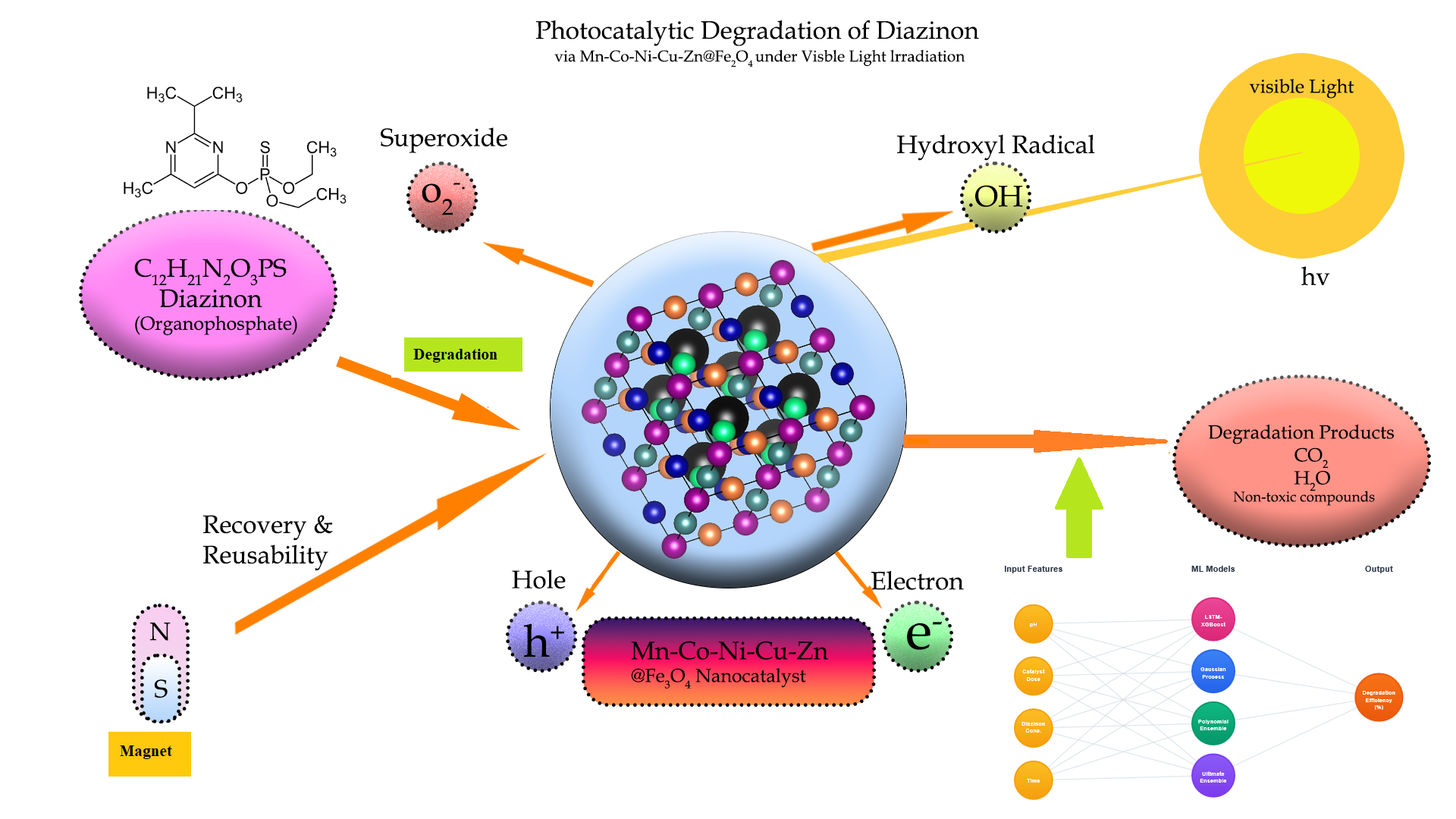
This study reports the synthesis of high-entropy alloy-functionalized magnetic nanoparticles (HEA@MNP) photocatalysts and investigates their application for the photocatalytic degradation of diazinon pesticide under visible LED irradiation. The core-shell nanoarchitecture of Fe₃O₄ magnetic core and Co-Ni-Cu-Zn-Mn HEA-like shell was prepared using a co-precipitation method combined with a microwave-assisted functionalization technique. FTIR, SEM-EDX, PXRD, and TG did characterization of HEA@MNP. The HEA@MNP photocatalysts exhibited excellent photocatalytic activity with a high degradation efficiency of 97.4% for diazinon, good adsorption capacity of 169.5 mg/g, and excellent reusability retaining 93% retained efficiency after seven cycles without noticeable emission of heavy metal ions. For process modeling and optimization, a full-fledged machine learning framework with four algorithms (LSTM-XGBoost, Gaussian Process, Polynomial Ensemble, and Ultimate Ensemble) was established. Among the evaluated models, the Ultimate Ensemble achieved the highest test R² of 0.936; however, overfitting analysis (ΔRMSE% = 49.5%) revealed moderate model instability. The Polynomial Ensemble demonstrated the most robust generalization performance (ΔRMSE% = 7.7%, Generalization Score = 0.969), suggesting it may be more reliable for practical applications despite slightly lower test metrics. For the multi-objective optimization, a new quantum-inspired genetic algorithm (QGA) was designed, and it has proven to be very effective in the solution processes with computational efficiency compared to the traditional methods (31 iterations are needed to converge instead of 300). Application of the QGA optimization approach enabled a 21.6% reduction in catalyst loading while sustaining a degradation efficiency of 86.48%, thereby enhancing the overall cost-effectiveness of the process by approximately 28.5%, Herein, photocatalytic scavenging experiments were carried out and showed that holes generated during the irradiation process are responsible for the predominant oxidation, and hydroxyl/superoxide radicals are the secondary oxidants. This combination of advanced materials, machine learning, and quantum-inspired optimization represents an elegant platform for sustainable water treatment technologies.
Keywords
- Diazinon; High-entropy alloy,
- Quantum genetic algorithm,
- Machine learning optimization,
- Photocatalytic degradation
References
- Bakhshaei, S., Ghafari, M., Daraei, H. Performance of UV/TiO2/PS, US/TiO2/PS and UV/US/TiO2/PS processes on the diazinon degradation from aqueous solutions and toxicity assay. Desalin. Water Treat. 319, 100556 (2024).
- Shamim, A., Abdullah, H., Abid, M. B. Nayyab, G. E., Daud, N. K. Advanced oxidation processes for sustainable wastewater treatment. J. Mater. Sci. 61, 4857–4893 (2026).
- Adamkovicova, M., Toman, R., Martiniakova, M., Omelka, R., Babosova, R., Krajcovicova, V., Grosskopf, B., Massanyi, P. Sperm motility and morphology changes in rats exposed to cadmium and diazinon. Reprod. Biol. Endocrinol. 14, 42 (2016).
- Liang, X., Duan, J., Tian, Y., Han, Y., Qin, Z., Zhu, H., Lu, Y., Nie, D., Guo, Y., Yang, X. One-pot etching UiO-66-NH2 to format orientational deposition AgCl/Ag0 without illumination for high-efficiency photocatalytic removal of diazinon. Sep. Purif. Technol. 367, 132836 (2025).
- Sahmi, A., Berkani, G., Lahmar, Benamira, H. M., Aksas, H., Trari M. Advancements in sono-photo-electrocatalytic oxidation for the removal of toxic contaminants in wastewaters. Int. J. Environ. Sci. Technol. 23, 132 (2026).
- Phuong, N.M., Chu, N. C., Thuan, D. V., Ha, M. N., Hanh, N. T., Viet, H. D. T., Thu, N. T. M., Quan, P. V., Truc, N. T. T. Novel removal of diazinon pesticide by adsorption and photocatalytic degradation of visible light-driven Fe-TiO2/Bent-Fe photocatalyst. J. Chem. 2019, 2678927 (2019).
- Manshouri, M., Daraei, H., Yazdanbakhsh, A.R. A feasible study on the application of raw ostrich feather, feather treated with H2O2 and feather ash for removal of phenol from aqueous solution. Desalin. Water Treat. 41, 179–185 (2012).
- El Shehawy, A. S., Elsayed, A., Ali, E. M. Biogenic synthesis of iron nanoparticles using Laurencia papillosa: characterization, optimization, and dual applications in heavy metal removal and potential cancer treatment. Sci. Rep. 16, 7191 (2026).
- Ejderyan, N., Sanyal, R., Sanyal, A. Polymer brush-coated magnetic nanoparticles as stimuli-responsive platforms for biomedical applications. Polymer 351, 129811 (2026).
- Deshmukh, F.Kiran, K., Pawar, S. V., Nawani, N., Golińska, P., Gade, A., Ingle, P., Gaikwad, S. C. Efficient photocatalytic degradation of azo dyes using Achyranthes aspera-mediated magnetic iron oxide nanoparticles: A green synthesis approach. Sustain. Chem. Environ. 100269 (2025).
- Sabouri, Z., Kazemi, M., Sabouri, M., Tabrizi Hafez Moghaddas, S. S., Darroudi, M. Biosynthesis of Ag doped MgO-NiO-ZnO nanocomposite with Ocimum Basilicum L extract and assessment of their biological and photocatalytic applications. J. Mol. Struct. 1306, 137895 (2024).
- Liu, H., Chen, S., Sun, C., Zhang, J., Wang, Y., Tang, Y., Du, Y., Dong, W., Wang, H., Suo, H.vLaccase immobilized on amino acid ionic liquid-modified magnetic lignin nanoparticles and its degradation of 2,4-dichlorophenol. Int. J. Biol. Macromol. 321, 146569 (2025).
- Das, S., Sanjay, M., Gautam, A. R. S., Behera, R., Tiwary, C. S., Chowdhury, S. Low bandgap high entropy alloy for visible light-assisted photocatalytic degradation of pharmaceutically active compounds: performance assessment and mechanistic insights. J. Environ. Manage. 342, 118081 (2023).
- Rius-Ayra, O., Biserova-Tahchieva, A., López-Jiménez, I., Llorca-Isern, N. Degradation of methyl red at the surface of FeAlNiCuCo high-entropy alloys. Surf. Interfaces 106959 (2025).
- Yadav, Y. K., Yadav, S., Shaz, M. A., Yadav, T. P. A facile synthesis of high entropy alloy nanoparticles and notable catalytic activity for methylene blue degradation. Mater. Lett. 138854 (2025).
- Ye, Y. F., Wang, Q., Lu, J., Liu, C. T., Yang, Y. High-entropy alloy: challenges and prospects. Mater. Today 19, 349–362 (2016).
- Sundaram, G. A., Muniyandi, G. R., Ethiraj, J., Parimelazhagan, V., Krishna Kumar, A. S. Introduction and advancements in room-temperature ferromagnetic metal oxide semiconductors for enhanced photocatalytic performance. Chem. Engineering 8, 36 (2024).
- Georgiadis, G.P., Elekidis, A.P., Georgiadis, M.C. Optimization-based scheduling for the process industries: from theory to real-life industrial applications. Processes 7, 438 (2019).
- Liu, H., Song, M. Techno-economic assessment and process design considerations for industrial-scale photocatalytic wastewater treatment. Water 18, 221 (2026).
- Bakır, R., Orak, C., Yüksel, A. A machine learning ensemble approach for predicting solar-sensitive hybrid photocatalysts on hydrogen evolution. Phys. Scr. 99, 076015 (2024).
- Kumar, J., Jha, S., Raturi, A., Bajpai, A., Sonkusare, R., Gurao, N. P., Biswas, K. Novel alloy design concepts enabling enhanced mechanical properties of high entropy alloys. Front. Mater. 9, 868721 (2022).
- Bakır, R., Orak, C., Horoz, S. Enhancing photocatalytic degradation of hazardous pollutants with green-synthesized catalysts: A machine learning approach. J. Environ. Manage. 385, 125695 (2025).
- Arabacı, B., Bakır, R., Orak, C., Yüksel, A. Predictive modeling of photocatalytic hydrogen production: integrating experimental insights with machine learning on Fe/g-C3N4 catalysts. Ind. Eng. Chem. Res. 64, 5184–5199 (2025).
- Arabacı, B., Bakır, R., Orak, C., Yüksel, A. Integrating experimental and machine learning approaches for predictive analysis of photocatalytic hydrogen evolution using Cu/g-C3N4. Renew. Energy 237, 121737 (2024).
- Bakır, R., Orak, C., Yüksel, A. Optimizing hydrogen evolution prediction: A unified approach using random forests, lightGBM, and Bagging Regressor ensemble model. Int. J. Hydrogen Energy 67, 101–110 (2024).
- Arshad, M.W., Lodi, S. Quantum computing in the automotive industry: survey, challenges, and perspectives. J. Supercomput. 81, 1–45 (2025).
- Wulff, E., Garcia Amboage, J. P., Aach, M., Gislason, T. E., Ingolfsson, T. K., Ingolfsson, T. K., Pasetto, E., Delilbasic, A., Riedel, M., Sarma, R., Girone, M., Lintermann, A. Distributed hybrid quantum-classical performance prediction for hyperparameter optimization. Quantum Mach. Intell. 6, 59 (2024).
- Riedmaier, S., Danquah, B., Schick, B., Diermeyer, F. Unified framework and survey for model verification, validation and uncertainty quantification. Arch. Comput. Methods Eng. 28, 2655–2688 (2021).
- Mai, H., Le, T.C., Chen, D., Winkler, D.A., Caruso, R.A. Machine learning for electrocatalyst and photocatalyst design and discovery. Chem. Rev. 122, 13478–13515 (2022).
- Khajeh, M. Application of factorial design and box–behnken matrix in the optimization of a magnetic nanoparticles procedure for copper determination in water and biological samples. Biol. Trace Elem. Res. 135, 355–363 (2010).
- Kang, L., Zhang, M., Liu, Z. H., Ooi, K. IR spectra of manganese oxides with either layered or tunnel structures. Spectrochim. Acta A Mol. Biomol. Spectrosc. 67, 864–869 (2007).
- Rogachev, A. S., Kovalev, D. Y., Kochetov, N. A., Shchukin, A. S., Vadchenko, S. G. Evolution of crystal structure in high-entropy AlCoCrFeNi alloy: An in situ high-temperature X-ray diffraction study. J. Alloys Compd. 861, 158562 (2021).
- Ge, S., Lin, S., Fu, H., Zhang, L., Geng, T., Zhu, Z., Li, Z., Li, H., Wang, A., Zhang, H., Zhang, H. High-temperature mechanical properties and dynamic recrystallization mechanism of in situ silicide-reinforced MoNbTaTiVSi refractory high-entropy alloy composite. Acta Metall. Sin. (Engl. Lett.) 35, 1617–1630 (2022).
- Kalantar, S., Bemani, A., Sayadi, M. H., Chamanehpour, E. Visible light-driven ZnO/Fe3O4 magnetic nanoparticles for detoxification of diazinon: the photocatalytic optimization process with RSM-BBD model. Environ. Sci. Pollut. Res. Int. 30, 95634–95647 (2023).
- Nikzad, S., Amooey, A.A., Alinejad-Mir, A. Adsorption of diazinon from aqueous solutions by magnetic guar gum-montmorillonite. Chem. Data Collect. 20, 100187 (2019).
- Nashtaei, M. S., Mollahosseini, A., Rabbani, M., Shabannashtaei, P., Parvaz, S. Preparing PAN/MOF nanofiber composite by electrospinning method for carbon dioxide adsorption. Inorg. Chem. Commun. 153, 110731 (2023).
- Pishgar, F., Panahi, H. A., Khodaparast Haghi, A. A., Motaghitalab, V., Hasani, A. H. Comparative study on adsorptive characteristics of diazinon and chlorpyrifos from water by thermosensitive nanosphere polymer. J. Chem. 2016, 8329650 (2016).
- Baghersad, M.H., Maleki, A., Khodabakhshi, M.R. Design and development of novel magnetic Lentinan/PVA nanocomposite for removal of diazinon, malathion, and diclofenac contaminants. J. Contam. Hydrol. 256, 104193 (2023).