
 10.57647/jnsc.2026.1603.13
Engineering Gold Nanocluster/Polymer Hybrid Nanocarriers to Boost Doxorubicin Transport and Cellular Uptake in Gastric Cancer Cells
- Yong He*
 1
1
- R&D Department of 3D Printing, Department of Gastrointestinal Surgery, Digestive Medicine Center, The Seventh Affiliated Hospital, Sun Yat-sen University, Shenzhen 518107, China
- School of Medicine, Sun Yat-sen University, Shenzhen 518107, China

Received: 17-12-2025
Revised: 27-01-2026
Accepted: 12-02-2026
Published in Issue 30-06-2026
Copyright (c) 2026 Yong He, Jinshi Chen, Cheng-San Wong (Author)

This work is licensed under a Creative Commons Attribution 4.0 International License.
How to Cite




PDF views: 47





Abstract
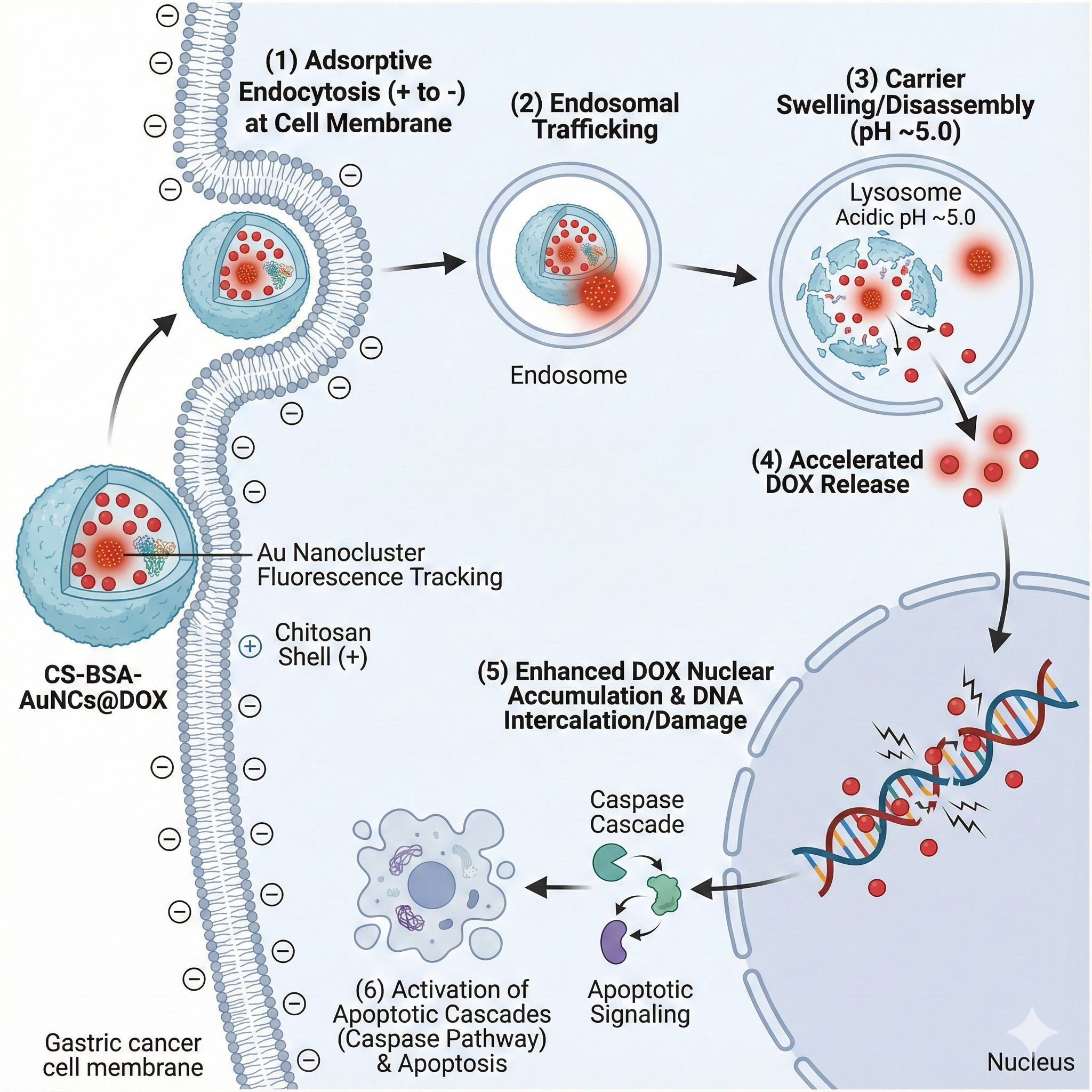
A pH-responsive, fluorescence-traceable core–shell nanosystem was prepared by co-encapsulating bovine serum albumin–templated Au nanoclusters and doxorubicin within ionotropically crosslinked chitosan (TPP gelation) to enhance intracellular chemotherapy delivery. Formulation screening (CS:TPP 3:1–6:1) identified an optimal composition with a hydrodynamic diameter of 145 ± 5 nm, PDI 0.18, and a surface potential of +32.4 ± 1.2 mV; TEM resolved 2.1 ± 0.3 nm clusters and uniform spherical particles. The lyophilized carriers displayed mesoporosity (SBET 42.5 m2/g; pore volume 0.15 cm3/g; mean pore size 12.4 nm). High drug incorporation was achieved (encapsulation efficiency 82.3 ± 1.4%; loading capacity 12.6 ± 0.8%). Dialysis experiments revealed gated release, with ~22% (pH 7.4) versus ~65% (pH 5.0) at 24 h and ~35% versus ~88% at 72 h; acidic kinetics followed the Korsmeyer–Peppas model (R2 = 0.985; n = 0.65). Hemolysis remained 1.2% at 100 μg/mL and <3.0% at 1000 μg/mL, and blank carriers preserved >90% viability at 500 μg/mL. In MGC-803 and SGC-7901 cells, the formulation lowered 48 h IC50 from 1.85 ± 0.12 to 0.92 ± 0.08 μg/mL and from 2.10 ± 0.15 to 1.15 ± 0.10 μg/mL, respectively. Uptake quantification showed a 4 h mean fluorescence intensity of 717 a.u. versus 280 a.u. for free drug, and apoptosis increased to 59.0% (early apoptosis 35.6%) compared with 40.6% (22.1%) for free drug. Confocal imaging showed time-dependent cytoplasmic-to-nuclear redistribution with persistent cluster fluorescence, supporting tracking. Together, these results suggest that enhanced cell-surface association driven by the cationic shell, combined with endo/lysosomal acidification–triggered reler exposure while limiting premature leakage under physiological pH.
Keywords
- Adsorptive endocytosis,
- Flow cytometry,
- Ionic gelation,
- Mesoporous texture,
- PH-gated diffusion
References
- Thrift, A. P.; Wenker, T. N.; El-Serag, H. B. Global burden of gastric cancer: epidemiological trends, risk factors, screening and prevention. Nat Rev Clin Oncol 20, 338–349 (2023).
- Wang, S.; Li, J.; Zhang, Z.; Cao, S.; Zhang, Z.; Bian, Y.; Xu, Y.; Ma, C. Advances in nanomedicine and delivery systems for gastric cancer research. Front Bioeng Biotechnol 13, 1565999 (2025).
- Bisht, A.; Avinash, D.; Sahu, K. K.; Patel, P.; Das Gupta, G.; Kurmi, B. D. A comprehensive review on doxorubicin: mechanisms, toxicity, clinical trials, combination therapies and nanoformulations in breast cancer. Drug Deliv Transl Res 15, 102–133 (2025).
- Wu, L.; Meng, Y.; Zheng, X.; Bai, Y.; Han, C.; Wang, Z.; Yang, J.; Jing, X.; Yao, Y. Pillar[5]arene-based prodrug as a GSH-responsive SO₂ nanogenerator for effective gas cancer therapy. Chin Chem Lett 36, 110808 (2025).
- Qin, N.; Fan, Y.; Yang, T.; Yang, Z.; Fan, D. The burden of gastric cancer and possible risk factors from 1990 to 2021, and projections until 2035: findings from the Global Burden of Disease Study 2021. Biomark Res 13, 5 (2025).
- Go, G.; Lee, C.-S.; Yoon, Y. M.; Lim, J. H.; Kim, T. H.; Lee, S. H. PrPC aptamer-conjugated gold nanoparticles for targeted delivery of doxorubicin to colorectal cancer cells. Int J Mol Sci 22, 1976 (2021).
- Rawat, P. S.; Jaiswal, A.; Khurana, A.; Bhatti, J. S.; Navik, U. Doxorubicin-induced cardiotoxicity: an update on the molecular mechanism and novel therapeutic strategies for effective management. Biomed Pharmacother 139, 111708 (2021).
- Lin, A.; Giuliano, C. J.; Palladino, A.; John, K. M.; Abramowicz, C.; Yuan, M. L.; Sausville, E. L.; Lukow, D. A.; Liu, L.; Chait, A. R.; et al. Off-target toxicity is a common mechanism of action of cancer drugs undergoing clinical trials. Sci Transl Med 11, eaaw8412 (2019).
- Dai, Y.; Yu, W.; Cheng, Y.; Zhou, Y.; Zou, J.; Meng, Y.; Chen, F.; Qian, Y.; Yao, Y. Recent developments in pillar[5]arene-based nanomaterials for cancer therapy. Chem Commun 61, 2484–2495 (2025).
- Cai, Y.; Zhang, Y.; Liang, X.; Deng, C.; Zhang, J.; Wang, H.; Duan, H.; Yao, Y. A water-soluble cationic [2]biphenyl-extended pillar[6]arene: synthesis, host–guest interaction with hemin and application in chemodynamic/photodynamic cancer therapy. Chem Commun 61, 5333–5336 (2025).
- Ashrafizadeh, M.; Hushmandi, K.; Mirzaei, S.; Bokaie, S.; Bigham, A.; Makvandi, P.; Rabiee, N.; Thakur, V. K.; Kumar, A. P.; Sharifi, E.; et al. Chitosan-based nanoscale systems for doxorubicin delivery: exploring biomedical application in cancer therapy. Bioeng Transl Med 8, e10325 (2022).
- Sharma, A.; Sharma, N.; Singh, S.; Dua, K. Review on theranostic and neuroprotective applications of nanotechnology in multiple sclerosis. J Drug Deliv Sci Technol 81, 104220 (2023).
- John, J. Advancements in nano-based drug delivery systems for therapeutics: a comprehensive review. RSC Pharm —,(2025).
- Gul, M.; Kashif, M.; Muhammad, S.; Azizi, S.; Sun, H. Various methods of synthesis and applications of gold-based nanomaterials: a detailed review. Cryst Growth Des 25, 2227–2266 (2025).
- Jin, R.; Wang, Q.; Dou, G.; Bai, Y.; Liu, S.; Cai, B.; Chen, X. Stimuli-responsive nanoplatform with mitochondria-specific multiple-modal therapeutics for effective tumor treatment. Appl Mater Today 21, 100883 (2020).
- Zhang, P.; Hou, H.; Xu, S.; Wen, Y.; Zhang, Y.; Xing, F. Localized surface plasmon resonance sensing based on monometallic gold nanoparticles: from material preparation to detection of bioanalytes. Anal Methods 17, 892–915 (2025).
- Waitkus, J.; Chang, Y.; Liu, L.; Puttaswamy, S. V.; Chung, T.; Molina Vargas, A. M.; Dollery, S. J.; O’Connell, M. R.; Cai, H.; Tobin, G. J.; et al. Gold nanoparticle-enabled localized surface plasmon resonance on unique gold nanomushroom structures for on-chip CRISPR-Cas13a sensing. Adv Mater Interfaces 10, 2201261 (2023).
- Lian, S.; Lamprou, D.; Zhao, M. Electrospinning technologies for the delivery of biopharmaceuticals: current status and future trends. Int J Pharm 651, 123641 (2024).
- Wang, T.; Xiao, D. Rapid synthesis of fluorescent bovine serum albumin–gold nanoclusters complex for glutathione determination. Microchim Acta 188, 484 (2021).
- Jahanban-Esfahlan, A.; Ostadrahimi, A.; Jahanban-Esfahlan, R.; Roufegarinejad, L.; Tabibiazar, M.; Amarowicz, R. Recent developments in the detection of bovine serum albumin. Int J Biol Macromol 138, 602–617 (2019).
- Hembury, M.; Beztsinna, N.; Asadi, H.; van den Dikkenberg, J. B.; Meeldijk, J. D.; Hennink, W. E.; Vermonden, T. Luminescent gold nanocluster-decorated polymeric hybrid particles with assembly-induced emission. Biomacromolecules 19, 2841–2848 (2018).
- Kumari, R.; Sharma, N.; Karwasra, R.; Khanna, K. Colon cancer and their targeting approaches through nanocarriers: a review. Asian Pac J Trop Biomed 13, 104 (2023).
- Jin, R.; Liu, Z.; Bai, Y.; Zhou, Y.; Gooding, J. J.; Chen, X. Core–satellite mesoporous silica–gold nanotheranostics for biological stimuli-triggered multimodal cancer therapy. Adv Funct Mater 28, 1801961 (2018).
- Lu, J.; Li, Y.; Qin, X.; Wang, Z.; Ouyang, A.; Su, B.; Guo, H.; Yang, X.; Shen, Z.; Li, J.; et al. A clinically inspired olsalazine-based metal–organic framework enables a universal nanodrugs platform for diverse disease. J Colloid Interface Sci 702, 138849 (2026).
- Duan, Y.; Duan, R.; Liu, R.; Guan, M.; Chen, W.; Ma, J.; Chen, M.; Du, B.; Zhang, Q. Chitosan-stabilized self-assembled fluorescent gold nanoclusters for cell imaging and biodistribution in vivo. ACS Biomater Sci Eng 4, 1055–1063 (2018).
- Zare, N.; Karimi-Maleh, H.; Zhang, Z.; Fu, L.; Rouhi, J.; Zhong, N.; Wen, Y.; Ghalkhani, M. Enhancing cancer biomarker identification: precise monitoring of MUC1 using V2C/Au nanocomposite-amplified electrochemical biosensor. Carbon Lett 35, 1691–1700 (2025).
- Madhusudhan, A.; Reddy, G. B.; Venkatesham, M.; Veerabhadram, G.; Kumar, D. A.; Natarajan, S.; Yang, M.-Y.; Hu, A.; Singh, S. S. Efficient pH-dependent drug delivery to target cancer cells by gold nanoparticles capped with carboxymethyl chitosan. Int J Mol Sci 15, 8216–8234 (2014).
- Imantay, A.; Mashurov, N.; Zhaisanbayeva, B. A.; Mun, E. Doxorubicin-conjugated nanoparticles for potential use as drug delivery systems. Nanomaterials 15, 133 (2025).
- Xie, J.; Zheng, Y.; Ying, J. Y. Protein-directed synthesis of highly fluorescent gold nanoclusters. J Am Chem Soc 131, 888–889 (2009).
- Hsu, N.-Y.; Lin, Y.-W. Microwave-assisted synthesis of bovine serum albumin–gold nanoclusters and their fluorescence-quenched sensing of Hg²⁺ ions. New J Chem 40, 1155–1161 (2016).
- Chevrier, D.; Thanthirige, V.; Luo, Z.; Driscoll, S.; Cho, P.; MacDonald, M.; Yao, Q.; Guda, R.; Xie, J.; Johnson, E.; et al. Structure and formation of highly luminescent protein-stabilized gold clusters. Chem Sci 9, 2782–2790 (2018).
- Calvo, P.; Remuñán-López, C.; Vila-Jato, J. L.; Alonso, M. J. Novel hydrophilic chitosan–polyethylene oxide nanoparticles as protein carriers. J Appl Polym Sci 63, 125–132 (1997).
- Gan, Q.; Wang, T.; Cochrane, C.; McCarron, P. Modulation of surface charge, particle size and morphological properties of chitosan–TPP nanoparticles intended for gene delivery. Colloids Surf B Biointerfaces 44, 65–73 (2005).
- Al-Shadidi, J. R. M. H.; Al-Shammari, S.; Al-Mutairi, D.; Alkhudhair, D.; Thu, H. E.; Hussain, Z. Chitosan nanoparticles for targeted cancer therapy: a review of stimuli-responsive, passive, and active targeting strategies. Int J Nanomedicine 19, 8373–8400 (2024).
- Wang, J., Tian, Q., Liu, Y., et al. Targeting metalloptosis in tumor therapy: from molecular mechanisms to application of metal nanoparticles. Mol Cancer 24, 260 (2025).
- Tian, G.; Sun, X.; Bai, J.; Dong, J.; Zhang, B.; Gao, Z.; Wu, J. Doxorubicin-loaded dual-functional hyaluronic acid nanoparticles: preparation, characterization and antitumor efficacy in vitro and in vivo. Mol Med Rep 19, 133–142 (2019).
- Zare, M.; Mohammadi Samani, S.; Sobhani, Z. Enhanced intestinal permeation of doxorubicin using chitosan nanoparticles. Adv Pharm Bull 8, 411–417 (2018).
- Aziz, A.; Sefidbakht, Y.; Rezaei, S.; Kouchakzadeh, H.; Uskoković, V. Doxorubicin-loaded, pH-sensitive albumin nanoparticles for lung cancer cell targeting. J Pharm Sci 111, 1187–1196 (2022).
- Gisbert-Garzarán, M.; Manzano, M.; Vallet-Regí, M. pH-responsive mesoporous silica and carbon nanoparticles for drug delivery. Bioengineering (Basel) 4, 3 (2017).
- Dornjak, L.; Kovačić, M.; Ostojić, K.; Angaits, A.; Szpunar, J.; Urlić, I.; Rogina, A. Chitosan–boric acid scaffolds for doxorubicin delivery in osteosarcoma treatment. Polymers 14, 4753 (2022).
- de la Harpe, K. M.; Kondiah, P. P. D.; Choonara, Y. E.; Marimuthu, T.; du Toit, L. C.; Pillay, V. The hemocompatibility of nanoparticles: a review of cell–nanoparticle interactions and hemostasis. Cells 8, 1209 (2019).
- Yedgar, S.; Barshtein, G.; Gural, A. Hemolytic activity of nanoparticles as a marker of their hemocompatibility. Micromachines (Basel) 13, 2091 (2022).
- Xu, J.; Liu, D.; Niu, H.; Zhu, G.; Xu, Y.; Ye, D.; Li, J.; Zhang, Q. Resveratrol reverses doxorubicin resistance by inhibiting epithelial–mesenchymal transition through modulating PTEN/Akt signaling pathway in gastric cancer. J Exp Clin Cancer Res 36, 19 (2017).
- He, Y.; Zhu, Q.; Chen, M.; Huang, Q.; Wang, W.; Li, Q.; Huang, Y.; Di, W. The changing 50% inhibitory concentration (IC50) of cisplatin: a pilot study on artifacts of the MTT assay and precise measurement of density-dependent chemoresistance in ovarian cancer. Oncotarget 7, 70803–70821 (2016).
- Zhou, J.; Li, K.; Zang, X.; Xie, Y.; Song, J.; Chen, X. ROS-responsive galactosylated nanoparticles with doxorubicin entrapment for triple-negative breast cancer therapy. Int J Nanomedicine 18, 1381–1397 (2023).
- Yin, T.; Zhang, Q.; Wu, H.; Gao, G.; Shapter, J. G.; Shen, Y.; He, Q.; Huang, P.; Qi, W.; Cui, D. In vivo high-efficiency targeted photodynamic therapy of ultrasmall Fe₃O₄@polymer nanoprobes based on small-size effect. NPG Asia Mater 9, e383 (2017).
- Norouzi, M.; Yathindranath, V.; Thliveris, J. A.; Kopec, B. M.; Siahaan, T. J.; Miller, D. W. Doxorubicin-loaded iron oxide nanoparticles for glioblastoma therapy: a combinational approach for enhanced delivery. Sci Rep 10,11292 (2020).
- Zhang, A.; Pan, S.; Zhang, Y.; Chang, J.; Cheng, J.; Huang, Z.; Li, T.; Zhang, C.; de la Fuente, J. M.; Zhang, Q.; et al. Carbon–gold hybrid nanoprobes for real-time imaging, photothermal/photodynamic and nanozyme oxidative therapy. Theranostics 9, 3443–3461 (2019).
- Yang, S.; Liang, N.; Li, H.; Xue, W.; Hu, D.; Jin, L.; Zhao, Q.; Yang, S. Design, synthesis and biological evaluation of novel betulinic acid derivatives. Chem Cent J 6, 141 (2012).
- Wang, Z.; Su, B.; Ouyang, A.; Liang, Z.; Yuan, P.; Qin, X.; Li, Y.; Huang, X.; Fan, L.; Guo, H.; Jin, R. Reengineering glycyrrhetinic acid into a therapeutic oligomer for targeted tumor therapy with cardioprotection. J Nanobiotechnol 23, 715 (2025).
- Weerawardene, K. L. D. M.; Aikens, C. M. Theoretical insights into the origin of photoluminescence of Au₂₅(SR)₁₈⁻ nanoparticles. J Am Chem Soc 138, 11202–11210 (2016).
- Raj, L. F. A. A.; Jonisha, R.; Revathi, B.; Jayalakshmy, E. Preparation and characterization of bovine serum albumin and chitosan nanoparticles for sustainable delivery system of quercetin. J Appl Pharm Sci 5, 001–005 (2015).
- Palanikumar, L.; Al-Hosani, S.; Kalmouni, M.; Nguyen, V. P.; Ali, L.; Pasricha, R.; Barrera, F. N.; Magzoub, M. pH-responsive high-stability polymeric nanoparticles for targeted delivery of anticancer therapeutics. Commun Biol 3, 95 (2020).
- Wu, J.; Jiang, K.; Wang, X.; Wang, C.; Zhang, C. On–off–on gold nanocluster-based near-infrared fluorescent probe for recognition of Cu(II) and vitamin C. Microchim Acta 184, 1315–1324 (2017).
- Zhang, S.; Wang, C. Precise analysis of nanoparticle size distribution in TEM images. Methods Protoc 6, 63 (2023).
- van de Looij, S. M.; Hebels, E. R.; Viola, M.; Hembury, M.; Oliveira, S.; Vermonden, T. Gold nanoclusters: imaging, therapy, and theranostic roles in biomedical applications. Bioconjug Chem 33, 4–23 (2022).
- Heng, W.; Wei, Y.; Zhou, S.; Ma, D.; Gao, Y.; Zhang, J.; Qian, S. Effects of temperature and ionic strength of dissolution medium on the gelation of amorphous lurasidone hydrochloride. Pharm Res 36, 72 (2019).
- Rajabimashhadi, Z.; Masi, A.; Bagheri, S.; Mele, C.; Colangelo, G.; Paladini, F.; Pollini, M. Development and characterization of chitosan microparticles via ionic gelation for drug delivery. Polymers 17, 2603 (2025).
- Jin, R.; Xie, J.; Yang, X.; Tian, Y.; Yuan, P.; Bai, Y.; Liu, S.; Cai, B.; Chen, X. A tumor-targeted nanoplatform with stimuli-responsive cascaded activities for multimodal tumor therapy. Biomater Sci 8, 1865–1874 (2020).
- Blachnio, M.; Zienkiewicz-Strzałka, M.; Deryło-Marczewska, A. Synthesis of composite sorbents with chitosan and varied silica phases for adsorption of anionic dyes. Molecules 29, 2087 (2024).
- Vigata, M.; Meinert, C.; Hutmacher, D. W.; Bock, N. Hydrogels as drug delivery systems: a review of current characterization and evaluation techniques. Pharmaceutics 12, 1188 (2020).
- Zhang, B.; Li, Q.; Xu, Q.; Li, B.; Dong, H.; Mou, Y. Polydopamine-modified ceria nanorods alleviate inflammation in colitis by scavenging ROS and regulating macrophage M2 polarization. Int J Nanomedicine 18, 4601–4616 (2023).
- Yang, H.; Sun, A.; Yang, J.; Cheng, H.; Yang, X.; Chen, H.; Falahati, M. Development of doxorubicin-loaded chitosan–heparin nanoparticles with selective anticancer efficacy against gastric cancer cells in vitro through regulation of intrinsic apoptosis pathway. Arab J Chem 14, 103266 (2021).
- Dong, L.; Li, M.; Zhang, S.; Li, J.; Shen, G.; Tu, Y.; Zhu, J.; Tao, J. Cytotoxicity of bovine serum albumin-stabilized gold nanoclusters: in vitro and in vivo study. Small 11, 2571–2581 (2015).
- Kciuk, M.; Gielecińska, A.; Mujwar, S.; Kołat, D.; Kałuzińska-Kołat, Ż.; Celik, I.; Kontek, R. Doxorubicin—an agent with multiple mechanisms of anticancer activity. Cells 12, 659 (2023).
- Liu, J.; Cabral, H.; Mi, P. Nanocarriers address intracellular barriers for efficient drug delivery, overcoming drug resistance, subcellular targeting and controlled release. Adv Drug Deliv Rev 207, 115239 (2024).
- Alshawwa, S. Z.; Kassem, A. A.; Farid, R. M.; Mostafa, S. K.; Labib, G. S. Nanocarrier drug delivery systems: characterization, limitations, future perspectives and implementation of artificial intelligence. Pharmaceutics 14, 883 (2022).
- Chen, L.; Hong, W.; Ren, W.; Xu, T.; Qian, Z.; He, Z. Recent progress in targeted delivery vectors based on biomimetic nanoparticles. Signal Transduct Target Ther 6, 225 (2021).
- Weeratunga, S.; Paul, B.; Collins, B. M. Recognising the signals for endosomal trafficking. Curr Opin Cell Biol 65, 17–27 (2020).
- Li, X.; Garrity, A. G.; Xu, H. Regulation of membrane trafficking by signalling on endosomal and lysosomal membranes. J Physiol 591, 4389–4401 (2013).
- Desai, N.; Rana, D.; Salave, S.; Benival, D.; Khunt, D.; Prajapati, B. G. Achieving endo/lysosomal escape using smart nanosystems for efficient cellular delivery. Molecules 29, 3131 (2024).
- Tang, R.; Ye, Y.; Zhu, S.; Wang, Y.; Lu, B.; Yao, Y. Pillar [6]arenes: from preparation and host–guest properties to self-assembly and applications. Chin Chem Lett 34, 107734 (2023).