
 10.57647/jnsc.2026.1602.10
A Comparative Study of Synergistic Effects of Biogenic Nanoparticles and Plant Extracts in Tragacanth and Carboxymethyl Tragacanth-based Edible Films for Preserving Raw Pistachios
- Ehsan Nazarzadeh Zare
 2
2 - Taotao Zhao
 4
4
- School of Physics, Damghan University, Damghan 36716-45667, Iran
- School of Chemistry, Damghan University, Damghan 36716-45667, Iran
- Department of Food Science and Technology, Da.C., Islamic Azad University, Damghan, Iran
- The Quzhou Affiliated Hospital of Wenzhou Medical University, Quzhou People's Hospital, 3240009, Quzhou, Zhejiang, China

Received: 19-10-2025
Revised: 16-12-2025
Accepted: 28-02-2026
Published in Issue 30-04-2026
Copyright (c) 2026 Zohre Jafari Vafa, Ehsan Nazarzadeh Zare, Ali Najafi, Taotao Zhao (Author)

This work is licensed under a Creative Commons Attribution 4.0 International License.
How to Cite




PDF views: 11





Abstract
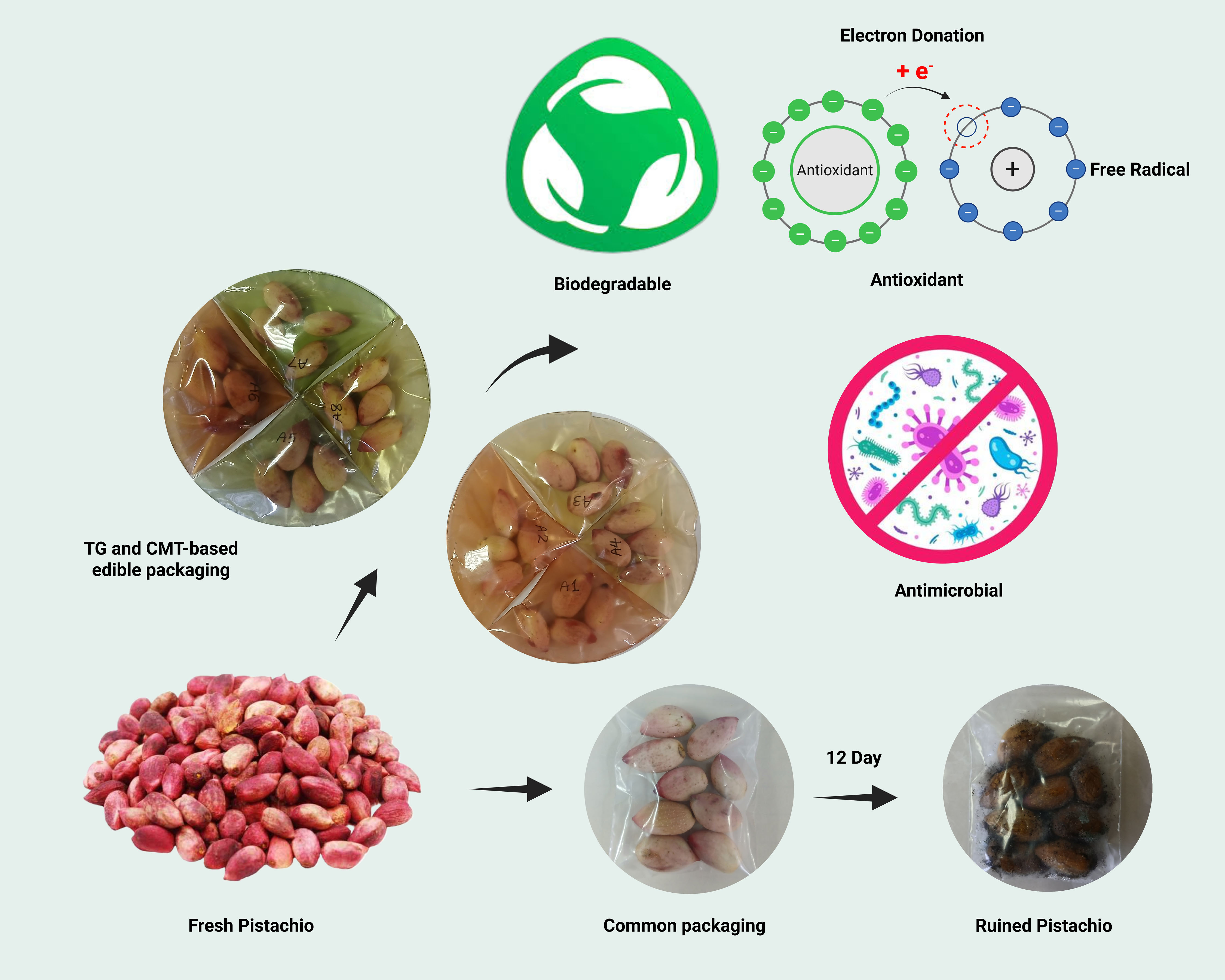
Bio-based nanocomposite films were developed using poly(vinyl alcohol) (PVA) reinforced with tragacanth gum (TG) and carboxymethyl tragacanth (CMT), incorporating biogenic ZnO or CuO nanoparticles and plant-derived extracts (cinnamon or clove). A comparative evaluation of structural, surface, mechanical, and oxygen barrier properties was conducted to assess their potential for active food packaging. FESEM analysis revealed that CMT-based films possessed a more homogeneous and compact microstructure with fewer microcracks compared to TG-based films. The lower contact angle observed for CMT-containing films indicated stronger intermolecular interactions and a denser polymer network. CMT-based films demonstrate a more favorable balance between strength and elongation, resulting in improved toughness and mechanical stability, which are critical for flexible food packaging applications. Oxygen permeability measurements demonstrated that optimized CMT-based film achieved a lower oxygen transmission rate (26.80 cm³/m²·24 h·0.1 MPa) than TG-based film (27.53 cm³/m²·24 h·0.1 MPa), despite reduced thickness (70 μm versus 78 μm). Analysis of diffusion and solubility coefficients indicated that reduced oxygen solubility within the CMT matrix (2.66 × 10⁻¹⁰ cm3/cm2.cm.Pa) was the dominant factor governing overall permeability. The practical performance of the films was further assessed by coating raw pistachios. The optimized CMT-based film preserved the visual quality of pistachios for up to 12 days under ambient conditions without observable deterioration. These results highlight CMT-based nanocomposite films as promising sustainable materials for oxygen-sensitive food packaging applications.
Keywords
- Active food packaging,
- Biogenic ZnO and CuO nanoparticles,
- Carboxymethyl tragacanth,
- Plant-derived antioxidants,
- Pistachio preservation,
- Tragacanth gum
References
- Islamipour, Z., Zare, E. N., Salimi, F., Ghomi, M. and Makvandi, P. Biodegradable antibacterial and antioxidant nanocomposite films based on dextrin for bioactive food packaging. J. Nanostruct. Chem. 12, 991–1006 (2022).
- Zare, E. N., Makvandi, P. and Tay, F. R. Recent progress in the industrial and biomedical applications of tragacanth gum: A review. Carbohydr. Polym. 212, 450–467 (2019).
- Tavakolipour, H. Postharvest operations of pistachio nuts. J. Food Sci. Technol. 52, 1124–1130 (2015).
- Ozturk, I., Sagdic, O., Yalcin, H., Capar, T. D. and Asyali, M. H. The effects of packaging type on the quality characteristics of fresh raw pistachios (Pistacia vera L.) during the storage. LWT-Food Sci. Technol. 65, 457–463 (2016).
- Saeedi, M., Mirdehghan, S. H., Saba, M. K. and Nazoori, F. Strategies to preserve quality and improve storage life of fresh in-hull pistachio: a review. Postharvest Biol. Technol. 230, 113751 (2025).
- Gopinath, K., Sathishkumar, G. and Xu, L. An overview of the copper oxide nanofillers integrated in food packaging systems. Coatings 14, 81 (2024).
- Mesgari, M., Aalami, A. H., Sathyapalan, T. and Sahebkar, A. A comprehensive review of the development of carbohydrate macromolecules and copper oxide nanocomposite films in food nanopackaging. Bioinorg. Chem. Appl. 2022, 7557825 (2022).
- Anugrah, D. S. B., Alexander, H., Pramitasari, R., Hudiyanti, D. and Sagita, C. P. A review of polysaccharide-zinc oxide nanocomposites as safe coating for fruits preservation. Coatings 10, 988 (2020).
- Jafarzadeh, S., et al. Green synthesis of nanomaterials for smart biopolymer packaging: challenges and outlooks. J. Nanostruct. Chem. 14, 113–136 (2024).
- Xie, Q., Liu, G., Zhang, Y., Yu, J., Wang, Y. and Ma, X. Active edible films with plant extracts: A updated review of their types, preparations, reinforcing properties, and applications in muscle foods packaging and preservation. Crit. Rev. Food Sci. Nutr. 63, 11425–11447 (2023).
- Gürler, N. and Ertekin, Ö. Physical and biological characteristics of eco-friendly films added with Cinnamomum zeylanicum extract for packaging materials. Int. J. Food Sci. Technol. 59, 2400–2410 (2024).
- Roy, S. and Rhim, J. W. Gelatin/cellulose nanofiber-based functional films added with mushroom-mediated sulfur nanoparticles for active packaging applications. J. Nanostruct. Chem. 12, 979–990 (2022).
- Ghani, A., Zare, E. N., Makvandi, P. and Rabiee, N. Antioxidant, antibacterial and biodegradable hydrogel films from carboxymethyl tragacanth gum and clove extract: Potential for wound dressings application. Carbohydr. Polym. Technol. Appl. 7, 100428 (2024).
- Janani, N., Zare, E. N., Salimi, F. and Makvandi, P. Antibacterial tragacanth gum-based nanocomposite films carrying ascorbic acid antioxidant for bioactive food packaging. Carbohydr. Polym. 247, 116678 (2020).
- Lakshmanan, M. Plant extraction methods. in Introduction to Basics of Pharmacology and Toxicology: Volume 3: Experimental Pharmacology: Research Methodology and Biostatistics 773–783 (Springer, 2022).
- Alves-Silva, G. F., Santos, L. G., Martins, V. G. and Cortez-Vega, W. R. Cassava starch films incorporated with clove essential oil and nanoclay as a strategy to increase the shelf life of strawberries. Int. J. Food Sci. Technol. 57, 6690–6698 (2022).
- Ahmed, M., Saini, P., Iqbal, U. and Sahu, K. Edible microbial cellulose-based antimicrobial coatings and films containing clove extract. Food Prod. Process. Nutr. 6, 65 (2024).
- Azadi, A., Rafieian, F., Sami, M. and Rezaei, A. Fabrication, characterization and antimicrobial activity of chitosan/tragacanth gum/polyvinyl alcohol composite films incorporated with cinnamon essential oil nanoemulsion. Int. J. Biol. Macromol. 245, 125225 (2023).
- Luesuwan, S., Naradisorn, M., Shiekh, K. A., Rachtanapun, P. and Tongdeesoontorn, W. Effect of active packaging material fortified with clove essential oil on fungal growth and post-harvest quality changes in table grape during cold storage. Polymers 13, 3445 (2021).
- Rizal, S., et al. Cinnamon-nanoparticle-loaded macroalgal nanocomposite film for antibacterial food packaging applications. Nanomaterials 13, 560 (2023).
- Gürler, N. and Ertekin, Ö. Physical and biological characteristics of eco-friendly films added with Cinnamomum zeylanicum extract for packaging materials. Int. J. Food Sci. Technol. 59, 2400–2410 (2024).
- Saeednia, S., Iranmanesh, P. and Shabani, T. Green Synthesis of Pistachio Skin Extract-Mediated Zinc Oxide Nanoparticles for Photocatalytic Degradation of Organic Dyes. Inorg. Chem. Res. 8, 1–7 (2024).
- Murugan, B., et al. Green synthesis of CuO nanoparticles for biological applications. Inorg. Chem. Commun. 155, 111088 (2023).
- Gao, Q., Feng, Z., Wang, J., Zhao, F., Li, C. and Ju, J. Application of nano-ZnO in the food preservation industry: antibacterial mechanisms, influencing factors, intelligent packaging, preservation film and safety. Crit. Rev. Food Sci. Nutr. 65, 4327–4353 (2025).
- Perumal, M. K. K., Rajasekaran, M. B. S., Renuka, R. R., Samrot, V. and Nagarajan, M. Zinc oxide nanoparticles and their nanocomposites as an imperative coating for smart food packaging. Appl. Food Res. 2025, 100849 (2025).
- Hamdy, M. S., Chandekar, K. V., Shkir, M., AlFaify, S., Ibrahim, E. H., Ahmad, Z., Kilany, M., Al-Shehri, B. M. and Al-Namshah, K. S. Novel Mg@ZnO nanoparticles synthesized by facile one-step combustion route for anti-microbial, cytotoxicity and photocatalysis applications. J. Nanostruct. Chem. 11, 1 (2021).
- Hsiao, K.-Y., Chung, R.-J., Chang, P.-P. and Tsai, T.-H. Identification of Hydroxyl and Polysiloxane Compounds via Infrared Absorption Spectroscopy with Targeted Noise Analysis. Polymers 17, 1533 (2025).
- Behrouzi, M. and Moghadam, P. N. Synthesis of a new superabsorbent copolymer based on acrylic acid grafted onto carboxymethyl tragacanth. Carbohydr. Polym. 202, 227–235 (2018).
- Thombare, N., Mahto, A., Singh, D., Chowdhury, A. R. and Ansari, M. F. Comparative FTIR characterization of various natural gums: a criterion for their identification. J. Polym. Environ. 31, 3372–3380 (2023).
- Babu, K. S., Reddy, A. R., Sujatha, C., Reddy, K. V. and Mallika, N. Synthesis and optical characterization of porous ZnO. J. Adv. Ceram. 2, 260–265 (2013).
- Kanchana, S. K., Vanitha, N. and Basavaraj, R. B. Structural and optical properties of polyvinyl alcohol/copper oxide (PVA/CuO) nanocomposites. Solid State Commun. 370, 115221 (2023).
- Nejatian, M., Abbasi, S. and Azarikia, F. Gum Tragacanth: Structure, characteristics and applications in foods. Int. J. Biol. Macromol. 160, 846–860 (2020).
- Jangizehi, A., Schmid, F., Besenius, P., Kremer, K. and Seiffert, S. Defects and defect engineering in Soft Matter. Soft Matter 16, 10809–10859 (2020).
- Folorunso, O., Hamam, Y., Sadiku, R. and Kupolati, W. Effects of defects on the properties of polymer nanocomposites: A brief review. J. Inorg. Organomet. Polym. Mater. 34, 5667–5690 (2024).
- Vyas, A., Ng, S., Fu, T. and Anum, I. ZnO-Embedded Carboxymethyl Cellulose Bioplastic Film Synthesized from Sugarcane Bagasse for Packaging Applications. Polymers 17, 579 (2025).
- Długosz, O. and Banach, M. Continuous synthesis of photocatalytic nanoparticles of pure ZnO and ZnO modified with metal nanoparticles. J. Nanostruct. Chem. 11, 601–617 (2021).
- Zhao, Y., et al. Comprehensive review of polysaccharide-based materials in edible packaging: A sustainable approach. Foods 10, 1845 (2021).
- Chen, J., Luo, L., Cen, C., Liu, Y., Li, H. and Wang, Y. The nano antibacterial composite film carboxymethyl chitosan/gelatin/nano ZnO improves the mechanical strength of food packaging. Int. J. Biol. Macromol. 220, 462–471 (2022).
- Rezaei, F. T. M., Aryaee, P. and Abdullahi, M. Evaluation of some physical and mechanical properties of carboxymethyl cellulose/Tragacanth edible film. in 4th National Conference on Food Science and Technology (Tehran, Iran, 2016).
- Rahman, M. S., et al. Recent developments of carboxymethyl cellulose. Polymers 13, 1345 (2021).
- Ahmed, M., Saini, P. and Iqbal, U. Microbial cellulose based films and composites for food packaging: A review. Ann. Univ. Dunarea Jos Galati. Fascicle VI-Food Technol. 45, 178–198 (2021).
- Rezaei, F. T. M., Aryaee, P. and Abdullahi, M. Evaluation of some physical and mechanical properties of carboxymethyl cellulose/Tragacanth edible film. in 4th National Conference on Food Science and Technology (Tehran, Iran, 2016).
- Bachra, Y., Grouli, A., Damiri, F., Talbi, M. and Berrada, M. A novel superabsorbent polymer from crosslinked carboxymethyl tragacanth gum with glutaraldehyde: synthesis, characterization, and swelling properties. Int. J. Biomater. 2021, 5008833 (2021).
- Ahmed, M., Saini, P., Iqbal, U. and Sahu, K. Edible microbial cellulose-based antimicrobial coatings and films containing clove extract. Food Prod. Process. Nutr. 6, 65 (2024).
- Gürler, N. and Ertekin, Ö. Physical and biological characteristics of eco-friendly films added with Cinnamomum zeylanicum extract for packaging materials. Int. J. Food Sci. Technol. 59, 2400–2410 (2024).Rabeel, M., et al. Controlling the wettability of ZnO thin films by spray pyrolysis for photocatalytic applications. Materials 15, 3364 (2022).
- Hammani, S., Daikhi, S., Bechelany, M. and Barhoum, A. Role of ZnO nanoparticles loading in modifying the morphological, optical, and thermal properties of immiscible polymer (PMMA/PEG) blends. Materials 15, 8453 (2022).
- Mesgari, M., Aalami, A. H., Sathyapalan, T. and Sahebkar, A. A comprehensive review of the development of carbohydrate macromolecules and copper oxide nanocomposite films in food nanopackaging. Bioinorg. Chem. Appl. 2022, 7557825 (2022).
- Rizal, S., et al. Cinnamon-nanoparticle-loaded macroalgal nanocomposite film for antibacterial food packaging applications. Nanomaterials 13, 560 (2023).
- Zhao, J., Wang, Y. and Liu, C. Film transparency and opacity measurements. Food Anal. Methods 15, 2840–2846 (2022).
- Chakka, V. P. and Zhou, T. Carboxymethylation of polysaccharides: Synthesis and bioactivities. Int. J. Biol. Macromol. 165, 2425–2431 (2020).
- Jiang, L., et al. Effects of carboxymethyl modification on physicochemical properties, structure of fenugreek polysaccharide and its capabilities of aroma enhancement and moisture retention in cigarettes. Int. J. Biol. Macromol. 2025, 146298 (2025).
- Badry, R., El-Nahass, M. M., Nada, N., Elhaes, H. and Ibrahim,
- M. A. Structural and UV-blocking properties of carboxymethyl cellulose sodium/CuO nanocomposite films. Sci. Rep. 13, 1123 (2023).
- Mohammadifar, M. A., Musavi, S. M., Kiumarsi, A. and Williams, P. A. Solution properties of targacanthin (water-soluble part of gum tragacanth exudate from Astragalus gossypinus). Int. J. Biol. Macromol. 38, 31–39 (2006).
- Mohammed, S. J., Al-Musawi, A. T., Al-Fraji, A. S. and Kareem, H. S. Comparison of three culture media in assessing the sensitivity of antibiotics to common foodborne microorganisms. J. Med. Life 15, 645 (2022).
- Emamifar, A., Kadivar, M., Shahedi, M. and Soleimanian-Zad, S. Evaluation of nanocomposite packaging containing Ag and ZnO on shelf life of fresh orange juice. Innov. Food Sci. Emerg. Technol. 11, 742–748 (2010).
- Sirelkhatim, A., et al. Review on zinc oxide nanoparticles: antibacterial activity and toxicity mechanism. Nano-Micro Lett. 7, 219–242 (2015).
- Brand-Williams, W., Cuvelier, M. E. and Berset, C. Use of a free radical method to evaluate antioxidant activity. LWT-Food Sci. Technol. 28, 25–30 (1995)
- Kedare, S. B. and Singh, R. P. Genesis and development of DPPH method of antioxidant assay. J. Food Sci. Technol. 48, 412–422 (2011).
- Barton, H. J. A ‘zero sample concentration approach’: Standardization of methods for the estimation of total antioxidant activity by the use of extrapolation to zero sample concentration. A novel standard. 1. ABTS cation radical scavenging. J. Agric. Food Chem. 58, 8918–8926 (2010).
- Munteanu, I. G. and Apetrei, C. Analytical methods used in determining antioxidant activity: A review. Int. J. Mol. Sci. 22, 3380 (2021).
- Thangapandi, J. R., Chelliah, P., Balakrishnan, S., et al. Antibacterial and photocatalytic aspects of zinc oxide nanorods synthesized using Piper nigrum seed extract. J. Nanostruct. Chem. 11, 549–560 (2021).
- Antosik, A. K., Bartkowiak, M., Zdanowicz, M. and Wilpiszewska, K. Carboxymethyl Polysaccharides/Montmorillonite Biocomposite Films and Their Sorption Properties. Polymers 17, 2130 (2025).
- Zheng, S., et al. Implication of surface properties, bacterial motility, and hydrodynamic conditions on bacterial surface sensing and their initial adhesion. Front. Bioeng. Biotechnol. 9, 643722 (2021).
- Zhang, H. and Nishinari, K. Characterization of the conformation and comparison of shear and extensional properties of curdlan in DMSO. Food Hydrocoll. 23, 1570–1578 (2009).
- Hanani, Z. A. N., Roos, Y. H. and Kerry, J. P. Use of beef, pork and fish gelatin sources in the manufacture of films and assessment of their composition and mechanical properties. Food Hydrocoll. 29, 144–151 (2012).
- Espitia, P. J. P., Soares, N. de F. F., Coimbra, J. S. dos R., de Andrade, N. J., Cruz, R. S. and Medeiros, E. A. A. Zinc oxide nanoparticles: synthesis, antimicrobial activity and food packaging applications. Food Bioprocess Technol. 5, 1447–1464 (2012).
- Grabowski, N. T. and Klein, G. Bacteria encountered in raw insect, spider, scorpion, and centipede taxa including edible species, and their significance from the food hygiene point of view. Trends Food Sci. Technol. 63, 80–90 (2017).
- Duncan, T. V. Applications of nanotechnology in food packaging and food safety: barrier materials, antimicrobials and sensors. J. Colloid Interface Sci. 363, 1–24 (2011).
- Cushen, M., Kerry, J., Morris, M., Cruz-Romero, M. and Cummins, E. Evaluation and simulation of silver and copper nanoparticle migration from polyethylene nanocomposites to food and an associated exposure assessment. J. Agric. Food Chem. 62, 1403–1411 (2014).
- Rhim, J.-W. and Ng, P. K. W. Natural biopolymer-based nanocomposite films for packaging applications. Crit. Rev. Food Sci. Nutr. 47, 411–433 (2007).
- Anal, A. K. and Singh, H. Recent advances in microencapsulation of probiotics for industrial applications and targeted delivery. Trends Food Sci. Technol. 18, 240–251 (2007).
- Bachra, Y., Grouli, A., Damiri, F., Talbi, M. and Berrada, M. A novel superabsorbent polymer from crosslinked carboxymethyl tragacanth gum with glutaraldehyde: synthesis, characterization, and swelling properties. Int. J. Biomater. 2021, 5008833 (2021).