
 10.57647/jnsc.2026.1603.12
Carbon Quantum Dots Derived from Fresh Natural Dyes to Improve the Optoelectronic Properties of Chitosan Biopolymer: Structural, Spectroscopic and Optical Studies
- Shujahadeen B. Aziz
 2
2 - Sambasivam Sangaraju8

Received: 30-09-2025
Revised: 10-12-2025
Accepted: 06-02-2025
Published in Issue 30-06-2026
Published Online: 30-03-2026
Copyright (c) 2026 Ismael I. Hussein, Ary R. Murad, Shujahadeen B. Aziz, Dara M. Aziz, Bakhet A. Alqurashy, Dyari M. Mamand, Kawan F. Kayani, Govar H. Hamasalih, Sambasivam Sangaraju (Author)

This work is licensed under a Creative Commons Attribution 4.0 International License.




PDF views: 158





Abstract
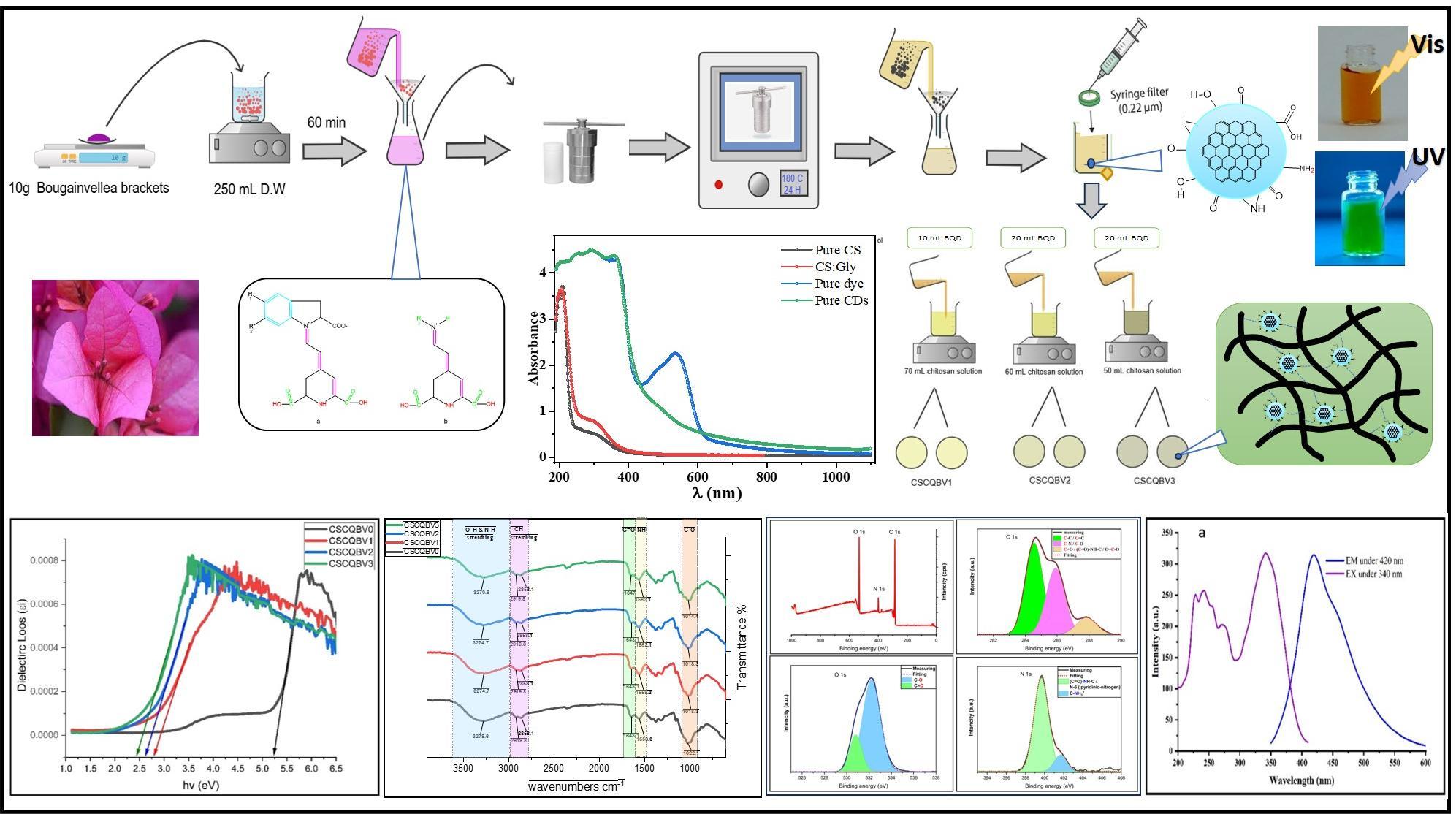
In this study an eco-friendly, one-pot hydrothermal processes use to synthesize water-soluble CQDs from natural dye extracted from Bougainvillea flowers (DBG). Carbon quantum dots (CQDs) offer outstanding optical properties and low toxicity, making them attractive for sustainable optoelectronic materials. The resulting bougainvillea carbon quantum dots (BQDs) were integrated with chitosan (CS) biopolymer to deliver composite films with high optical properties. Structural, morphological, and optical analyses, supported by NMR, FTIR, XRD, HRTEM, XPS, and UV-vis spectroscopy, confirmed the production of amorphous BQDs and strong CQD–CS interactions with reduced crystallinity. Notably, the optical band gap narrowed significantly from 5.23 eV in pure CS to 2.42 eV in BQDs-doped composites. The BQDs exhibited excitation-dependent photoluminescence with a quantum yield of 2.74%, while Urbach energy analysis indicated increased localized states with higher BQD content. Enhanced refractive indices, dielectric constants, and non-linear optical properties further demonstrate the composites’ potential for photonic and optoelectronic applications. This work establishes a green, scalable strategy to boost biopolymer functionality using natural carbon sources.
Keywords
- Chitosan biopolymers,
- Carbon dot,
- Green dye,
- Optoelectronic properties,
- Structural analysis Cite
References
- I. Huseen, A. R. Murad, and S. B. Aziz, “Insights to structural, morphological, thermal and spectroscopic properties of chitosan biopolymer functionalized with extracted dye of discarded Bougainvillea brackets (DBG) steps, Int. J. Polym. Anal. Charact., 31(1), 90–115, (2026).
- D.M. Aziz, S.J. Mohammed, P.A. Mohammed, S. Al-Zangana, S.B. Aziz, D.S. Muhammad, R.T. Abdulwahid, A.H.A. Darwesh, and S.A. Hussein, “Spectroscopic study of wemple-didomenico empirical formula and taucs model to determine the optical band gap of dye-doped polymer based on chitosan: Common poppy dye as a novel approach to reduce the optical band gap of biopolymer,” Spectrochim. Acta, Part A, 325, 125142, (2025).
- M. Jorns and D. Pappas, “A review of fluorescent carbon dots, their synthesis, physical and chemical characteristics, and applications,” Nanomater., 11, 1448, (2021).
- S. Pandiyan, L. Arumugam, S.P. Srirengan, R. Pitchan, P. Sevugan, K. Kannan, G. Pitchan, T.A. Hegde, and V. Gandhirajan, “Biocompatible Carbon Quantum Dots Derived from Sugarcane Industrial Wastes for Effective Nonlinear Optical Behavior and Antimicrobial Activity Applications,” ACS Omega, 5, 30363–30372, (2020).
- X. Xu, R. Ray, Y. Gu, H.J. Ploehn, L. Gearheart, K. Raker, and W.A. Scrivens, “Electrophoretic analysis and purification of fluorescent single-walled carbon nanotube fragments,” J. Am. Chem. Soc., 126, 12736–12737, (2004).
- S. Dinç, M. Kara, A. Ve, D. Dergisi, and S. Dinc, “Synthesis and Applications of Carbon Dots from Food and Natural Products, ” J. Api. Nat., 1, 33-37, (2018).
- K.R. Ali, D.M. Mamand, A.R. Murad, I.I. Huseen, D.M. Aziz, K.F. Kayani, S.I. Al-Saeedi, S.B. Aziz, and J. Hassan, “Carbon Quantum Dots from Hybrid Poplar Leaf Dye for Enhanced Optical Properties of PVA Composites: Green Solvothermal Synthesis and Spectroscopic Analysis,” J. Sci.: Adv. Mater. Devices, 10(4), 101009, (2025).
- O. G. Rojas-Valencia, D. L. Díaz-Santiago, J. L. Casas-Espínola, C. M. Reza-San Germán, and M. Estrada Flores, “One step synthesis-functionalization of Carbon Quantum Dost by carbonization of beetroot fruit (Beta Vulgaris) bagasse and their performance in sensing of Ag+ and Cu2+ ions,” Inorg. Chem. Commun., 158, 111604, (2023).
- L. Li, Y. Han, L. Wang, W. Jiang, and H. Zhao, “Dye Plants Derived Carbon Dots for Flexible Secure Printing,” Nanomater. (Basel), 12(18), 3168, (2022).
- N. M. Ramlan, A. Q. A’yun, R. H. Putri, S. Fatimah, Isnaeni, and D. Tahir, “Analysis Optical Properties of Carbon Dots from Paper Flowers (Bougainvillea spectabilis),” Omega J. Fis. Pend. Fis., 4(2), 30-34, (2018).
- Q. Wu, X. Fu, Z. Chen, H. Wang, J. Wang, Z. Zhu, and G. Zhu, “Composition, Color Stability and Antioxidant Properties of Betalain-Based Extracts from Bracts of Bougainvillea,” molecules, 27(16), 5120, (2022).
- H. M. C. Azeredo, “Betalains: Properties, sources, applications, and stability - A review,” Int. J. Food Sci. Technol., 44, 2365–2376, (2009).
- V. Manigandan, R. Karthik, S. Ramachandran, and S. Rajagopal, “Chitosan Applications in Food Industry,” in Biopolymers for Food Design, Elsevier, 469–491, (2018).
- P. Kumar Dutta, J. Dutta, and V. S. Tripathi, “Chitin and chitosan: Chemistry, properties and applications,” J. Sci. Ind. Res., 63, 20–31, (2004).
- Y. Faqir, J. Ma, and Y. Chai, “Chitosan in modern agriculture production,” Plant Soil Environ., 67(12), 679–699, (2021).
- D. Zhao, S. Yu, B. Sun, S. Gao, S. Guo, and K. Zhao, “Biomedical applications of chitosan and its derivative nanoparticles, ” Polymers, 10(4), 462, (2018).
- I. Aranaz, A.R. Alcántara, M.C. Civera, C. Arias, B. Elorza, A.H. Caballero, and N. Acosta, “Chitosan: An overview of its properties and applications,” Polym., 13(19), 3256, (2021)
- Y. W. Fen, W. Mahmood, M. Yunus, M. M. Moksin, Z. A. Talib, and N. A. Yusof, “Optical Properties of Crosslinked Chitosan Thin Film with Glutaraldehyde Using Surface Plasmon Resonance Technique,” Am. J. Eng. Appl. Sci., 4(1), 61–65, (2011).
- S. B. Aziz, D. Aziz, D. Muhammad, P. Hama, and O. Abdullah, “Enhancing the Optical Properties of Chitosan-Based Biopolymer for Optoelectronic Applications Using Natural Dye Extracted from Hollyhock Waste Flowers,” Opt. Mater., 159, 116596, (2024).
- D. Domyati, “Synthesis, optical characterization and electrical behavior of chitosan/MgO/Cr2O3 nanocomposite for electrical applications,” Opt. Mater., 152, 115479, (2024).
- D.M. Mamand, D.S. Muhammad, D.Q. Muheddin, K.A. Abdalkarim, D.A. Tahir, H.A. Muhammad, S.B. Aziz, S.A. Hussen, and J. Hassan, “Optical band gap modulation in functionalized chitosan biopolymer hybrids using absorption and derivative spectrum fitting methods: A spectroscopic analysis,” Sci. Rep., 15, 3162, (2025).
- Q. Zeng, T. Feng, S. Tao, S. Zhu, and B. Yang, “Precursor-dependent structural diversity in luminescent carbonized polymer dots (CPDs): the nomenclature,” Light Sci. Appl., 10(142), (2021).
- D. R. Smith, A. P. Escobar, M. N. Andris, B. M. Boardman, and G. M. Peters, “Understanding the Molecular-Level Interactions of Glucosamine-Glycerol Assemblies: A Model System for Chitosan Plasticization,” ACS Omega, 6(39), 25227–25234, (2021).
- E. Kaivosoja, S. Virtanen, R. Rautemaa, R. Lappalainen, and Y. T. Konttinen, “Spectroscopy in the analysis of bacterial and eukaryotic cell footprints on implant surfaces,” Eur. Cell. Mater., 24, 60–73, (2012).
- G. Simões Dos Reis, C. Mayandi Subramaniyam, A.D. Cárdenas, S.H. Larsson, M. Thyrel, U. Lassi, and F. García-Alvarado, “Facile Synthesis of Sustainable Activated Biochars with Different Pore Structures as Efficient Additive-Carbon-Free Anodes for Lithium- and Sodium-Ion Batteries,” ACS Omega, 7(46), 42570–42581, (2022).
- X. Yang, P. Huang, P. Zhao, S. Xie, D. Xie, S. Wang, and F. Cheng, “Nitrogen and Oxygen Dual-doped Porous Carbon from Nature Macromolecular Chitosan for Fast and Stable Zinc-ion Hybrid Supercapacitors,” J. Electrochem. Soc., 170(1), 010508, (2023).
- H. Gunther’ and G. Jlkell, “’H Nuclear Magnetic Resonance Spectra of Cyclic Monoenes: Hydrocarbons, Ketones, Heterocycles, and Benzo Derivatives.”, 77, 599-637, (1977).
- N. Didonato and P. G. Hatcher, “Alicyclic carboxylic acids in soil humic acid as detected with ultrahigh resolution mass spectrometry and multi-dimensional NMR,” Org. Geochem., 112, 33-46, (2017).
- D. D. Clarke, “C NMR with Proton Coupling Allows Teaching of Hybridization of C-H Bonds on an Experimental Basis,” ACS Symp. Ser., 1376, 13–22, (2021).
- B. De and N. Karak, “A green and facile approach for the synthesis of water soluble fluorescent carbon dots from banana juice,” RSC Adv., 3, 8286–8290, (2013).
- Metin. Balcı, Basic 1H- and 13C-NMR spectroscopy. London, U.K, (2005).
- Q. Zhang, R. Wang, B. Feng, X. Zhong, and K. (Ken) Ostrikov, “Photoluminescence mechanism of carbon dots: triggering high-color-purity red fluorescence emission through edge amino protonation. Nat. Commun., 12(6856), (2021).
- A. M. El-Shafey, “Carbon dots: Discovery, structure, fluorescent properties, and applications,” Green Process. Synth., 10(1), 134–156, (2021).
- L. Cui, X. Ren, M. Sun, H. Liu, and L. Xia, “Carbon dots: Synthesis, properties and applications,” Nanomater., 11(12), 3419 (2021).
- S. Das, L. Ngashangva, and P. Goswami, “Carbon dots: An emerging smart material for analytical applications,” Micromachines, 12(1), 84, (2021).
- T. Balakrishnan, W. L. Ang, E. Mahmoudi, A. W. Mohammad, and N. S. Sambudi, “Formation mechanism and application potential of carbon dots synthesized from palm kernel shell via microwave assisted method,” Carbon Resour. Convers., 5(2), 150–166, (2022).
- L. Li and T. Dong, “Photoluminescence tuning in carbon dots: surface passivation or/and functionalization, heteroatom doping,” J. Mater. Chem. C, 6, 7944–7970, (2018).
- N. Hazra, S. Hazra, S. Paul, and A. Banerjee, “Surface modification of carbon dots via peptide covalent conjugation,” Chem. Commun., 59(33), 4931–4934, (2023).
- Z. A. Qureshi, H. Dabash, D. Ponnamma, and M. K. G. Abbas, “Carbon dots as versatile nanomaterials in sensing and imaging: Efficiency and beyond,” Heliyon, 10(11), e31634, (2024).
- K. F. Kayani, “Phosphorus-doped carbon dots and their analytical and bioanalytical applications: a review,” Talanta, 297, 128768, (2026).
- T. Balakrishnan, W. L. Ang, E. Mahmoudi, A. W. Mohammad, and N. S. Sambudi, “Formation mechanism and application potential of carbon dots synthesized from palm kernel shell via microwave assisted method,” Carbon Resour. Convers., 5(2), 150–166, (2022).
- H. Lin, J. Huang, and L. Ding, “Preparation of Carbon Dots with High-Fluorescence Quantum Yield and Their Application in Dopamine Fluorescence Probe and Cellular Imaging,” J. Nanomater., 2019(1), 1–9, (2019).
- S. Jabbar Abbas and A. Atia Muhson, “Preparation and Characterization of the Carbon Quantum Dots,” J. Kufa phys., 11(2), 45–51, (2019).
- S. Kumar and J. Koh, “Physiochemical, optical and biological activity of chitosan-chromone derivative for biomedical applications,” Int. J. Mol. Sci., 13(5), 6102–6116 (2012)
- A. Al-Harrasi, S. Bhtaia, M.S. Al-Azri, H.A. Makeen, M. Albratty, H.A. Alhazmi, S. Mohan, A. Sharma, and T. Behl, “Development and Characterization of Chitosan and Porphyran Based Composite Edible Films Containing Ginger Essential Oil,” Polymers, 14(13), (2022).
- A. AL-Amir, E. H. Gomaa, R. E. El-Azabawy, and A. A. El-Bayaa, “Valorization Beetroot Waste for Eco-Friendly Extraction of Natural Dye for Textile and Food Applications,” Egypt. J. Chem., 65(8), 725–736, (2022).
- G. B. Mahendran, S. J. Ramalingam, J. B. B. Rayappan, S. Kesavan, T. Periathambi, and N. Nesakumar, “Green preparation of reduced graphene oxide by Bougainvillea glabra flower extract and sensing application,” J. Mater. Sci.: Mater. Electron., 31, 14345–14356, (2020).
- S. N. A. Kumar, S. K. Ritesh, G. Sharmila, and C. Muthukumaran, “Extraction optimization and characterization of water soluble red purple pigment from floral bracts of Bougainvillea glabra,” Arabian J. Chem., 10, S2145–S2150, (2017).
- W. Wang, W. H. Chen, and M. F. Jang, “Characterization of hydrochar produced by hydrothermal carbonization of organic sludge,” Future Cities Environ., 6(1), 1–10, (2020).
- T.Y.A. Essel, A. Koomson, M.P.O. Seniagya, G.P. Cobbold, S.K. Kwofie, B.O. Asimeng, P.K. Arthur, G. Awandare, and E.K. Tiburu, “Chitosan composites synthesized using acetic acid and tetraethylorthosilicate respond differently to methylene blue adsorption,” Polymers, 10(5), 466, (2018).
- S. Acosta-Ferreira, O.S. Castillo, J.T. Madera-Santana, D.A. Mendoza-García, C.A. Núñez-Colín, C. Grijalva-Verdugo, A.G. Villa-Lerma, A.T. Morales-Vargas, and J.R. Rodríguez-Núñez, “Production and physicochemical characterization of chitosan for the harvesting of wild microalgae consortia,” Biotechnol. Rep., 28, e00554, (2020).
- A. A. Zaki, M. Khalafalla, K. H. Alharbi, and K. D. Khalil, “Synthesis, characterization and optical properties of chitosan-La2O3 nanocomposite,” Bull. Mater. Sci., 45(128), (2022).
- W. Tang, S. S. Rassay, and N. M. Ravindra, “Electronic & Optical properties of Transition-Metal Dichalcogenides,” Madridge J. Nanotechnol. Nanosci., 2(1), 58–64, (2017).
- S. I. Qashou, E. F. M. El-Zaidia, A. A. A. Darwish, and T. A. Hanafy, “Methylsilicon phthalocyanine hydroxide doped PVA films for optoelectronic applications: FTIR spectroscopy, electrical conductivity, linear and nonlinear optical studies,” Physica. B., 571, 93–100, (2019).
- A. Yisau Fasasi, “Effect of Precursor Solvents on the Optical Properties of Copper Oxide Thin Films Deposited Using Spray Pyrolysis for Optoelectronic Applications,” Am. J. Mater. Synth. Process., 3(2), 12-22, (2018).
- A. S. Hassanien and A. A. Akl, “Influence of composition on optical and dispersion parameters of thermally evaporated non-crystalline Cd50S50-xSex thin films,” J. Alloys Compd., 648, 280–290, (2015).
- M. E. Sánchez-Vergara, J. C. Alonso-Huitron, A. Rodriguez-Gómez, and J. N. Reider-Burstin, “Determination of the optical GAP in thin films of amorphous dilithium phthalocyanine using the Tauc and Cody models,” Molecules, 17(9), 10000–10013, (2012).
- H. S. Soliman, E. F. M. El-Zaidia, H. A. M. Ali, and S. M. Atef, “Effect of annealing on optical properties of 2-chloro-5-(2,5-dimethoxy-benzylidene)-1,3-diethyl-dihydro-pyrimidine-4,6(1H,5H)-dione thin films,” Mater. Sci. Semicond. Process., 26, 726–730, (2014).
- H. A. Mohammed, P. A. Mohammed, and S. B. Aziz, “Physical characteristics of polymer composites based on PVA doped with Mn2þ metal complexes synthesized by green approach: insights to linear and optoelectronic optical properties,” Oxford Open Mater. Sci., 5(1), itaf003, (2025).
- A.A. Musa, A. Bello, S.M. Adams, A.P. Onwualu, V.C. Anye, K.A. Bello, and I.I. Obianyo, “Nano-Enhanced Polymer Composite Materials: A Review of Current Advancements and Challenges,” Polymers (Basel), 17(7), 893, (2025).
- K. K. Ahmed, S. A. Hussen, and S. B. Aziz, “Transferring the wide band gap chitosan: POZ-based polymer blends to small optical energy band gap polymer composites through the inclusion of green synthesized Zn2+-PPL metal complex,” Arabian J. Chem., 15, 3162, (2022).
- S. Moeen, M. Ikram, A. Haider, J. Haider, A. Ul-Hamid, W. Nabgan, T. Shujah, M. Naz, and I. Shahzadi, “Comparative Study of Sonophotocatalytic, Photocatalytic, and Catalytic Activities of Magnesium and Chitosan-Doped Tin Oxide Quantum Dots,” ACS Omega, 7, 50, 46428–46439, (2022).
- A. Badawi, S. S. Alharthi, N. Y. Mostafa, M. G. Althobaiti, and T. Altalhi, “Effect of carbon quantum dots on the optical and electrical properties of polyvinylidene fluoride polymer for optoelectronic applications,” Appl. Phys. A, 125(12), 858, (2019).
- M. Ikram, I. Shahzadi, A. Haider, S. Hayat, J. Haider, A. Ul-Hamid, A. Shahzadi, W. Nabgan, S. Dilpazir, and S. Ali, “Improved catalytic activity and bactericidal behavior of novel chitosan/V 2 O 5 co-doped in tin-oxide quantum dots,” RSC Adv., 12, 23129–23142, (2022).
- A. A. P. Mansur and H. S. Mansur, “Quantum dot/glycol chitosan fluorescent nanoconjugates,” Nanoscale Res. Lett., 10(172), (2015).
- H. S. Mansur and A. A. P. Mansur, “Nano-photocatalysts based on ZnS quantum dots/chitosan for the photodegradation of dye pollutants,” IOP Conf. Ser. Mater. Sci. Eng., 76, 012003, (2015).
- S. Mallakpour and E. Khadem, “Construction of crosslinked chitosan/nitrogen-doped graphene quantum dot nanocomposite for hydroxyapatite biomimetic mineralization,” Int. J. Biol. Macromol., 120(ptB), 1451–1460, (2018).
- R. Kroon, M. Lenes, J. C. Hummelen, P. W. M. Blom, and B. de Boer, “Small Bandgap Polymers for Organic Solar Cells (Polymer Material Development in the Last 5 Years),” Polym. Rev., 48, 3, 531–582, (2008).
- F. Yakuphanoglu, M. Sekerci, and O. F. Ozturk, “The determination of the optical constants of cu(ii) compound having 1-chloro-2,3-o-cyclohexylidinepropane thin film,” Opt. Commun., 239, 275–280, (2004).
- B. Ghosh, F. Guzmán-Olivos, and R. Espinoza-González, “Plasmon-enhanced optical absorption with graded bandgap in diamond-like carbon (DLC) films,” J. Mater. Sci., 52(1), 218–228, (2017).
- R. S. Al-Faleh and A. M. Zihlif, “A study on optical absorption and constants of doped poly(ethylene oxide),” Physica B, 406, 1919–1925, (2011).
- S. Prasher, M. Kumar, and S. Singh, “Electrical and Optical Properties of O6+ Ion Beam-Irradiated Polymers,” Int. J. Polym. Anal. Charact., 19(2), 204–211, (2014).
- A. S. Hassanien, I. M. El Radaf, and A. A. Akl, “Physical and optical studies of the novel non-crystalline CuxGe20-xSe40Te40 bulk glasses and thin films,” J. Alloys Compd., 849, 156718, (2020).
- A. R. Murad, A. Iraqi, S. B. Aziz, S. N. Abdullah, R. T. Abdulwahid, and S. A. Hussen, “Optical, electrochemical, thermal, and structural properties of synthesized fluorene/ dibenzosilole-benzothiadiazole dicarboxylic imide alternating organic copolymers for photovoltaic applications,” Coatings, 10(12), 1–22, (2020).
- S. Sudhahar, M. Krishna Kumar, A. Silambarasan, R. Muralidharan, and R. Mohan Kumar, “Studies on Structural, Spectral, and Optical Properties of Organic Nonlinear Optical Single Crystal: 2-Amino-4,6-dimethylpyrimidinium p-Hydroxybenzoate,” J. Mater., 2013(9), 1–7, (2013).
- A. M. Alsaad, Q. M. Al-Bataineh, A. A. Ahmad, Z. Albataineh, and A. Telfah, “Optical band gap and refractive index dispersion parameters of boron-doped ZnO thin films: A novel derived mathematical model from the experimental transmission spectra,” Optik, 211, 164641, (2020).
- F. Yakuphanoglu, M. Sekerci, and A. Balaban, “The effect of film thickness on the optical absorption edge and optical constants of the Cr(III) organic thin films,” Opt. Mater., 27, 1369–1372, (2005).
- N. An, B. Zhuang, M. Li, Y. Lu, and Z. G. Wang, “Combined Theoretical and Experimental Study of Refractive Indices of Water-Acetonitrile-Salt Systems,” Russ. J. Phys. Chem. B, 119, 10701–10709, (2015).
- E.A. Costner, B.K. Long, C. Navar, S. Jockusch, X. Lei, P. Zimmerman, A. Campion, N.J. Turro, and C. Grant Willson, “Fundamental optical properties of linear and cyclic alkanes: VUV absorbance and index of refraction,” J. Phys. Chem. A, 113(33), 9337–9347, (2009).
- Y. Rao and S. Chen, “Molecular composites comprising TiO2 and their optical properties,” Macromolecules, 41, 4838–4844, (2008).
- J. Jin, R. Qi, Y. Su, M. Tong, and J. Zhu, “Preparation of high-refractive-index PMMA/TiO2 nanocomposites by one-step in situ solvothermal method,” Iran. Polym. J., 22, 767–774, (2013).
- P. Tao, Y. Li, A. Rungta, A. Viswanath, J. Gao, B.C. Benicewicz, R.W. Siegel, and L.S. Schadler, “TiO2 nanocomposites with high refractive index and transparency,” J. Mater. Chem., 21, 18623–18629, (2011).
- F. F. Muhammad, S. B. Aziz, and S. A. Hussein, “Effect of the dopant salt on the optical parameters of PVA:NaNO3 solid polymer electrolyte,” J. Mater. Sci.: Mater. Electron., 26, 521–529, (2015).
- S. B. Aziz, H. M. Ahmed, A. M. Hussein, A. B. Fathulla, R. M. Wsw, and R. T. Hussein, “Tuning the absorption of ultraviolet spectra and optical parameters of aluminum doped PVA based solid polymer composites,” J. Mater. Sci.: Mater. Electron., 26(10), 8022–8028, (2015)
- A.Y. Fasasi, B.D. Ngom, J.B. Kana-Kana, R. Bucher, M. Maaza, C. Theron, and U. Buttner, “Synthesis and characterisation of Gd-doped BaTiO3 thin films prepared by laser ablation for optoelectronic applications,” J. Phys. Chem. Solids, 70, 1322–1329, (2009).
- A. S. Hassanien, “Studies on dielectric properties, opto-electrical parameters and electronic polarizability of thermally evaporated amorphous Cd50S50-xSex thin films,” J. Alloys Compd., 671, 566–578, (2016).
- B. Burtan-Gwizdala, J. Cisowski, R. Lisiecki, K.J. Kowalska, B. Jarzabek, N. Nosidlak, M. Reben, A.M. Alshehri, K.I. Hussein, and E.S. Yousef, “Thermal, Optical, and Emission Traits of SM3+-Ion-Doped Fluoride/Chloride/Oxide Glass for Red/Orange Laser Fiber Applications,” Fibers, 12(11), 100, (2024).
- N. El-ka Dry, “FREE-ELECTRON ANALYSIS OF OPTICAL PROPERTIES OF THERMALLY EVAPORATED GOLD FILMS,” Acta Phys. Pol., 86(3), 375–383, (1993).
- M. H. El-Newehy, A. M. El-Mahalawy, B. M. Thamer, and M. Moydeen Abdul Hameed, “Fabrication and Characterization of Eco-Friendly Thin Films as Potential Optical Absorbers for Efficient Multi-Functional Opto-(Electronic) and Solar Cell Applications,” Materials, 16(9), 3475, (2023).
- K. A. Aly and F. M. Abdel-Rahim, “Effect of Sn addition on the optical constants of Ge-Sb-S thin films based only on their measured reflectance spectra,” J. Alloys Compd., 561, 284–290, (2013).
- M.M. Nofal, S.B. Aziz, J.M. Hadi, W.O. Karim, E.M.A. Dannoun, A.M. Hussein, and S.A. Hussen, “Polymer composites with 0.98 transparencies and small optical energy band gap using a promising green methodology: Structural and optical properties,” Polymers (Basel), 13(10), 1648, (2021).
- D.O. Tiede, C. Romero-Pérez, K.A. Koch, K.B. Ucer, M.E. Calvo, A.R. Srimath Kandada, J.F. Galisteo-López, and H. Míguez, “Effect of Connectivity on the Carrier Transport and Recombination Dynamics of Perovskite Quantum-Dot Networks,” ACS Nano, 18, 2325–2334, (2024).
- H. Eren, R.J.R. Bednarz, M.A. Jazi, L. Donk, S. Gudjonsdottir, P. Bohländer, R. Eelkema, and A.J. Houtepen, “Permanent Electrochemical Doping of Quantum Dot Films through Photopolymerization of Electrolyte Ions,” Chem. Mater., 34(9). 4019–4028, (2022).
- J. H. Joshi, D. D. Khunti, M. J. Joshi, and K. D. Parikh, “Penn model and Wemple-DiDomenico single oscillator analysis of cobalt sulfide nanoparticles, AIP Conf. Proc., 1837, 040033, (2017).
- Q. Hou, K. Chen, H. Zhang, Y. Li, H. Liu, X. Dong, Y. Huang, and Q. Li, “Magnetic properties of Co doped ZnS diluted magnetic semiconductor,” J. Phys. Conf. Ser., 430, 012076, (2013).
- R. Naik, A. Aparimita, C. Sripan, and R. Ganesan, “Structural, linear and non-linear optical properties of annealed and irradiated Ag/Se heterostructure films for optoelectronic applications,” Optik (Stuttg), 194, 162894, (2019).
- A. M. Shehap and D. S. Akil, “Structural and optical properties of TiO2 nanoparticles/PVA for different composites thin films,” Int. J. Nanoelectron. Mater., 9, 17–36, (2016).
- M. Alzaid, A. Qasem, E. R. Shaaban, and N. M. A. Hadia, “Extraction of thickness, linear and nonlinear optical parameters of Ge20+xSe80-x thin films at normal and slightly inclined light for optoelectronic devices,” Opt. Mater., 110, 110539, (2020).
- D.O. Tiede, C. Romero-Pérez, K.A. Koch, K.B. Ucer, M.E. Calvo, A.R. Srimath Kandada, J.F. Galisteo-López, and H. Míguez, “Effect of Connectivity on the Carrier Transport and Recombination Dynamics of Perovskite Quantum-Dot Networks,” ACS Nano, 18, 2325–2334, (2024).
- S. Giri, P. Priyadarshini, D. Alagarasan, R. Ganesan, and R. Naik, “Annealing-induced phase transformation in In10Se70Te20 thin films and its structural, optical and morphological changes for optoelectronic applications,” RSC Adv,. 13, 24955–24972, (2023).
- L. Tichy, H. Ticha, P. Nagels, R. Callaerts, R. Mertens, and M. Vlcek, “Optical properties of amorphous As-Se and Ge-As-Se thin films,” Mater. Lett., 39, 122–128, (1999).
- S. Mishra, P. Kumar Singh, R. K. Yadav, A. Umar, P. Lohia, and D. K. Dwivedi, “Investigation of glass forming ability, linear and non-linear optical properties of Ge-Se-Te-Sb thin films,” Chem. Phys., 541, 111021, (2021).
- A. A. Abuelwafa, M. S. A. El-sadek, S. Elnobi, and T. Soga, “Effect of transparent conducting substrates on the structure and optical properties of tin (II) oxide (SnO) thin films: Comparative study,” Ceram. Int., 47, 13510–13518, (2021)
- A. A. Abuelwafa, H. M. Alsoghier, S. Elnobi, M. Dongol, and T. Soga, “Quantum computational, linear and non-linear optical properties of spin-coated nickel (II)-tetraphenylporphyrin/FTO thin films,” Optik, 234, 166618, (2021).