
 10.57647/jnsc.2026.1601.05
MXene-Based Wearable Sweat Biosensors for Personalized Health Monitoring: Materials Innovation and Data-Driven Approaches
- Ceren Karaman
 1
1 - Onur Karaman2
- Taotao Zhao3

Received: 21-10-2025
Revised: 25-11-2025
Accepted: 20-12-2025
Published in Issue 28-02-2026
Copyright (c) 2026 Ceren Karaman, Onur Karaman, Jun Jiang, Taotao Zhao (Author)

This work is licensed under a Creative Commons Attribution 4.0 International License.




PDF views: 480





Abstract
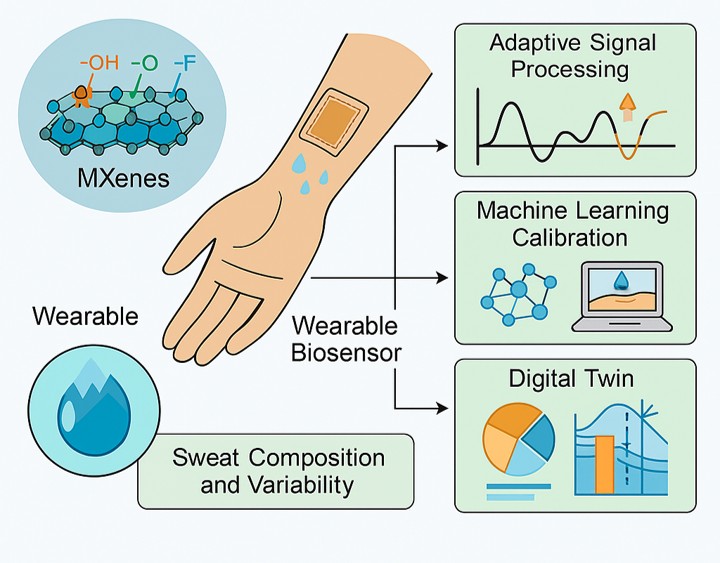
MXenes, a diverse family of two-dimensional transition metal carbides and nitrides, have emerged as highly promising materials for wearable biosensors due to their exceptional conductivity, tunable surface chemistry, and mechanical flexibility. Among their most compelling applications is sweat-based health monitoring, which enables non-invasive, real-time access to dynamic physiological information. Unlike previous reviews that broadly survey MXene-enabled wearables, this work provides a unified perspective that integrates human-specific sweat variability, sweat-relevant structure–property relationships of MXene compositions, and data-driven methodologies for adaptive, personalized sensing. Translating MXene-based sensors into robust, personalized platforms requires innovations that extend beyond material design into adaptive signal processing, machine learning calibration, and individualized digital modeling. This review critically examines the structure–property relationships of various MXene compositions and outlines material engineering strategies for enhancing sensitivity, selectivity, and operational stability in sweat environments. Furthermore, it highlights how computational frameworks can calibrate, adapt, and simulate sensor behavior under individualized biochemical conditions. In silico sweat simulation and architecture optimization are also discussed as transformative tools for accelerating biosensor development. By bridging advanced materials with data-driven methodologies, this review establishes a blueprint for the next generation of MXene-based wearable systems capable of intelligent, personalized health monitoring.
Keywords
- MXenes,
- Wearable Biosensors,
- Sweat Analysis,
- Personalized Bioelectronics,
- Digital Twin,
- Machine Learning,
- Electrochemical Sensors,
- In-silico Optimization
References
- S. Gong, Y. Lu, J. Yin, A. Levin, and W. Cheng. “Materials-driven soft wearable bioelectronics for connected healthcare.”. Chem Rev, 124: 455-553, (2024).
- M. Kim, D.J. Joe, I. Doh, and Y.H. Cho. “Piezoelectric nanocomposite-based multifunctional wearable bioelectronics for mental stress analysis utilizing physiological signals.”. Adv Mater Technol, 9: 2301610, (2024).
- J. Xu, Y. Fang, and J. Chen. “Wearable biosensors for non-invasive sweat diagnostics.”. Biosensors, 11:245, (2021).
- M. Chen, D. Cui, H. Haick, and N. Tang. “Artificial intelligence‐based medical sensors for healthcare system.”. Adv Sensor Res, 3: 2300009, (2024).
- H. Haick and N. Tang. “Artificial intelligence in medical sensors for clinical decisions.”. ACS Nano, 15: 3557-3567, (2021).
- S. Shajari, K. Kuruvinashetti, A. Komeili, and U. Sundararaj. “The emergence of ai-based wearable sensors for digital health technology: a review.”. Sensors, 23: 9498, (2023).
- Z. Zhang, Z. Li, K. Wei, Z. Cao, Z. Zhu, and R. Chen. “Sweat as a source of non-invasive biomarkers for clinical diagnosis: an overview.”. Talanta, 273: 125865, (2024).
- R.D. Munje, S. Muthukumar, B. Jagannath, and S. Prasad. “A new paradigm in sweat based wearable diagnostics biosensors using room temperature ionic liquids (RTILs).”. Sci Rep, 7:1950, (2017).
- S.M. Khor, J. Choi, P. Won, and S.H. Ko.“Challenges and strategies in developing an enzymatic wearable sweat glucose biosensor as a practical point-of-care monitoring tool for type ii diabetes.”. Nanomater, 12:221, (2022).
- C. Wu.“Non-invasive wearable sweat and tear-based biosensors for continuous health monitoring.”. Highlights Sci Eng Technol, 55: 9959, (2023).
- R.F.R. Ursem, A. Steijlen, M. Parrilla, J. Bastemeijer, A. Bossche, and K. De Wael. “Worth your sweat: wearable microfluidic flow rate sensors for meaningful sweat analytics.”. Lab Chip, 25: 1296–1315, (2025).
- J.N. Hussain, N. Mantri, and M.M. Cohen. “Working up a good sweat - the challenges of standardising sweat collection for metabolomics analysis.”. Clin Biochem Rev, 38: 13, (2017).
- L.B. Baker. “Physiology of sweat gland function: the roles of sweating and sweat composition in human health.”. Temperature, 6: 211-259, (2019).
- J. Min, J. Tu, C. Xu, H. Lukas, S. Shin, Y. Yang, S.A. Solomon, D. Mukasa, and W. Gao. “Skin-interfaced wearable sweat sensors for precision medicine.”. Chem Rev, 123: 5049-5138. (2023).
- H. Ehtesabi and S.O. Kalji. “Carbon nanomaterials for sweat-based sensors: a review.”. Microchim Acta, 191:77, (2024).
- H. Li and D. Wang.“Progress and applications of nanotechnology-based wearable sensors in human motion and posture detection.”. J Nanostruct Chem, 15: 152504, (2025).
- V. Kedambaimoole, K. Harsh, K. Rajanna, P. Sen, M.M. Nayak, and S. Kumar. “MXene wearables: properties, fabrication strategies, sensing mechanism and applications.”. Mater Adv, 3:3784-3808, (2022).
- W. Ji, J. Zhu, W. Wu, N. Wang, J. Wang, J. Wu, Q. Wu, X. Wang, C. Yu, G. Wei, L. Li, and F. Huo. “Wearable sweat biosensors refresh personalized health/medical diagnostics.”. Research, 2021: 9757126, (2021).
- D. Mohanapriya, J. Satija, S. Senthilkumar, V. Kumar Ponnusamy, and K. Thenmozhi. “Design and engineering of 2D MXenes for point-of-care electrochemical detection of bioactive analytes and environmental pollutants.”. Coord Chem Rev, 507:215746, (2024).
- M.R. Ali, M.S. Bacchu, M.R. Al-Mamun, M.I. Hossain, A. Khaleque, A. Khatun, D.D. Ridoy, M.A.S. Aly, and M.Z.H. Khan. “Recent advanced in MXene research toward biosensor development.”. Crit. Rev. Anal. Chem., 54:1381-1398, (2024).
- L. Jia, Zh. Lei, N. Zare, T. Wu, M. Ghalkhani, L. Wan, and Y. Xu.“Ti3C2 MXene-enhanced electro- chemical biosensors for prostate-specific antigen (psa) detection in prostate cancer.”. J Nanostruct Chem, 1: 152502, (2025).
- M. Safarkhani, B. Farasati Far, E.C. Lima, S. Jafarzadeh, P. Makvandi, R.S. Varma, Y.S. Huh, M. Ebrahimi Warkiani, and N. Rabiee. “Integration of mxene and microfluidics: a perspective.”, ACS Biomater sci Eng, 10:657-676, (2024).
- A. Khosla, Sonu, H.T.A. Awan, K. Singh, Gaurav, R. Walvekar, Z. Zhao, A. Kaushik, M. Khalid, and V. Chaudhary. “Emergence of MXene and MXene–polymer hybrid membranes as future- environmental remediation strategies.”. Adv Sci, 9:2203527, (2022).
- T. Zhang, L. Chang, and X. Xiao. “Surface and interface regulation of mxenes: methods and properties.”. Adv Sci, 9: 2203527, (2023).
- V. Natu and M.W. Barsoum. “MXene surface terminations: a perspective.”. J. Phys. Chem. C, 127: 20197-20206, (2023).
- N. Li, J. Peng, W.J. Ong, T. Ma, Arramel, P. Zhang, J. Jiang, X. Yuan, and C. (John) Zhang. “MXenes: an emerging platform for wearable electronics and looking beyond.”. Matter, 4: 377-407, (2021).
- S. Moradi, A. Firoozbakhtian, M. Hosseini, O. Karaman, S. Kalikeri, G.G. Raja, and H. Karimi-Maleh. “Advancements in wearable technology for monitoring lactate levels using lactate oxidase enzyme and free enzyme as analytical approaches: a review.”. Int J Biol Macromol, 254: 127577, (2024).
- R. Ibragimova, M.J. Puska, and H.P. Komsa. “PH-dependent distribution of functional groups on titanium-based mMXenes.”. ACS Nano, 13: 9171-9181, (2019).
- S. Patle and D. Rotake. “Recent advances, technological challenges and requirements to predict the future treads in wearable sweat sensors: a critical review.”. Microchemical Journal, 200: 110457, (2024).
- A. Cazalé, W. Sant, F. Ginot, J.C. Launay, G. Savourey, F. Revol-Cavalier, J.M. Lagarde, D. Heinry, J. Launay, and P. Temple-Boyer. “Physiological stress monitoring using sodium ion potentiometric microsensors for sweat analysis.”. Sens Actuators B Chem, 225:1-9, (2016).
- L.B. Baker and A.S. Wolfe. “Physiological mechanisms determining eccrine sweat composition.”. Eur J Appl Physiol, 120: 719-752, (2020).
- L. Klous, C.J. de Ruiter, S. Scherrer, N. Gerrett, and H.A.M. Daanen. “The (in)dependency of blood and sweat sodium, chloride, potassium, ammonia, lactate and glucose concentrations during submaximal exercise.”. Eur J Appl Physiol, 121: 803-816, (2021).
- H. Zafar, A. Channa, V. Jeoti, and G.M. Stojanović. “Comprehensive review on wearable sweat-glucose sensors for continuous glucose monitoring.”. Sensors, 22:638, (2022).
- P.J. Derbyshire, H. Barr, F. Davis, and S.P.J. Higson.“Lactate in human sweat: a critical review of research to the present day.”. J Physiol Sci, 62:429-440, (2012).
- E.C. Nakajima and B. Van Houten.“Metabolic symbiosis in cancer: refocusing the warburg lens.” . Mol Carcinog, 52: 329-337, (2013).
- A. Futane, M. Senthil, S. Jayashree, A. Srinivasan, R. Kalpana, and V. Narayanamurthy. “Sweat analysis for urea sensing: trends and challenges.”. Analytical Methods, 15:4405-4426, (2023).
- S. Sudha, R. Kalpana, and P. Soundararajan. “Quantification of sweat urea in diabetes using electro-optical technique.”. Physiol Meas, 42: 095002, (2021).
- Y. Zhang, H. Guo, S.B. Kim, Y. Wu, D. Ostojich, S.H. Park, X. Wang, Z. Weng, R. Li, A.J. Bandodkar, Y. Sekine, J. Choi, S. Xu, S. Quaggin, R. Ghaffari, and J.A. Rogers. “Passive sweat collection and colorimetric analysis of biomarkers relevant to kidney disorders using a soft microfluidic system.” . Lab Chip, 19: 1545-1555, (2019).
- C.T. Huang, M.L. Chen, L.L. Huang, and I.F. Mao.“Uric acid and urea in human sweat.” . Chinese J Physiol, 45:109-115, (2002).
- T. Laochai, C. Moonla, J. Moon, K. Sakdaphetsiri, L. Yin, L.F. Mendes, A. Abbas, O. Djassemi, S. Seker, K. Mahato, O. Chailapakul, J. Wang, and N. Rodthongkum. “Touch–based potentiometric sensors for simultaneous detection of urea and ammonium from fingertip sweat.”. Sens Actuators B Chem, 413: 135898, (2024).
- Y. Araki and S. Ando. “Urea, amino acid and ammonia in human sweat.”. Japanese Journal of Physiology, 3:211-218, (1952).
- S. Itoh and T. Nakayama.“Ammonia in human sweat and its origin.”. Japanese J Physiol, 3:133-137, (1952).
- D. Czarnowski, J. Górski, J. Jóźwiuk, and A. Boroń-Kaczmarska. “Plasma ammonia is the principal source of ammonia in sweat.”. Eur J Appl Physiol Occup Physiol, 65:135-137, (1992).
- M.A. King, S.D. Brown, K.A. Barnes, P.J.D. De Chavez, and L.B. Baker. “Regional and time course differences in sweat cortisol, glucose, and select cytokine concentrations during exercise.”. Eur J Appl Physiol, 123: 1727-1738, (2023).
- C.J. Weber, O.M. Clay, R.E. Lycan, G.K. Anderson, and O. Simoska. “Advances in electrochemical biosensor design for the detection of the stress biomarker cortisol.”. Anal Bioanal Chem, 416: 87-106, (2024).
- M. Sekar, M. Pandiaraj, S. Bhansali, N. Ponpandian, and C. Viswanathan.“Carbon fiber based electrochemical sensor for sweat cortisol measurement.”. Sci Rep, 9:403, (2019).
- P. Pearlmutter, G. DeRose, C. Samson, N. Linehan, Y. Cen, L. Begdache, D. Won, and A. KOH. “Sweat and saliva cortisol response to stress and nutrition factors.” . Sci Rep, 10:19050, (2020).
- L. Tian, M. Jiang, M. Su, X. Cao, Q. Jiang, Q. Liu, and C. Yu. “Sweat cortisol determination utilizing MXene and multi-walled carbon nanotube nanocomposite functionalized immunosensor.”. Microchemical Journal, 185: 108172, (2023).
- M. Ding, S. Zhang, J. Wang, Y. Ding, and C. Ding. “Ultrasensitive ratiometric electrochemiluminescence sensor with an efficient antifouling and antibacterial interface of PSBMA@SiO2-MXene for oxytetracycline trace detection in the marine environment.”. Anal Chem, 95: 16327-16334, (2023).
- J.C.C. Sheng, B.D. La Franier, and M. Thompson. “Assembling surface linker chemistry with minimization of non-specific adsorption on biosensor materials.”. Materials, 14:472, (2021).
- A. Karrat and A. Amine. “Innovative approaches to suppress non-specific adsorption in molecularly imprinted polymers for sensing applications.”. Biosens Bioelectron, 250: 116053, (2024).
- N.R. Jalal, T. Madrakian, M. Ahmadi, A. Afkhami, S. Khalili, M. Bahrami, and M. Roshanaei. “Wireless wearable potentiometric sensor for simultaneous determination of ph, sodium and potassium in human sweat.”. Sci Rep, 14: 11526, (2024).
- K. Zhao, B. Kang, and B. Zhou.“Wearable electrochemical sensors for monitoring of inorganic ions and ph in sweat.”. Int J Electrochem Sci, 17: 220452, (2022).
- V. Couturaud.“Biophysical characteristics of the skin in relation to race, sex, age, and site.” Handbook of Cosmetic Science and Technology, Third Edition,pp. 5-24, (2009).
- X. Sun, X. Gao, Z. Li, X. Zhang, X. Zhai, Q. Zhang, L. Li, N. Gao, G. He, and H. Li. “Nanowires framework supported porous lotus-carbon anode boosts lithium-ion and sodium-ion batteries.”. Small Methods, 8: 2300746, (2024).
- A.C. Gonçalves, F.A.L. Marson, R.M.H. Mendonça, C.S. Bertuzzo, I.A. Paschoal, J.D. Ribeiro, A.F. Ribeiro, and C.E. Levy. “Chloride and sodium ion concentrations in saliva and sweat as a method to diagnose cystic fibrosis.”. J Pediatr (Rio J), 95: 443-450, (2019).
- J.J. Wine.“How the sweat gland reveals levels of cftr activity.”, J Cystic Fibros, 2022, 21:396-406 (2022).
- P. Braconnier, B. Milani, N. Loncle, J.M. Lourenco, W. Brito, J. Delacoste, M. Maillard, M. Stuber, M. Burnier, and M. Pruijm. “Short-term changes in dietary sodium intake influence sweat sodium concentration and muscle sodium content in healthy individuals.”. J Hypertens, 38: 159-166, (2020).
- D.S. Bari, H.Y. Yacoob Aldosky, and Ø.G. Martinsen. “Simultaneous measurement of electrodermal activity components correlated with age-related differences.”. J Biol Phys, 46: 177-188, (2020).
- N.A. Coull, A.M. West, S.G. Hodder, P. Wheeler, and G. Havenith. “Body mapping of regional sweat distribution in young and older males.”. Eur J Appl Physiol, 121: 109-125, (2021).
- M. Villiger, R. Stoop, T. Vetsch, E. Hohenauer, M. Pini, P. Clarys, F. Pereira, and R. Clijsen. “Evaluation and review of body fluids saliva, sweat and tear compared to biochemical hydration assessment markers within blood and urine.”. Eur J Clin Nutr, 72: 69-76, (2018).
- J. Surapongchai, V. Saengsirisuwan, I. Rollo, R.K. Randell, K. Nithitsuttibuta, P. Sainiyom, C.H.W. Leow, and J.K.W. Lee. “Hydration status, fluid intake, sweat rate, and sweat sodium concentration in recreational tropical native runners.”. Nutrients, 13: 1374, (2021).
- S.N. Cheuvront and R.W. Kenefick.“Dehydration: physiology, assessment, and performance effects.”. Compr Physiol, 4: 257-285, (2014).
- S. Pham, D. Yeap, G. Escalera, R. Basu, X. Wu, N.J. Kenyon, I. Hertz-Picciotto, M.J. Ko, and C.E. Davis. “Wearable sensor system to monitor physical activity and the physiological effects of heat exposure.”. Sensors, 20: 855, (2020).
- J. Siquier- Coll, I. Bartolomé, M. Pérez-Quintero, F.J. Grijota, D. Muñoz, and M. Maynar-Mariño. “Effect of heat exposure and physical exercise until exhaustion in normothermic and hyperthermic conditions on serum, sweat and urinary concentrations of magnesium and phosphorus.”. J Therm Biol, 84: 176-184, (2019).
- L. Klous, C. de Ruiter, P. Alkemade, H. Daanen, and N. Gerrett. “Sweat rate and sweat composition following active or passive heat re-acclimation: a pilot study.”. Temperature, 8: 90-104, (2021).
- N.K.M. Churcher, S. Upasham, P. Rice, C.F. Greyling, and S. Prasad. “Sweat based-multiplexed detection of npy-cortisol for disease diagnostics and stress management.”. Electroanalysis, 34: 375-386, (2022).
- S. Upasham, A. Bhide, K.C. Lin, and S. Prasad. “Point-of-use sweat biosensor to track the endocrine-inflammation relationship for chronic disease monitoring.”. Future Sci OA, 7: FSO628, (2021).
- C. Cheng, X. Li, G. Xu, Y. Lu, S.S. Low, G. Liu, L. Zhu, C. Li, and Q. Liu. “Battery-free, wireless, and flexible electrochemical patch for in situ analysis of sweat cortisol via near field communication.”. Biosens Bioelectron, 172: 112782, (2021).
- A.D. Grant, T.J. Upton, J.R. Terry, B.L. Smarr, and E. Zavala. “Analysis of wearable time series data in endocrine and metabolic research.”. Curr Opin Endocr Metabol Res, 25: 100380, (2022).
- X. Yuan, C. Li, X. Yin, Y. Yang, B. Ji, Y. Niu, and L. Ren.“Epidermal wearable biosensors for monitoring biomarkers of chronic disease in sweat.”. Biosensors, 13:313, (2023).
- N. Tiwari, S. Chatterjee, K. Kaswan, J.H. Chung, K.P. Fan, and Z.H. Lin. “Recent advancements in sampling, power management strategies and development in applications for non-invasive wearable electrochemical sensors.”. J Electroanal Chem, 907:116064, (2022).
- J. Foster, J.W. Smallcombe, S. Hodder, O. Jay, A.D. Flouris, and G. Havenith. “Quantifying the impact of heat on human physical work capacity; part ii: the observed interaction of air velocity with temperature, humidity, sweat rate, and clothing is not captured by most heat stress indices.”. Int J Biometeorol, 66: 507-520, (2022).
- B. Zhong, K. Jiang, L. Wang, and G. Shen. “Wearable sweat loss measuring devices: from the role of sweat loss to advanced mechanisms and designs.”, Adv Sci, 9:2103257, (2022).
- U. Amara, I. Hussain, M. Ahmad, K. Mahmood, and K. Zhang. “2D mxene-based biosensing: a review.”. Small, 19: 2205249, (2023).
- Y. Yang, S. Yang, X. Xia, S. Hui, B. Wang, B. Zou, Y. Zhang, J. Sun, and J.H. Xin. “MXenes for wearable physical sensors toward smart healthcare.”. ACS Nano, 18: 24705–24740, (2024).
- C.G. Ann Maria, A. Varghese, and M. Nidhin. “Recent advances in nanomaterials based molecularly imprinted electrochemical sensors.”. Critical Rev Anal Chem, 53:88-97, (2023).
- S. Patle and D. Rotake.“Recent advances, technological challenges and requirements to predict the future treads in wearable sweat sensors: a critical review.”. Microchemical Journal, 200: 110457, (2024).
- A. Childs, B. Mayol, J.A. Lasalde-Ramírez, Y. Song, J.R. Sempionatto, and W. Gao. “Diving into sweat: advances, challenges, and future directions in wearable sweat sensing.” . ACS Nano, 18: 24605–24616, (2024).
- R. Liang, L. Zhong, Y. Zhang, Y. Tang, M. Lai, T. Han, W. Wang, Y. Bao, Y. Ma, S. Gan, and L. Niu. “Directly using ti3c2tx mxene for a solid-contact potentiometric pH sensor toward wearable sweat ph monitoring.”. Membranes, 13: 376, (2023).
- D. Jiang, X. Liu, W. Zhan, M. Fu, J. Liu, J. He, Y. Li, Y. Li, X. Chen, and C. Yu. “Skin-interfaced wearable sensor for long-term reliable monitoring of uric acid and pH in sweat.”. Nano Lett, 25: 1427–1435, (2025).
- Q. Ning, S. Feng, Y. Cheng, T. Li, D. Cui, and K. Wang. “Point-of-care biochemical assays using electrochemical technologies: approaches, applications, and opportunities.”. Microchim Acta, 189:310, (2022).
- D.H. Ho, Y.Y. Choi, S.B. Jo, J.M. Myoung, and J.H. Cho. “Sensing with Mxenes: progress and prospects.”. Adv Mater, 33: 2005846, (2021).
- N. Davis, J. Heikenfeld, C. Milla, and A. Javey. “The challenges and promise of sweat sensing.”. Nat Biotechnol, 42: 860-871, (2024).
- P. Zhao, E.D. Patamia, and T.L. Andrew. “Strategies to combat the fouling and surface texture issues associated with fabric-based colorimetric sensors.”. Sens Actuators B Chem, 377: 133099, (2023).
- X. Qiao, Y. Cai, Z. Kong, Z. Xu, and X. Luo. “A wearable electrochemical sensor based on anti-fouling and self-healing polypeptide complex hydrogels for sweat monitoring.” . ACS Sens, 8: 2834-2842, (2023).
- Z. Xu, Y. Liu, M. Lv, X. Qiao, G.C. Fan, and X. Luo. “An anti-fouling wearable molecular imprinting sensor based on semi-interpenetrating network hydrogel for the detection of tryptophan in sweat.”. Anal Chim Acta, 1283: 341948, (2023).
- S. Liu, J. Tang, F. Ji, W. Lin, and S. Chen. “Recent advances in zwitterionic hydrogels: preparation, property, and biomedical application.”, Gels, 8:46. (2022).
- Z. Song, R. Han, K. Yu, R. Li, and X. Luo. “Antifouling strategies for electrochemical sensing in complex biological media.” Microchimica Acta, 191:138, (2024).
- X. Yin, E. Peri, E. Pelssers, J. Den Toonder, and M. Mischi.“Estimation of blood glucose levels by sweat sensing based on biophysical modeling of glucose transport.” 2023 IEEE International Symposium on Medical Measurements and Applications, MeMeA 2023 - Conference Proceedings (2023).
- W. Gao, G.A. Brooks, and D.C. Klonoff.“Wearable physiological systems and technologies for metabolic monitoring.”. J Appl Physiol, 124: 548-556, (2018).
- M. Hemdan, M.A. Ali, A.S. Doghish, S.S.A. Mageed, I.M. Elazab, M.M. Khalil, M. Mabrouk, D.B. Das, and A.S. Amin. “Innovations in biosensor technologies for healthcare diagnostics and therapeutic drug monitoring: applications, recent progress, and future research challenges.”. Sensors, 24: 5143, (2024).
- U. Chadha, P. Bhardwaj, R. Agarwal, P. Rawat, R. Agarwal, I. Gupta, M. Panjwani, S. Singh, C. Ahuja, S.K. Selvaraj, M. Banavoth, P. Sonar, B. Badoni, and A. Chakravorty. “Recent progress and growth in biosensors technology: a critical review.”. J Ind Eng Chem, 109:21-51, (2022).
- Y. Huang, C. Luo, F. Xia, Y. Song, L. Jiang, and F. Li. “Multi-analyte sensing strategies towards wearable and intelligent devices.”. Chem Sci, 13: 12309-12325, (2022).
- F. Beygnezhad, K. Dashtian, R. Zare-Dorabei, and Z. Zangouei.“Biological ce/fe-metal organic framework multifunctional nanozyme-based colorimetric sensor array for multi-analyte detection in human sweat.”. Sens Actuators B Chem, 423: 136769, (2025).
- Y. Zhang, Y. Sun, J. Han, M. Zhang, F. Li, and D. Yang.“High-sensitivity flexible electrochemical sensor for real-time multi-analyte sweat analysis.”. Talanta, 287: 127644, (2025).
- Q. ul A. Zahra, S. Ullah, F. Shahzad, B. Qiu, X. Fang, A. Ammar, Z. Luo, and S. Abbas Zaidi. “MXene-based aptasensors: advances, challenges, and prospects.”. Prog Mater Sci, 129:100967, (2022).
- M.A.K. Purbayanto, V. Presser, K. Skarżyński, M. Słoma, M. Naguib, and A.M. Jastrzębska. “MXenes: multifunctional materials for the smart cities of tomorrow.”. Adv Funct Mater, 35: 2409953, (2025).
- M. Naguib, M.W. Barsoum, and Y. Gogotsi. “Ten years of progress in the synthesis and development of Mxenes.”. Advanced Materials, 33: 2103393, (2021).
- J.C. Lei, X. Zhang, and Z. Zhou. “Recent advances in Mxene: preparation, properties, and applications.”. Frontiers of Physics, 10:276-286, (2015).
- S.M.M. Raj, A.K. Sundramoorthy, R. Atchudan, D. Ganapathy, and A. Khosla.“Review—recent trends on the synthesis and different characterization tools for Mxenes and their emerging applications.”. J Electrochem Soc, 169: 077501, (2022).
- Y. Xu, L. Wan, N. Zare, S.-W. Wang, and Zh. Lei. “Cr2C Mxene modification of an electrochemical platform allows for highly selective and sensitive detection of PSMA, a prostate cancer biomarker.”. J Nanostruct Chem, 15: 152517, (2025).
- Z. Zhang and H. Karimi-Maleh.“Label-free electrochemical aptasensor based on gold nanoparticles/titanium carbide Mxene for lead detection with its reduction peak as index signal.”. Adv Compos Hybrid Mater, 6: 68, (2023).
- N. Zare, H. Karimi-Maleh, Z. Zhang, L. Fu, J. Rouhi, N. Zhong, Y. Wen, and M. Ghalkhani. “Enhancing cancer biomarker identification: precise monitoring of muc1 using V2C/Au nanocomposite-amplified electrochemical biosensor.”. Carbon Letters, 35: 1691–1700, (2025).
- N. Zare, H. Karimi-Maleh, Z. Zhang, Y. Wen, N. Zhong, and L. Fu. “Enhanced detection of HER2 using a TiVC Xenes/gold nanocomposite amplified analytical biosensor for precise cancer biomarker monitoring.”. Adv Compos Hybrid Mater, 7: 165, (2024).
- C.B. Subba, D.P. Rai, M.E. Tursunov, A.T. Dekhkonov, and Z. Pachuau. “Comprehensive review of max phase and Mxene materials: synthesis, properties, and applications.”. Carbon Letters, 35: 2485-2570, (2025).
- N.H. Solangi, S.A. Mazari, N.M. Mubarak, R.R. Karri, N. Rajamohan, and D.V.N. Vo.“Recent trends in Mxene-based material for biomedical applications.” . Environ Res, 222: 115337, (2023).
- C. Sen Liu, J. Li, and H. Pang. “Metal-organic framework-based materials as an emerging platform for advanced electrochemical sensing.”. Coor Chem Rev, 410:213222, (2020).
- B.C. Wyatt, A. Rosenkranz, and B. Anasori. “2D Mxenes: tunable mechanical and tribological properties.”. Adv Mater, 33: 2007973, (2021).
- G. Li, S. Lian, J. Wang, G. Xie, N. Zhang, and X. Xie. “Surface chemistry engineering and the applications of Mxenes.”. Journal of Materiomics, 9: 1160-1184, (2023).
- X. Wang, G.M.C. Ong, M. Naguib, and J. Wu. “Theoretical insights into Mxene termination and surface charge regulation.”. J Phys Chem C, 125: 21771-21779, (2021).
- L. Liu, E. Raymundo-Piñero, S. Sunny, P.L. Taberna, and P. Simon. “Role of surface terminations for charge storage of Ti3C2Tx Mxene electrodes in aqueous acidic electrolyte.”. Angewandte Chemie, 63: e202319238, (2024).
- F. Shahzad, S.A. Zaidi, and R.A. Naqvi. “2D transition metal carbides (Mxene) for electrochemical sensing: a review.”. Critical Reviews in Analytical Chemistry, 52:848-864, (2022).
- M. Pantrangi, E. Ashalley, M.K. Hadi, H. Xiao, Y. Zhang, W. Ahmed, N. Singh, A. Alam, U. Younis, F. Ran, P. Liang, and Z. Wang. “Flexible micro-supercapacitors: materials and architectures for smart integrated wearable and implantable devices.”. Energy Storage Mater, 73: 103791, (2024).
- J.L. Hart, K. Hantanasirisakul, A.C. Lang, B. Anasori, D. Pinto, Y. Pivak, J.T. van Omme, S.J. May, Y. Gogotsi, and M.L. Taheri. “Control of Mxenes’ electronic properties through termination and intercalation.”. Nat Commun, 10:522, (2019).
- A.A.A. Abdelazeez, A. Ben Gouider Trabelsi, F.H. Alkallas, S. AlFaify, M. Shkir, T.A. Alrebdi, K.S. Almugren, F. V. Kusmatsev, and M. Rabia. “Tuning the structural, electronic, and optical properties of monolayer graphene through heteroatom doping: a first-principles study with future light sensing applications.”. Photonics, 10:838, (2023).
- A. Wojciechowska, M. Chandel, and A.M. Jastrzębska. “Surface functionalization and interfacial design of Mxenes.”. MXene Nanocomposites: Design, Fabrication, and Shielding Applications, CRC Press, 37-66. (2023).
- X. Han, K. Cao, Y. Yao, J. Zhao, C. Chai, and P. Dai. “A novel electrochemical sensor for glucose detection based on a Ti3X2Tx/ZIF-67 nanocomposite.”. RSC Adv, 12: 20138-20146, (2022).
- M. Lounasvuori, T. Zhang, Y. Gogotsi, and T. Petit. “Tuning the microenvironment of water confined in Ti3C2Tx Mxene by cation intercalation.” . Journal of Physical Chemistry C, 128: 2803-2813, (2024).
- M. Hu, L. Chen, Y. Jing, Y. Zhu, J. Dai, A. Meng, C. Sun, J. Jia, and Z. Li. “Intensifying electrochemical activity of Ti3C2Tx Mxene via customized interlayer structure and surface chemistry.”. Molecules, 28: 5776, (2023).
- S. Kumar.“Fluorine-free mxenes: recent advances, synthesis strategies, and mechanisms.”. Small, 20:2308225, (2024).
- Y. Long, Y. Tao, T. Shang, H. Yang, Z. Sun, W. Chen, and Q.H. Yang. “Roles of metal ions in Mxene synthesis, processing and applications: a perspective.”. Adv Sci, 9: 2200296, (2022).
- M. Okubo, A. Sugahara, S. Kajiyama, and A. Yamada. “MXene as a charge storage host.” . Acc Chem Res, 51: 591-599, (2018).
- R.K. Sen, P. Prabhakar, N. Bisht, M. Patel, S. Mishra, A.K. Yadav, D. V. Venu, G.K. Gupta, P.R. Solanki, S. Ramakrishnan, D.P. Mondal, A.K. Srivastava, N. Dwivedi, and C. Dhand. “2D materials-based aptamer biosensors: present status and way forward.”. Curr Med Chem, 29: 5815-5849, (2021).
- R. Khan and S. Andreescu. “Mxenes-based bioanalytical sensors: design, characterization, and applications.”. Sensors, 20:5434, (2020).
- J. Wen, Q. Fu, W. Wu, H. Gao, X. Zhang, and B. Wang. “Understanding the different diffusion mechanisms of hydrated protons and potassium ions in titanium carbide Mxene.”. ACS Appl Mater Interfaces, 11: 7087-7095, (2019).
- S. Kalasin and P. Sangnuang.“Multiplex wearable electrochemical sensors fabricated from sodiated polymers and Mxene nanosheet to measure sodium and creatinine levels in sweat.”. ACS Appl Nano Mater, 6: 18209–18221, (2023).
- A. Prasad, J. Hasse, T. Steimle, D. Nepal, G.J. Frank, and V. Varshney.“Mechanical behavior of Mxene-polymer layered nanocomposite using computational finite element analysis.”. Compos B Eng, 284: 111689, (2024).
- S. Wan, X. Li, Y. Chen, N. Liu, S. Wang, Y. Du, Z. Xu, X. Deng, S. Dou, L. Jiang, and Q. Cheng. “Ultrastrong Mxene films via the synergy of intercalating small flakes and interfacial bridging.”. Nat Commun, 13: 7340, (2022).
- C. Liang, Y. Meng, Y. Zhang, H. Zhang, W. Wang, M. Lu, and G. Wang. “Insights into the impact of interlayer spacing on Mxene-based electrodes for supercapacitors: a review.”. J Energy Storage, 65:107341, (2023).
- K. Arole, S.E. Pas, R.M. Thakur, L.A. Amiouny, M.H. Kabir, M. Dujovic, M. Radovic, J.L. Lutkenhaus, M.J. Green, and H. Liang.“Effects of intercalation on ml-Ti3C2Tz mxene properties and friction performance.”. ACS Appl Mater Interfaces, 16: 64156–64165, (2024).
- A. Altan and M. Namvari.“Multifunctional, flexible, and mechanically robust polyimide-Mxene nanocomposites: a review.” . 2d Mater, 10: 042001, (2023).
- C. Ma, M.G. Ma, C. Si, X.X. Ji, and P. Wan.“Flexible mxene-based composites for wearable devices.”. Advanced Functional Materials, 31:2009524, (2021).
- H. Cao, N.N. Neal, S. Pas, M. Radovic, J.L. Lutkenhaus, M.J. Green, and E.B. Pentzer.“Architecting mxenes in polymer composites.” . Prog Polym Sci, 153: 101830, (2024).
- J.H. Pu, X. Zhao, X.J. Zha, L. Bai, K. Ke, R.Y. Bao, Z.Y. Liu, M.B. Yang, and W. Yang.“Multilayer structured Ag NW/WPu-Mxene fiber strain sensors with ultrahigh sensitivity and a wide operating range for wearable monitoring and healthcare.” . J Mater Chem A Mater, 7: 15913-15923, (2019).
- S. Seyedin, S. Uzun, A. Levitt, B. Anasori, G. Dion, Y. Gogotsi, and J.M. Razal. “MXene composite and coaxial fibers with high stretchability and conductivity for wearable strain sensing textiles.”. Adv Funct Mater, 30: 1910504, (2020).
- H. Li and Z. Du. “Preparation of a highly sensitive and stretchable strain sensor of Mxene/silver nanocomposite-based yarn and wearable applications.”. ACS Appl Mater Interfaces, 11: 45930-45938, (2019).
- Y. Cai, J. Shen, G. Ge, Y. Zhang, W. Jin, W. Huang, J. Shao, J. Yang, and X. Dong.“Stretchable ti3c2tx mxene/carbon nanotube composite based strain sensor with ultrahigh sensitivity and tunable sensing range.”. ACS Nano, 12: 56-62, (2018).
- Y. Yang, Z. Cao, P. He, L. Shi, G. Ding, R. Wang, and J. Sun. “Ti3C2Tx Mxene-graphene composite films for wearable strain sensors featured with high sensitivity and large range of linear response.”. Nano Energy, 66: 104134, (2019).
- L. Chen, F. Chen, G. Liu, H. Lin, Y. Bao, D. Han, W. Wang, Y. Ma, B. Zhang, and L. Niu. “Superhydrophobic functionalized Ti3C2Tx Mxene-based skin-attachable and wearable electrochemical pH sensor for real-time sweat detection.”. Anal Chem, 94: 7319-7328, (2022).
- H. Riazi, S.K. Nemani, M.C. Grady, B. Anasori, and M. Soroush. “Ti3C2 Mxene–polymer nanocomposites and their applications.”. J Mater Chem A Mater, 9: 8051–8098, (2021).
- F. Damiri, Md.H. Rahman, M. Zehravi, A.A. Awaji, M.Z. Nasrullah, H.A. Gad, M.Z. Bani-Fwaz, R.S. Varma, M.O. Germoush, H.S. Al-malky, A.A. Sayed, S. Rojekar, M.M. Abdel-Daim, and M. Berrada.“MXene (Ti3C2Tx)-embedded nanocomposite hydrogels for biomedical applications: a review.” . Materials, 15: 1666, (2022).
- E.A. Mayerberger, R.M. Street, R.M. McDaniel, M.W. Barsoum, and C.L. Schauer. “Antibacterial properties of electrospun Ti3C2Tz (Mxene)/chitosan nanofibers.”. RSC Adv, 8: 35386-35394, (2018).
- A. Rozmysłowska-Wojciechowska, E. Karwowska, M. Gloc, J. Woźniak, M. Petrus, B. Przybyszewski, T. Wojciechowski, and A.M. Jastrzębska. “Controlling the porosity and biocidal properties of the chitosan-hyaluronate matrix hydrogel nanocomposites by the addition of 2D Ti3C2Tx Mxene.” . Materials, 13: 4587, (2020).
- S. De and B.P. Bastakoti.“Doped and functionalized non-Ti-Mxenes for flexible and wearable electronic devices.” . J Mater Chem A Mater, 13: 855–888, (2025).
- M. Lian, Y. Shi, W. Zhang, J. Zhao, and D. Chen. “Nitrogen and sulfur co-doped Nb2C-Mxene nanosheets for the ultrasensitive electrochemical detection dopamine under acidic conditions in gastric juice.”. Journal of Electroanalytical Chemistry, 904: 115849, (2022).
- C.-B. Ma, X. Shang, M. Sun, X. Bo, J. Bai, Y. Du, and M. Zhou. “Emerging multifunctional wearable sensors: integrating multimodal sweat analysis and advanced material technologies for next-generation health monitoring.” . ACS Sens, 10: 2388-2408, (2025).
- J.T. Lee, B.C. Wyatt, G.A. Davis, A.N. Masterson, A.L. Pagan, A. Shah, B. Anasori, and R. Sardar.“ Covalent surface modification of Ti3C2Tx Mxene with chemically active polymeric ligands producing highly conductive and ordered microstructure films.”. ACS Nano, 15: 19600-19612, (2021).
- X. Liu, Y. Qiu, D. Jiang, F. Li, Y. Gan, Y. Zhu, Y. Pan, H. Wan, and P. Wang.“Covalently grafting first-generation PAMAM dendrimers onto Mxenes with self-adsorbed Au NPs for use as a functional nanoplatform for highly sensitive electrochemical biosensing of ctnt.”. Microsyst Nanoeng, 8: 35, (2022).
- S. Thurakkal and X. Zhang.“Noncovalent functionalization of ti3c2tx using cationic porphyrins with enhanced stability against oxidation.”. Mater Chem Front, 6: 561-569, (2022).
- P. Fan, E. Ma, C. Liu, Y. Zhao, X. Wen, L. Wang, L. Li, and Q. Qu.“A new electrochemical DNA biosensor based on the density control strategy of Ti3C2NH2 Mxene@Qu nanocomposites for the detection of hepatitis b virus-dna.”. Ionics, 30: 541-552, (2024).
- Y. Mao, F. Ren, D. Zhou, and Y. Li.“Highly sensitive pcf-spr ri sensor for cancer detection using gold/graphene/Ti3C2Tx-Mxene hybrid layer.”. Plasmonics, 20: 2279–2290, (2024).
- K.A. Saraswathi, M. Sai Bhargava Reddy, N. Jayarambabu, K. Venkateswara Rao, S. Aich, and T. Venkatappa Rao. “Non-invasive disposable 2D Ti3C2T based enzyme free electrochemical sweat glucose biosensor.”. Microchemical Journal, 205: 111302, (2024).
- Y. Chen, H. Xiao, Q. Fan, W. Tu, S. Zhang, X. Li, and T. Hu.“Fully integrated biosensing system for dynamic monitoring of sweat glucose and real-time ph adjustment based on 3D graphene Mxene aerogel.”. ACS Appl Mater Interfaces,16: 55155-55165, (2024).
- C. Dai, Y. Chen, X. Jing, L. Xiang, D. Yang, H. Lin, Z. Liu, X. Han, and R. Wu.“Two-dimensional tantalum carbide (Mxenes) composite nanosheets for multiple imaging-guided photothermal tumor ablation.”. ACS Nano, 11: 12696-12712, (2017).
- J. Yin, H. Zhang, Y. Wang, Y. Hasebe, Y. Dong, and Z. Zhang.“Highly sensitive non-invasive glucose sensing based on chitosan-coated Mxene/NiCO-ldh composites.” . Journal of Electroanalytical Chemistry, 984: 119064, (2025).
- Y. Pan, M. He, J. Wu, H. Qi, and Y. Cheng.“One-step synthesis of Mxene-functionalized PEDOT:PSS conductive polymer hydrogels for wearable and noninvasive monitoring of sweat glucose.”. Sens Actuators B Chem, 401: 135055, (2024).
- Q. Yan, Y. Cheng, R. Wang, and J. Sun.“Recent advances in 3D porous Mxenes: structures, properties and applications.”. J Phys D Appl Phys, 55: 093001, (2022).
- F. Bu, M.M. Zagho, Y. Ibrahim, B. Ma, A. Elzatahry, and D. Zhao.“Porous Mxenes: synthesis, structures, and applications.”. Nano Today, 30, 100803, (2020).
- W. Hao, S. Ren, X. Wu, X. Shen, and S. Cui.“Recent advance in the construction of 3d porous structure Ti3C2Tx Mxene and their multi-functional applications.”. Journal of Alloys and Compounds, 968: 172219, (2023).
- J. Jiang, F. Li, J. Zou, S. Liu, J. Wang, Y. Zou, K. Xiang, H. Zhang, G. Zhu, Y. Zhang, X. Fu, and J.P. Hsu.“Three-dimensional Mxenes heterostructures and their applications.”. Science China Materials, 65: 2895-2910, (2022).
- H.C. Ates, P.Q. Nguyen, L. Gonzalez-Macia, E. Morales-Narváez, F. Güder, J.J. Collins, and C. Dincer.“End-to-end design of wearable sensors.”. Nature Reviews Materials, 7:887-907, (2022).
- K. Manibalan and J.-T. Chen.“Recent progress on mxene–polymer composites for soft electronics applications in sensing and biosensing: a review.” . J Mater Chem A Mater, 12: 27130–27156, (2024).
- M.A. Zahed, D.K. Kim, S.H. Jeong, M. Selim Reza, M. Sharifuzzaman, G.B. Pradhan, H. Song, M. Asaduzzaman, and J.Y. Park.“Microfluidic-integrated multimodal wearable hybrid patch for wireless and continuous physiological monitoring.” . ACS Sens, 8: 2960-2974, (2023).
- Q. Wang, X. Pan, C. Lin, H. Gao, S. Cao, Y. Ni, and X. Ma.“Modified ti3c2tx (mxene) nanosheet-catalyzed self-assembled, anti-aggregated, ultra-stretchable, conductive hydrogels for wearable bioelectronics.”. Chemical Engineering Journal, 401: 126129, (2020).
- T. Gong, Z. ngyang Li, H. Liang, Y. Li, X. Tang, F. Chen, Q. Hu, and H.Q. Wang.“High-sensitivity wearable sensor based on a mxene nanochannel self-adhesive hydrogel.”. ACS Appl Mater Interfaces, 15: 19349-19361, (2023).
- M. Salauddin, S.M.S. Rana, M.T. Rahman, M. Sharifuzzaman, P. Maharjan, T. Bhatta, H. Cho, S.H. Lee, C. Park, K. Shrestha, S. Sharma, and J.Y. Park.“Fabric-assisted Mxene/silicone nanocomposite-based triboelectric nanogenerators for self-powered sensors and wearable electronics.”. Adv Funct Mater, 32: 2107143, (2022).
- Q. Yi, X. Pei, P. Das, H. Qin, S.W. Lee, and R. Esfandyarpour. “A self-powered triboelectric mxene-based 3d-printed wearable physiological biosignal sensing system for on-demand, wireless, and real-time health monitoring.”. Nano Energy, 101: 107511, (2022).
- S. Wang, X. Du, Y. Luo, S. Lin, M. Zhou, Z. Du, X. Cheng, and H. Wang.“Hierarchical design of waterproof, highly sensitive, and wearable sensing electronics based on Mxene-reinforced durable cotton fabrics.”. Chemical Engineering Journal, 408: 127363, (2021).
- L. Kong, W. Li, T. Zhang, H. Ma, Y. Cao, K. Wang, Y. Zhou, A. Shamim, L. Zheng, X. Wang, and W. Huang.“Wireless technologies in flexible and wearable sensing: from materials design, system integration to applications.” . Advanced Materials, 36: 2400333, 2024.
- S. He, X. Sun, H. Zhang, C. Yuan, Y. Wei, and J. Li.“Preparation strategies and applications of Mxene-polymer composites: a review.”. Macromolecular Rapid Communications, 42:2100324, (2021).
- J. Jimmy and B. Kandasubramanian.“Mxene functionalized polymer composites: synthesis and applications.”. European Polymer Journal, 122:109367, (2020).
- Y. Liu, D. Xu, Y. Ding, X. Lv, T. Huang, B. Yuan, L. Jiang, X. Sun, Y. Yao, and J. Tang.“A conductive polyacrylamide hydrogel enabled by dispersion-enhanced mxene@chitosan assembly for highly stretchable and sensitive wearable skin.” . J Mater Chem B, 9: 8862-8870, (2021).
- W. Peng, X. Pan, X. Liu, Y. Gao, T. Lu, J. Li, M. Xu, and L. Pan.“A moisture self-regenerative, ultra-low temperature anti-freezing and self-adhesive Polyvinyl alcohol/Polyacrylamide/CaCl2/Mxene ionotronics hydrogel for bionic skin strain sensor.”. J Colloid Interface Sci, 634: 782-792, (2023).
- Y. Sun, Y. Du, Y. Zhang, J. Yang, J. Liu, R. Tian, J. Wang, Q. Li, X. He, and J. Fu.“Anti-swelling and photoresponsive Mxene-based polyampholyte hydrogel sensors for underwater positioning and urban waterlogging pre-warning.” . J Mater Chem A Mater, 12: 22166–22179, (2024).
- F. Shahzad, A. Iqbal, S.A. Zaidi, S.W. Hwang, and C.M. Koo.“Nafion-stabilized two-dimensional transition metal carbide (Ti3C2Tx Mxene) as a high-performance electrochemical sensor for neurotransmitter.”. Journal of Industrial and Engineering Chemistry, 79: 338-344, (2019).
- M. Cao, S. Liu, S. Liu, Z. Tong, X. Wang, and X. Xu.“Preparation of ZnO/Ti3C2Tx/Nafion/Au electrode.”. Microchemical Journal, 175: 107068 , (2022).
- W.Y. Guo, T. Mai, L.Z. Huang, W. Zhang, M.Y. Qi, C. Yao, and M.G. Ma.“Multifunctional Mxene conductive zwitterionic hydrogel for flexible wearable sensors and arrays.” . ACS Appl Mater Interfaces, 15: 24933-24947, (2023).
- K. Zhang, J. Sun, J. Song, C. Gao, Z. Wang, C. Song, Y. Wu, and Y. Liu.“Self-healing Ti3C2 Mxene/PDMS supramolecular elastomers based on small biomolecules modification for wearable sensors.”. ACS Appl Mater Interfaces, 12: 45306–45314, (2020).
- C.C. dos Santos, G.N. Lucena, G.C. Pinto, M.J. Júnior, and R.F.C. Marques.“Advances and current challenges in non‐invasive wearable sensors and wearable biosensors—a mini‐review.”. Med Devices Sens, 4: e10130, (2021).
- K. Phasuksom, N. Ariyasajjamongkol, and A. Sirivat.“Screen-printed electrode designed with mxene/doped-polyindole and mwcnt/doped-polyindole for chronoamperometric enzymatic glucose sensor.”. Heliyon, 10: e24346, (2024).
- H.R. Chen, W.M. Meng, R.Y. Wang, F.L. Chen, T. Li, D.D. Wang, F. Wang, S.E. Zhu, C.X. Wei, H.D. Lu, and W. Yang.“Engineering highly graphitic carbon quantum dots by catalytic dehydrogenation and carbonization of ti3c2tx-mxene wrapped polystyrene spheres.” . Carbon N Y, 190: 319-328, (2022).
- P. Das, P.K. Marvi, S. Ganguly, X. Tang, B. Wang, S. Srinivasan, A.R. Rajabzadeh, and A. Rosenkranz.“MXene-based elastomer mimetic stretchable sensors: design, properties, and applications.”. Nano-Micro Letters, 16:135, (2024).
- I. Turcan, T.A. Filip, T. Vlad-Bubulac, D. Rusu, and M.A. Olariu.“Dielectrophoretic direct assembling of mxene flakes at the level of screen-printed interdigitated microelectrodes and their evaluation in gas sensing applications.” . 2d Mater, 11: 045014, (2024).
- Y. Lu, X. Qu, W. Zhao, Y. Ren, W. Si, W. Wang, Q. Wang, W. Huang, and X. Dong.“Highly stretchable, elastic, and sensitive mxene-based hydrogel for flexible strain and pressure sensors.” . Research, 2020: 2038560, (2020).
- Y. Zhang, L. Wang, L. Zhao, K. Wang, Y. Zheng, Z. Yuan, D. Wang, X. Fu, G. Shen, and W. Han.“Flexible self-powered integrated sensing system with 3d periodic ordered black phosphorus@mxene thin-films.”. Advanced Materials, 33: 2007890, (2021).
- J.S. Nah, S.C. Barman, M.A. Zahed, M. Sharifuzzaman, H. Yoon, C. Park, S. Yoon, S. Zhang, and J.Y. Park.“A wearable microfluidics-integrated impedimetric immunosensor based on ti3c2tx mxene incorporated laser-burned graphene for noninvasive sweat cortisol detection.” . Sens Actuators B Chem, 329: 129206, (2021).
- B. Liu, B. Ran, C. Chen, L. Shi, J. Jin, and Y. Zhu.“High-throughput microfluidic production of bimetallic nanoparticles on mxene nanosheets and application in hydrogen peroxide detection.” . ACS Appl Mater Interfaces, 14: 56298-56309, (2022).
- X.H. Wen, X.F. Zhao, X.H. Wang, Y. Wang, J.C. Guo, H.G. Zhou, C.T. Zuo, and H.L. Lu.“Fe3O4/mxene nanosphere-based microfluidic chip for the accurate diagnosis of alzheimer’s disease.” . ACS Appl Nano Mater, 5: 15925-15933, (2022).
- D.H. Lee, J.C. Yang, J.Y. Sim, H. Kang, H.R. Kim, and S. Park.“Bending sensor based on controlled microcracking regions for application toward wearable electronics and robotics.” . ACS Appl Mater Interfaces, 14: 31312-31320, (2022).
- Y. Yu, S. Peng, P. Blanloeuil, S. Wu, and C.H. Wang.“Wearable temperature sensors with enhanced sensitivity by engineering microcrack morphology in pedot:pss–pdms sensors.” . ACS Appl Mater Interfaces, 12: 36578–36588, (2020).
- Y. Zhou, H. Lian, Z. Li, L. Yin, Q. Ji, K. Li, F. Qi, and Y.A. Huang.“Crack engineering boosts the performance of flexible sensors.”. View, 3: 20220025, (2022).
- H. Dai, J. Chang, J. Yang, H. Wang, J. Zhou, and G. Sun.“Bio-inspired interfacial engineering of mxene fibers toward synergistic improvement in mechanical strength and electrochemical performance.” . Adv Funct Mater, 34: 2312654, (2024).
- Y. Wang, C. Xu, Z. Mao, X. Peng, W. Cui, H. Deng, and H. Chen.“Bio-inspired bi-directional design: mxene@mof as a light-driven integrated platform for mrsa management and monitoring.” . Compos B Eng, 292: 112086, (2025).
- Y. Chen, Y. Hao, L. Feng, J. Meng, Z. Yang, H. Wu, P. Li, Z. Zhu, B. Zhao, and Q. Wei.“A flexible multifunctional triboelectric nanogenerator based on bio-inspired nanocellulose/tannic acid@mxene-composited hydrogel for human healthcare.” . Int J Biol Macromol, 306: 141261, (2025).
- M. Venkatesan, J. Chandrasekar, Y. Hsu, T. Sun, P. Li, X. King, M. Chung, R. Chung, W. Lee, Y. Zhou, J. Lin, and C. Kuo. “Rationally improved surface charge density of triboelectric nanogenerator with TiO2‐Mxene/polystyrene nanofiber charge trapping layer for biomechanical sensing and wound healing application.”. Advanced Science, 11:2404019, (2024).
- S. Hajian, P. Khakbaz, M. Moshayedi, D. Maddipatla, B.B. Narakathu, V.S. Turkani, B.J. Bazuin, M. Pourfath, and M.Z. Atashbar.“Impact of different ratios of fluorine, oxygen, and hydroxyl surface terminations on ti3c2t x mxene as ammonia sensor: a first-principles study.” Proceedings of IEEE Sensors (2018).
- J.D. Gouveia and J.R.B. Gomes.“Effect of the surface termination on the adsorption of flue gas by the titanium carbide mxene.” . Mater Today Chem, 29: 101441, (2023).
- X. Li, Z. An, Y. Lu, J. Shan, H. Xing, G. Liu, Z. Shi, Y. He, Q. Chen, R.P.S. Han, D. Wang, J. Jiang, F. Zhang, and Q. Liu.“Room temperature vocs sensing with termination-modified Ti3C2Tx Mxene for wearable exhaled breath monitoring.” . Adv Mater Technol, 7: 2100872, (2022).
- R. Ghaffari, D.S. Yang, J. Kim, A. Mansour, J.A. Wright, J.B. Model, D.E. Wright, J.A. Rogers, and T.R. Ray.“State of sweat: emerging wearable systems for real-time, noninvasive sweat sensing and analytics.”. ACS sensors, 6: 2787-2801, (2021).
- W. Zhang, S. Jiang, H. Yu, S. Feng, and K. Zhang.“Ga@MXene-based flexible wearable biosensor for glucose monitoring in sweat.” . iScience, 28: 111737, (2025).
- V. Myndrul, E. Coy, N. Babayevska, V. Zahorodna, V. Balitskyi, I. Baginskiy, O. Gogotsi, M. Bechelany, M.T. Giardi, and I. Iatsunskyi. “MXene nanoflakes decorating zno tetrapods for enhanced performance of skin-attachable stretchable enzymatic electrochemical glucose sensor.”. Biosens Bioelectron, 207: 114141, 2022.
- Z. Zheng, Y. Zhao, Z. Ye, J. Hu, and H. Wang.“Electrically conductive porous mxene-polymer composites with ultralow percolation threshold via pickering high internal phase emulsion templating strategy.” . J Colloid Interface Sci, 618: 290-299, (2022).
- H. Cao, Y. Wang, A. Sarmah, K.W. Liu, Z. Tan, K.D. Arole, J.L. Lutkenhaus, M. Radovic, M.J. Green, and E.B. Pentzer.“Electrically conductive porous ti3c2t x mxene-polymer composites from high internal phase emulsions (hipes).” . 2d Mater, 9: 044004, (2022).
- M. Liu, Y. Zhuo, A. Sarycheva, Y. Gogotsi, M.A. Bissett, R.J. Young, and I.A. Kinloch.“Deformation of and interfacial stress transfer in Ti3C2 mxene-polymer composites.” . ACS Appl Mater Interfaces, 14: 10681-10690, (2022).
- K. Völlmecke, R. Afroz, S. Bierbach, L.J. Brenker, S. Frücht, A. Glass, R. Giebelhaus, A. Hoppe, K. Kanemaru, M. Lazarek, L. Rabbe, L. Song, A. Velasco Suarez, S. Wu, M. Serpe, and D. Kuckling.“Hydrogel-based biosensors.”. Gels, 8: 768, (2022).
- J. Tavakoli and Y. Tang.“Hydrogel based sensors for biomedical applications: an updated review.”. Polymers, 9: 364, (2017).
- X. Fu, Y. Qiu, H. Zhang, Y. Tian, A. Liu, and H. Wu.“Microfluidic sweat patch based on capillary force and evaporation pump for real-time continuous sweat analysis.” . Biomicrofluidics, 18: 034106, (2024).
- C.H. Wu, H.J.H. Ma, P. Baessler, R.K. Balanay, and T.R. Ray.“Skin-interfaced microfluidic systems with spatially engineered 3d fluidics for sweat capture and analysis.” . Sci Adv, 9: eadg4272, (2023).
- X. He, T. Xu, Z. Gu, W. Gao, L.P. Xu, T. Pan, and X. Zhang.“Flexible and superwettable bands as a platform toward sweat sampling and sensing.” . Anal Chem, 91: 4296-4300, (2019).
- M.A. Zahed, M. Sharifuzzaman, H. Yoon, M. Asaduzzaman, D.K. Kim, S. Jeong, G.B. Pradhan, Y. Do Shin, S.H. Yoon, S. Sharma, S. Zhang, and J.Y. Park.“A nanoporous carbon-mxene heterostructured nanocomposite-based epidermal patch for real-time biopotentials and sweat glucose monitoring.” . Adv Funct Mater, 32: 2208344, (2022).
- S.G. Chavan, P.R. Rathod, A. Koyappayil, G. Karuppaiah, A. Go, E. Jin, J. Park, and M.-H. Lee.“Self-assembled aunps on niobium carbide (Nb2C) mxene-based apta-sensor for progesterone recognition in female sweat and serum sample.” . Sens Actuators B Chem, 437: 137722, (2025).
- T. Laochai, J. Yukird, N. Promphet, J. Qin, O. Chailapakul, and N. Rodthongkum.“Non-invasive electrochemical immunosensor for sweat cortisol based on l-cys/aunps/ mxene modified thread electrode.” . Biosens Bioelectron, 203: 114039, (2022).
- A.K. Subramania, S. Sugumaran, P. Sethuramalingam, R. Ramesh, P. Dhandapani, and S. Angaiah.“NiCo2O4/ti2nbc2 (double mxene) nanohybrid-based non-enzymatic electrochemical biosensor for the detection of glucose in sweat.” . Bioprocess Biosyst Eng, 46: 1755-1763, (2023).
- L. Feng, J. Chen, M. Yang, J. Wang, S. Yin, D. Zhang, W. Qin, and J. Song.“CuxO decorated ti3c2tx mxene composites for non-enzymatic glucose sensing with large linear ranges.” . Microchimica Acta, 191: 451, (2024).
- A. Ravitchandiran, S. AlGarni, M.S. AlSalhi, R. Rajaram, T. Malik, and S. Angaiah.“ZnFe(pba)@ti3c2tx nanohybrid-based highly sensitive non-enzymatic electrochemical sensor for the detection of glucose in human sweat.” . Sci Rep, 14: 23835, (2024).
- Z. Damirchi, A. Firoozbakhtian, M. Hosseini, and M.R. Ganjali.“Ti3C2/ni/sm-based electrochemical glucose sensor for sweat analysis using bipolar electrochemistry.” . Microchimica Acta, 191: 137, (2024).
- R. Khan and S. Andreescu.“Catalytic mxceo2 for enzyme based electrochemical biosensors: fabrication, characterization and application towards a wearable sweat biosensor.” . Biosens Bioelectron, 248: 115975, (2024).
- Y. Zhang, Z. Wang, X. Liu, Y. Liu, Y. Cheng, D. Cui, F. Chen, and W. Cao.“A mxene/mos2 heterostructure based biosensor for accurate sweat ascorbic acid detection.” . FlatChem, 39: 100503, (2023).
- V. Magesh, A.K. Sundramoorthy, D. Ganapathy, R. Atchudan, S. Arya, R.A. Alshgari, and A.M. Aljuwayid.“Palladium hydroxide (pearlman’s catalyst) doped mxene (ti3c2tx) composite modified electrode for selective detection of nicotine in human sweat.” . Biosensors, 13:54, (2023).
- F. Chen, J. Wang, L. Chen, H. Lin, D. Han, Y. Bao, W. Wang, and L. Niu.“A wearable electrochemical biosensor utilizing functionalized ti3c2tx mxene for the real-time monitoring of uric acid metabolite.” . Anal Chem, 96: 3914-3924, (2024).
- S. Choudhury, S. Zafar, D. Deepak, A. Panghal, B. Lochab, and S.S. Roy.“A surface modified laser-induced graphene based flexible biosensor for multiplexed sweat analysis.” . J Mater Chem B, 13: 274–287, (2025).
- Z. Chen, Y. Liu, W. Yu, S. Liu, and Y. Huang.“Machine learning-driven wearable sweat sensors with agnw/mxene for non-invasive sers-based cardiovascular disease detection.” . ACS Appl Nano Mater, 8: 5602–5610, (2025).
- Z. Zhou, X. He, J. Xiao, J. Pan, M. Li, T. Xu, and X. Zhang.“Machine learning-powered wearable interface for distinguishable and predictable sweat sensing.” . Biosens Bioelectron, 265: 116712, (2024).
- S. Das, H. Mazumdar, K.R. Khondakar, and A. Kaushik.“Machine learning assisted enhancement in a two-dimensional material’s sensing performance.” . ACS Appl Nano Mater, 7: 13893–13918, (2024).
- X. Xiao, J. Yin, J. Xu, T. Tat, and J. Chen.“Advances in machine learning for wearable sensors.” . ACS Nano, 18: 22734–22751, (2024).
- Z. Chen, Y. Liu, W. Yu, S. Liu, and Y. Huang.“Machine learning-driven wearable sweat sensors with agnw/mxene for non-invasive sers-based cardiovascular disease detection.” . ACS Appl Nano Mater, 8: 5602–5610, (2025).
- L. Zhou, S.S. Menon, X. Li, M. Zhang, and M.H. Malakooti.“Machine learning enables reliable colorimetric detection of ph and glucose in wearable sweat sensors.” . Adv Mater Technol, 10: 2401121, (2025).
- Z. Zhou, X. He, J. Xiao, J. Pan, M. Li, T. Xu, and X. Zhang.“Machine learning-powered wearable interface for distinguishable and predictable sweat sensing.” . Biosens Bioelectron, 265: 116712, (2024).
- W. Wang, H. Zhou, Z. Xu, Z. Li, L. Zhang, and P. Wan.“Flexible conformally bioadhesive mxene hydrogel electronics for machine learning‐facilitated human‐interactive sensing.” . Advanced Materials, 36: 2401035, (2024).
- W. Guo, Z. Ma, Z. Chen, H. Hua, D. Wang, M. Elhousseini Hilal, Y. Fu, P. Lu, J. Lu, Y. Zhang, D. Ho, and B.L. Khoo.“Thin and soft ti3c2tx mxene sponge structure for highly sensitive pressure sensor assisted by deep learning.” . Chemical Engineering Journal, 485: 149659, (2024).
- S. Duan, Y. Lin, Q. Shi, X. Wei, D. Zhu, J. Hong, S. Xiang, W. Yuan, G. Shen, and J. Wu.“Highly sensitive and mechanically stable mxene textile sensors for adaptive smart data glove embedded with near-sensor edge intelligence.” . Advanced Fiber Materials, 6: 1541–1553, (2024).
- L. Uhlenberg, A. Derungs, and O. Amft.“Co-simulation of human digital twins and wearable inertial sensors to analyse gait event estimation.” . Front Bioeng Biotechnol, 11: 1104000, (2023).
- Y.C. Zhao, Z. Wang, H. Zhao, N.A. Yap, R. Wang, W. Cheng, X. Xu, and L.A. Ju.“Sensing the future of thrombosis management: integrating vessel-on-a-chip models, advanced biosensors, and ai-driven digital twins.” . ACS Sens, 10: 1507–1520, (2025).
- A. Vallée.“Digital twin for healthcare systems.”. Digital Health, 5:1253050, (2023).
- P. Deshpande, B. Ravikumar, S. Tallur, D. Paul, and B. Rai.“Development of an insilico model of eccrine sweat using molecular modelling techniques.” . Sci Rep, 12: 20263, (2022).
- C. Tang, W. Yi, E. Occhipinti, Y. Dai, S. Gao, and L.G. Occhipinti.“A roadmap for the development of human body digital twins.” . Nature Reviews Electrical Engineering, 1: 199-207, (2024).
- S. Sen and K.D. Kilic.“Digital twins in medicine, ai-driven personalized healthcare, and predictive analytics.” In: AI-Powered Digital Twins for Predictive Healthcare: Creating Virtual Replicas of Humans. IGI Global Scientific Publishing, (2025). p. 359-396.
- S. Kumar, S. Kumar, M.A. Ali, P. Anand, V.V. Agrawal, R. John, S. Maji, and B.D. Malhotra.“Microfluidic-integrated biosensors: prospects for point-of-care diagnostics.”. Biotech J, 8:1267-1279, (2013).
- F. Shahbazi, M. Jabbari, M.N. Esfahani, and A. Keshmiri.“A computational simulation platform for designing real-time monitoring systems with application to covid-19.” . Biosens Bioelectron, 171: 112716, (2021).
- D. Mukasa, M. Wang, J. Min, Y. Yang, S.A. Solomon, H. Han, C. Ye, and W. Gao.“A computationally assisted approach for designing wearable biosensors toward non-invasive personalized molecular analysis.” . Advanced Materials, 35: 2212161, (2023).
- C. Wang, Y. Zhang, X. Zeng, C. Jin, Y. Liu, M. Yang, D. Huo, and C. Hou.“Boosted synergistic catalytic performance of pt single-atom catalyst nis2/pt on wearable hydrogel biosensor for sweat lactic acid analysis.” . Anal Chim Acta, 1355: 343971, (2025).
- S. Choudhury, S. Zafar, D. Deepak, A. Panghal, B. Lochab, and S.S. Roy.“A surface modified laser-induced graphene based flexible biosensor for multiplexed sweat analysis.” . J Mater Chem B, 13: 274–287, (2025).
- X. Lei, H. Fan, Y. Zhao, M. Zhong, Z. Wu, L. Li, S. Li, X. Xing, J. Liu, Y. Sun, Y. Jiang, and G. Ren.“MXene-enhanced laser-induced graphene flexible sensor with rapid response for monitoring pilots’ body motion.” . Micromachines (Basel), 16: 513, 2025.
- W. Sun, W. Li, C. Xue, W. Zhang, and Y. Jiang.“MXene-silk composites integrated on laser-induced graphene platform for touch-free sensing.” . Chemical Engineering Journal, 509: 161317, (2025).
- A.M. Abdullah, M.A.S. Biswas, A. Dutta, J. Li, S. Das, X. Zhang, W. Zhang, F.T. Zohra, A. Moreno Calva, J.L. Gray, H. Jabelli, C. Wu, and H. Cheng.“In situ functionalized mxene on porous laser-induced graphene for adsorption-dominated miniaturized multifunctional sensors.” . ACS Nano, 19: 33841–33856, (2025).