
 10.57647/jnsc.2026.1601.01
Silver Nanoparticle-Decorated PCL Scaffolds: In-Vitro Antimicrobial Activity and Effects on Osteogenic Cell Responses
- Jian Zhou*

 1
1
- Department of Orthopaedic Surgery, Zhongshan Hospital, Fudan University, Shanghai 200032, China

Received: 13-09-2025
Revised: 16-10-2025
Accepted: 02-11-2025
Published in Issue 28-02-2026
Copyright (c) 2026 Xiaogang Zhou, An’nan Hu, Jian Zhou (Author)

This work is licensed under a Creative Commons Attribution 4.0 International License.
How to Cite




PDF views: 145





Abstract
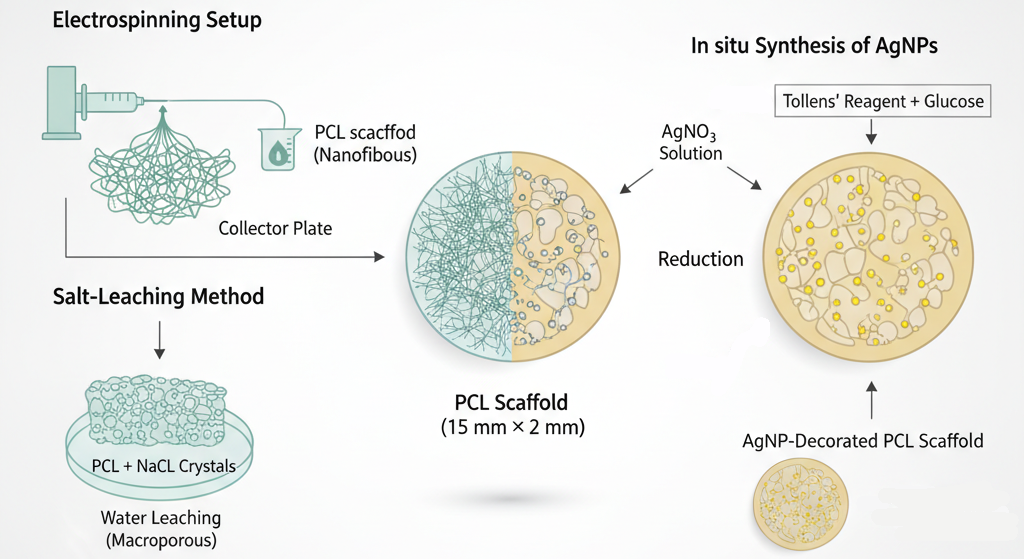
To engineer and evaluate silver nanoparticle-decorated polycaprolactone (PCL) scaffolds that simultaneously provide antibacterial activity and support osteogenic cell responses for bone tissue engineering. Methods: Electrospun PCL scaffolds were functionalized by in situ chemical reduction of AgNO₃ to generate uniformly distributed AgNPs and then characterized by TEM/XRD, EDS/XPS, FTIR/XRD, and porosity analyses. Antibacterial performance was tested against Staphylococcus aureus and Escherichia coli by disk diffusion and CFU assays, while MC3T3-E1 preosteoblast responses were assessed by CCK-8 proliferation, ALP activity, and osteogenic gene expression. Results: AgNPs averaged ~22 nm; surface silver content was ~3.2 at% (~0.8 wt%), yielding sustained Ag⁺ release of ~0.4 μg per 50 mg scaffold over 21 days (~80% by day 14). PCL–Ag scaffolds produced inhibition zones of 12.5 ± 0.5 mm (S. aureus) and 11.0 ± 0.4 mm (E. coli) and achieved >99.9% bacterial reduction in suspension. MC3T3-E1 proliferation increased relative to PCL controls (day-7 OD450 2.50 ± 0.15 vs. 2.08 ± 0.12; p<0.01). Early osteogenesis was enhanced, with ALP 1.8× at day 7 and 1.5× at day 14, accompanied by upregulated RUNX2 and BMP2; scaffold porosity and PCL crystallinity were preserved. Conclusions: In situ AgNP decoration confers durable antibacterial activity while promoting osteogenic cell functions, indicating a promising infection-resistant platform for bone regeneration.
Keywords
- Antibacterial efficacy,
- Biomaterial characterization,
- Nanofibrous scaffold,
- Osteogenic differentiation,
- Silver ion release
References
- Liang, W., Zhou, C., Bai, J., Zhang, H., Long, H., Jiang, B. et al. Current developments and future perspectives of nanotechnology in orthopedic implants: an updated review. Front Bioeng Biotechnol 12, 1342340 (2024).
- Aydin, M., Marek, N., Luciani, T., Mohamed-Ahmed, S., Lund, B., Gjerde, C. et al. Impact of porosity and stiffness of 3D printed polycaprolactone scaffolds on osteogenic differentiation of human mesenchymal stromal cells and activation of dendritic cells. ACS Biomater Sci Eng 10, 7539–7554 (2024).
- Vaquette, C., Bock, N., Tran, P. Layered antimicrobial selenium nanoparticle–calcium phosphate coating on 3D printed scaffolds enhanced bone formation in critical size defects. ACS Appl Mater Interfaces 12, 55638–55648 (2020).
- Li, Z., Li, S. Biogenic synthesis of gold nanoparticles using Capparis zeylanica extract and their oxidative and cytotoxic effects on colorectal cancer cells. J Nanostruct Chem 15, 152511 (2025).
- Xu, G., Zhao, I., Lung, C., Yin, I., Lo, E., Chu, C. Silver compounds for caries management. Int Dent J 74, 179–186 (2024).
- Rodrigues, A., Batista, J., Rodrigues, M., Thipe, V., Minarini, L., Lopes, P. et al. Advances in silver nanoparticles: a comprehensive review on their potential as antimicrobial agents and their mechanisms of action elucidated by proteomics. Front Microbiol 15, 1440065 (2024)
- Khan, T., Umar, A., Waheed, A., Khan, M., Wajid, M., Ullah, H. Assessment of possible potential toxicity risks in albino mice exposed to amine coated silver nanoparticles. Kuwait J Sci 51, 100172 (2023).
- Fatima, T., Abrar, H., Jahan, N., Shamim, S., Ahmed, N., Ali, A. et al. Molecular marker identification, antioxidant, antinociceptive, and anti-inflammatory responsiveness of malonic acid capped silver nanoparticle. Front Pharmacol 14, 1319613 (2023).
- Kishore, K., Rajesh, S., Sivadas, S., Selvasudha, N., Barathidasan, R., Vasanthi, H. Pectin encapsulated novel nanocomposite augments wound healing in Sprague Dawley rats. Carbohydr Polym Technol Appl 6, 100370 (2023).
- Qiao, J., Wu, G., Jiang, S., Yong, Z., Ma, F., Jiao, J. Synthesis, surface chemical characterization, and enhanced osteoblast response of strontium-substituted hydroxyapatite nanoparticles for alveolar bone regeneration.
- J Nanostruct Chem 15, 152512 (2025).
- Qian, Y., Zhou, X., Zhang, F., Diekwisch, T. G. H., Luan, X., Yang, J. Triple PLGA/PCL scaffold modification including silver impregnation, collagen coating, and electrospinning significantly improve biocompatibility, antimicrobial, and osteogenic properties for orofacial tissue regeneration. ACS Appl Mater Interfaces 11, 37381–37396 (2019).
- Sun, C., Che, Y., Lu, S. Preparation and application of collagen scaffold-encapsulated silver nanoparticles and bone morphogenetic protein 2 for enhancing the repair of infected bone. Biotechnol Lett 37, 467–473 (2015).
- Paterson, T. E., Shi, R., Tian, J., Harrison, C. J., De Sousa Mendes, M., Hatton, P. V. et al. Electrospun scaffolds containing silver-doped hydroxyapatite with antimicrobial properties for applications in orthopedic and dental bone surgery. J Funct Biomater 11, 58 (2020).
- Chen, F., Han, J., Guo, Z., Mu, C., Yu, C., Ji, Z. et al. Antibacterial 3D-printed silver nanoparticle/poly lactic-co-glycolic acid (PLGA) scaffolds for bone tissue engineering. Materials 16, 3895 (2023)
- Zhang, M., Lin, H., Wang, Y., Yang, G., Zhao, H., Sun, D. Fabrication and durable antibacterial properties of 3D porous wet electrospun RCSC/PCL nanofibrous scaffold with silver nanoparticles. Appl Surf Sci 414, 52–62 (2017).
- Bayrak, E., Forough, M., Tutumlu, Z., Eroğul, O. In situ synthesis of silver nanoparticles as a facile strategy to prepare PCL scaffolds with antibacterial activity for a potential treatment for decubitus ulcers. J Mater Res 39, 2067–2081 (2024).
- Abad-Alvaro, I., Bolea, E., Laborda, F., Castillo, J. R. An ICP-MS-based platform for release studies on silver-based nanomaterials. J Anal At Spectrom 32, 1101–1108 (2017).
- Jackson, S. M., Demer, L. L. Peroxisome proliferator-activated receptor activators modulate the osteoblastic maturation of MC3T3-E1 preosteoblasts. FEBS Lett 471, 119–124 (2000).
- Wise, J., Yarin, A., Megaridis, C., Cho, M. Chondrogenic differentiation of human mesenchymal stem cells on oriented nanofibrous scaffolds: engineering the superficial zone of articular cartilage. Tissue Eng Part A 15, 913–921 (2009).
- Hoque, M., San, W., Wei, F., Li, S., Huang, M., Vert, M. et al. Processing of polycaprolactone and polycaprolactone-based copolymers into 3D scaffolds, and their cellular responses. Tissue Eng Part A 15, 3013–3024 (2009).
- Pal, S., Nisi, R., Stoppa, M., Licciulli, A. Silver-functionalized bacterial cellulose as antibacterial membrane for wound-healing applications. ACS Omega 2, 3632–3639 (2017).
- López-Esparza, J., Espinosa-Cristóbal, L., Donohué-Cornejo, A., Reyes-López, S. Antimicrobial activity of silver nanoparticles in polycaprolactone
- nanofibers against Gram-positive and Gram-negative bacteria. Ind Eng Chem Res 55, 12532–12538 (2016).
- Liu, Y., Hsu, S. Biomaterials and neural regeneration. Neural Regen Res 15, 1243–1244 (2020).
- Wang, C., Yin, J., Wang, R., Jiao, T., Huang, H., Zhou, J. et al. Facile preparation of self-assembled polydopamine-modified electrospun fibers for highly effective removal of organic dyes. Nanomaterials (Basel) 9, 116 (2019).
- González-Garibay, A., Sánchez-Hernández, I., Torres-González, O., Hernández-Aviña, A., Villarreal-Amézquita, A., Padilla-Camberos, E. Antidiabetic activity of silver nanoparticles biosynthesized with Stenocereus queretaroensis flower extract. Pharmaceuticals 18, 1310 (2025).
- Rashidi, N., Najmoddin, N., Tavakoli, A. H., Samanipour, R. 3D printed hetero-layered composite scaffold with engineered superficial zone promotes osteogenic differentiation of pre-osteoblast MC3T3-E1 cells. Surf Interfaces 51, 104683 (2024).
- Kiumarsi, N., Najmoddin, N. Systematically engineered GO with magnetic CuFe₂O₄ to enhance bone regeneration on 3D printed PCL scaffold. Surf Interfaces 39, 102973 (2023).
- Jiaxing, J., Zuo, Y., Li, Y., Li, J. Antibacterial calcium phosphate/polyurethane composite scaffolds for bone regeneration. Front Bioeng Biotechnol 4, 02225 (2016).
- Tordi, P., Gelli, R., Ridi, F., Bonini, M. A bioinspired and sustainable route for the preparation of Ag-crosslinked alginate fibers decorated with silver nanoparticles. Carbohydr Polym 326, 121586 (2024).
- Anandalakshmi, K., Venugobal, J., Ramasamy, V. Characterization of silver nanoparticles by green synthesis method using Pedalium murex leaf extract and their antibacterial activity. Appl Nanosci 6, 399–408 (2015).
- Akhigan, N., Najmoddin, N., Azizi, H., Mohammadi, M. Zinc oxide surface-functionalized PCL/graphene oxide scaffold: enhanced mechanical and antibacterial properties. Int J Polym Mater Polym Biomater 72, 1423–1433 (2023).
- Kora, A., Arunachalam, J. Biosynthesis of silver nanoparticles by the seed extract of Strychnos potatorum: a natural phytocoagulant. IET Nanobiotechnol 7, 83–89 (2013).
- Menazea, A. A., Abdelbadie, S. A., Ahmed, M. K. Manipulation of AgNPs coated on selenium/carbonated hydroxyapatite/ε-polycaprolactone nanofibrous via pulsed laser deposition for wound healing applications. Appl Surf Sci 508, 145299 (2020).
- Zhao, Y., Liu, Y., Tian, C., Liu, Z., Wu, K., Zhang, C. et al. Construction of antibacterial photothermal PCL/AgNPs/BP nanofibers for infected wound healing. Mater Des 226, 111670 (2023).
- Sarıipek, F. B., Sevgi, F., Dursun, S. Preparation of poly(ε-caprolactone) nanofibrous mats incorporating graphene oxide–silver nanoparticle hybrid composite by electrospinning method for potential antibacterial applications. Colloids Surf A Physicochem Eng Asp 653, 129969 (2022).
- Santos, F. G., Bonkovoski, L. C., Garcia, F. P., Cellet, T. S. P., Witt, M. A., Nakamura, C. V. et al. Antibacterial performance of a PCL–PDMAEMA blend nanofiber-based scaffold enhanced with immobilized silver nanoparticles. ACS Appl Mater Interfaces 9, 9304–9314 (2017).
- Thomas, R., Soumya, K. R., Mathew, J., Radhakrishnan, E. K. Electrospun polycaprolactone membrane incorporated with biosynthesized silver nanoparticles as effective wound dressing material. Appl Biochem Biotechnol 176, 2213–2224 (2015).
- Shi, J., You, T., Gao, Y., Liang, X., Li, C., Yin, P. Large-scale preparation of flexible and reusable surface-enhanced Raman scattering platform based on electrospinning AgNPs/PCL nanofiber membrane. RSC Adv 7, 58275–58284 (2017).
- de Menezes, B. R. C., Montanheiro, T. L. do A., Sampaio, A. da G., Koga-Ito, C. Y., Thim, G. P., Montagna, L. S. PCL/β-AgVO₃ nanocomposites obtained by solvent casting as potential antimicrobial biomaterials. J Appl Polym Sci 138, 50130 (2021).
- Yuan, Q., Zhang, Q., Xu, X., Du, Y., Xu, J., Song, Y. et al. Development and characterization of novel orthodontic adhesive containing PCL–gelatin–AgNPs fibers. J Funct Biomater 13, 303 (2022).
- Vilamová, Z., Šimonová, Z., Bednář, J., Mikeš, P., Cieslar, M., Svoboda, L. et al. Silver-loaded poly(vinyl alcohol)/polycaprolactone polymer scaffold as a biocompatible antibacterial system. Sci Rep 14, 11093 (2024).
- Bozkaya, O., Arat, E., Gün Gök, Z., Yiğitoğlu, M., Vargel, İ. Production and characterization of hybrid nanofiber wound dressing containing Centella asiatica-coated silver nanoparticles by mutual electrospinning method. Eur Polym J 166, 111023 (2022).
- Muraro, P. C. L., Pinheiro, L. D. S. M., Chuy, G., Vizzotto, B. S., Pavoski, G., Espinosa, D. C. R. et al. Silver nanoparticles from residual biomass: biosynthesis, characterization and antimicrobial activity. J Biotechnol 343, 47–51 (2022).
- Qian, Y., Zhou, X., Zhang, F., Diekwisch, T. G. H., Luan, X., Yang, J. Triple PLGA/PCL scaffold modification including silver impregnation, collagen coating, and electrospinning significantly improve biocompatibility, antimicrobial, and osteogenic properties for orofacial tissue regeneration. ACS Appl Mater Interfaces 11, 37381–37396 (2019).
- Zhou, W., Jia, Z., Xiong, P., Yan, J., Li, Y., Li, M. et al. Bioinspired and biomimetic AgNPs/gentamicin-embedded silk fibroin coatings for robust antibacterial and osteogenetic applications. ACS Appl Mater Interfaces 9, 25830–25846 (2017).
- Pauksch, L., Hartmann, S., Rohnke, M., Szalay, G., Alt, V., Schnettler, R. et al. Biocompatibility of silver nanoparticles and silver ions in primary human mesenchymal stem cells and osteoblasts. Acta Biomater 10, 439–449 (2014).
- Bromberg, L. E., Braman, V. M., Rothstein, D. M., Spacciapoli, P., O’Connor, S. M., Nelson, E. J. et al. Sustained release of silver from periodontal wafers for treatment of periodontitis. J Control Release 68, 63–72 (2000).
- AshaRani, P. V., Low Kah Mun, G., Hande, M. P., Valiyaveettil, S. Cytotoxicity and genotoxicity of silver nanoparticles in human cells. ACS Nano 3, 279–290 (2009).
- Feng, J., Xu, S., Pan, G., Yao, L., Guan, Y., Zhou, L. et al. Clean preparation of washable antibacterial polyester fibers by high temperature and high pressure hydrothermal self-assembly. Nanotechnol Rev 10, 1740–1751 (2021).
- Baba Ismail, Y. M., Ferreira, A. M., Bretcanu, O., Dalgarno, K., El Haj, A. J. Polyelectrolyte multilayers assembly of SiCHA nanopowders and collagen type I on aminolysed PLA films to enhance cell–material interactions. Colloids Surf B Biointerfaces 159, 445–453 (2017).
- Chantre, C. O., Campbell, P. H., Golecki, H. M., Buganza, A. T., Capulli, A. K., Deravi, L. F. et al. Production-scale fibronectin nanofibers promote wound closure and tissue repair in a dermal mouse model. Biomaterials 166, 96–108 (2018).
- Rawadi, G., Vayssière, B., Dunn, F., Baron, R., Roman-Roman, S. BMP-2 controls alkaline phosphatase expression and osteoblast mineralization by a Wnt autocrine loop. J Bone Miner Res 18, 1842–1853 (2003).
- Yang, Y., Cheng, Y., Deng, F., Shen, L., Zhao, Z., Peng, S. et al. A bifunctional bone scaffold combines osteogenesis and antibacterial activity via in situ grown hydroxyapatite and silver nanoparticles. Bio-Des Manuf 4, 452–468 (2021).
- Mansoorian, P., Ajorloo, M., Najmoddin, N. Engineered GO with magnetic iron oxide nanoparticles promotes osteogenic differentiation on 3D printed PCL scaffold. Diam Relat Mater 156, 112424 (2025).
- Kuttappan, S., Mathew, D., Nair, M. B. Biomimetic composite scaffolds containing bioceramics and collagen/gelatin for bone tissue engineering – a mini review. Int J Biol Macromol 93, 1390–1401 (2016).
- Caddeo, S., Mattioli-Belmonte, M., Cassino, C., Barbani, N., Dicarlo, M., Gentile, P. et al. Newly designed collagen/polyurethane bioartificial blend as coating on bioactive glass–ceramics for bone tissue engineering applications. Mater Sci Eng C 96, 218–233 (2019).
- Cho, Y. S., Kim, H.-K., Ghim, M.-S., Hong, M. W., Kim, Y. Y., Cho, Y.-S. Evaluation of the antibacterial activity and cell response for 3D-printed polycaprolactone/nanohydroxyapatite scaffold with zinc oxide coating. Polymers 12, 2193 (2020).
- Ilyas, K., Akhtar, M. A., Ammar, E. B., Boccaccini, A. R. Surface modification of 3D-printed PCL/BG composite scaffolds via mussel-inspired polydopamine and effective antibacterial coatings for biomedical applications. Materials 15, 8289 (2022).
- Lu, Z., Xiao, J., Wang, Y., Meng, M. In situ synthesis of silver nanoparticles uniformly distributed on polydopamine-coated silk fibers for antibacterial application. J Colloid Interface Sci 452, 8–14 (2015).
- Song, Y., Jiang, H., Wang, B., Kong, Y., Chen, J. Silver-incorporated mussel-inspired polydopamine coatings on mesoporous silica as an efficient nanocatalyst and antimicrobial agent. ACS Appl Mater Interfaces 10, 1792–1801 (2018)