
 10.57647/jnsc.2025.1505.20
Catalytic and Antibacterial Activities with Molecular Docking Analysis of Chitosan and Polyethylene Glycol-NiO2 Nanostructures
- Muhammad Imran
 1
1 - Iram Shahzadi2
- Ali Haider3
- Mudassir Hassan4
- Anwar Ul-Hamid5
- Waseem Safdar
 6
6 - Junaid Haider6
- Muhammad Ikram*4
- Interdisciplinary Research Center for Hydrogen Technologies and Carbon Management (IRC-HTCM), King Fahd University of Petroleum & Minerals, Dhahran 31261, Saudi Arabia
- School of Pharmacy, University of Management and Technology, Lahore 54770, Pakistan
- Department of Clinical Sciences, Faculty of Veterinary and Animal Sciences, Muhammad Nawaz Shareef, University of Agriculture, Multan 66000, Punjab, Pakistan
- Solar Cell Applications Research Lab, Department of Physics, Government College University Lahore, Lahore 54000, Punjab, Pakistan
- Core Research Facilities, Research Institute, King Fahd University of Petroleum & Minerals, Dhahran 31261, Saudi Arabia
- Department of Biological Sciences, National University of Medical Sciences, Rawalpindi 46000, Pakistan

Received: 11-08-2025
Revised: 09-09-2025
Accepted: 19-09-2025
Published in Issue 17-10-2025
Copyright (c) 2025 Muhammad Imran, Iram Shahzadi, Ali Haider, Mudassir Hassan, Anwar Ul-Hamid, Waseem Safdar, Junaid Haider, Muhammad Ikram (Author)

This work is licensed under a Creative Commons Attribution 4.0 International License.
How to Cite




PDF views: 166





Abstract
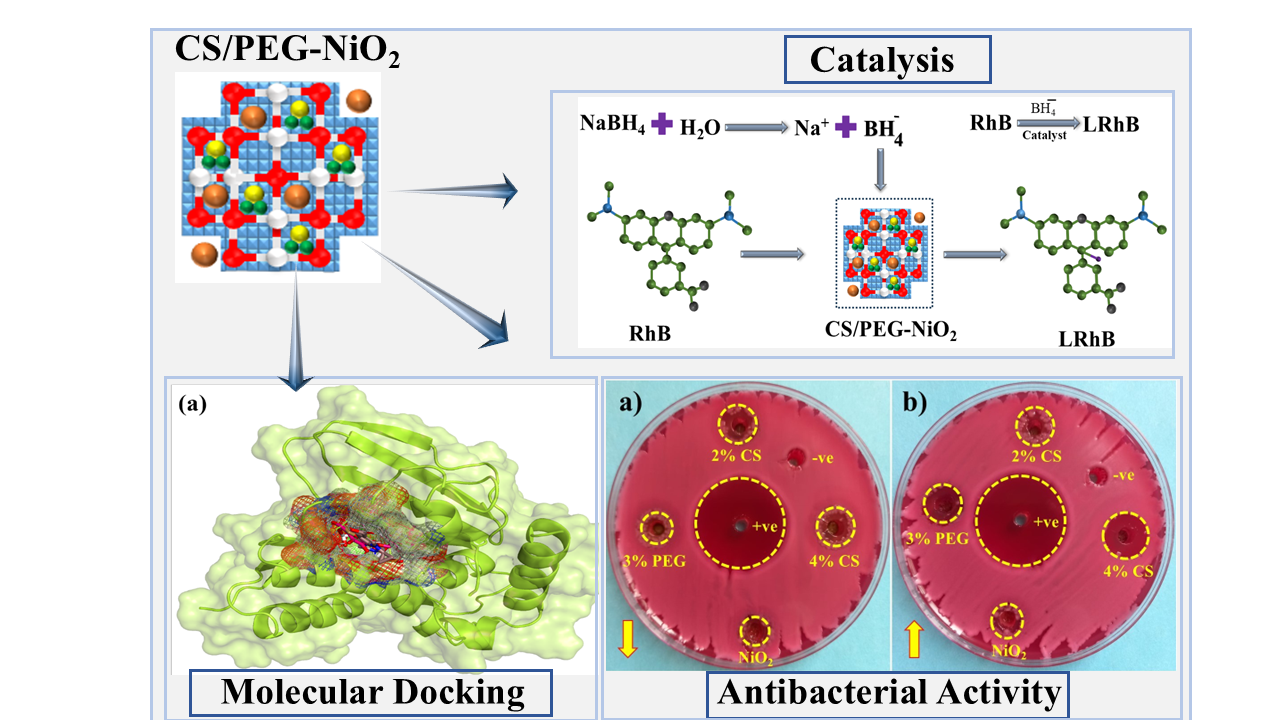
Toxic dyes and microbes in water have an alarming effect on the integrity of the environment and dairy industries. In this study, 2 and 4 % of chitosan (CS) and 3 % of polyethylene glycol (PEG) were incorporated to nickel oxide (NiO2) nanostructures (NSs) to degrade dyes and to kill bacteria effectively, synthesized via the low-temperature co-precipitation technique. The motive of the research is to enhance catalytic and antimicrobial properties through surface modification and the generation of more active sites upon incorporation of dopants. X-ray crystallographic patterns confirm the hexagonal crystal structure of NiO2 and a reduction in crystallite size with doping. The band gap energy of NiO2 increases from 3.17 to 3.25 eV upon doping. TEM elucidates the formation of an interconnected network of nanorods and nanoparticles with reduced agglomeration upon PEG and CS addition. Doping controlled the morphology and charge recombination dynamics of NiO2, which significantly boosts the catalytic and antibacterial potential. Particle size of the NiO2 nanostructures decreases from 34.7 to 24.53 nm with the addition of dopants. Notably, the highly doped sample exhibited maximum RhB degradation of 92.3 % in neutral medium and maximum inhibition zone of 5.25±0.03 mm against gram-negative multiple drug-resistant Escherichia coli (MDR E. coli) (p<0.05). The computational results correspond with observational data, providing compelling support for the microbial efficacy of CS/PEG-NiO2 in suppressing DNA gyrase.
Keywords
- Chitosan,
- Antimicrobial,
- Dye degradation,
- Nanostructures
References
- Li, P.; Wu, J., Drinking water quality and public health. Exposure and Health, 11 (2), 73-79 (2019).
- Baggio, G.; Qadir, M.; Smakhtin, V., Freshwater availability status across countries for human and ecosystem needs. Science of the Total Environment, 792, 148230 (2021).
- Sharma, M.; Behl, K.; Nigam, S.; Joshi, M., TiO2-GO nanocomposite for photocatalysis and environmental applications: A green synthesis approach. Vacuum, 156, 434-439 (2018).
- Chen, S.; Zhang, J.; Zhang, C.; Yue, Q.; Li, Y.; Li, C., Equilibrium and kinetic studies of methyl orange and methyl violet adsorption on activated carbon derived from Phragmites australis. Desalination, 252 (1-3), 149-156 (2010).
- Islam, T.; Repon, M. R.; Islam, T.; Sarwar, Z.; Rahman, M. M., Impact of textile dyes on health and ecosystem: a review of structure, causes, and potential solutions. Environmental Science and Pollution Research, 30 (4), 9207-9242 (2023).
- Al-Gheethi, A. A.; Azhar, Q. M.; Kumar, P. S.; Yusuf, A. A.; Al-Buriahi, A. K.; Mohamed, R. M. S. R.; Al-Shaibani, M. M., Sustainable approaches for removing Rhodamine B dye using agricultural waste adsorbents: A review. Chemosphere, 287, 132080 (2022).
- Selvaraj, V.; Karthika, T. S.; Mansiya, C.; Alagar, M., An over review on recently developed techniques, mechanisms and intermediate involved in the advanced azo dye degradation for industrial applications. Journal of molecular structure, 1224, 129195 (2021).
- Rauf, M.; Ashraf, S. S., Fundamental principles and application of heterogeneous photocatalytic degradation of dyes in solution. Chemical engineering journal, 151 (1-3), 10-18 (2009).
- Saleh, T. A.; Mustaqeem, M.; Khaled, M., Water treatment technologies in removing heavy metal ions from wastewater: A review. Environmental Nanotechnology, Monitoring & Management, 17, 100617 (2022).
- Khan, Z.; Bashir, O.; Khan, M. N.; Khan, T. A.; Al-Thabaiti, S. A., Cationic surfactant assisted morphology of Ag@ Cu, and their catalytic reductive degradation of Rhodamine B. Journal of Molecular Liquids, 248, 1096-1108 (2017).
- Liu, Y.; Lan, Q.; Sun, S.; Yang, Q., Synergistic oxygen vacancy-rich CuO/visible light activation of peroxymonosulfate for degradation of rhodamine B: Fast catalyst synthesis and degradation mechanism. RSC advances, 12 (5), 2928-2937 (2022).
- Tomar, R.; Abdala, A. A.; Chaudhary, R.; Singh, N., Photocatalytic degradation of dyes by nanomaterials. Materials Today: Proceedings, 29, 967-973 (2020).
- Varshan, G. A.; Namasivayam, S. K. R., A critical review on sustainable formulation of anti-quorum sensing compounds using nanotechnology principles against Candida albicans. BioNanoScience, 15 (1), 161 (2025).
- Raj, L. A.; Pavithra, R.; Namasivayam, S. K. R., Green route synthesis of Highly Stable Zinc Oxide Nanoparticles using Root Extract of Andrographis paniculata and evaluation of their potential activities. Plant Nano Biology, 100162 (2025).
- Falcaro, P.; Ricco, R.; Yazdi, A.; Imaz, I.; Furukawa, S.; Maspoch, D.; Ameloot, R.; Evans, J. D.; Doonan, C. J., Application of metal and metal oxide nanoparticles@ MOFs. Coordination Chemistry Reviews, 307, 237-254 (2016).
- Hameeda, B.; Mushtaq, A.; Saeed, M.; Munir, A.; Jabeen, U.; Waseem, A., Development of Cu-doped NiO nanoscale material as efficient photocatalyst for visible light dye degradation. Toxin Reviews, 40 (4), 1396-1406 (2021).
- Alagiri, M.; Ponnusamy, S.; Muthamizhchelvan, C., Synthesis and characterization of NiO nanoparticles by sol–gel method. Journal of Materials Science: Materials in Electronics, 23, 728-732 (2012).
- Al-Zaqri, N.; Umamakeshvari, K.; Mohana, V.; Muthuvel, A.; Boshaala, A., Green synthesis of nickel oxide nanoparticles and its photocatalytic degradation and antibacterial activity. Journal of Materials Science: Materials in Electronics, 33 (15), 11864-11880 (2022).
- Prabhu, S.; Thangadurai, T. D.; Bharathy, P. V.; Kalugasalam, P., Synthesis and characterization of nickel oxide nanoparticles using Clitoria ternatea flower extract: Photocatalytic dye degradation under sunlight and antibacterial activity applications. Results in Chemistry, 4, 100285 (2022).
- Ahmad, R.; Bedük, T.; Majhi, S. M.; Salama, K. N., One-step synthesis and decoration of nickel oxide nanosheets with gold nanoparticles by reduction method for hydrazine sensing application. Sensors and Actuators B: Chemical, 286, 139-147 (2019).
- Khan, M.; Ahmad, R.; Tripathy, N.; Khosla, A.; Khan, M. I. R.; Mishra, P.; Syed, M. A.; Ansari, W. A., Fabrication of an ultra-sensitive hydrazine sensor based on nano-chips shaped nickel hydroxide modified electrodes. Microsystem Technologies, 28 (1), 279-286 (2022).
- Anand, G. T.; Nithiyavathi, R.; Ramesh, R.; Sundaram, S. J.; Kaviyarasu, K., Structural and optical properties of nickel oxide nanoparticles: Investigation of antimicrobial applications. Surfaces and Interfaces, 18, 100460 (2020).
- Hassan, A. A.; Adil, H.; Alyasiri, T.; Alsayed, R.; Makia, R.; Kadhom, M.; Salman, H.; Yousif, E., Nickel oxide nanoparticles with ginger extract: An environmentally sustainable method for antibacterial applications. Results in Chemistry, 9, 101617 (2024).
- Arshad, S.; Imran, M.; Haider, A.; Shahzadi, A.; Saeed, H.; Ul-Hamid, A.; Al-Anazy, M. M.; Yousef, E. S.; Ikram, M., Evaluation of Bactericidal Potential and Catalytic Dye Degradation of Yttrium/Graphitic Carbon Nitride Doped Nickel Oxide Nanostructures. Journal of Inorganic and Organometallic Polymers and Materials, 34 (5), 2017-2029 (2024).
- Subramanyam, K.; Sreelekha, N.; Murali, G.; Reddy, D. A.; Vijayalakshmi, R., Structural, optical and magnetic properties of Cr doped SnO2 nanoparticles stabilized with polyethylene glycol. Physica B: Condensed Matter, 454, 86-92 (2014).
- Priyanka, S.; Namasivayam, S. K. R.; Kennedy, J. F.; Moovendhan, M., Starch-chitosan-Taro mucilage nanocomposite active food packaging film doped with zinc oxide nanoparticles–Fabrication, mechanical properties, anti-bacterial activity and eco toxicity assessment. International Journal of Biological Macromolecules, 277, 134319 (2024).
- Wang, L.; Wang, S.; Bei, J. z., Synthesis and characterization of macroinitiator‐amino terminated PEG and poly (γ‐benzyl‐L‐glutamate)‐PEO‐poly (γ‐benzyl‐L‐glutamate) triblock copolymer. Polymers for Advanced Technologies, 15 (10), 617-621 (2004).
- Sowmya, R.; Namasivayam, S. K. R.; Sivasuriyan, K. S.; Varshan, G. A., Anti-cancer potential of chitosan-starch selenium Nanocomposite: Targeting osteoblastoma and insights of molecular docking. Biochemical and Biophysical Research Communications, 765, 151853 (2025).
- Sivasuriyan, K. S.; Namasivayam, S. K. R.; Rajendran, S.; Subbulakshmi, A. V. G., Biocompatible chitosan-starch bio-composite fabricated with Mukia maderaspatana metabolites: Preparation and evaluation for enhanced potential pharmacological activities. Next Materials, 8, 100911 (2025).
- Zhang, J.; Wang, Q.; Wang, A., Synthesis and characterization of chitosan-g-poly (acrylic acid)/attapulgite superabsorbent composites. Carbohydrate polymers, 68 (2), 367-374 (2007).
- Naseem, K.; Abrar, E.; Khalid, A.; Ismail, M. A., Inorganic nanoparticles as a potential catalyst for the reduction of Rhodamine B dye: A critical review. Inorganic Chemistry Communications, 163, 112367 (2024).
- Li, H.; Liao, J.; Zeng, T., A facile synthesis of CuO nanowires and nanorods, and their catalytic activity in the oxidative degradation of Rhodamine B with hydrogen peroxide. Catalysis Communications, 46, 169-173 (2014).
- Bergey, D. H., Bergey's manual of determinative bacteriology. Lippincott Williams & Wilkins: 1994.
- Iwalokun, B.; Ogunledun, A.; Ogbolu, D.; Bamiro, S.; Jimi-Omojola, J., In vitro antimicrobial properties of aqueous garlic extract against multidrug-resistant bacteria and Candida species from Nigeria. Journal of medicinal food, 7 (3), 327-333 (2004).
- Haider, A.; Ijaz, M.; Imran, M.; Naz, M.; Majeed, H.; Khan, J.; Ali, M.; Ikram, M., Enhanced bactericidal action and dye degradation of spicy roots’ extract-incorporated fine-tuned metal oxide nanoparticles. Applied Nanoscience, 10, 1095-1104 (2020).
- Haider, A.; Ijaz, M.; Ali, S.; Haider, J.; Imran, M.; Majeed, H.; Shahzadi, I.; Ali, M. M.; Khan, J. A.; Ikram, M., Green synthesized phytochemically (Zingiber officinale and Allium sativum) reduced nickel oxide nanoparticles confirmed bactericidal and catalytic potential. Nanoscale research letters, 15, 1-11 (2020).
- Shahzadi, I.; Islam, M.; Saeed, H.; Haider, A.; Shahzadi, A.; Haider, J.; Ahmed, N.; Ul-Hamid, A.; Nabgan, W.; Ikram, M., Formation of biocompatible MgO/cellulose grafted hydrogel for efficient bactericidal and controlled release of doxorubicin. International Journal of Biological Macromolecules, 220, 1277-1286 (2022).
- Mesleh, M. F.; Cross, J. B.; Zhang, J.; Kahmann, J.; Andersen, O. A.; Barker, J.; Cheng, R. K.; Felicetti, B.; Wood, M.; Hadfield, A. T., Fragment-based discovery of DNA gyrase inhibitors targeting the ATPase subunit of GyrB. Bioorganic & Medicinal Chemistry Letters, 26 (4), 1314-1318 (2016).
- Elabbasy, M.; Abd El-Kader, M.; Ismail, A.; Menazea, A., Regulating the function of bismuth (III) oxide nanoparticles scattered in Chitosan/Poly (Vinyl Pyrrolidone) by laser ablation on electrical conductivity characterization and antimicrobial activity. Journal of Materials Research and Technology, 10, 1348-1354 (2021).
- Vidyasagar, C.; Naik, Y. A., Surfactant (PEG 400) effects on crystallinity of ZnO nanoparticles. Arabian Journal of Chemistry, 9 (4), 507-510 (2016).
- Elfadl, A. A.; Bashal, A. H.; Habeeb, T. H.; Khalafalla, M. A.; Alkayal, N. S.; Khalil, K. D., Preparation, characterization, dielectric properties, and AC conductivity of chitosan stabilized metallic oxides CoO and SrO: experiments and tight binding calculations. Polymers, 15 (20), 4132 (2023).
- Mahmoud, A. M.; Ibrahim, F. A.; Shaban, S. A.; Youssef, N. A., Adsorption of heavy metal ion from aqueous solution by nickel oxide nano catalyst prepared by different methods. Egyptian Journal of Petroleum, 24 (1), 27-35 (2015).
- Din, M. I.; Rehman, S.; Hussain, Z.; Intisar, A.; Ahmed, E.; Sharif, A.; Hussain, T.; Khalid, R.; Ameen, S.; Arshad, M., Eco friendly synthesis of nickel oxide nanoparticles and its application on pyrolysis of Calotropis procera (AKH) Plant roots. Journal of Optoelectronic and Biomedical Materials Vol, 13 (3), 119-125 (2021).
- Xin, X.; Lü, Z.; Zhou, B.; Huang, X.; Zhu, R.; Sha, X.; Zhang, Y.; Su, W., Effect of synthesis conditions on the performance of weakly agglomerated nanocrystalline NiO. Journal of Alloys and Compounds, 427 (1-2), 251-255 (2007).
- Nabiyouni, G.; Barati, A.; Saadat, M., Surface adsorption of polyethylene glycol and polyvinyl alcohol with variable molecular weights on zinc oxide nanoparticles, (2011).
- Anuje, M.; Pawaskar, P. N.; Khot, V.; Sivan, A.; Jadhav, S.; Meshram, J.; Thombare, B., Synthesis, characterization, and cytotoxicity evaluation of polyethylene glycol-coated iron oxide nanoparticles for radiotherapy application. Journal of Medical Physics, 46 (3), 154-161 (2021).
- Sarhan, A., Characterization of Chitosan and polyethylene glycol blend film. Egyptian Journal of Chemistry, 62 (Special Issue (Part 2) Innovation in Chemistry), 405-412 (2019).
- Jana, S.; Mondal, G.; Mitra, B. C.; Bera, P.; Chakraborty, B.; Mondal, A.; Ghosh, A., Facile synthesis of nickel oxide thin films from PVP encapsulated nickel sulfide thin films: an efficient material for electrochemical sensing of glucose, hydrogen peroxide and photodegradation of dye. New Journal of Chemistry, 41 (24), 14985-14994 (2017).
- Din, M. I.; Nabi, A. G.; Rani, A.; Aihetasham, A.; Mukhtar, M., Single step green synthesis of stable nickel and nickel oxide nanoparticles from Calotropis gigantea: catalytic and antimicrobial potentials. Environmental Nanotechnology, Monitoring & Management, 9, 29-36 (2018).
- Hong, S.-J.; Mun, H.-J.; Kim, B.-J.; Kim, Y.-S., Characterization of nickel oxide nanoparticles synthesized under low temperature. Micromachines, 12 (10), 1168 (2021).
- Liu, S.; Zeng, T. H.; Hofmann, M.; Burcombe, E.; Wei, J.; Jiang, R.; Kong, J.; Chen, Y., Antibacterial activity of graphite, graphite oxide, graphene oxide, and reduced graphene oxide: membrane and oxidative stress. ACS nano, 5 (9), 6971-6980 (2011).
- Kumar, A.; Pandey, A. K.; Singh, S. S.; Shanker, R.; Dhawan, A., Engineered ZnO and TiO2 nanoparticles induce oxidative stress and DNA damage leading to reduced viability of Escherichia coli. Free Radical Biology and Medicine, 51 (10), 1872-1881 (2011).
- Akhavan, O.; Ghaderi, E.; Esfandiar, A., Wrapping bacteria by graphene nanosheets for isolation from environment, reactivation by sonication, and inactivation by near-infrared irradiation. The journal of physical chemistry B, 115 (19), 6279-6288 (2011).
- Akhavan, O.; Ghaderi, E., Toxicity of graphene and graphene oxide nanowalls against bacteria. ACS nano, 4 (10), 5731-5736 (2010).
- Lakshmi Prasanna, V.; Vijayaraghavan, R., Insight into the mechanism of antibacterial activity of ZnO: surface defects mediated reactive oxygen species even in the dark. Langmuir, 31 (33), 9155-9162 (2015).