
 10.57647/jnsc.2025.1503.11
Biogenic Synthesis of Gold Nanoparticles Using Capparis zeylanica Extract and Their Oxidative and Cytotoxic Effects on Colorectal Cancer Cells
- Shuwen Li*

 1
1

Received: 20-05-2025
Revised: 11-06-2025
Accepted: 22-06-2025
Published in Issue 28-06-2025
Copyright (c) 2025 Zeli Li, Shuwen Li (Author)

This work is licensed under a Creative Commons Attribution 4.0 International License.




PDF views: 319





Abstract
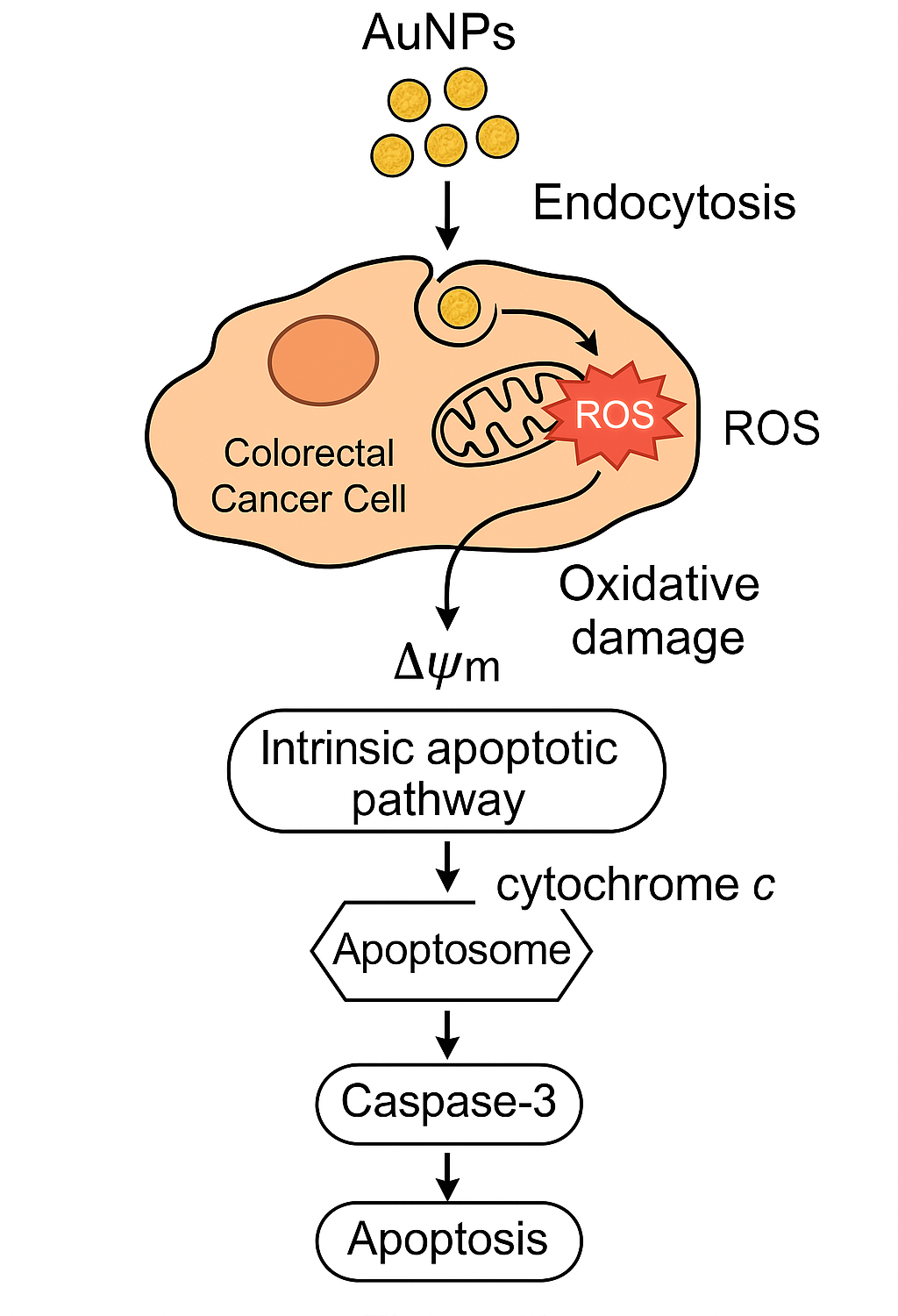
This work uses leaf extract from Capparis zeylanica, a medicinal plant that is seldom investigated for nanomaterial synthesis, to create gold nanoparticles (AuNPs) in a sustainable manner. According to TEM and SEM, the resultant AuNPs were mostly spherical and ranged in size from 40 to 50 nm. In contrast to previous findings on green synthesis, our study makes use of C. zeylanica's distinct phytochemical makeup, which is rich in flavonoids and glycosides, to improve the creation of nanoparticles and their biofunctionality. While FTIR and GC-MS/MS revealed the participation of extract-derived phenolic and flavonoid chemicals in reduction and stabilization, XRD indicated a face-centered cubic crystalline structure. In HT-29 colorectal cancer cells, these AuNPs biologically caused a dose-dependent rise in reactive oxygen species (ROS), which increased by 4.0 times at 40 µg/mL. Furthermore, we provide comprehensive mechanistic insight, demonstrating that these AuNPs trigger apoptosis by depolarizing the mitochondrial membrane and activating caspase-3, an element that is often overlooked in previous research. The significant cytotoxicity is confirmed by the IC₅₀ value of 27.5 µg/mL. Overall, this work contributes to the area of green nanomedicine by combining mechanistic confirmation of anticancer effectiveness with robust phytochemical-assisted production.
Keywords
- Apoptosis,
- Reactive oxygen species,
- Green synthesis,
- Cytotoxicity,
- Phytochemicals
References
- Ramos, A.P., Cruz, M.A.E., Tovani, C.B., Ciancaglini, P. Biomedical applications of nanotechnology. Biophys Rev 9, 79–89 (2017).
- Haleem, A., Javaid, M., Singh, R.P., et al. Applications of nanotechnology in medical field: A brief review. Glob Health J 7, 70–77 (2023).
- Chain, C.Y., Daza Millone, M.A., Cisneros, J.S., et al. Surface plasmon resonance as a characterization tool for lipid nanoparticles used in drug delivery. Front Chem 8, 605307 (2021).
- Gupta, D., Boora, A., Thakur, A., Gupta, T.K. Green and sustainable synthesis of nanomaterials: Recent advancements and limitations. Environ Res 231, 116316 (2023).
- Rathod, S., Preetam, S., Pandey, C., Bera, S.P. Exploring synthesis and applications of green nanoparticles and the role of nanotechnology in wastewater treatment. Biotechnol Rep 41, e00830 (2024).
- Nilavukkarasi, M., Vijayakumar, S., Prathipkumar, S. Capparis zeylanica mediated bio-synthesized ZnO nanoparticles as antimicrobial, photocatalytic and anti-cancer applications. Mater. Sci Energy Technol 3, 335–343 (2020).
- Patil, C.D., Patil, S.V., Salunke, B.K., Salunkhe, R.B. Bioefficacy of Plumbago zeylanica (Plumbaginaceae) and Cestrum nocturnum (Solanaceae) plant extracts against Aedes aegypti (Diptera: Culicidae) and nontarget fish Poecilia reticulata. Parasitol Res 108, 1253–1263 (2011).
- Ghramh, H.A., Khan, K.A., Ibrahim, E.H., Setzer, W.N. Synthesis of gold nanoparticles (AuNPs) using Ricinus communis leaf ethanol extract, their characterization, and biological applications. Nanomaterials 9, 765 (2019).
- Jeught, K.V.D., Xu, H.-C., Li, Y.-J., et al. Drug resistance and new therapies in colorectal cancer. World J Gastroenterol 24, 3834–3848 (2018).
- Hossain, M.S., Karuniawati, H., Jairoun, A.A., et al. Colorectal cancer: A review of carcinogenesis, global epidemiology, current challenges, risk factors, preventive and treatment strategies. Cancers 14, 1732 (2022).
- Aldahhan, R., Almohazey, D., Khan, F.A. Emerging trends in the application of gold nanoformulations in colon cancer diagnosis and treatment. Semin Cancer Biol 86, 1056–1065 (2022).
- Wang, J., Zhao, H., Song, W., et al. Gold nanoparticle-decorated drug nanocrystals for enhancing anticancer efficacy and reversing drug resistance through chemo-/photothermal therapy. Mol Pharmaceutics 19, 2518–2534 (2022).
- Xia, Q., Huang, J., Feng, Q., et al. Size- and cell type-dependent cellular uptake, cytotoxicity and in vivo distribution of gold nanoparticles. Int J Nanomed 14, 6957–6970 (2019).
- Kapoor, A., Kumar, S., Kumar, N., et al. ZnS nanoparticles: Role of Ga³⁺ ions substitution on the structural, morphological, optical, and dielectric properties. Phys Scr 98, 055909 (2023).
- Díaz-Visurraga, J., Daza, Pozo Valenzuela, C., et al. Study on antibacterial alginate-stabilized copper nanoparticles by FT-IR and 2D-IR correlation spectroscopy. Int J Nanomed 7, 3597–3610 (2012).
- Han, S., Bi, S., Guo, T., et al. Nano co-delivery of plumbagin and dihydrotanshinone I reverses immunosuppressive TME of liver cancer. J Controlled Release 348, 250–263 (2022).
- Samari, F., Baluchi, L., Salehipoor, H., Yousefinejad, S. Controllable phyto-synthesis of cupric oxide nanoparticles by aqueous extract of Capparis spinosa (caper) leaves and application in iron sensing. Microchem J 150, 104158 (2019).
- Zhang, Y., Hudson-Smith, N.V., Frand, S.D., et al. Influence of the spatial distribution of cationic functional groups at nanoparticle surfaces on bacterial viability and membrane interactions. J Am Chem Soc 142, 10814–10823 (2020).
- Ghramh, H.A., Khan, K.A., Ibrahim, E.H., Setzer, W.N. Synthesis of gold nanoparticles (AuNPs) using Ricinus communis leaf ethanol extract, their characterization, and biological applications. Nanomaterials 9, 765 (2019).
- Gomathi, D., Kalaiselvi, M., Ravikumar, G., et al. GC-MS analysis of bioactive compounds from the whole plant ethanolic extract of Evolvulus alsinoides (L.) L. J Food Sci Technol 52, 1212–1217 (2015).
- Bharadwaj, K.K., Rabha, B., Pati, S., et al. Green synthesis of gold nanoparticles using plant extracts as beneficial prospect for cancer theranostics. Molecules 26, 6389 (2021).
- G, V., P, A.S. GC-MS analysis of bioactive compounds on ethanolic leaf extract of Phyllodium pulchellum L. Desv. Int J Pharmacogn Phytochem Res 9, Article 8050 (2017).
- Rattanawongwiboon, T., Soontaranon, S., Hemvichian, K., et al. Study on particle size and size distribution of gold nanoparticles by TEM and SAXS. Radiat Phys Chem 191, 109842 (2022).
- Yamashita, Y., Tashiro, S., Ishii, Y., et al. Shape-selective one-step synthesis of branched gold nanoparticles on the crystal surface of redox-active Pd(II)-macrocycles. Dalton Trans 51, 1318–1324 (2022).
- He, T., Chen, D., Jiao, X., et al. Solubility-controlled synthesis of high-quality Co₃O₄ nanocrystals. Chem Mater 17, 4023–4030 (2005).
- Gami, B., Bloch, K., Mohammed, S.M., et al. Leucophyllum frutescens-mediated synthesis of silver and gold nanoparticles for catalytic dye degradation. Front Chem 10, 932416 (2022).
- Khalkho, B.R., Deb, M.K., Kurrey, R., et al. Citrate functionalized gold nanoparticles assisted micro extraction of L-cysteine in milk and water samples using Fourier transform infrared spectroscopy. Spectrochim Acta Part A 267, 120523 (2022).
- Magyari, K., Nagy-Simon, T., Vulpoi, A., et al. Novel bioactive glass–AuNP composites for biomedical applications. Mater Sci Eng C 76, 752–759 (2017).
- Johnson, J.B., Mani, J.S., Broszczak, D., et al. Hitting the sweet spot: A systematic review of the bioactivity and health benefits of phenolic glycosides from medicinally used plants. Phytother Res 35, 3484–3508 (2021).
- Lyu, Y., Becerril, L.M., Vanzan, M., et al. The interaction of amines with gold nanoparticles. Adv Mater 36, 2211624 (2024).
- Eskandari-Nojedehi, M., Jafarizadeh-Malmiri, H., Rahbar-Shahrouzi, J. Hydrothermal green synthesis of gold nanoparticles using mushroom (Agaricus bisporus) extract: Physico-chemical characteristics and antifungal activity studies. Green Process Synth 7, 38–47 (2018).
- Suvarna, S., Das, U., Kc, S., et al. Synthesis of a novel glucose capped gold nanoparticle as a better theranostic candidate. PLoS One 12, e0178202 (2017).
- Deepty, M., Srinivas, Ch., Kumar, E.R., et al. XRD, EDX, FTIR and ESR spectroscopic studies of co-precipitated Mn–substituted Zn–ferrite nanoparticles. Ceram Int 45, 8037–8044 (2019).
- Gomathi, D., Kalaiselvi, M., Ravikumar, G., et al. GC-MS analysis of bioactive compounds from the whole plant ethanolic extract of Evolvulus alsinoides (L.) L. J Food Sci Technol 52, 1212–1217 (2015).
- Sastry, A.B.S., Karthik Aamanchi, R.B., Sree Rama Linga Prasad, Ch., Murty, B.S. Large-scale green synthesis of Cu nanoparticles. Environ Chem Lett 11, 183–187 (2013).
- Elbagory, A.M., Cupido, C.N., Meyer, M., Hussein, A.A. Large scale screening of Southern African plant extracts for the green synthesis of gold nanoparticles using microtitre-plate method. Molecules 21, 1498 (2016).
- Jeon, J.-K., Kim, J.-K. Track analysis of a synchrotron X-ray photoelectric nanoradiator by in situ fluorescence imaging of reactive oxygen species: Comparative study of gold and iron oxide nanoparticles. J Synchrotron Radiat 25, 1768–1773 (2018).
- Maddah, A., Danesh, H., Ziamajidi, N., et al. Oxidative stress induction by gold nanoparticles in HCT-116 colon cancer cells. Compr Health Biomed Stud 2, Article 145183 (2024).
- Kim, T.K. Understanding one-way ANOVA using conceptual figures. Korean J Anesthesiol 70, 22 (2017).
- Nilavukkarasi, M., Vijayakumar, S., Prathipkumar, S. Capparis zeylanica mediated bio-synthesized ZnO nanoparticles as antimicrobial, photocatalytic and anti-cancer applications. Mater Sci Energy Technol 3, 335–343 (2020).
- Akbarzadeh Khiavi, M., Safary, A., Barar, J. et al. PEGylated gold nanoparticles-ribonuclease induced oxidative stress and apoptosis in colorectal cancer cells. BioImpacts 10, 27–36 (2019).
- Pavlovich, E., Volkova, N., Yakymchuk, E. et al. In vitro study of influence of Au nanoparticles on HT29 and SPEV cell lines. Nanoscale Res Lett 12, 494 (2017).
- Abate, M., Festa, A., Falco, M. et al. Mitochondria as playmakers of apoptosis, autophagy and senescence. Semin Cell Dev Biol 98, 139–153 (2020).
- Smiley, S.T., Reers, M., Mottola-Hartshorn, C. et al. Intracellular heterogeneity in mitochondrial membrane potentials revealed by a J-aggregate-forming lipophilic cation JC-1. Proc. Natl Acad Sci 88, 3671–3675 (1991).
- Suski, J., Lebiedzinska, M., Bonora, M. et al. Relation between mitochondrial membrane potential and ROS formation. In: Palmeira, C.M., Moreno, A.J. (eds) Mitochondrial Bioenergetics. Springer, New York, NY, 357–381 (2018).
- Chen, Q., Gong, B., Almasan, A. Distinct stages of cytochrome c release from mitochondria: Evidence for a feedback amplification loop linking caspase activation to mitochondrial dysfunction in genotoxic stress-induced apoptosis. Cell Death Differ 7, 227–233 (2000).
- Seong, M., Lee, D.G. Reactive oxygen species-independent apoptotic pathway by gold nanoparticles in Candida albicans. Microbiol Res 207, 33–40 (2018).
- Gopalakrishnan, V., Singaravelan, R. Enhanced antidiabetic and antioxidant properties of gold nanoparticles green synthesized using blossom extract of Azadirachta indica: In vitro studies. Inorg Chem Commun 158, 111609 (2023).
- Eynali, S., Khoei, S., Khoee, S., Esmaelbeygi, E. Evaluation of the cytotoxic effects of hyperthermia and 5-fluorouracil-loaded magnetic nanoparticles on human colon cancer cell line HT-29. Int. J. Hyperthermia 33, 327–335 (2017).
- Longley, D.B., Harkin, D.P., Johnston, P.G. 5-Fluorouracil: mechanisms of action and clinical strategies. Nat Rev Cancer 3, 330–338 (2003).
- Xia, Q., Huang, J., Feng, Q. et al. Size- and cell type-dependent cellular uptake, cytotoxicity and in vivo distribution of gold nanoparticles. Int J Nanomedicine 14, 6957–6970 (2019).