
 10.57647/jnsc.2025.1503.10
Fe3O4/RGO-Ionic liquid Nanocatalyst as Amplifier for Fabrication of Highly Sensitive Electrochemical Sensor in Monitoring of Thallium Environmental Fluids
- Somaye Cheraghi*

 1
1
- Department of Chemistry, University of Jiroft, Jiroft, Iran
- Department of Chemistry, Shahid Bahonar University of Kerman, Kerman, Iran

Received: 08-03-2025
Revised: 12-05-2025
Accepted: 25-05-2025
Published in Issue 18-06-2025
Copyright (c) 2025 Somaye Cheraghi, Mohammad Amin Dasar, Mohammad Ali Taher (Author)

This work is licensed under a Creative Commons Attribution 4.0 International License.
How to Cite




PDF views: 309





Abstract
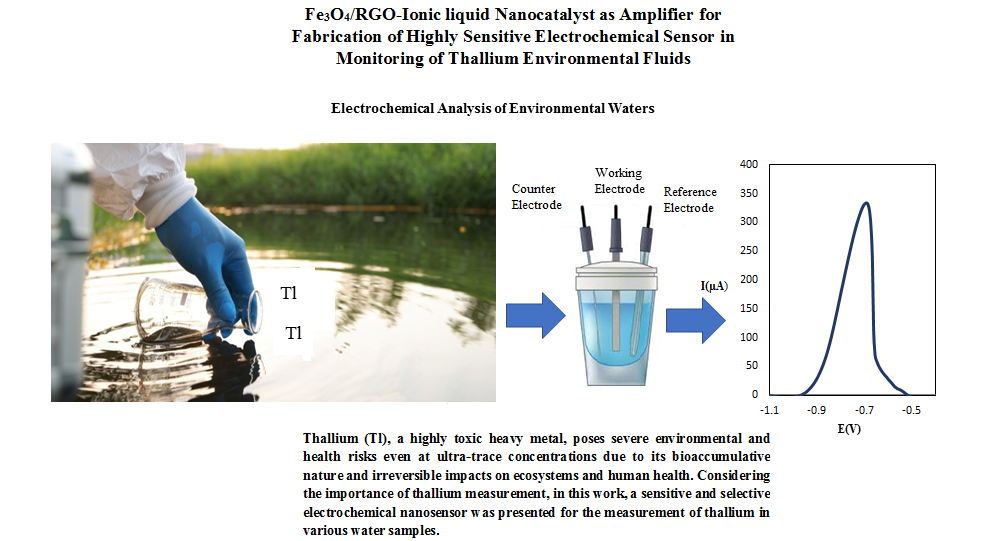
The analysis of Tl(I) is essential due to its high toxicity, environmental persistence, and potential to cause neurotoxic and carcinogenic effects even at trace levels. In this work, a reduced graphene oxide–magnetite nanocomposite (rGO–Fe₃O₄) combined with the ionic liquid N -butyl-3-methylimidazolium tetrafluoroborate (N-B-3-MITFB) was used to modify a carbon paste electrode. The resulting rGO–Fe₃O₄/N-B-3-MITFB/CPE was employed for the sensitive detection of Tl(I) in aqueous samples. The electrochemical characteristics of the sensor were systematically investigated using differential pulse anodic stripping voltammetry (DPASV). This electrode demonstrated strong oxidative activity for Tl(I) at a lower overvoltage (compared to unmodified electrodes), along with a higher current response and enhanced sensitivity. Under optimal conditions (pH 7, accumulation time 400 s, scan rate of 30 mV·s⁻¹), the calibration curve for Tl(I) exhibited a linear range of 0.07–420 µM with a limit of detection (LOD) of 0.9 nM. The proposed sensor displayed excellent selectivity for determining Tl(I) levels in the presence of common interfering species (e.g., Pb²⁺, Cr²⁺, Cu²⁺, NO₃⁻). The rGO-Fe3O4/N-B-3-MITFB/CPE showed high analytical performance for Tl(I) analysis in diverse water samples (e.g.,drinking water, well water, and waste water), achieving recoveries of 97.5–102.4%.
References
- Rodríguez-Mercado, J. J., & Altamirano-Lozano, M. A.: Genetic toxicology of thallium: a review. Drug Chem. Toxicol. 36, 369-383 (2013).
- Blumenthal, B., Sellers, K., & Koval, M.: Thallium and thallium compounds. Kirk-Othmer Encycl Chem Technol. (2000).
- Liu, J., Luo, X., Sun, Y., Tsang, D. C., Qi, J., Zhang, W., ... & Sheng, G.: Thallium pollution in China and removal technologies for waters: A review. Environ. Int.126, 771-790 (2019).
- Song, Z., Deng, H., Chen, Z., Liu, T., & Xiao, T.: Accumulation of thallium and potential toxic elements in a water-soil-rice system from a pyrite mining area, southern China: Source apportionment and health risk assessment. J. Environ. Chem. Ecotoxicol. 7,407-416 (2025).
- Wallbridge, T., James, S., Lee, R., Khan, A., Bradberry, S., & Elamin, M. E.: Successful treatment of potentially lethal dose thallium sulfate poisoning with sequential use of Prussian blue and multiple-dose activated charcoal. Clin. Toxicol. 61, 200-201 (2023).
- Fujihara, J., & Nishimoto, N.: Thallium-poisoner’s poison: An overview and review of current knowledge on the toxicological effects and mechanisms. Curr Res Toxicol. 6, 100157 (2024).
- Osorio-Rico, L., Santamaria, A., & Galván-Arzate, S.: Thallium toxicity: general issues, neurological symptoms, and neurotoxic mechanisms. Neurotoxic. Met. 18, 345–353 (2017).
- Wang, J., Fei, G., Zheng, P., Yan, N., Chen, G., Li, W., ... & Guo, L.: Solution Cathode Glow Discharge–Atomic Emission Spectrometry (SCGD-AES) With an Interference Filter for Spectral Discrimination for the Determination of Thallium in Surface Water. Anal. Lett. 58, 415-424 (2025).
- Liu, W., Deng, L., Li, H., Lin, W., Yang, Y., Zhang, L., ... & Zhu, R.: Determination of trace heavy metal ion Tl (I) in water by energy dispersive X-ray fluorescence spectrometry using prussian blue dispersed on solid sepiolite. Talanta. 284, 127295 (2025).
- Kowalska, J., Drwal, A., Tutaj, K., Kovshun, L., & Krasnodębska-Ostręga, B.: On site separation of inorganic forms of thallium and arsenic in sea water systems followed by ICP-MS determination. Anal. Methods. 15, 6082-6087 (2023).
- Zhao, Y., Cheng, F., Men, B., He, Y., Xu, H., Yang, X., & Wang, D.: Simultaneous separation and determination of thallium in water samples by high‐performance liquid chromatography with inductively coupled plasma mass spectrometry. J. Sep. Sci. 42, 3311-3318 (2019).
- Chu, Y. L., Wang, R. Y., & Jiang, S. J.: Speciation analysis of thallium by reversed‐phase liquid chromatography‐inductively coupled plasma mass spectrometry. J. Chin. Chem.Soc. 59, 219-225 (2012).
- Cheraghi, S., Taher, M. A., & Fazelirad, H.: Voltammetric sensing of thallium at a carbon paste electrode modified with a crown ether. Mikrochim. Acta. 180, 1157-1163 (2013).
- Jin, X., Baghayeri, M., Nodehi, M., Koshki, M. S., Ramezani, A., Fayazi, M., ... & Makvandi, P.: Evaluation of thallium ion as an effective ion in human health using an electrochemical sensor. Environ. Res. 238, 117026 (2023).
- Wu, R., Zou, J., Deng, L., Gu, C., Lin, W., Huang, Z., ... & Zhu, R.: Prussian Blue Nanoparticle-Modified Glassy Carbon Electrode for Electrochemical Determination of Thallium (I). J. Anal. Chem. 79, 1624-1634(2024).
- Baweja, S., Lochab, A., Baxi, S., & Saxena, R.: Computational investigation of thallium interactions with functionalized multi-walled carbon nanotubes for electrochemical sensing applications. Pure Appl. Chem. 96, 421-428(2024).
- Melucci, D., Casolari, S., Locatelli, M., & Locatelli, C.: Thallium: A Polluting Metal of New Generation. Its Voltammetric Determination in Herbal Medicines in Presence of Metal Interferences. Analytica. 2, 76-83 (2021).
- Inaudi, P., Esposito, C., Malandrino, M., Favilli, L., Giacomino, A., & Abollino, O.: Development of a portable method for monitoring and speciation of arsenic in aquatic systems by anodic stripping voltammetry: Applications to real samples. Talanta, 291, 127880 (2025).
- Yang, Y., Huang, Y., Luo, H., Zhao, J., Bi, J., & Wu, G.: Ion interference and elimination in electrochemical detection of heavy metals using anodic stripping voltammetry. J. Electrochem. Soc. 170, 057507(2023).
- Zhang, J., Wu, S., Wu, Z., Zhang, F., Jin, B., & Yang, C.: Review of Underwater In Situ Voltammetry Analyzers for Trace Metals. Chemosensors. 12, 158 (2024).
- Cheraghi, S., A Taher, M., Bijad, M., & Sadeghifar, H.: A review: Stripping voltammetric methods as a high sensitive strategy for trace analysis of ions, pharmaceutical and food samples. Curr. Anal. Chem. 13, 5-12 (2017).
- Barón-Jaimez, J., Joya, M. R., & Barba-Ortega, J.: Anodic stripping voltammetry–ASV for determination of heavy metals. J. Phys. Conf. Ser. 466, 012023 (2013).
- Joseph, A., Subramanian, S., Ramamurthy, P. C., Sampath, S., Kumar, R. V., & Schwandt, C.: Iminodiacetic acid functionalized polypyrrole modified electrode as Pb (II) sensor: synthesis and DPASV studies. Electrochim. Acta, 137, 557-563 (2014).
- Sengupta, P., Pramanik, K., & Sarkar, P.: Simultaneous detection of trace Pb (II), Cd (II) and Hg (II) by anodic stripping analyses with glassy carbon electrode modified by solid phase synthesized iron-aluminate nano particles. Sensor. Actuators. B. Chem. 329, 129052 (2021).
- Eloul, S., & Compton, R. G.: Voltammetric sensitivity enhancement by using preconcentration adjacent to the electrode: simulation, critical evaluation, and insights. J. Phys. Chem. C. 118, 24520-24532 (2014).
- Wang, K., Liang, R., & Qin, W.: Enhancing the sensitivity of polymeric membrane polycation-sensitive electrodes by surface modification of a polydopamine nanolayer. Sensor. Actuat. B. Chem. 405, 135310 (2024).
- Tomac, I., Adam, V., & Labuda, J.: Advanced chemically modified electrodes and platforms in food analysis and monitoring. Food Chem. 460, 140548 (2024).
- Cheraghi, S., Shalali, F., & Taher, M. A.: Kojic acid exploring as an essential food additive in real sample by a nanostructure sensor amplified with ionic liquid. J. Food Meas. Charact., 17, 1728-1734(2023).
- Cetinkaya, A., Kaya, S. I., Yence, M., Budak, F., & Ozkan, S. A.: Ionic liquid-based materials for electrochemical sensor applications in environmental samples. Trends Environ. Anal. Chem. 37, e00188 (2023).
- Pereira, J., Souza, R., & Moita, A.: A Review of Ionic Liquids and Their Composites with Nanoparticles for Electrochemical Applications. Inorg. 12, 186(2024).
- Raj, M. A., & John, S. A. Graphene-modified electrochemical sensors. In Graphene-based electrochemical sensors for biomolecules. pp. 1-41. Elsevier (2019).
- Hsine, Z., Mlika, R., Jaffrezic-Renault, N., & Korri-Youssoufi, H.: Recent progress in graphene based modified electrodes for electrochemical detection of dopamine. Chemosensors, 10, 249 (2022).
- Azman, N. Z. M., Zainal, P. N. S., & Alang Ahmad, S. A.: Enhancement the electrochemical conductivity of a modified reduced graphene oxide/calixarene screen-printed electrode using response surface methodology. Plos one, 15, e0234148 (2020).
- Yusoff, F., Suresh, K., Khairul, W. M., & Noorashikin, M. S.: Electrocatalytic Reduction of Oxygen on Reduced Graphene Oxide/Iron Oxide (rGO/Fe3O4) Composite Electrode. Russ.J.Phys.Chem.A. 95, 834-842 (2021).
- Niranjana, J. S., Koyakutty, H., Thomas, A. A., & Bushiri, M. J.: Novel synthesis of multi-layered rGO/Fe3O4 nanocomposite in a single step and its efficient electrochemical sensing of vitamin C. Mater. Sci. Eng. B. 290, 116283(2023).
- Elgamouz, A., Kawde, A. N., Shehadi, I. A., Sayari, S., Abdullah Mohammed, S. A., Abdelrazeq, A., ... & Hasan, K.: Modified graphite pencil electrode based on graphene oxide-modified Fe3O4 for ferrocene-mediated electrochemical detection of hemoglobin. ACS omega. 8, 11880-11888 (2023).
- Mutić, S., Anojčić, J., Vraneš, M., Panić, J., & Papović, S.: Voltammetric determination of organic UV filters by carbon paste electrodes modified with pyridinium-based ionic liquids. Talanta, 266, 125103 (2024).
- Upasham, S., Banga, I. K., Jagannath, B., Paul, A., Lin, K. C., Muthukumar, S., & Prasad, S.: Electrochemical impedimetric biosensors, featuring the use of Room Temperature Ionic Liquids (RTILs): Special focus on non-faradaic sensing. Biosens. Bioelectron. 177, 112940 (2021).
- Rama, R., Meenakshi, S., Pandian, K., & Gopinath, S. C. B.: Room temperature ionic liquids-based electrochemical sensors: an overview on paracetamol detection. Crit. Rev. Anal. Chem. 52, 1422-1431(2022).
- Zhang, Z., Zheng, H., Liu, Y., Ma, S., Feng, Q., Qu, J., & Zhu, X.: Highly sensitive detection of multiple antiviral drugs using graphitized hydroxylated multi-walled carbon nanotubes/ionic liquids-based electrochemical sensors. Environ. Res. 249, 118466 (2024).
- Oularbi, L., Turmine, M., Salih, F. E., & El Rhazi, M.: Ionic liquid/carbon nanofibers/bismuth particles novel hybrid nanocomposite for voltammetric sensing of heavy metals. J. Environ. Chem. Eng. 8, 103774 (2020).
- Karimi-Maleh, H., Shafieizadeh, M., Taher, M. A., Opoku, F., Kiarii, E. M., Govender, P. P., ... & Orooji, Y.: The role of magnetite/graphene oxide nano-composite as a high-efficiency adsorbent for removal of phenazopyridine residues from water samples, an experimental/theoretical investigation. J. Mol. Liq. 298, 112040 (2020).
- Marcano, D. C., Kosynkin, D. V., Berlin, J. M., Sinitskii, A., Sun, Z., Slesarev, A., ... & Tour, J. M.: Improved synthesis of graphene oxide. ACS nano. 4, 4806-4814 (2010).
- Petnikota, S., Maseed, H., Srikanth, V. V. S. S., Reddy, M. V., Adams, S., Srinivasan, M., & Chowdari, B. V. R.: Experimental elucidation of a graphenothermal reduction mechanism of Fe2O3: An enhanced anodic behavior of an exfoliated reduced graphene oxide/Fe3O4 composite in Li-ion batteries. J. Phys. Chem. C. 121, 3778-3789 (2017).
- Gürsoy, S., Zeytinci, N. K., Zaman, B. T., Bakırdere, S., & Öztürk Er, E.: Study of linear and nonlinear isotherm and kinetic parameters of hexavalent chromium adsorption onto reduced graphene oxide coated iron oxide. Sci. Rep. 15, 25206 (2025).