
 10.1007/s40097-014-0096-z
Microbe-mediated synthesis of antimicrobial semiconductor nanoparticles by marine bacteria
- S. Rajeshkumar*
 1
1 - M. Ponnanikajamideen1
- C. Malarkodi1
- M. Malini1
- G. Annadurai1
- Environmental Nanotechnology Division, Sri Paramakalyani Centre for Environmental Sciences, Manonmaniam Sundaranar University, Alwarkurichi, Tamilnadu, 627412, IN

Published in Issue 25-03-2014
How to Cite
Rajeshkumar, S., Ponnanikajamideen, M., Malarkodi, C., Malini, M., & Annadurai, G. (2014). Microbe-mediated synthesis of antimicrobial semiconductor nanoparticles by marine bacteria. Journal of Nanostructure in Chemistry, 4(2 (June 2014). https://doi.org/10.1007/s40097-014-0096-z




HTML views: 106
PDF views: 101
Share:





Abstract
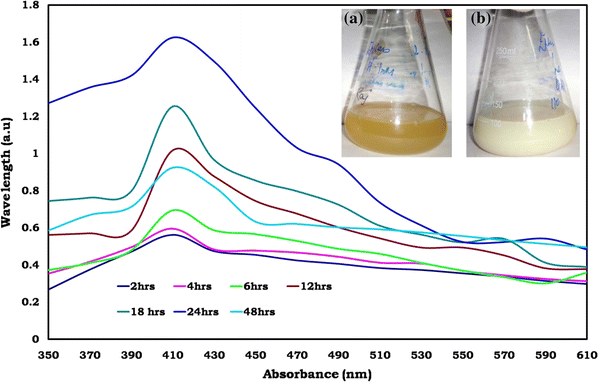
Abstract Development of bio-mediated synthesis of CdS nanoparticles is one of the important fields in nanoparticles. The present investigation demonstrates the eco-friendly synthesis of cadmium sulfide nanoparticles using Enterococcus sp. (RMAA). The formation of an intense peak at 410 nm in the UV–Vis spectrum reveals the synthesis of CdS nanoparticles. The crystalline natures of the synthesized CdS nanoparticles were identified by X-ray diffraction assay. The scanning electron microscope analysis shows the formation of spherical-shaped CdS nanoparticles with a size range of about 50–180 nm. Fourier transform infrared spectrum shows that the synthesized CdS nanoparticles are capped with bimolecular compounds which are responsible for the reduction of cadmium sulfate to sulfide nanoparticles. The resulting CdS nanoparticles were tested for antibacterial activity using agar well diffusion method against the test cultures of Serratia nematodiphila, Escherichia coli, Klebsiella planticola, Vibrio sp. and Planomicrobium sp. having good zone of inhibition. The fungicidal activity of CdS nanoparticles against pathogenic fungus Aspergillus niger and Aspergillus flavus produced a good zone of inhibition. The novel green chemistry approach is an eco-friendly and reliable process and suitable for large-scale production.Keywords
- Enterococcus sp.,
- CdS nanoparticles,
- Semiconductor,
- Extracellular synthesis,
- Antibacterial activity
References
- Albrecht, A: Evaluating dark energy probes using multi-dimensional dark energy parameters. DETF. 0609591, (2006)
- Rajeshkumar et al. (2013) Intracellular and extracellular biosynthesis of silver nanoparticles by using marine bacteria Vibrio alginolyticus (pp. 21-25)
- Malarkodi et al. (2013) Eco-friendly synthesis and characterization of gold nanoparticles using Klebsiella pneumonia https://doi.org/10.1186/2193-8865-3-30
- Malarkodi and Annadurai (2012) A novel biological approach on extra synthesis and characterization of semiconductor Zinc Sulfide nanoparticles (pp. 389-395) https://doi.org/10.1007/s13204-012-0138-0
- Malarkodi et al. (2013) Novel eco-friendly synthesis of titanium oxide nanoparticles by using Planomicrobium sp, and evaluation of its antimicrobial activity 4(3) (pp. 59-66)
- Rajeshkumar et al. (2012) Synthesis and characterization of antimicrobial silver nanoparticles using marine brown seaweed Padina tetrastromatica 4(10) (pp. 511-513)
- Gnanajobitha et al. (2013) Preparation and characterization of fruit-mediated silver nanoparticles using pomegranate extract and assessment of its antimicrobial activity 2(1) (pp. 04-10)
- Falkiewicz-Dulik and Macura (2008) Nanosilver as substance biostabilising footwear materials in the foot mycosis prophylaxis (pp. 145-150)
- Verma et al. (2009) Biosynthesis of noble metal nanoparticles and their application
- Erra, S, Shivakumar, C, Zhao, H, Barri, B, Morel, DL, Frekides, CS: An effective method of Cu incorporation in CdTe solar cells for improved stability. Thin Solid Films
- 515
- (15), 5833–5836 (2007)
- Lakowicz et al. (2002) Emission spectral properties of cadmium sulfide nanoparticles with multiphoton excitation https://doi.org/10.1021/jp0134953
- Ushakov et al. (2006) Optical properties of cadmium sulfide nanoparticles on the surface of polytetrafluoroethylene nanogranules https://doi.org/10.1134/S0030400X06030180
- Venkatram et al. (2005) Nonlinear absorption, scattering and optical limiting studies of CdS nanoparticles https://doi.org/10.1364/OPEX.13.000867
- Bansal et al. (2012) Green synthesis of CdS nanoparticles and effect of capping agent concentration on crystallite size 2(8) (pp. 69-71)
- Chatterjee and Patra (2001) Cadmium sulfide aggregates through reverse micelles https://doi.org/10.1111/j.1151-2916.2001.tb00857.x
- Ghows and Entezari (2010) A novel method for the synthesis of CdS nanoparticles without surfactant https://doi.org/10.1016/j.ultsonch.2010.06.008
- Li Huang et al. (2010) Solvothermal synthesis of nanocrystalline cadmium sulfide
- Villars, P., Calvert, L.D.: Pearson’s Handbook of Crystallographic Data for Intermetallic Phases, vol 2, (1985)
- Rozamond et al. (2004) Bacterial biosynthesis of cadmium sulfide, nanocrystals (pp. 1553-1559) https://doi.org/10.1016/j.chembiol.2004.08.022
- Dunne et al. (2000) Influence of particle size and dissolution conditions on the degradation properties of polylactide-co-glycolide particles (pp. 1659-1668) https://doi.org/10.1016/S0142-9612(00)00040-5
- Mousavi, R.A., Akhavan Sepahy, A., Fazeli, M.R.: Biosynthesis, Purification and characterization of cadmium sulfide nanoparticles using Enterobacteriaceae and their application. In: Proceedings Of The International Conference Nanomaterials, vol. 1, applications and properties, no 1, pp. 2304–1862 (2012)
- Andean et al. (2011) Biosynthesis of gold nanoparticles using dried flowers extract of Achillea wilhelmsii plant 6(3) (pp. 1011-1017)
- Malarkodi et al. (2013) Biosynthesis of semiconductor nanoparticles by using sulfur reducing bacteria 1(2) (pp. 83-91)
- Pandian et al. (2011) Biologically synthesized fluorescent CdS NPs encapsulated by PHB (pp. 319-325) https://doi.org/10.1016/j.enzmictec.2011.01.005
- Sanghi and Verma (2009) A facile green extracellular biosynthesis of CdS nanoparticles by immobilized fungus (pp. 886-891) https://doi.org/10.1016/j.cej.2009.08.006
- Vanaja and Annadurai (2012) Coleus aromaticus leaf extract mediated synthesis of silver nanoparticles and its bactericidal activity (pp. 217-223) https://doi.org/10.1007/s13204-012-0121-9
- Kim et al. (2009) Cinnamon zeylanicum bark extract and powder mediated green synthesis of nano-crystalline silver particles and its bactericidal activity (pp. 332-338) https://doi.org/10.1016/j.colsurfb.2009.05.019
- Shukla et al. (2012) Potent antibacterial activity of nano CdO synthesized via microemulsion scheme 3(4) (pp. 678-685)