
 10.1007/s40097-018-0290-5
Preparation of PANI–CuZnO ternary nanocomposite and investigation of its effects on polyurethane coatings antibacterial, antistatic, and mechanical properties
- Abdolreza Mirmohseni*
 1
1 - Mortaza Rastgar1
- Ali Olad1

Published in Issue 30-11-2018




HTML views: 119
PDF views: 127





Abstract
Abstract
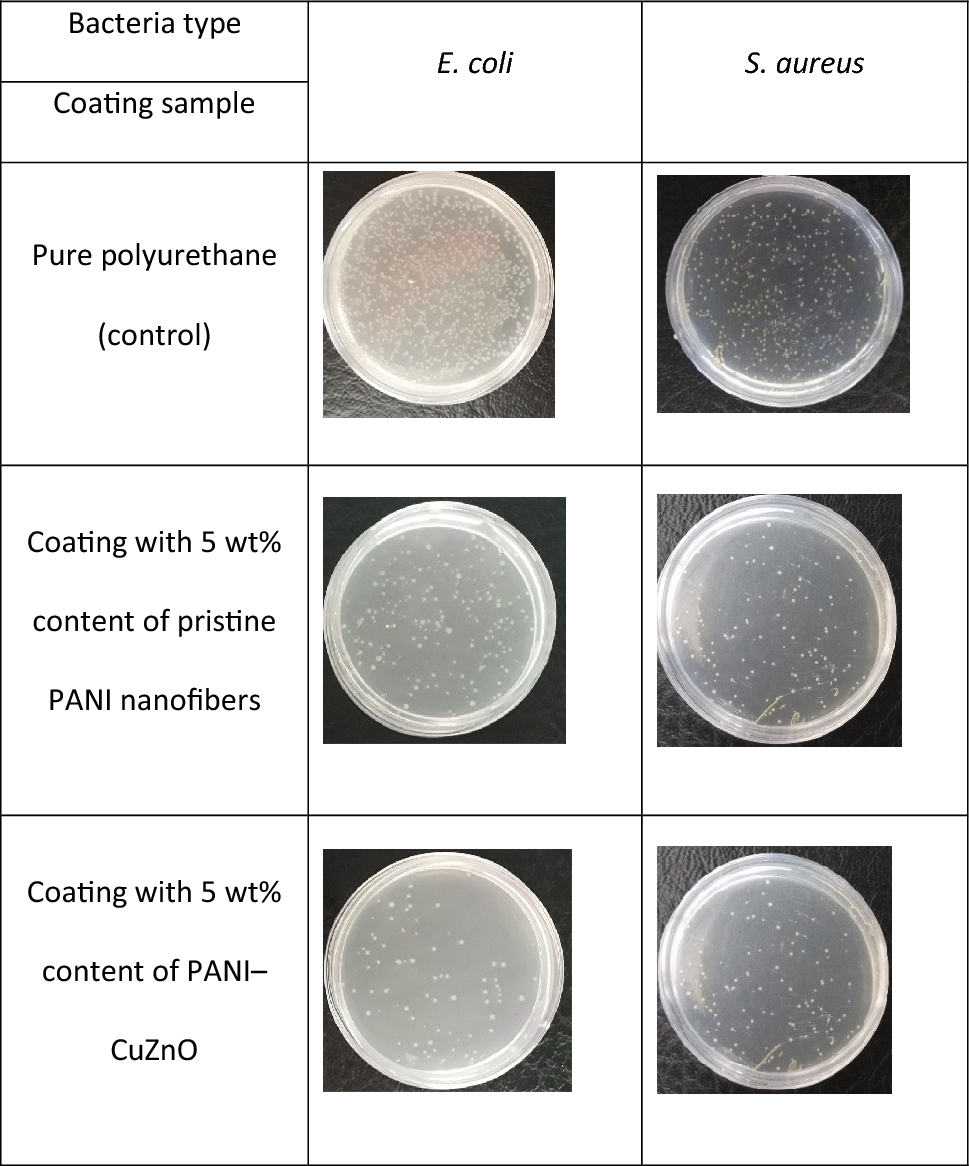
In this study, a facile method for the production of Antibacterial and Antistatic polyurethane coatings was investigated using copper modified ZnO nanoparticles–polyaniline nanofibers (PANI–CuZnO) ternary nanocomposite. PANI–CuZnO ternary nanocomposite was synthesized through two steps. First, copper-modified ZnO nanoparticles were produced through the hydrolysis method using acetate precursors, and then they were mixed with polyaniline nanofibers, which were synthesized by seeding method. The obtained nanocomposite was characterized by FTIR, XRD, and FESEM techniques. Results of evaluating the antibacterial action of the polyurethane coatings with the content of ternary nanocomposite showed that the obtained coatings have a proper antibacterial action against Gram-positive and Gram-negative bacteria. In addition, measuring the coatings’ surface electrical resistance revealed that addition of the ternary nanocomposite to the polyurethane coatings’ matrix causes the surface electrical resistance of the coatings significantly decreases and reaches 8 × 10
7
Ω/sq. Thereby, they could be categorized as an antistatic coating. Moreover, the addition of PANI–CuZnO enhanced adhesion strength and scratch resistance of the final polyurethane coatings.
Graphical abstract
Keywords
- Ternary nanocomposite,
- Modified ZnO nanoparticles,
- Polyaniline nanofibers,
- Antibacterial,
- Antistatic
References
- Gupta and Bahadur (2017) Visible light sensitive mesoporous Cu-substituted ZnO nanoassembly for enhanced photocatalysis, bacterial inhibition, and noninvasive tumor regression (pp. 8702-8709) https://doi.org/10.1021/acssuschemeng.7b01433
- Bogdanovic et al. (2015) Nanomaterial with high antimicrobial efficacy—copper/polyaniline nanocomposite (pp. 1955-1966) https://doi.org/10.1021/am507746m
- Kasithevar et al. (2017) Antibacterial efficacy of silver nanoparticles against multi-drug resistant clinical isolates from post-surgical wound infections (pp. 327-334) https://doi.org/10.1016/j.micpath.2017.04.013
- Saravanan et al. (2014) Extracellular biosynthesis, characterization and antibacterial activity of silver nanoparticles synthesized by Bacillus subtilis (NCIM—2266) (pp. 21-27) https://doi.org/10.1166/jbns.2014.1201
- Wang et al. (2016) Functionalization of MWCNTs with silver nanoparticles decorated polypyrrole and their application in antistatic and thermal conductive epoxy matrix nanocomposite (pp. 31782-31789) https://doi.org/10.1039/C6RA01248E
- Mostafaei and Nasirpouri (2013) Preparation and characterization of a novel conducting nanocomposite blended with epoxy coating for antifouling and antibacterial applications (pp. 679-694) https://doi.org/10.1007/s11998-013-9487-1
- Krishnamurthi et al. (2017) Zinc oxide-supported copper clusters with high biocidal efficacy for Escherichia coli and Bacillus cereus (pp. 2524-2535) https://doi.org/10.1021/acsomega.7b00214
- Vellaichamy et al. (2017) A new in situ synthesized ternary CuNPs-PANI-GO nano composite for selective detection of carcinogenic hydrazine (pp. 156-165) https://doi.org/10.1016/j.snb.2017.01.117
- Kruk et al. (2015) Synthesis and antimicrobial activity of monodisperse copper nanoparticles (pp. 17-22) https://doi.org/10.1016/j.colsurfb.2015.02.009
- Padmavathy et al. (2017) Selective cleavage of the polyphosphoester in crosslinked copper based nanogels: enhanced antibacterial performance through controlled release of copper (pp. 12664-12676) https://doi.org/10.1039/C7NR02446K
- Bhuyan et al. (2015) A comparative study of pure and copper (Cu)-doped ZnO nanorods for antibacterial and photocatalytic applications with their mechanism of action https://doi.org/10.1007/s11051-015-3093-3
- El Saeed et al. (2015) Synthesis of ZnO nanoparticles and studying its influence on the antimicrobial, anticorrosion and mechanical behavior of polyurethane composite for surface coating (pp. 282-289) https://doi.org/10.1016/j.dyepig.2015.05.037
- Jena et al. (2015) Surface functionalized zinc oxide (ZnO) nanoparticle filled organic–inorganic hybrid materials with enhanced thermo-mechanical properties (pp. 82-90) https://doi.org/10.1016/j.porgcoat.2015.05.022
- Jha et al. (2018) Ammonia vapour sensing properties of in situ polymerized conducting PANI-nanofiber/WS 2 nanosheet composites (pp. 735-745) https://doi.org/10.1039/C7NJ03343E
- Ponnaiah et al. (2018) New electrochemical sensor based on a silver-doped iron oxide nanocomposite coupled with polyaniline and its sensing application for picomolar-level detection of uric acid in human blood and urine samples (pp. 3037-3046) https://doi.org/10.1021/acs.jpcb.7b11504
- Yuan et al. (2018) Sepiolite/CNT/S@ PANI composite with stable network structure for high performance lithium sulfur batteries (pp. 17950-17957) https://doi.org/10.1039/C8RA01925H
- Prasankumar et al. (2018) Synthesis and enhanced electrochemical performance of PANI/Fe3O4 nanocomposite as supercapacitor electrode (pp. 466-475) https://doi.org/10.1016/j.jallcom.2018.05.108
- Ramachandran et al. (2017) Removal of elevated level of chromium in groundwater by the fabricated PANI/Fe3O4 nanocomposites (pp. 7490-7498) https://doi.org/10.1007/s11356-017-8465-z
- Lin et al. (2018) Improvement of mechanical properties and anticorrosion performance of epoxy coatings by the introduction of polyaniline/graphene composite https://doi.org/10.1016/j.surfcoat.2018.01.050
- Zhu et al. (2018) The synthesis and antistatic, anticorrosive properties of polyaniline composite coating (pp. 270-279) https://doi.org/10.1016/j.porgcoat.2018.06.004
- Tissera et al. (2018) Heterogeneous in situ polymerization of polyaniline (PANI) nanofibers on cotton textiles: improved electrical conductivity, electrical switching, and tuning properties (pp. 35-44) https://doi.org/10.1016/j.carbpol.2018.01.027
- Mao et al. (2018) Enhanced electrochemical properties of hierarchically sheath-core aligned carbon nanofibers coated carbon fiber yarn electrode-based supercapacitor via polyaniline nanowire array modification (pp. 406-413) https://doi.org/10.1016/j.jpowsour.2018.07.022
- Liu et al. (2013) Conductive polyurethane composites containing polyaniline-coated nano-silica (pp. 138-142) https://doi.org/10.1016/j.jcis.2012.11.028
- Olad and Nosrati (2013) Preparation and corrosion resistance of nanostructured PVC/ZnO–polyaniline hybrid coating (pp. 113-118) https://doi.org/10.1016/j.porgcoat.2012.08.017
- Miao et al. (2017) Preparation of novel Cu/TiO2 mischcrystal composites and antibacterial activities for Escherichia coli under visible light (pp. 9658-9663) https://doi.org/10.1016/j.ceramint.2017.04.137
- Geilich et al. (2015) Silver nanoparticle-embedded polymersome nanocarriers for the treatment of antibiotic-resistant infections (pp. 3511-3519) https://doi.org/10.1039/C4NR05823B
- Zhang et al. (2017) Preparation of antistatic polystyrene superfine powder with polystyrene modified carbon nanotubes as antistatic agent (pp. 1-7) https://doi.org/10.1016/j.compscitech.2016.11.010
- Wang et al. (2017) Preparation of high antistatic HDPE/polyaniline encapsulated graphene nanoplatelet composites by solution blending (pp. 2796-2803) https://doi.org/10.1039/C6RA26458A
- Hosseini and Sefidi (2017) Electrochemical impedance spectroscopy evaluation on the protective properties of epoxy/DBSA doped polyaniline-TiO2 nanocomposite coated mild steel under cathodic polarization (pp. 66-76) https://doi.org/10.1016/j.surfcoat.2017.10.043
- Rana et al. (2014) Influence of surface modification by 2-aminothiophenol on optoelectronics properties of ZnO nanoparticles (pp. 877-891) https://doi.org/10.1080/17458080.2012.736640
- Zhang et al. (2016) One-step synthesis of novel PANI–Fe3O4@ZnO core–shell microspheres: an efficient photocatalyst under visible light irradiation (pp. 486-493) https://doi.org/10.1016/j.apsusc.2016.01.137
- Sharmin et al. (2015) Linseed oil polyol/ZnO bionanocomposite towards mechanically robust, thermally stable, hydrophobic coatings: a novel synergistic approach utilising a sustainable resource (pp. 47928-47944) https://doi.org/10.1039/C5RA03262H