
 10.1007/s40097-015-0166-x
Voltammetric and impedimetric behaviour of phytosynthesized nickel nanoparticles
- Solomon A. Mamuru*
 1
1 - Nurudeen Jaji2
- Electrochemical NanoLab, Department of Chemistry, Adamawa State University, Mubi, 650001, NG
- Electrochemical NanoLab, Department of Chemistry, Adamawa State University, Mubi, 650001, NG Department of Chemistry, Federal College of Education (Technical), Gombe, NG

Published in Issue 18-07-2015
How to Cite
Mamuru, S. A., & Jaji, N. (2015). Voltammetric and impedimetric behaviour of phytosynthesized nickel nanoparticles. Journal of Nanostructure in Chemistry, 5(4 (December 2015). https://doi.org/10.1007/s40097-015-0166-x




HTML views: 12
PDF views: 109
Share:





Abstract
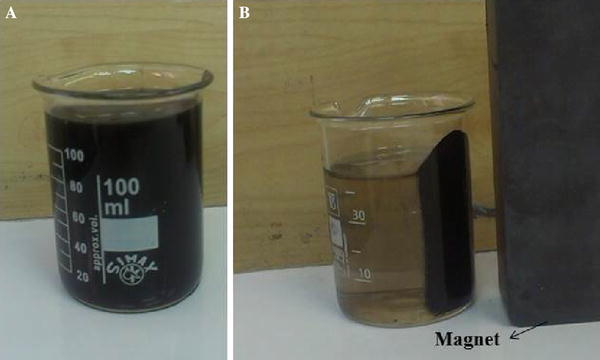
Abstract The biosynthesis of nickel nanoparticles from nickel chloride using Moringa oleifera leaf extract as reducing agent was successfully carried out; the formation of nickel nanoparticles was confirmed by the use of UV–visible spectroscopy, FTIR spectroscopy, atomic force microscopy, cyclic voltammetry and electrochemical impedance spectroscopy techniques. Optical property showed a colour change from faint light blue of the nickel chloride to dark reddish brown of the nickel nanoparticle after addition of the plant extract, while FTIR confirmed the possible biomolecule responsible for the reduction as anthraquinones; the UV–visible spectroscopy showed the wavelength of nickel nanoparticles at 297 nm, and atomic force microscopy gave images of the nickel nanoparticles as aggregate nanoclusters. Voltammetric and impedimetric behaviour of the nickel nanoparticles towards a one-electron-transfer redox probe was interrogated using cyclic voltammetry and impedance spectroscopy. The equivalent electrical circuit used to fit the measured impedance data indicates that the nanoparticles exhibited patterns characteristic of superimposed porous layer. Electron transfer rate constant K s and the apparent heterogeneous electron transfer constant K app were calculated as 6.18 × 10 18 and 1.60 × 10 −3 cm s −1 , respectively. Such high value is an indication of how fast the nickel nanoparticle can transfer electron from the nanoparticle to the underlying platinum electrode, implying that the nanoparticle can be a potential candidate in the fabrication of biosensors and in catalysis.Keywords
- Biomaterial,
- Nanostructures,
- Fourier transform infrared spectroscopy,
- Electrochemical properties
References
- Porta et al. (2000) Metal sols as a useful tool for heterogeneous gold catalyst preparation: reinvestigation of a liquid phase oxidation (pp. 165-172) https://doi.org/10.1016/S0920-5861(00)00370-9
- Hoppe et al. (2006) One-step synthesis of gold and silver hydrosols using poly(N-vinyl-2-pyrrolidone) as a reducing agent (pp. 7027-7034) https://doi.org/10.1021/la060885d
- Lyon et al. (2004) Synthesis of Fe oxide core/Au shell nanoparticles by iterative hydroxylamine seeding (pp. 719-723) https://doi.org/10.1021/nl035253f
- Lu et al. (2007) In situ formation of Ag nanoparticles in spherical polyacrylic acid brushes by UV-irradiation (pp. 7676-7681) https://doi.org/10.1021/jp070973m
- Swihart (2003) Vapour-phase synthesis of nanoparticles (pp. 127-133) https://doi.org/10.1016/S1359-0294(03)00007-4
- Eustis and El-Sayed (2006) Why gold nanoparticles are more precious than pretty gold: noble metal surface plasmon resonance and its enhancement of the radiative and nonradiative properties of nanocrystals of different shapes (pp. 209-217) https://doi.org/10.1039/B514191E
- Joerger et al. (2000) Biologically produced Ag-C composite for optically functional thin film coatings (pp. 407-409) https://doi.org/10.1002/(SICI)1521-4095(200003)12:6<407::AID-ADMA407>3.0.CO;2-O
- Ingle et al. (2009) Fusarium solani: a novel biological agent for the extracellular synthesis of silver nanoparticles (pp. 2079-2085) https://doi.org/10.1007/s11051-008-9573-y
- Lee et al. (2011) Biological synthesis of copper nanoparticles using plant extract (pp. 371-374)
- Govindaraju et al. (2010) Biogenic silver nanoparticles by Solanum torvum and thier promising antibacterial activity (pp. 394-399)
- Gopinath et al. (2013) Phytosynthesis of silver nanoparticles using Pterocarpus santalinus leaf extract and their antibacterial properties https://doi.org/10.1186/2193-8865-3-68
- Gaware et al. (2012) Ecofriendly synthesis of anisotropic gold nanoparticles: a potential candidate of SERS studies (pp. 6-12) https://doi.org/10.1155/2012/276246
- Adekunle and Ozoemena (2010) Electron transport and electrocatalytic properties of MWCNT/nickel nanocomposites: hydrazine and diethyl aminoethanethiol as analytical probes (pp. 41-49) https://doi.org/10.1016/j.jelechem.2010.04.010
- Babu et al. (2013) Green synthesized nickel nanoparticles modified electrode in ionic liquid medium and its application towards determination of biomolecules (pp. 135-143) https://doi.org/10.1016/j.talanta.2013.02.025
- Salimi et al. (2008) Highly sensitive sensor for picomolar detection of insulin at physiological pH, using GC electrode modified with guanine and electrodeposited nickel oxide nanoparticles (pp. 792-798) https://doi.org/10.1016/j.bios.2008.06.046
- Vinod et al. (2011) A facile synthesis and characterisation of Ag, Au and Pt nanoparticles using a natural hydrocolloid gum kondagogu (Cochlospermum gossypium) (pp. 291-298) https://doi.org/10.1016/j.colsurfb.2010.11.035
- MubarakAli et al. (2011) Plant extract mediated synthesis of silver and gold nanoparticles and its antibacterial activity against clinically isolated pathogens (pp. 360-365) https://doi.org/10.1016/j.colsurfb.2011.03.009
- Patil et al. (2012) Bioisnpired synthesis of highly stabilized silver nanoparticles using Ocimum tenuiflorum leaf extract and their antibacterial activity (pp. 234-238) https://doi.org/10.1016/j.saa.2012.02.009
- Narayanan and Sakthivel (2011) Green synthesis of biogenic metal nanoparticles by terrestial and aquatic phototrophic and heterotrophic eukaryotes and biocompatible agents (pp. 59-79) https://doi.org/10.1016/j.cis.2011.08.004
- Lukman et al. (2011) Facile synthesis, stabilization and anti-bacterial performance of discrete Ag nanoparticles using medicago sativa seed exudates (pp. 433-444) https://doi.org/10.1016/j.jcis.2010.09.088
- Kreibig and Volmer (1995) Springer https://doi.org/10.1007/978-3-662-09109-8
- Baia et al. (2007) Structural properties of silver nanoclusters-phosphate glass composites (pp. 313-318) https://doi.org/10.1016/j.vibspec.2006.03.006
- Smitha et al. (2008) Studies on surface plasmon resonance and photoluminescence of silver nanoparticles (pp. 186-190) https://doi.org/10.1016/j.saa.2007.12.002
- Rodriguez et al. (1998) Simultaneous determination of iron, nickel and cobalt by UV-visible spectrophotometry with multivariate calibration (pp. 463-470) https://doi.org/10.1016/S0039-9140(98)00157-X
- Patnaik (2004) McGraw Hill
- Kasolo et al. (2010) Phytochemicals and uses of Moringa oleifera leaves in Ugandan rural communities (pp. 753-757)
- Ramesh et al. (1998) Atomic force microscopy investigation of the surface topography and adhesion of nickel nanoparticles to submicrospherical silica (pp. 461-467) https://doi.org/10.1016/S0009-2614(97)01446-2
- Hou et al. (2005) Size-controlled synthesis of nickel nanoparticles (pp. 218-222) https://doi.org/10.1016/j.apsusc.2004.09.045
- Lin et al. (2013) A highly sensitive nonenzymatic glucose sensor based on multi-walled carbon nanotube with nickel and copper nanoparticles (pp. 164-172) https://doi.org/10.1016/j.electacta.2013.02.098
- Davies and Compton (2005) The cyclic and linear sweep voltammetry of regular and random arrays of microdisc electrodes: theory (pp. 63-82) https://doi.org/10.1016/j.jelechem.2005.07.022
- Davies et al. (2005) Voltammetry at spatially heterogeneous electrodes (pp. 797-808) https://doi.org/10.1007/s10008-005-0699-x
- Mamuru and Ozoemena (2010) Heterogeneous electron transfer and oxygen reduction reaction at nanostructured iron(II)phthalocyanine and its MWCNTs nanocomposites (pp. 985-994) https://doi.org/10.1002/elan.200900438
- Mamuru et al. (2010) Iron(II) tetrakis (diaquaplatinum) octacarboxyphthalocyanine supported on multi-walled carbon nanotubes platform: an efficient functional material for enhancing electron transfer kinetics and electrocatalytic oxidation of formic acid (pp. 10705-10715) https://doi.org/10.1039/c0jm02210a
- Mamuru and Ozoemena (2009) Impedimetric and electrocatalytic properties of nanostructured iron(II) phthalocyanine at pyrolytic graphite electrode (pp. 113-119) https://doi.org/10.1016/j.matchemphys.2008.08.078
- Orazem and Tribollet (2008) Wiley https://doi.org/10.1002/9780470381588
- Laviron (1979) General expression of the linear potential sweep voltammogram in the case of diffusion less electrochemical systems (pp. 19-28) https://doi.org/10.1016/S0022-0728(79)80075-3