
 10.1007/s40097-022-00517-x
Dual-functional cobalt phosphide nanoparticles for performance enhancement of lithium-sulfur battery
- Haixing Liu
 1
1 - Xiaofei Wang1
- Qian Wang2
- Chenchen Pei1
- Hui Wang3
- Shouwu Guo*4

Published in Issue 01-10-2022

This work is licensed under a Creative Commons Attribution 4.0 International License.









Abstract
Abstract
Metal phosphides fabricated using metal organic frameworks (MOF) have recently been widely studied in lithium-sulfur (Li–S) battery because of the unique microstructure and electrocatalytic activity. However, the growth of MOF is very rapid and the particle size mainly focuses on micrometer, which severely limits the catalytic effect. Herein, we fabricate nanoscale MOF embedded with carbon nanotube (CNT), owing to the ultra-small CoP (25 nm, denoted as S-CoP) derived from the phosphating of MOF and unique network of CNT, the designed micro-nano structure S-CoP/CNT accelerates the conversion of lithium polysulfides (LiPSs), boosts the precipitation/decomposition processes of lithium sulfide (Li
2
S) and provides an effective adsorption barrier. Meanwhile, the fabricated S-CoP/CNT separator endows an ultralong dendrite-free Li deposition up to 1714 h. The Li–S battery with S-CoP/CNT modified separator can deliver an initial capacity of 1513.22 mAh g
−1
at 0.1 °C, a reversibility capacity of 574.95 mAh g
−1
up to 500 cycles at 0.5 °C. The satisfactory performance is also verified at a high sulfur loading of 4.2 mg cm
−2
and a favorable initial capacity of 1161.8 mAh g
−1
can be maintained. This study provides a facile strategy to fabricate nano metal phosphides derived from MOF for Li–S battery.
Graphical abstract
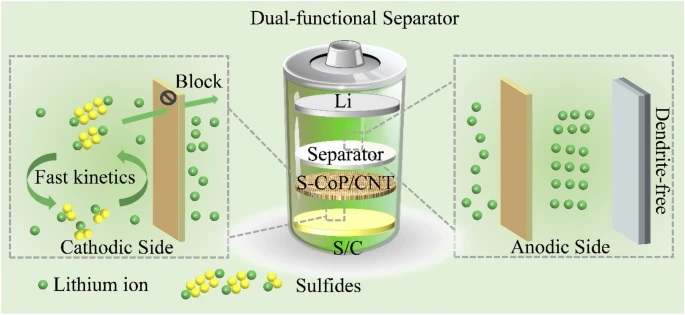
The S-CoP/CNT can not only promotes the electrolyte infiltration into the dual-functional separator, accelerates the redox kinetics of LiPSs and suppresses the corresponding shuttle effect, but also homogenizes the Li-ion distribution and leads to the dendrite-free lithium deposition.
Keywords
- Li–S battery,
- Shuttle effect,
- Small size,
- Modified separator,
- Transition metal phosphides
References
- Huang et al. (2014) Manipulating surface reactions in lithium-sulphur batteries using hybrid anode structures https://doi.org/10.1038/ncomms4015
- Zhao et al. (2021) Regulation of carbon distribution to construct high-sulfur-content cathode in lithium-sulfur batteries (pp. 203-208) https://doi.org/10.1016/j.jechem.2020.07.054
- Moon et al. (2013) Encapsulated monoclinic sulfur for stable cycling of Li-S rechargeable batteries (pp. 6547-6553) https://doi.org/10.1002/adma.201303166
- Osada et al. (2016) The design of nanostructured sulfur cathodes using layer by layer assembly (pp. 1668-1673) https://doi.org/10.1039/C6EE00444J
- Song et al. (2021) Prussian blue analogs derived Fe-Ni-P@nitrogen-doped carbon composites as sulfur host for high-performance lithium-sulfur batteries (pp. 51-58) https://doi.org/10.1016/j.jcis.2021.03.125
- Gao et al. (2021) SnP0.94 nanodots confined carbon aerogel with porous hollow superstructures as an exceptional polysulfide electrocatalyst and “adsorption nest” to enable enhanced lithium-sulfur batteries https://doi.org/10.1016/j.cej.2021.129724
- Gao et al. (2022) Nanopolyhedron Co–C/Cores triggered carbon nanotube in-situ growth inside carbon aerogel shells for fast and long-lasting lithium-sulfur batteries https://doi.org/10.1016/j.jpowsour.2021.230913
- Gao et al. (2020) Porous hollow carbon aerogel-assembled core@polypyrrole nanoparticle shell as an efficient sulfur host through a tunable molecular self-assembly method for rechargeable lithium/sulfur batteries (pp. 15822-15833) https://doi.org/10.1021/acssuschemeng.0c02456
- Guo et al. (2018) 3D CNTs/Graphene-S-Al3Ni2 cathodes for high-sulfur-loading and long-life lithium-sulfur batteries https://doi.org/10.1002/advs.201800026
- Zhao et al. (2021) Enhanced sulfur redox kinetics and polysulfide regulations with petal-like nickel hydroxide nanosheets/rGO modified separators in Li-S batteries https://doi.org/10.1016/j.apsusc.2021.149393
- Hu et al. (2015) In situ polymerized PAN-assisted S/C nanosphere with enhanced high-power performance as cathode for lithium/sulfur batteries (pp. 5116-5123) https://doi.org/10.1021/acs.nanolett.5b01294
- Luo et al. (2021) Bimetal CoNi active sites on mesoporous carbon nanosheets to kinetically boost lithium-sulfur batteries https://doi.org/10.1002/smll.202100414
- Ni et al. (2021) A Graphene/WO3 nanowire composite with enhanced capture and polysulfides conversion catalysis for high-performance Li-S batteries (pp. 335-347) https://doi.org/10.1016/j.carbon.2021.05.056
- Li et al. (2020) Tuning the band structure of MoS2 via Co9S8@MoS2 core-shell structure to boost catalytic activity for lithium-sulfur batteries (pp. 17285-17294) https://doi.org/10.1021/acsnano.0c07332
- Zhao et al. (2021) Synergetic effect of spatially separated dual co-catalyst for accelerating multiple conversion reaction in advanced lithium sulfur batteries https://doi.org/10.1016/j.nanoen.2020.105621
- Luo et al. (2022) One dimensional carbon-based composites as cathodes for lithium-sulfur battery (pp. 101-120) https://doi.org/10.1016/j.jmst.2021.12.048
- Tong et al. (2021) Defective graphitic carbon nitride modified separators with efficient polysulfide traps and catalytic sites for fast and reliable sulfur electrochemistry https://doi.org/10.1002/adfm.202010455
- Wen et al. (2021) Rational design of 3D hierarchical MXene@AlF3/Ni(OH)2 nanohybrid for high-performance lithium-sulfur batteries https://doi.org/10.1016/j.cej.2020.128102
- Wang et al. (2021) Immobilizing polysulfide via multiple active sites in W18O49 for Li-S batteries by oxygen vacancy engineering (pp. 422-429) https://doi.org/10.1016/j.ensm.2021.09.020
- Wen et al. (2021) Hierarchical nMOF-867/MXene nanocomposite for chemical adsorption of polysulfides in lithium-sulfur batteries (pp. 8231-8241) https://doi.org/10.1021/acsaem.1c01481
- Tan et al. (2020) Mai, L: Revealing the origin of highly efficient polysulfide anchoring and transformation on anion-substituted vanadium nitride host https://doi.org/10.1002/adfm.202008034
- Yan et al. (2021) Coupling highly dispersed Sb2S3 nanodots with nitrogen/sulfur dual-doped porous carbon nanosheets for efficient immobilization and catalysis of polysulfides conversion https://doi.org/10.1016/j.cej.2020.127688
- Guo et al. (2022) Ultralong cycle life enabled by in situ growth of CoMo1-xP/Mo heterostructure for lithium-sulfur batteries (pp. 5-12) https://doi.org/10.1016/j.jechem.2022.05.025
- Zhao et al. (2021) Understanding the modulation effect and surface chemistry in a heteroatom incorporated graphene-like matrix toward high-rate lithium-sulfur batteries (pp. 14777-14784) https://doi.org/10.1039/D1NR03390E
- Wang et al. (2021) Hollow nickel-cobalt bimetal phosphides as a confined polysulfide reactor for high-performance lithium-sulfur batteries https://doi.org/10.1016/j.electacta.2021.139303
- Zhou et al. (2018) Deciphering the modulation essence of p bands in Co-based compounds on Li-S chemistry (pp. 2681-2693) https://doi.org/10.1016/j.joule.2018.08.010
- Chen et al. (2019) Co-Fe mixed metal phosphide nanocubes with highly interconnected-pore architecture as an efficient polysulfide mediator for lithium-sulfur batteries (pp. 4731-4741) https://doi.org/10.1021/acsnano.9b01079
- Li et al. (2020) Enhancing Li-S redox kinetics by fabrication of a three dimensional Co/CoP@nitrogen-doped carbon electrocatalyst https://doi.org/10.1016/j.cej.2019.122595
- Gu et al. (2020) MOF-derived Ni-doped CoP@C grown on CNTs for high-performance supercapacitors https://doi.org/10.1016/j.cej.2019.123454
- Cheng et al. (2020) Enhancing adsorption and reaction kinetics of polysulfides using CoP-coated N-doped mesoporous Carbon for High-Energy-Density Lithium-Sulfur Batteries (pp. 43844-43853) https://doi.org/10.1021/acsami.0c13601
- Chen et al. (2018) A multi-shelled CoP nanosphere modified separator for highly efficient Li-S batteries (pp. 13694-13701) https://doi.org/10.1039/C8NR03854F
- Huang et al. (2018) Regulating the polysulfide redox conversion by iron phosphide nanocrystals for high-rate and ultrastable lithium-sulfur battery (pp. 340-348) https://doi.org/10.1016/j.nanoen.2018.06.052
- Hanif et al. (2019) ZIF derived PtNiCo/NC cathode catalyst for proton exchange membrane fuel cell https://doi.org/10.1016/j.apcatb.2019.117947
- Zhong et al. (2018) Surface chemistry in cobalt phosphide-stabilized lithium-sulfur batteries (pp. 1455-1459) https://doi.org/10.1021/jacs.7b11434
- Wang et al. (2021) Thickness-independent scalable high-performance Li-S batteries with high areal sulfur loading via electron-enriched carbon framework https://doi.org/10.1038/s41467-021-24873-4
- Cui et al. (2020) An atomic-confined-space separator for high performance lithium-sulfur batteries (pp. 1896-1903) https://doi.org/10.1039/C9TA11250B
- Zhou et al. (2017) Catalytic oxidation of Li2S on the surface of metal sulfides for Li-S batteries (pp. 840-845) https://doi.org/10.1073/pnas.1615837114
- Song et al. (2019) Rationalizing electrocatalysis of Li-S chemistry by mediator design: progress and prospects https://doi.org/10.1002/aenm.201901075
- Xie et al. (2019) Implanting atomic cobalt within mesoporous carbon toward highly stable lithium-sulfur batteries https://doi.org/10.1002/adma.201903813
- Zhou et al. (2021) Rational design of the lotus-like N-Co2VO4-Co heterostructures with well-defined Interfaces in suppressing the shuttle effect and dendrite growth in lithium-sulfur batteries https://doi.org/10.1002/smll.202104109
- Ye et al. (2020) Curbing polysulfide shuttling by synergistic engineering layer composed of supported Sn4P3 nanodots electrocatalyst in lithium-sulfur batteries https://doi.org/10.1016/j.nanoen.2020.104532
- Yao et al. (2021) ZnS-SnS@NC heterostructure as robust lithiophilicity and sulfiphilicity mediator toward high-rate and long-life lithium-sulfur batteries (pp. 7114-7130) https://doi.org/10.1021/acsnano.1c00270
- Tong et al. (2022) Simultaneously achieving fast sulfur redox kinetics and high-loading in lithium-sulfur batteries (pp. 451-461) https://doi.org/10.1016/j.carbon.2021.11.031
- Huang et al. (2019) Sandwich-like ultrathin TiS2 nanosheets confined within N, S Codoped porous carbon as an effective polysulfide promoter in lithium-sulfur batteries https://doi.org/10.1002/aenm.201901872