
 10.1007/s40097-022-00483-4
Facile synthesis of molybdenum disulfide adorned heteroatom-doped porous carbon for energy storage applications
- Somasundaram Chandra Kishore
 1
1 - Raji Atchudan2
- Suguna Perumal3
- Thomas Nesakumar Jebakumar Immanuel Edison2
- Ashok K. Sundramoorthy4
- Rajangam Vinodh5
- Muthulakshmi Alagan6
- Yong Rok Lee*2

Published in Issue 08-03-2022
Copyright (c) 2025 Somasundaram Chandra Kishore, Raji Atchudan, Suguna Perumal, Thomas Nesakumar Jebakumar Immanuel Edison, Ashok K. Sundramoorthy, Rajangam Vinodh, Muthulakshmi Alagan, Yong Rok Lee (Author)

This work is licensed under a Creative Commons Attribution 4.0 International License.









Abstract
Abstract
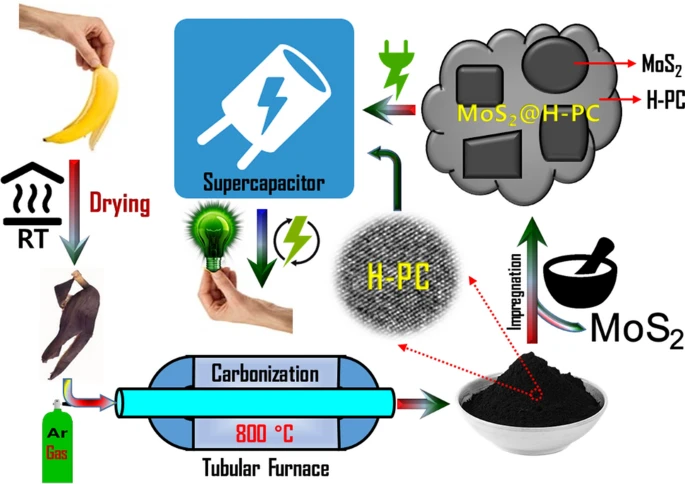
The rising energy demand and fossil-fuel use, along with growing environmental pollution, need the creation and development of innovative, ecologically friendly, and renewable high-performance energy storage systems. The key requirements of sustainable translation of biomass waste into a cost-effective and high-performance supercapacitor have become a primary concern to overcome the existing pitfalls. The current work outlines the large-scale synthesis of greater energy density, quicker charging, and superior long-term supercapacitor electrodes using banana peel as a heteroatom-doped carbon (H-PC) precursor that is both sustainable and economical. Dried banana peel carbonized at 800 °C for 2 h under the argon atmosphere was homogeneously mixed 20 wt% of MoS
2
by the dry-impregnation method. Few layers of MoS
2
-decorated H-PC (MoS
2
@H-PC) composite owning micro/mesoporous structure, and satisfactory surface area (210 m
2
g
−1
) was fabricated as the active electrode material to examine the electrochemical properties. MoS
2
@H-PC exhibited significant faradaic reactions and electrostatic adsorption due to the presence of numerous electrochemical active sites leading to a profound specific capacitance of 408 F g
−1
at a current density of 1 A g
−1
. Exploiting the unique heterostructure and the synergy of nitrogen atoms, MoS
2
, and carbon layers, MoS
2
@H-PC reveals impressive cyclic stability with 90% capacitance retention beyond 10,000 cycles. This study paves the path for the future development of high energy density and robust supercapacitors from various agricultural waste products and landfills.
Graphical abstract
Keywords
- Banana peel,
- Biomass,
- Porous carbon,
- Molybdenum disulfide,
- Supercapacitor,
- Energy storage
References
- Chen et al. (2009) Progress in electrical energy storage system: a critical review (pp. 291-312) https://doi.org/10.1016/j.pnsc.2008.07.014
- Valadi et al. (2021) Metal oxide electron transport materials for perovskite solar cells: a review (pp. 2185-2207) https://doi.org/10.1007/s10311-020-01171-x
- Abdel Maksoud et al. (2021) Advanced materials and technologies for supercapacitors used in energy conversion and storage: a review (pp. 375-439) https://doi.org/10.1007/s10311-020-01075-w
- Sanad et al. (2020) Thermoelectric energy harvesters: a review of recent developments in materials and devices for different potential applications (pp. 1-43)
- Dai et al. (2022) A strategy for high performance of energy storage and transparency in KNN-based ferroelectric ceramics https://doi.org/10.1016/j.cej.2021.131959
- Zhang et al. (2022) Mo6+–P5+ co-doped Li2ZnTi3O8 anode for Li-storage in a wide temperature range and applications in LiNi0.5Mn1.5O4/Li2ZnTi3O8 full cells (pp. 35-43) https://doi.org/10.1039/D1QI01077H
- Ren et al. (2015) Review of electrical energy storage system for vehicular applications (pp. 225-236) https://doi.org/10.1016/j.rser.2014.08.003
- Yu et al. (2019) Biomass-derived materials for electrochemical energy storage and conversion: overview and perspectives (pp. 55-67) https://doi.org/10.1002/eem2.12030
- Wang et al. (2012) A review of electrode materials for electrochemical supercapacitors (pp. 797-828) https://doi.org/10.1039/C1CS15060J
- Vinodh et al. (2020) Novel electrode material derived from porous polymeric organic framework of phloroglucinol and terephthaldehyde for symmetric supercapacitors https://doi.org/10.1016/j.est.2020.101283
- Zuo et al. (2017) Silicon based lithium-ion battery anodes: a chronicle perspective review (pp. 113-143) https://doi.org/10.1016/j.nanoen.2016.11.013
- Fayed et al. (2021) Carbon and nitrogen co-doped MoS2 nanoflakes as an electrode material for lithium-ion batteries and supercapacitors
- Zhang et al. (2016) A novel aluminum-graphite dual-ion battery https://doi.org/10.1002/aenm.201502588
- Ji et al. (2017) A novel potassium-ion-based dual-ion battery https://doi.org/10.1002/adma.201700519
- Mu et al. (2020) Molecular grafting towards high-fraction active nanodots implanted in N-doped carbon for sodium dual-ion batteries https://doi.org/10.1093/nsr/nwaa178
- Wang et al. (2011) A review of polymer electrolyte membrane fuel cells: technology, applications, and needs on fundamental research (pp. 981-1007) https://doi.org/10.1016/j.apenergy.2010.09.030
- González et al. (2016) Review on supercapacitors: technologies and materials (pp. 1189-1206) https://doi.org/10.1016/j.rser.2015.12.249
- Atchudan et al. (2019) Direct growth of iron oxide nanoparticles filled multi-walled carbon nanotube via chemical vapour deposition method as high-performance supercapacitors (pp. 2349-2360) https://doi.org/10.1016/j.ijhydene.2018.08.183
- Wang et al. (2010) Ni (OH) 2 nanoplates grown on graphene as advanced electrochemical pseudocapacitor materials (pp. 7472-7477) https://doi.org/10.1021/ja102267j
- Mefford et al. (2014) Anion charge storage through oxygen intercalation in LaMnO 3 perovskite pseudocapacitor electrodes (pp. 726-732) https://doi.org/10.1038/nmat4000
- Li et al. (2013) Amorphous nickel hydroxide nanospheres with ultrahigh capacitance and energy density as electrochemical pseudocapacitor materials (pp. 1-7)
- Zhang et al. (2015) NiCo2S4/Ni (OH) 2 core-shell heterostructured nanotube arrays on carbon-fabric as high-performance pseudocapacitor electrodes (pp. 870-875) https://doi.org/10.1016/j.apsusc.2015.05.084
- Bryan et al. (2016) Conducting polymers for pseudocapacitive energy storage (pp. 5989-5998) https://doi.org/10.1021/acs.chemmater.6b01762
- Miller et al. (2010) Graphene double-layer capacitor with ac line-filtering performance (pp. 1637-1639) https://doi.org/10.1126/science.1194372
- Edison et al. (2021) Electrochemically exfoliated graphene sheets as electrode material for aqueous symmetric supercapacitors https://doi.org/10.1016/j.surfcoat.2021.127150
- Atchudan et al. (2019) Electrocatalytic and energy storage performance of bio-derived sulphur-nitrogen-doped carbon (pp. 357-369) https://doi.org/10.1016/j.jelechem.2018.12.007
- Wu et al. (2014) Synthesis of starch-derived mesoporous carbon for electric double layer capacitor (pp. 166-172) https://doi.org/10.1016/j.cej.2014.02.023
- Largeot et al. (2008) Relation between the ion size and pore size for an electric double-layer capacitor (pp. 2730-2731) https://doi.org/10.1021/ja7106178
- Zhang et al. (2020) Eco-friendly and scalable synthesis of micro-/mesoporous carbon sub-microspheres as competitive electrodes for supercapacitors and sodium-ion batteries https://doi.org/10.1016/j.apsusc.2020.147511
- Qu et al. (2015) Highly ordered nitrogen-rich mesoporous carbon derived from biomass waste for high-performance lithium–sulfur batteries (pp. 399-408) https://doi.org/10.1016/j.carbon.2014.12.001
- Ji et al. (2016) Green processing of plant biomass into mesoporous carbon as catalyst support (pp. 301-308) https://doi.org/10.1016/j.cej.2016.03.033
- Lu et al. (2017) Biomass-derived heteroatoms-doped mesoporous carbon for efficient oxygen reduction in microbial fuel cells (pp. 350-356) https://doi.org/10.1016/j.bios.2017.07.006
- Ma et al. (2014) Sugar-derived carbon/graphene composite materials as electrodes for supercapacitors (pp. 566-572) https://doi.org/10.1016/j.electacta.2013.11.028
- Chen et al. (2020) Rice husk-based hierarchical porous carbon for high performance supercapacitors: The structure-performance relationship (pp. 432-444) https://doi.org/10.1016/j.carbon.2020.01.088
- Mondal et al. (2017) Naturally nitrogen doped porous carbon derived from waste shrimp shells for high-performance lithium ion batteries and supercapacitors (pp. 72-80) https://doi.org/10.1016/j.micromeso.2017.03.019
- Liu et al. (2018) Nitrogen-doped hierarchical porous carbon from wheat straw for supercapacitors (pp. 11595-11605) https://doi.org/10.1021/acssuschemeng.8b01798
- Atchudan et al. (2017) Green synthesis of nitrogen-doped graphitic carbon sheets with use of Prunus persica for supercapacitor applications (pp. 276-286) https://doi.org/10.1016/j.apsusc.2016.10.030
- Xu et al. (2021) Banana peel derived nitrogen-doped porous carbon with enhanced electrocatalytic activity for complete oxidation of methanol under room temperature https://doi.org/10.1016/j.snb.2021.130112
- Tjahjanti, P., Luliafan, M., Fahruddin, A., Ernanda, R.: J. Phys.: Confer. Ser. 012174 (IOP Publishing)
- Li et al. (2020) Deep insight into the pore size distribution of N-doped porous carbon materials on electrochemical energy storage and CO2 sorption https://doi.org/10.1016/j.diamond.2020.107802
- Li et al. (2017) Hierarchically porous carbon derived from banana peel for lithium sulfur battery with high areal and gravimetric sulfur loading (pp. 160-167) https://doi.org/10.1016/j.jpowsour.2017.07.038
- Gao et al. (2020) Energy density-enhancement mechanism and design principles for heteroatom-doped carbon supercapacitors https://doi.org/10.1016/j.nanoen.2020.104666
- Li et al. (2015) Emerging energy applications of two-dimensional layered transition metal dichalcogenides (pp. 293-305) https://doi.org/10.1016/j.nanoen.2015.10.023
- Dutta and De (2018) MoS2 nanosheet/rGO hybrid: an electrode material for high performance thin film supercapacitor (pp. 9771-9775) https://doi.org/10.1016/j.matpr.2017.10.165
- Wang et al. (2019) A core-sheath holey graphene/graphite composite fiber intercalated with MoS2 nanosheets for high-performance fiber supercapacitors (pp. 493-501) https://doi.org/10.1016/j.electacta.2019.03.084
- Muduli et al. (2021) Polypyrrole-MoS2 nanopetals as efficient anode material for lead-based hybrid ultracapacitors https://doi.org/10.1149/1945-7111/abfd77
- Tiwari et al. (2021) Self-standing MoS2/CNT and MnO2/CNT one dimensional core shell heterostructures for asymmetric supercapacitor application (pp. 291-303) https://doi.org/10.1016/j.carbon.2021.02.080
- Atchudan et al. (2019) Betel-derived nitrogen-doped multicolor carbon dots for environmental and biological applications https://doi.org/10.1016/j.molliq.2019.111817
- Mao et al. (2014) High electrochemical performance based on the TiO2 nanobelt@few-layered MoS2 structure for lithium-ion batteries (pp. 12350-12353) https://doi.org/10.1039/C4NR03991B
- Berntsen et al. (2003) A solvothermal route to high-surface-area nanostructured MoS2 (pp. 4498-4502) https://doi.org/10.1021/cm0311170
- Li and Nakamura (2018) Structural change of molybdenum sulfide facilitates the electrocatalytic hydrogen evolution reaction at neutral pH as revealed by in situ Raman spectroscopy (pp. 401-406) https://doi.org/10.1016/S1872-2067(17)62945-0
- Atchudan et al. (2019) An ultrasensitive photoelectrochemical biosensor for glucose based on bio-derived nitrogen-doped carbon sheets wrapped titanium dioxide nanoparticles (pp. 160-169) https://doi.org/10.1016/j.bios.2018.10.049
- Atchudan et al. (2017) Facile green synthesis of nitrogen-doped carbon dots using Chionanthus retusus fruit extract and investigation of their suitability for metal ion sensing and biological applications (pp. 497-509) https://doi.org/10.1016/j.snb.2017.02.119
- Wang et al. (2015) An advanced MoS2/carbon anode for high-performance sodium-ion batteries (pp. 473-481) https://doi.org/10.1002/smll.201401521
- Jiang et al. (2015) 2D monolayer MoS2–carbon interoverlapped superstructure: engineering ideal atomic interface for lithium ion storage (pp. 3687-3695) https://doi.org/10.1002/adma.201501059
- Zhu et al. (2021) Porous N-doped carbon/MnO2 nanoneedles for high performance ionic liquid-based supercapacitors https://doi.org/10.1016/j.matlet.2021.129837
- Eda et al. (2011) Photoluminescence from chemically exfoliated MoS2 (pp. 5111-5116) https://doi.org/10.1021/nl201874w
- Jin et al. (2016) MoS 2 quantum dot decorated gC 3 N 4 composite photocatalyst with enhanced hydrogen evolution performance (pp. 52611-52619) https://doi.org/10.1039/C6RA07060D
- Bai et al. (2019) Glucose-induced synthesis of 1T-MoS2/C hybrid for high-rate lithium-ion batteries https://doi.org/10.1002/smll.201805420
- Atchudan et al. (2016) Nitrogen-doped carbon dots originating from unripe peach for fluorescent bioimaging and electrocatalytic oxygen reduction reaction (pp. 8-18) https://doi.org/10.1016/j.jcis.2016.07.058
- Santhoshkumar and Murugan (2021) Rationally designed SERS AgNPs/GO/g-CN nanohybrids to detect methylene blue and Hg2+ ions in aqueous solution https://doi.org/10.1016/j.apsusc.2021.149544
- Rajagopalan and Chung (2014) Reduced chemically modified graphene oxide for supercapacitor electrode (pp. 1-10) https://doi.org/10.1186/1556-276X-9-535
- Jebakumar Immanuel Edison et al. (2017) Green synthesized N-doped graphitic carbon sheets coated carbon cloth as efficient metal free electrocatalyst for hydrogen evolution reaction (pp. 14390-14399) https://doi.org/10.1016/j.ijhydene.2017.04.228
- Ratnayake et al. (2019) Carbon quantum dots-decorated nano-zirconia: a highly efficient photocatalyst (pp. 23-30) https://doi.org/10.1016/j.apcata.2018.10.022
- Murugan et al. (2019) Highly sensitive, stable g-CN decorated with AgNPs for SERS sensing of toluidine blue and catalytic reduction of crystal violet (pp. 5294-5310) https://doi.org/10.1007/s10853-018-3184-5
- Murugan et al. (2021) Hydrothermal synthesis, characterization and electrochemical behavior of NiMoO4 nanoflower and NiMoO4/rGO nanocomposite for high-performance supercapacitors https://doi.org/10.1016/j.electacta.2021.138973
- Murugan and Dhamodharan (2021) Separate and simultaneous determination of vanillin, theophylline and caffeine using molybdenum disulfide embedded polyaniline/graphitic carbon nitrite nanocomposite modified glassy carbon electrode https://doi.org/10.1016/j.diamond.2021.108684
- Li et al. (2021) Improving fast and safe transfer of lithium ions in solid-state lithium batteries by porosity and channel structure of polymer electrolyte (pp. 48525-48535) https://doi.org/10.1021/acsami.1c11489
- Thakur et al. (2018) MoS2 flakes integrated with boron and nitrogen-doped carbon: striking gravimetric and volumetric capacitive performance for supercapacitor applications (pp. 163-173) https://doi.org/10.1016/j.jpowsour.2018.09.029
- Yang et al. (2020) Rapid sintering method for highly conductive Li7La3Zr2O12 ceramic electrolyte (pp. 10917-10924) https://doi.org/10.1016/j.ceramint.2020.01.106
- Song et al. (2018) Hydrothermal synthesis and electrochemical properties of MoS2/C nanocomposite (pp. 6708-6716) https://doi.org/10.20964/2018.07.54
- Niu et al. (2020) Structurally stable ultrathin 1T–2H MoS2 heterostructures coaxially aligned on carbon nanofibers toward superhigh-energy-density supercapacitor and enhanced electrocatalysis https://doi.org/10.1016/j.cej.2020.125672
- Quan et al. (2019) Highly dispersible hexagonal carbon–MoS2–carbon nanoplates with hollow sandwich structures for supercapacitors (pp. 4757-4766) https://doi.org/10.1002/chem.201806060
- Gao et al. (2019) Molecular self-assembly assisted synthesis of carbon nanoparticle-anchored MoS2 nanosheets for high-performance supercapacitors (pp. 187-194) https://doi.org/10.1016/j.electacta.2018.10.109
- Yang et al. (2015) High-performance supercapacitor based on three-dimensional MoS2/graphene aerogel composites (pp. 123-128) https://doi.org/10.1016/j.compscitech.2015.11.004
- Masikhwa et al. (2017) High performance asymmetric supercapacitor based on molybdenum disulphide/graphene foam and activated carbon from expanded graphite (pp. 155-165) https://doi.org/10.1016/j.jcis.2016.10.095
- Liu et al. (2018) Synthesis of dense MoS 2 nanosheet layers on hollow carbon spheres and their applications in supercapacitors and the electrochemical hydrogen evolution reaction (pp. 2198-2204) https://doi.org/10.1039/C8QI00562A
- Yang et al. (2018) Use of a diatomite template to prepare a MoS 2/amorphous carbon composite and exploration of its electrochemical properties as a supercapacitor (pp. 35672-35680) https://doi.org/10.1039/C8RA07062H
- Ali et al. (2018) Unveiling the effect of the structure of carbon material on the charge storage mechanism in MoS2-based supercapacitors (pp. 16301-16308) https://doi.org/10.1021/acsomega.8b02261